You may be months or years past a first rhinoplasty, yet still checking your profile in every mirror, noticing that one side of the tip sits higher, or breathing less freely than before. The disappointment can be especially confusing when the nose looks improved in some ways but feels unstable, blocked, or visibly irregular in others. A second operation may help, but revision rhinoplasty isn't a chance to repeat the first procedure with a different technique.
The central question is what structure is failing, and what support is available to rebuild it. Scar tissue, altered cartilage, weakened septal support, and changes in the nasal valves can affect appearance and breathing at the same time. The safest decision begins with anatomy, realistic goals, and a surgeon who treats the nose as a three-dimensional framework rather than a surface to be reshaped.
Table of Contents
- When a Second Nose Surgery Becomes the Right Next Step
- Why Patients Seek a Revision in the First Place
- The Consultation and Planning Process
- Surgical Techniques and Nonsurgical Alternatives
- Risks, Complications, and Realistic Outcomes
- Recovery Timeline from Splint to Final Result
- How to Choose the Right Revision Surgeon
- Cost, Financing, and Next Steps Toward a Consult
When a Second Nose Surgery Becomes the Right Next Step
Consider a patient who is two years out from her primary rhinoplasty. Her nasal tip has gradually become asymmetrical and less projected, while breathing through one side has become harder. She isn't asking for a completely different nose. She wants to know whether another operation can restore support without creating a new set of problems.
That situation illustrates what revision rhinoplasty, also called secondary rhinoplasty, means. It's surgery performed to correct or refine the result of a previous nasal operation. Unlike primary rhinoplasty, the surgeon isn't beginning with untouched cartilage and predictable tissue planes. The framework has already been altered, and the skin and soft tissue may contain scar tissue that changes how the nose heals.
Timing matters
Most surgeons need the nose to mature before deciding whether a second operation is appropriate. A minimum waiting period of 12 months is typically recommended so swelling can resolve, scars can soften, and any grafts or structural changes can stabilize. Earlier evaluation may still be useful when there's a significant functional problem, but operating too soon can mean treating temporary swelling as though it were a permanent deformity.
A large U.S. claims analysis of 175,842 septorhinoplasty patients found an overall revision rate of 3.3%, with a median time to revision of 1.2 years. Half of revisions occurred between 8 months and 2.3 years, which reinforces why timing should be individualized rather than based on impatience alone. The published claims analysis also found that some patients who needed revision later required additional revision surgery.
A useful candidacy check
You may be ready for a consultation if:
- Your concern has stabilized: The shape or breathing problem persists after the normal healing period.
- You can describe the problem: Examples include valve collapse, deviation, loss of tip support, or a visible contour irregularity.
- You're medically prepared: Your health, medications, nicotine exposure, and healing risks can be reviewed.
- Your expectations are flexible: Improvement may be substantial, but perfect symmetry and complete correction aren't guaranteed.
- You've processed the first experience: Emotional readiness matters because revision involves uncertainty, recovery, and trade-offs.
Revision may not be the right next step if the nose is still changing, the concern is based only on an isolated photograph, or the desired result requires anatomy the available tissue can't support. The goal isn't to promise a flawless redo. It's to determine whether reconstruction can improve both the nasal framework and the airway.
Why Patients Seek a Revision in the First Place
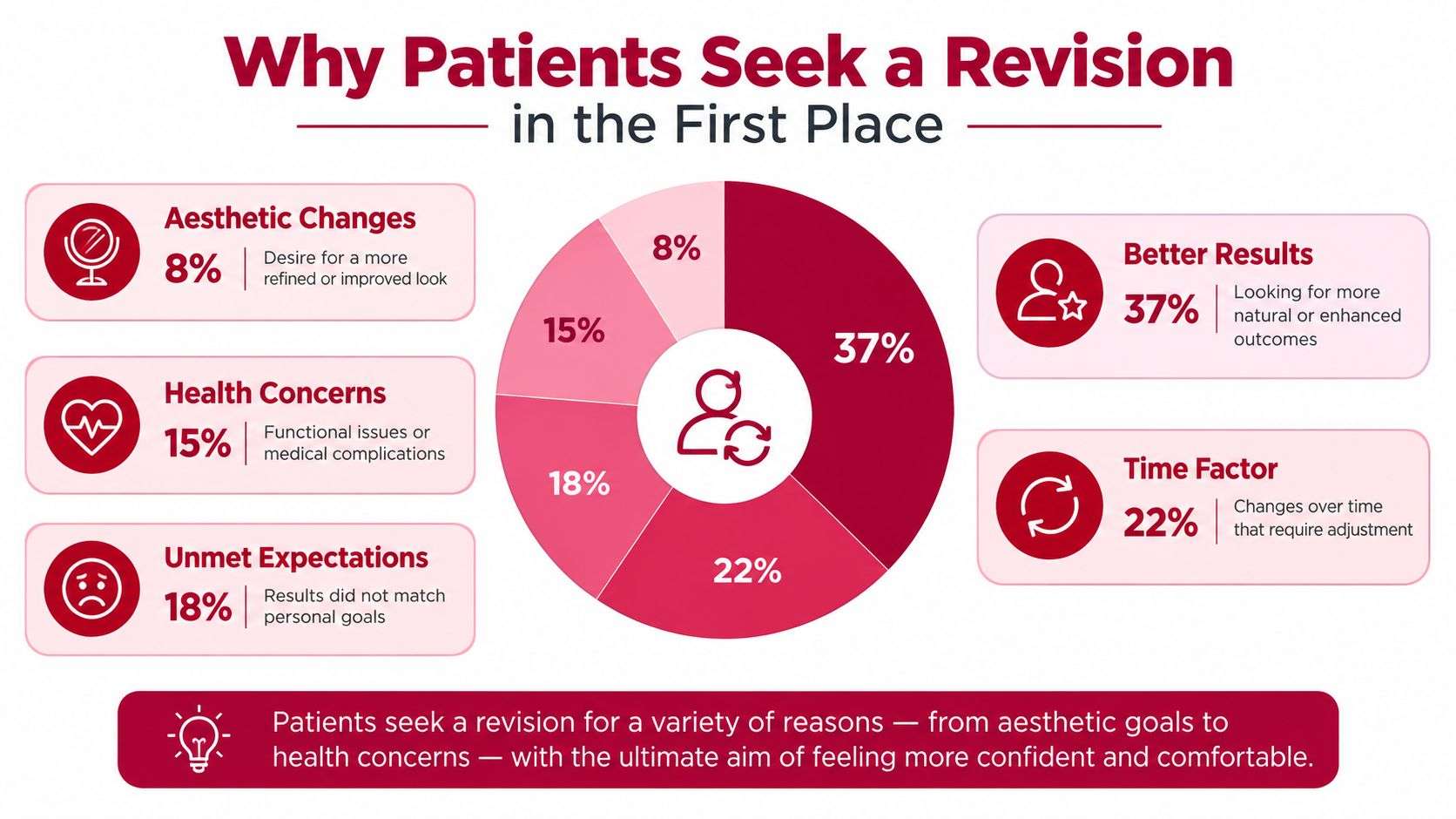
A request for revision usually falls into three overlapping categories: cosmetic, functional, and structural. These labels help organize the evaluation, but they rarely exist in isolation. A pinched-looking tip, for example, may be the visible sign of weakened cartilage that also narrows the external nasal valve.
Cosmetic concerns
Patients may notice a residual dorsal hump, an overly scooped bridge, a pollybeak contour, or a tip that's too rotated, too weak, or insufficiently projected. Other concerns include asymmetry, visible edges, or irregularities caused by previous rasping or cartilage removal. These problems can be subtle in person but prominent in certain lighting or when the face is viewed from below.
Aesthetic dissatisfaction also has to be interpreted carefully. One person may want a softer bridge, while another wants the nose to look less operated on. The surgeon should identify whether the issue is skin, cartilage, scar tissue, bone, or the relationship between those elements.
Functional symptoms
Breathing difficulty can persist after surgery or develop as the framework changes during healing. Possible causes include a residual or recurrent septal deviation, narrowing of the internal or external nasal valve, turbinate enlargement, synechiae from internal scarring, or a septal perforation.
The symptom may not be obvious during a brief conversation. Patients often describe alternating blockage, exercise-related obstruction, dryness, crusting, or a sense that the nose collapses when they inhale. A functional assessment therefore needs to examine airflow and valve behavior, not only the front and side appearance.
Structural failure
Structural problems arise when the cartilage framework no longer provides adequate strength. Over-resection can weaken the bridge or tip, producing loss of projection, saddle deformity, alar retraction, or collapse during breathing. The nose may look narrow and refined at first, then become pinched as support gives way.
Expert reviews emphasize that a straight, sturdy, flexible septal framework is essential for a durable result. When previous surgery has depleted or warped the septum, reconstruction may require septal extension grafts, spreader grafts, or costal cartilage. A review of revision rhinoplasty challenges connects inadequate support with problems such as tip collapse, valve compromise, persistent deviation, and abnormal projection.
The practical lesson is simple. A visible contour problem may be the endpoint of a deeper mechanical problem. Treating only the surface can leave the airway and support unchanged.
The Consultation and Planning Process
A revision consultation should feel more like an investigation than a quick request for a new profile. The surgeon needs to understand what was changed, how the nose healed, and which tissues remain available before recommending an operation.
Start with the surgical history
Bring the operative report, implant or graft details, preoperative and postoperative photographs, and records of any injections or complications. If the original surgeon is willing to share documentation, that information can clarify whether septal cartilage was removed, whether osteotomies were performed, and where grafts were placed.
Your own timeline matters, too. Describe when swelling changed, when breathing worsened, whether the tip shifted, and whether symptoms vary with exercise, sleep, allergies, or position. A medication list and information about nicotine use also belong in the discussion because they affect surgical planning and healing.
Examine the remaining framework
The physical examination assesses skin thickness, scar mobility, cartilage strength, septal alignment, tip support, and valve competence. The surgeon may gently manipulate the sidewalls and tip to see whether the airway improves with support. This helps distinguish a surface complaint from a mechanical collapse.
Standardized photographs are useful because they document the front, profile, oblique, and base views under consistent conditions. Computer morphing can help clarify an aesthetic target, but it isn't a guarantee. It shows a proposed direction, not the exact result that altered tissue will produce.
Evaluate airflow when symptoms are present
An internal examination may include nasal endoscopy. In selected cases, cone-beam CT can help assess the septum, turbinates, bony framework, and the position of previous grafts. Imaging doesn't replace a physical examination, but it can reveal anatomy that isn't visible from the outside.
The consultation should end with a defined plan, not merely a technique name. Ask what needs to be rebuilt, which graft source is realistic, whether an open or closed approach is appropriate, and what limitations thick skin, scarring, or depleted cartilage create. You should receive time to review consent materials, preoperative instructions, expected follow-up, and the available records before making a decision.
Practical rule: If the proposed plan focuses only on shaving, injecting, or reshaping the visible contour without explaining support and airflow, ask for a more complete structural assessment.
Surgical Techniques and Nonsurgical Alternatives
The choice between surgical approaches depends on what must be corrected, not on which option sounds less invasive. In revision cases, an open approach is often useful because it allows the surgeon to release scar tissue and directly inspect the altered framework. A closed approach uses internal incisions and may suit a limited refinement when the required work can be performed without broad exposure.
Comparing graft sources
| Graft source | Main advantage | Important limitation |
|---|---|---|
| Septal cartilage | Straight and useful for structural support | It may be depleted or weakened after the first surgery |
| Auricular cartilage | Curved material can help with selected contour work | It has limited straight, load-bearing strength |
| Costal cartilage | Provides abundant, sturdy material for major reconstruction | It requires a chest incision and can introduce risks such as warping |
When native septal cartilage is unavailable, autologous ear or rib cartilage may allow the surgeon to rebuild the midvault, tip, or septal support. The trade-off is greater operative complexity and a separate donor site. Graft choice should follow the mechanical need. A small contour irregularity doesn't require the same material as a collapsed bridge or severely weakened tip.
Where nonsurgical care fits
A hyaluronic acid filler may camouflage a small depression or dorsal irregularity when the underlying framework is stable. It can't rebuild a collapsed valve, straighten a significantly deviated septum, or restore lost tip support. Injections intended to reduce early scar bulk, including selected steroid or 5-fluorouracil treatments, also require careful timing and medical supervision.
Filler reversal has a limited role when the problem comes from a reversible injectable overcorrection. It won't remove surgical scar tissue or repair a structural deformity. Patients considering a nonsurgical contour adjustment can review the distinction between camouflage and structural correction in this guide to nonsurgical nose procedures.
The decision is clearest when framed around the cause:
- Stable framework with a minor contour issue: Camouflage may be reasonable.
- Early, localized scar bulk: Targeted medical treatment may be considered.
- Airway narrowing or collapse: Structural surgery is usually required.
- Loss of projection or saddle deformity: Grafting and reconstruction are generally more appropriate.
Risks, Complications, and Realistic Outcomes
Revision surgery carries a different risk profile because the surgeon works through scarred tissue planes, altered blood supply, and a reduced cartilage reserve. The operation may improve the nose, but it can't erase the biological memory of the first surgery. Skin thickness, scar behavior, congenital asymmetry, and the quality of the remaining cartilage all influence the result.
Published data show why informed consent matters. In one historical series, revisional surgery was requested by 10% of patients after primary rhinoplasty, while the request rate rose to 19% after the next procedure when the first operation had been performed elsewhere. The retrospective clinical analysis also reported a 5% minor complication rate in that series. These figures come from a historical cohort and shouldn't be treated as a personal prediction, but they demonstrate that dissatisfaction and repeat surgery have long been recognized concerns.
Complications specific to reconstruction
Potential problems include prolonged edema, persistent asymmetry, skin thinning over the tip, visible or palpable graft edges, graft warping, resorption, septal perforation, and continued or new nasal obstruction. Rib cartilage can provide strong material, but its behavior must be anticipated during shaping and healing.
A review of graft biology reported revision rates of 17.9% for severely crushed cartilage versus 3.5% for intact cartilage, with resorption rates of 3.4% versus 0.9%, respectively. The cartilage graft review also reported a 15.5% revision rate over a mean follow-up of 3 years and 6 months in one augmentation series, while tertiary revision after previous costal cartilage reconstruction reached 24% in a small cohort. These findings don't mean every patient receiving a graft will need another procedure. They show why graft quality and surgical planning matter.
A contracted-nose review reported aesthetic dissatisfaction as the most commonly reported complication at 12.5%, infection at 4.5%, and reoperation at 5.3%. The review and meta-analysis also found that some angle-based measures didn't significantly improve, an important reminder that a better appearance doesn't guarantee every measurable feature will change.
The possibility of a third operation should be discussed before the second one, not after disappointment returns. That conversation isn't meant to discourage you. It gives you a realistic basis for weighing improvement against additional scarring, healing time, and uncertainty.
Recovery Timeline from Splint to Final Result
Recovery after revision rhinoplasty unfolds in stages. Patients often feel anxious when the splint comes off and the nose looks swollen, lifted, numb, or unfamiliar. Those early appearances aren't reliable indicators of the final contour, particularly when scar tissue and grafts are involved.
Early healing
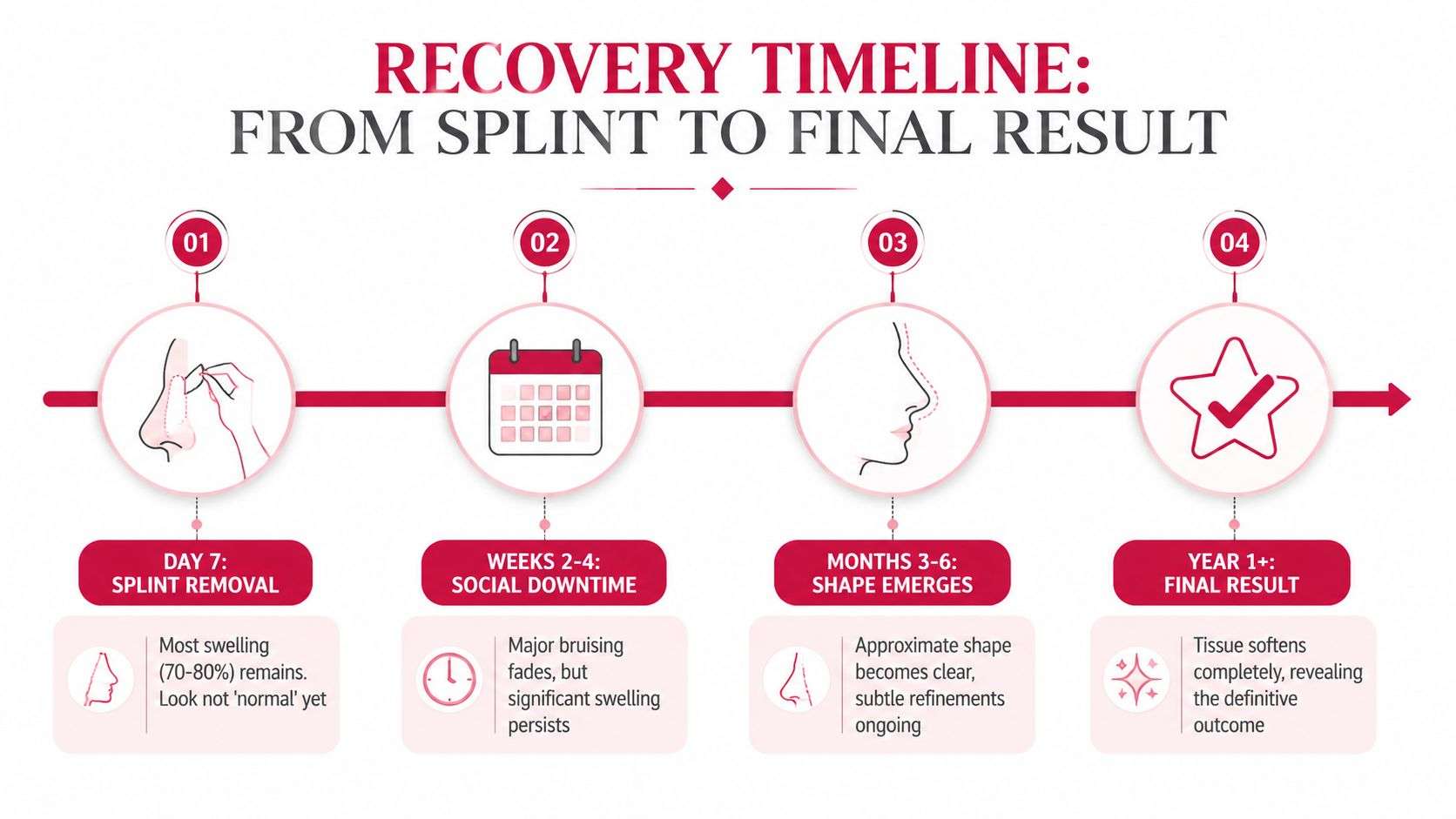
At roughly day 7, splint removal is an important checkpoint, but most patients won't look normal yet. The provided recovery timeline describes 70% to 80% of swelling still remaining at this stage. Bruising usually becomes less prominent through the first month, while congestion, numbness, tightness, and a firm tip can persist.
During the early period, protect the nose from pressure and accidental contact. Sleep with your head raised if your surgical team recommends it, keep incision care consistent, and don't restart strenuous activity until you receive clearance.
The middle months
By the three-month stage, the bridge may look more defined, but the tip can remain firm and swollen. Revision patients often need patience because scar tissue can hold the skin envelope tightly over the reconstructed framework. At six months, the broad shape may be easier to judge, while subtle asymmetry and tip definition continue to settle.
Common restrictions include:
- Bridge pressure: Avoid placing glasses on the bridge for the period specified by your surgeon, often 4 to 6 weeks.
- Impact risk: Avoid contact sports for 3 months unless your surgeon gives different instructions.
- Sun exposure: Use careful sun protection for a year to reduce discoloration and protect healing skin.
Your surgeon's instructions take priority because grafting, osteotomies, skin thickness, and airway work change the recovery plan. Don't use a generic calendar to overrule individualized medical advice.
The long view
The final result is often assessed at one year or later, when tissues have softened and the contour has matured. A recovery guide can help you organize questions about swelling, activity, incision care, and follow-up in this complete rhinoplasty recovery resource.
A useful mindset is to treat recovery as a year-long project. Early swelling is information about healing, not a verdict on the operation.
How to Choose the Right Revision Surgeon
The surgeon's ability to name a technique matters less than the ability to explain the structural reason for your problem. Revision rhinoplasty should be approached as reconstructive nasal surgery, even when the original concern is cosmetic.
Credentials and case experience
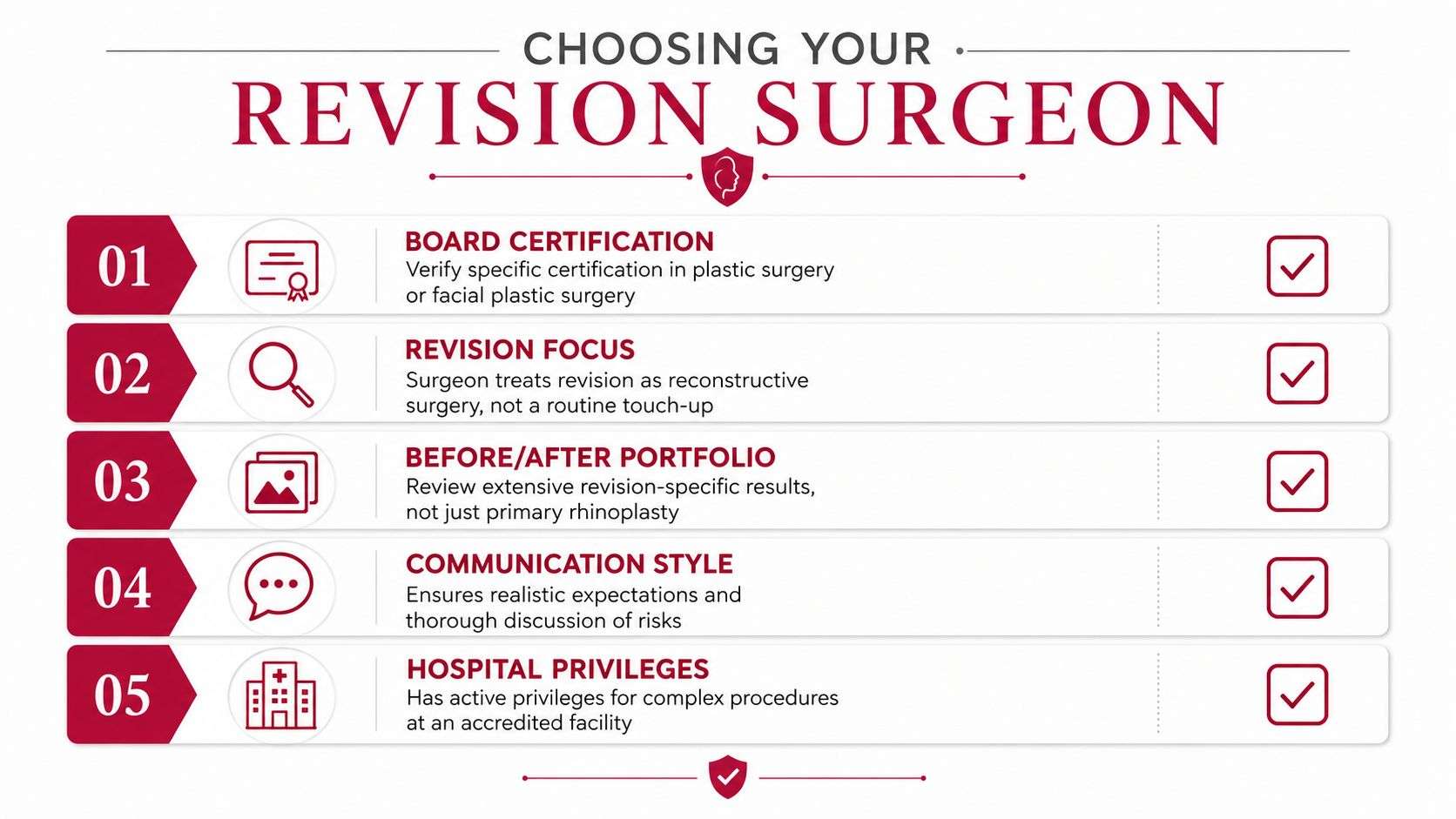
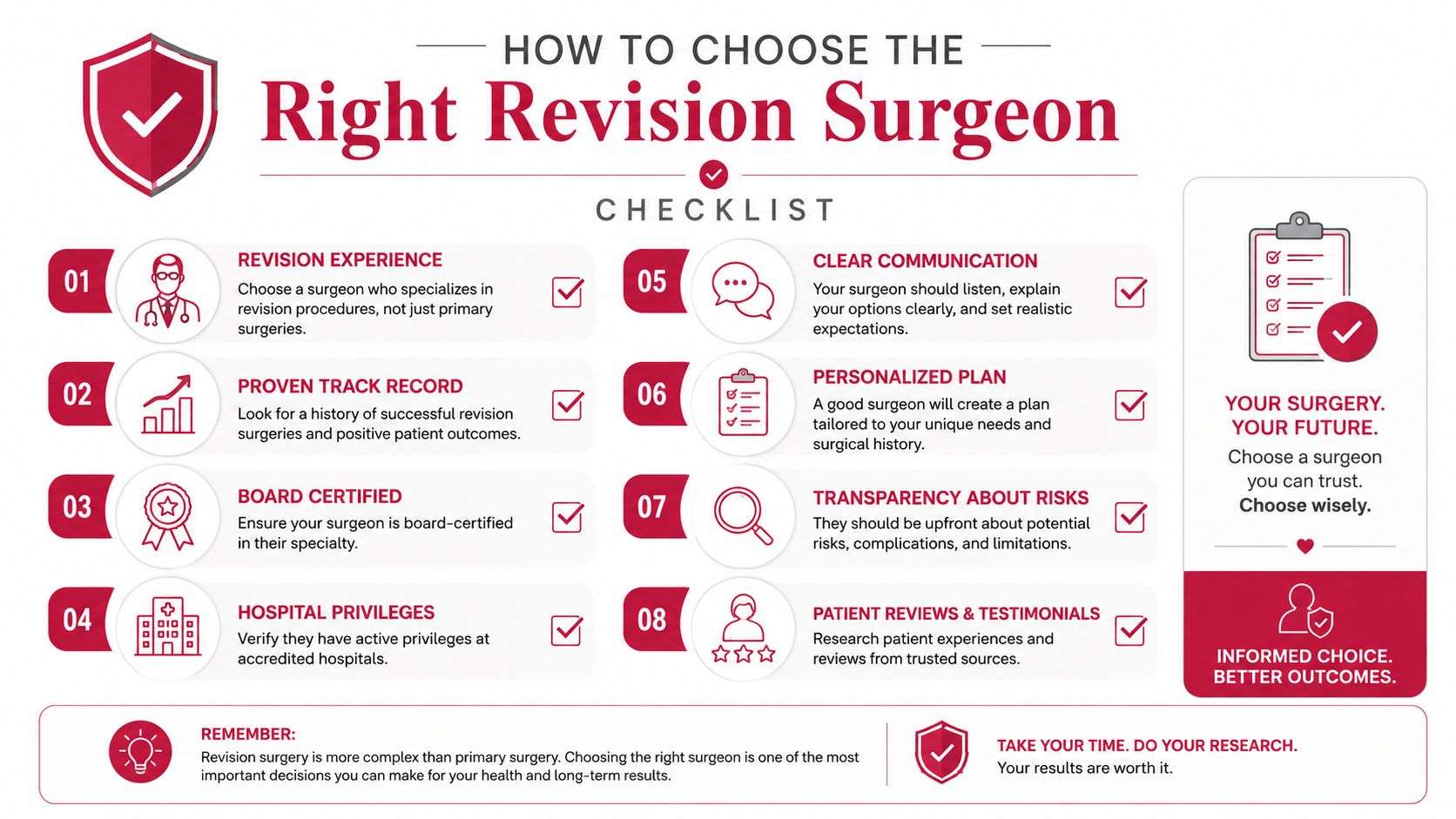
Look for board certification in plastic surgery or facial plastic and reconstructive surgery, along with focused training and substantial experience in primary and secondary rhinoplasty. Ask how frequently the surgeon performs complex revisions and how often the practice uses ear or rib cartilage.
A surgeon should be comfortable discussing depleted septal cartilage, scarred tissue, valve mechanics, and the possibility that reconstruction may need to be staged. A broad cosmetic portfolio isn't enough. Review healed revision cases with concerns similar to yours, such as a pinched tip, bridge collapse, asymmetry, or obstruction.
Questions that reveal the planning quality
Bring direct questions to the consultation:
- Cause: What anatomical problem is producing my visible or functional concern?
- Support: Is my septum strong enough, or will another graft source be needed?
- Approach: Why is an open or closed exposure more appropriate for this case?
- Responsibility: Who will perform each part of the operation, and where will surgery occur?
- Contingency: What happens if healing doesn't proceed as expected?
- Records: Can the practice obtain and review my prior operative notes and imaging?
- Aftercare: How often will I be examined, and how are concerns handled after surgery?
Before-and-after photographs should show consistent views and an appropriate healing interval. Be cautious when a surgeon guarantees a specific result, promises identical outcomes for different noses, pressures you to schedule, or dismisses breathing concerns as secondary.
A better selection standard
The right consultation should make the problem more understandable, not merely make the procedure sound attractive. You should leave knowing what can be improved, what may remain imperfect, which grafts could be required, and why the proposed plan fits your anatomy.
Georgia Plastic & Reconstructive Surgery provides rhinoplasty consultations, patient education materials, and access to before-and-after rhinoplasty content as part of its broader facial and reconstructive surgery practice. Those resources can help you prepare questions, but your decision should still rest on the surgeon's assessment of your specific framework and goals.
Cost, Financing, and Next Steps Toward a Consult
Revision rhinoplasty generally costs more than primary surgery because the operation may involve scar release, airway reconstruction, graft harvesting, and more demanding structural work. A responsible estimate should separate the surgeon's fee, anesthesia, facility charges, imaging, preoperative testing, prescriptions, and follow-up care.
The final amount can vary with the complexity of the deformity, the graft source, geographic location, and whether any portion of the procedure addresses a documented functional problem. Cosmetic revision work is generally not covered by insurance, while some medically documented airway corrections may qualify. Confirm benefits and preauthorization directly with your insurer rather than assuming coverage.
Build a complete financial picture
Ask the practice:
- What is included: Clarify consultations, facility charges, anesthesia, imaging, medications, and postoperative visits.
- What could change: Ask how additional grafting, unexpected scar tissue, or staged correction would affect the estimate.
- What payment options exist: Review medical financing, payment plans, and staged payments in the practice's plastic surgery financing guide.
- What policies apply: Read the policies for cancellations, refunds, complications, and future revision procedures.
- What travel adds: Include transportation, lodging, local support, and the required time near the surgical team.
If you're comparing other facial treatments while planning surgery, understand that a separate procedure has its own pricing structure. For example, this resource on erbium laser cost per session can help distinguish per-session skin treatment pricing from the bundled costs of reconstructive nasal surgery.
Prepare before booking
Gather your operative report, previous photographs, imaging, pathology records if available, medication list, allergy history, and a written description of your breathing symptoms. Bring photographs that show the result over time, not only the image you like least. During consultation, ask for a proposed structural plan, graft discussion, recovery expectations, and a complete fee estimate.
Don't choose solely by price. In revision surgery, the surgeon's experience with altered anatomy and the availability of suitable cartilage may matter more than a lower initial quote.
Georgia Plastic & Reconstructive Surgery offers rhinoplasty consultations, structural evaluation, recovery guidance, and patient education for people considering revision after a difficult first result. Visit Georgia Plastic & Reconstructive Surgery to review the practice's rhinoplasty resources and request a consultation focused on your breathing, appearance, prior operative records, and realistic reconstruction options.