You're standing in front of the mirror, lifting the waistband of your underwear, then looking back at a mini tummy tuck photo on your phone. The lower belly looks smoother, but you keep zooming in on the line beneath it. Will your scar sit that low? Will it fade that much? And what happens if it doesn't?
Table of Contents
- Standing in Front of the Mirror After Comparing Photos
- What a Mini Tummy Tuck Actually Changes
- Where the Scar Sits and How Long It Runs
- The Healing Timeline From Week One to One Year
- How to Read Before-and-After Photos Honestly
- Scar Care That Actually Helps
- When the Procedure Is Not the Right Fit
- Your Consultation Checklist and Final Takeaways
Standing in Front of the Mirror After Comparing Photos
Searching for mini tummy tuck before and after scar images can leave you with more questions than answers. One photograph shows a faint line. Another shows a darker, uneven scar, yet both may be labeled as successful results.
Neither photograph tells you everything you need to know. You may not know how long the person had been healing, whether they received scar treatment, or how closely their starting anatomy resembles yours. A similar-looking belly doesn't necessarily mean a similar surgical plan.
What you're really trying to compare
Your concern may be less about having a scar and more about living with its particular appearance. Perhaps you're comfortable with a line beneath underwear but worried about a raised ridge. Or you'd accept a longer scar if it meant avoiding a visible fold at either end.
Common questions worth bringing into the consultation include:
- Visibility in clothing. Will the proposed line fit beneath the underwear and swimwear you wear?
- Balance between the sides. Will the ends sit at comparable heights, and what existing asymmetry might remain?
- Color and texture. Could the scar become darker, lighter, wider, or more raised than the examples you've saved?
- The trade-off. How much improvement in your lower-abdominal contour would make a permanent scar acceptable to you?
These aren't superficial concerns. They're part of deciding whether surgery matches your priorities.
A useful before-and-after photograph helps you ask better questions. It doesn't promise that your body will reproduce the result.
Try separating your reactions to the belly shape from your reactions to the scar. You might love the flatter contour but dislike the incision placement, or appreciate the scar while noticing unresolved upper-abdominal looseness.
That distinction matters. The purpose of a consultation isn't to persuade you that every scar is worth it. It's to establish what can reasonably change, what may remain, and what uncertainty you're comfortable accepting.
What a Mini Tummy Tuck Actually Changes
A mini tummy tuck, also called limited abdominoplasty, focuses on a restricted area of the lower abdomen. The central planning question is whether your concern is concentrated below the belly button or whether it extends farther across the abdominal wall.
Think of shortening a small hem on a shirt versus having the whole shirt altered. A limited adjustment can work well when the problem is localized. It can't reliably substitute for broader changes when the fabric is loose throughout.
Start with the tissue, not the procedure name
The surgeon needs to distinguish among loose skin, underlying fat, and abdominal-wall laxity. These can produce a similar-looking pouch, but they aren't interchangeable problems. Skin removal, fat contouring, and decisions about muscle repair require different planning.
A mini operation may be considered for limited lower-abdominal skin excess. Significant upper-abdominal laxity or muscle separation extending above the navel deserves a broader discussion rather than an automatic recommendation for the smallest incision.
| Your main concern | What the consultation should clarify |
|---|---|
| A small fold below the navel | Whether limited skin removal would address it adequately |
| Fullness with little loose skin | Whether fat contouring, rather than a tuck, matches the problem |
| Looseness above and below the navel | Whether a full abdominoplasty would offer more complete correction |
| Mixed skin excess and fat deposits | Whether a combined approach, such as lipoabdominoplasty, is appropriate |
A shorter operation name doesn't mean negligible risk. A literature review of abdominoplasty complications reported local-complication rates of 13.5% for mini-abdominoplasty, 20% for traditional abdominoplasty, and 10.3% for lipoabdominoplasty.
Those figures describe groups of patients, not your individual likelihood of a problem. They also don't establish that one operation is the right choice because its reported rate was lower.
The practical decision is anatomical: which procedure can address your concerns without creating an unacceptable compromise? Choosing a mini tuck solely to minimize the incision can be disappointing if the untreated area remains your main concern afterward.
Where the Scar Sits and How Long It Runs
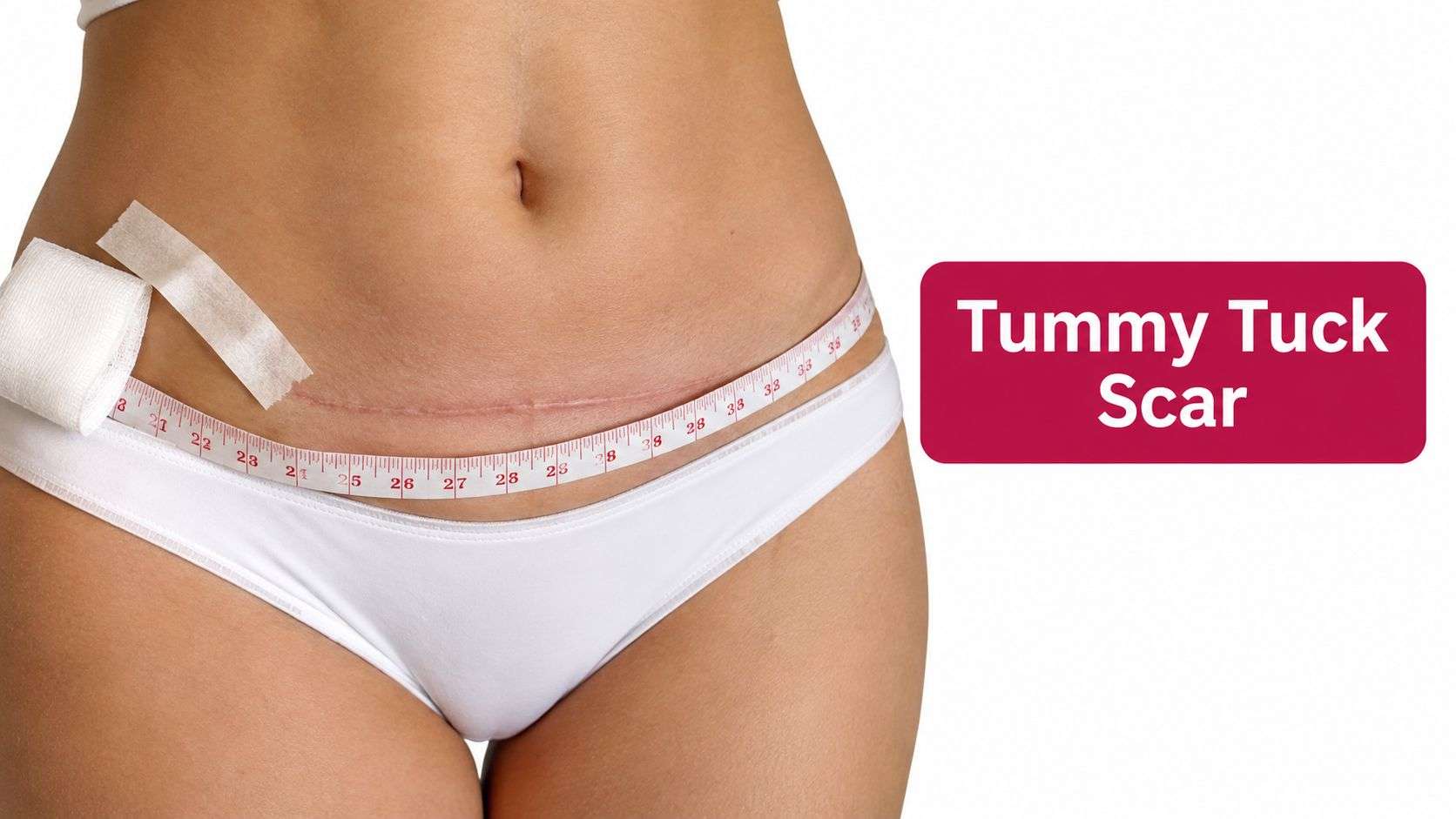
The planned scar is generally a low, transverse line across the suprapubic area, the lower abdomen immediately above the pubic region. Surgeons often aim to place it beneath an underwear or bikini waistband, but “beneath the bikini line” isn't a universal anatomical measurement.
Clothing varies. So do torso proportions, skin mobility, and the amount of tissue that can be removed while closing the incision appropriately. Bring your usual underwear or a swimsuit bottom to the planning appointment rather than relying on an imagined clothing line.
Length and height are different measurements
Available evidence supports a generally shorter scar after mini-abdominoplasty than after conventional abdominoplasty. However, there isn't a reliable universal mini-tuck scar length that should be applied to every patient.
One review discussing abdominal contouring and scar-position measurements describes a study of 310 abdominoplasty patients in which the mean vertical scar position was 9.9 cm at one month and 9.92 cm at one year, indicating little average positional change after the early postoperative period.
Those measurements concern vertical position, not incision length, and the study wasn't limited to mini tummy tucks. They aren't a template for where your surgeon should place your scar.
A personalized incision discussion should address:
- The central position. Ask where the line will sit relative to your pubic hairline and preferred waistband.
- The lateral ends. Ask how far each end may extend toward the hips and whether they'll remain covered.
- An existing C-section scar. Ask whether it can be incorporated or removed, and what anatomical constraints could prevent that.
- Closure tension. Ask whether pursuing a lower or shorter line would compromise the closure or contour.
Placement question: Ask your surgeon to show the proposed line on your body while you're standing, not just describe it on a photograph.
A scar that's shorter but higher may bother you more than a longer line that fits your clothing. Likewise, making an incision too short for the tissue being treated may leave an unsatisfactory transition at its ends.
The meaningful comparison is planned placement plus contour, not a contest for the smallest scar.
The Healing Timeline From Week One to One Year
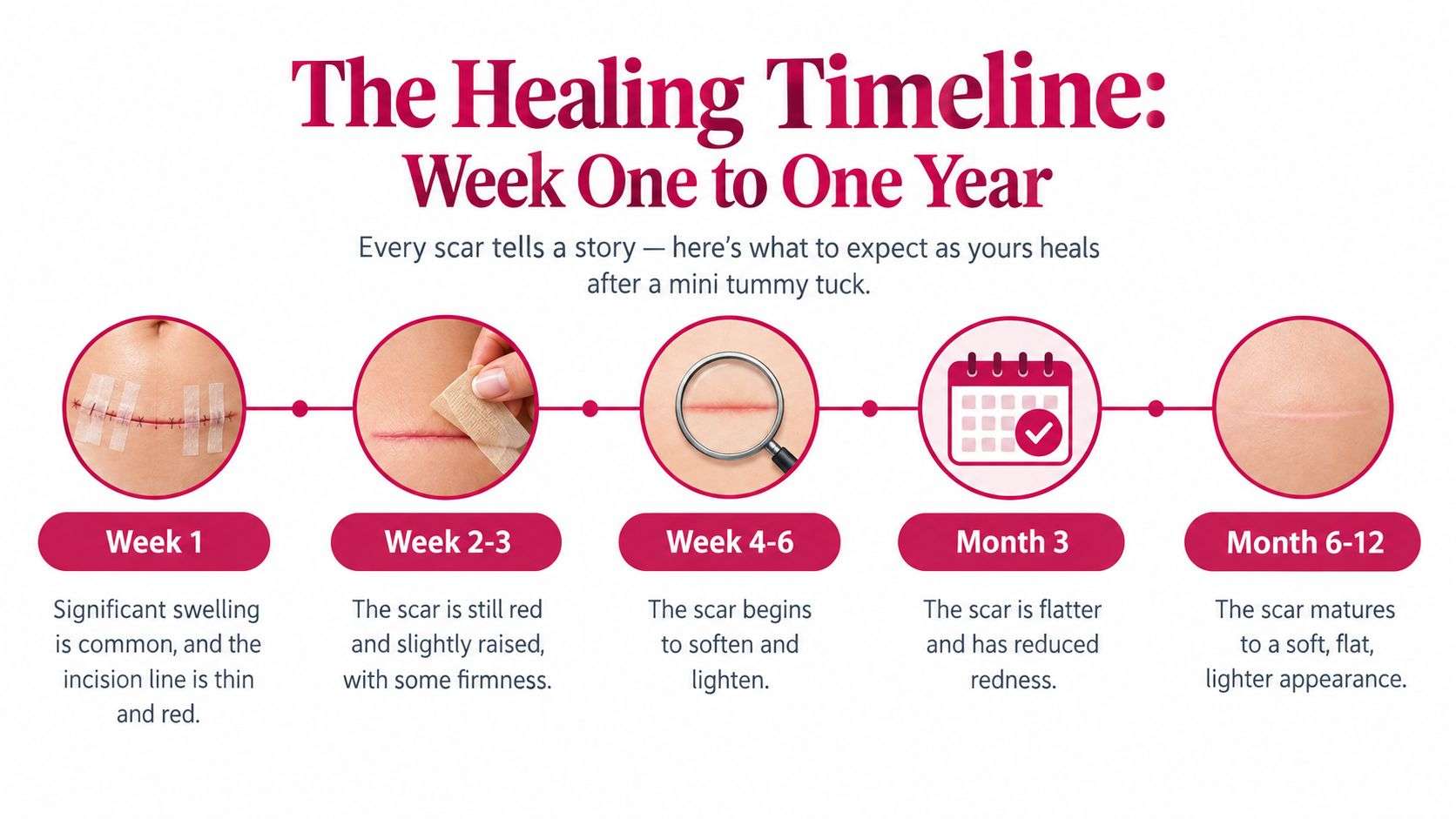
A fresh incision and a mature scar are different things. Early redness, swelling, firmness, and unevenness don't necessarily describe the eventual result, but they also shouldn't be dismissed without assessment when they're worsening or concerning.
The timeline below is a general orientation, not a schedule your scar must follow. The scar-maturation evidence discussed earlier supports observing change over many months rather than judging the result immediately.
Early healing is about the incision
During the first week, dressings, tape, or sutures may partly obscure the line. Swelling can make the surrounding contour difficult to interpret. Your priority is following wound-care instructions and attending the recommended checks, not deciding whether the scar is attractive.
Over the following weeks, the line may remain red, feel firm, or appear slightly raised. Some people notice itching or temporary irregularity. Don't assume that every change is normal, particularly if you notice spreading redness, drainage, wound separation, fever, or increasing pain; contact your surgical team promptly.
Later healing is about scar quality
During the middle months, the scar may gradually soften or flatten, and its color may change. That change isn't identical across skin tones: a scar doesn't have to follow a neat red-to-pink-to-pale progression.
Toward the later part of the year, you can assess the scar more meaningfully against earlier photographs. Still, the anniversary of surgery isn't a guarantee of complete fading, a flat surface, or an exact match to surrounding skin.
- Track your own changes. Take photographs under consistent lighting and in a similar position.
- Record symptoms. Note persistent itching, tenderness, thickening, or expansion for your follow-up visit.
- Separate scar recovery from activity clearance. A line that looks closed doesn't tell you whether deeper tissues are ready for exercise.
Use the mini tummy tuck recovery guide to prepare questions about recovery, then follow your surgeon's individual instructions. Don't compare your fresh incision with an undated gallery image and conclude that you're healing poorly.
How to Read Before-and-After Photos Honestly
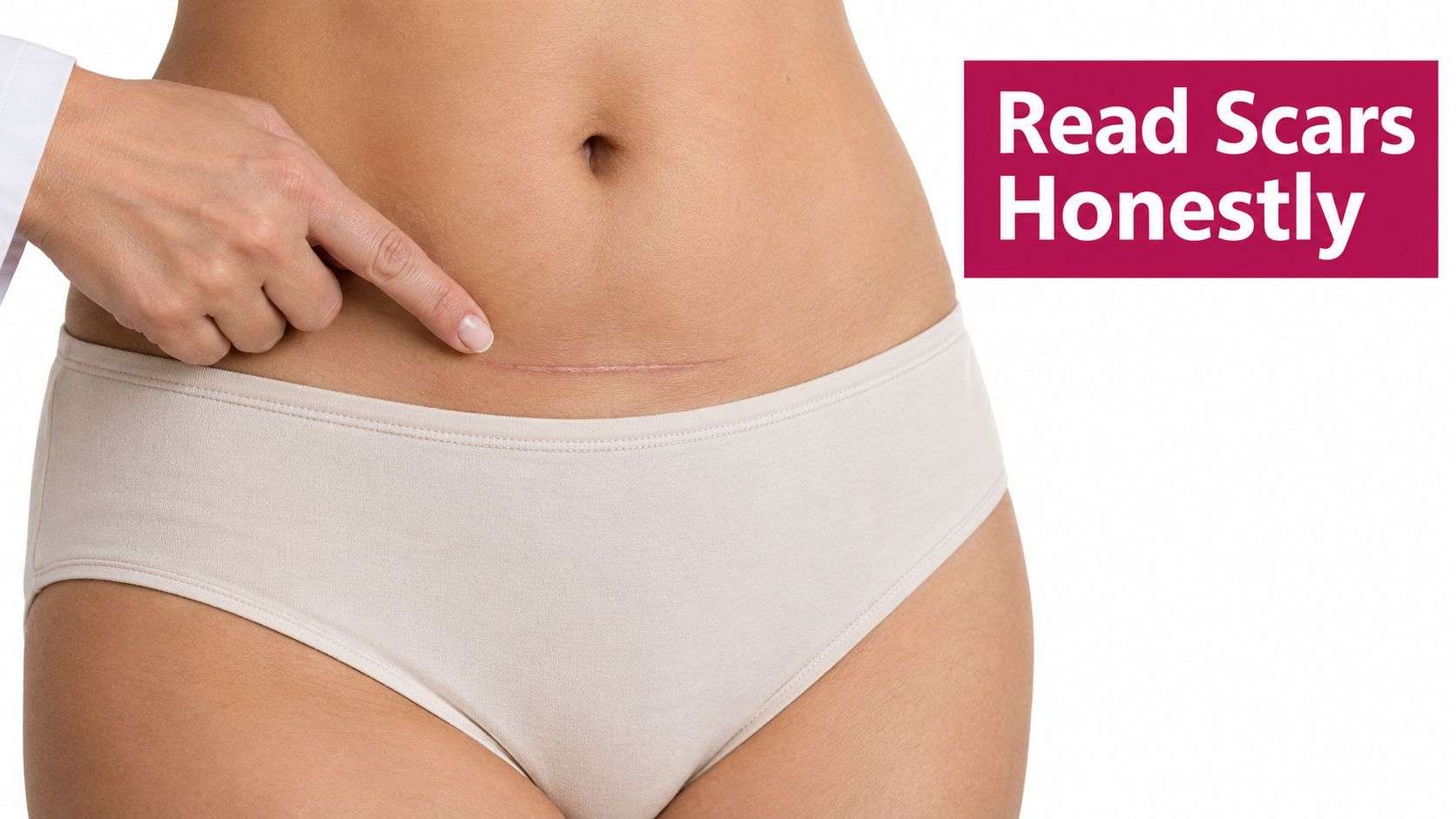
Consider two photographs of the same lower abdomen: one taken straight on with even lighting, the other taken from above with the waistband pulled over the incision. The second may look more flattering, but it gives you less information about the scar.
Standardized photographs are more useful for comparison because they reduce avoidable differences in pose, lighting, framing, and camera distance. Casual photographs can still show valuable details, particularly close-up texture, but they need context.
Compare like with like
Start by confirming what operation was performed and when the after image was taken. A combined procedure shouldn't be treated as a preview of an isolated mini tuck, and a still-healing scar shouldn't be judged as mature.
Then look beyond the center of the incision. Its ends, the surrounding contour, and the untreated abdomen may tell you more about the overall trade-off.
| Photograph detail | A useful question |
|---|---|
| Waistband covers part of the scar | Can I see the entire incision without clothing obscuring it? |
| Different lighting or skin tanning | Could the color difference be photographic rather than surgical? |
| One side appears higher | Is this posture, pre-existing asymmetry, or the actual scar position? |
| Raised folds at the ends | Are these temporary changes or persistent contour irregularities? |
| A faint, narrow line | Was scar treatment or revision performed before this photograph? |
Treat concerns as questions, not diagnoses
A high central scar, conspicuous lateral puckers sometimes called dog ears, or persistent asymmetry deserves discussion. A photograph alone usually can't explain why the feature occurred or whether correction is appropriate.
Gallery rule: Ask to see the result clearly enough that you can identify its limitations, not just admire its improvement.
Look for examples with similar starting skin excess and body proportions, while remembering that visual similarity can't reveal someone's healing history. Even an excellent photograph can't show whether the person previously formed raised scars or needed additional care.
The most honest gallery conversation includes results that vary. Ask what the surgeon considers a satisfactory outcome, which features might improve with time, and which would prompt reassessment.
Scar Care That Actually Helps
Scar care should follow the condition of the wound, not the urgency you feel to make the line disappear. Applying products too early or combining treatments without guidance can complicate an already sensitive area.
Silicone is a reasonable first-line discussion, particularly for abnormal raised scarring. Earlier literature reports hypertrophic or keloid scarring after abdominoplasty in approximately 1% to 3.7% of cases, with silicone compression identified as a useful first-line measure in a review of abdominoplasty scar outcomes and management.
Begin with a closed incision and a clear plan
Ask your surgeon when the incision is sufficiently closed for silicone sheeting or gel. The choice should account for skin sensitivity, the location of the scar, and what you can use consistently. Don't apply scar products to an open or draining area unless specifically instructed.
Discuss sun protection, clothing coverage, and how to monitor pigmentation changes. Avoid picking scabs, aggressive rubbing, home needling, or repeatedly introducing unproven creams. More treatment isn't automatically better treatment.
For readers familiar with postpartum incision care, the Bornbir C-section care guide offers a related resource for organizing wound-care questions. It isn't a substitute for the instructions provided after your tummy tuck, because the procedures and closures differ.
Escalate according to the problem
A scar that remains troubling needs an assessment of what's wrong, rather than a generic package of treatments.
- Raised or expanding tissue. Ask whether injections or other targeted treatment are appropriate and whether intervention should begin before further maturation.
- Persistent discoloration or texture changes. Discuss whether laser-based care is suitable for your scar and skin tone, including the possibility of unwanted pigment changes.
- An unfavorable position or contour. Ask whether revision could improve the problem and what additional scarring it would create.
No topical product should be presented as a way to erase a surgical scar. Likewise, injections, lasers, energy-based treatments, and revision aren't guarantees of normal scar development.
The post-surgical scar-care resource can help you prepare for this discussion. Agree on review points with your surgeon rather than imposing a universal waiting period on every treatment, especially if a scar is actively worsening.
When the Procedure Is Not the Right Fit
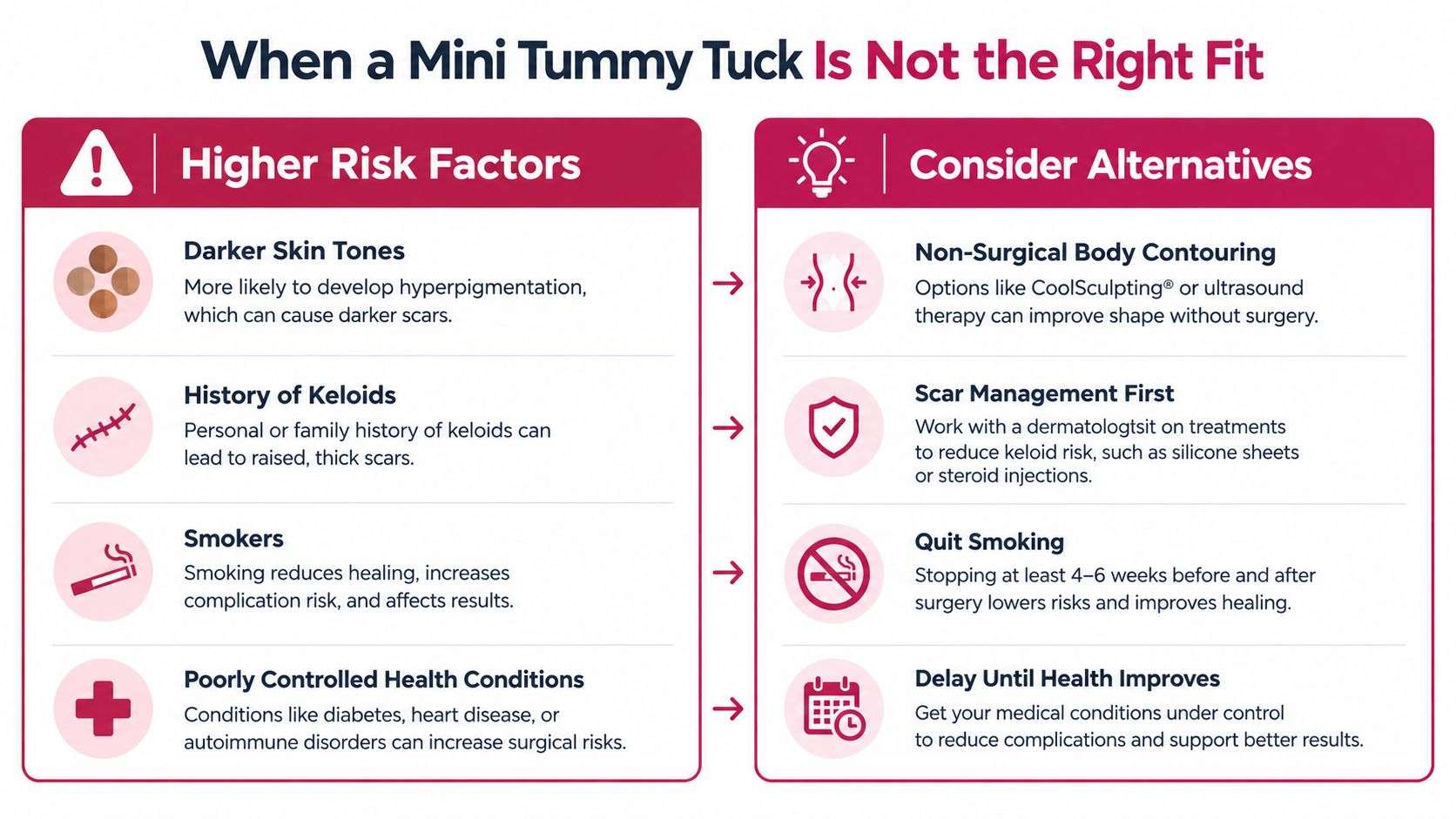
The assumption to challenge is that a smaller incision automatically makes someone a better candidate. Your anatomy determines whether a mini tuck can address the problem; your health and healing history help determine whether proceeding is sensible.
A limited procedure may leave you dissatisfied if your main looseness extends above the belly button. Separately, someone with suitable lower-abdominal anatomy may need more preparation or a more cautious scar plan.
Discuss your history rather than relying on appearance
Darker skin shouldn't be treated as a blanket reason to rule out surgery. Describe how your skin responds to injury, especially persistent darkening or lightening. Pigmentation changes and raised scars are separate concerns, and both deserve individualized discussion.
Bring up these issues before choosing a date:
- Prior raised scars or family history. Show existing scars and explain whether they grew, itched, or required treatment.
- Smoking and nicotine use. Disclose cigarettes, vaping, and other nicotine products so your team can establish its requirements.
- Diabetes or wound-healing problems. Ask whether medical optimization or additional clearance is needed.
- Pregnancy-related changes. Discuss ongoing body changes and future pregnancy plans rather than assuming you're ready because the lower pouch is bothersome.
An alternative must address the same concern
Delaying surgery may be more appropriate than switching procedures immediately. A full abdominoplasty may merit consideration when the anatomical problem is broader, but a larger operation doesn't remove scar risk.
Nonsurgical contouring also shouldn't be presented as an equivalent replacement for surgical skin removal. Ask what an alternative can realistically change and what it would leave untreated.
Review the comparison of tummy tuck and mini tummy tuck before your appointment. The decision should reflect your priorities, not just your preference for the word “mini.”
Your Consultation Checklist and Final Takeaways
A productive consultation ends with more than a procedure name. You should understand the proposed incision, the limits of correction, your relevant healing concerns, and how the practice will respond if recovery doesn't follow the expected course.
Bring the photographs you've saved, but label what you like about each one. “I like this low placement” is more useful than “I want this result.” Include any examples that worry you so the surgeon can explain whether those concerns apply to your situation.
Questions to bring with you
- Show me the planned incision. Where would it sit on my torso, and what might require changing its length or position?
- Explain what would remain. Which of my concerns wouldn't improve with the proposed operation?
- Show me comparable follow-up photographs. Can I see standardized images at earlier and later healing stages, with the full scar visible?
- Assess my healing history. What do my existing scars, pigmentation changes, medical conditions, and family history mean for planning?
- Describe the aftercare plan. When should I begin each recommended measure, and whom should I contact about concerning changes?
- Explain additional treatment and revision. What would trigger reassessment, who provides treatment, and what costs or policies should I understand?
Know what a personalized answer sounds like
A useful answer connects the recommendation to findings from your examination. It identifies uncertainty instead of promising an invisible line, and it distinguishes a possible improvement from a guaranteed result.
You should also leave knowing how follow-up works. Ask whether concerns are assessed in person, how photographs are used between visits, and what to do if you're recovering away from the practice.
Your decision is about the whole outcome, including the contour you want, the scar you can accept, and the care you're prepared to undertake. If an important question remains unresolved, it's reasonable to pause before scheduling.
The strongest expectation isn't that your scar will match someone else's photograph. It's that you understand the proposed trade-off well enough to make an informed choice about your own body.
Georgia Plastic & Reconstructive Surgery offers mini tummy tuck and other abdominal contouring procedures, along with in-person consultations, recovery guidance, and patient education. Visit Georgia Plastic & Reconstructive Surgery to schedule a consultation and bring your scar photographs, healing history, and preferred underwear line for a personalized discussion of incision placement and procedure choice.