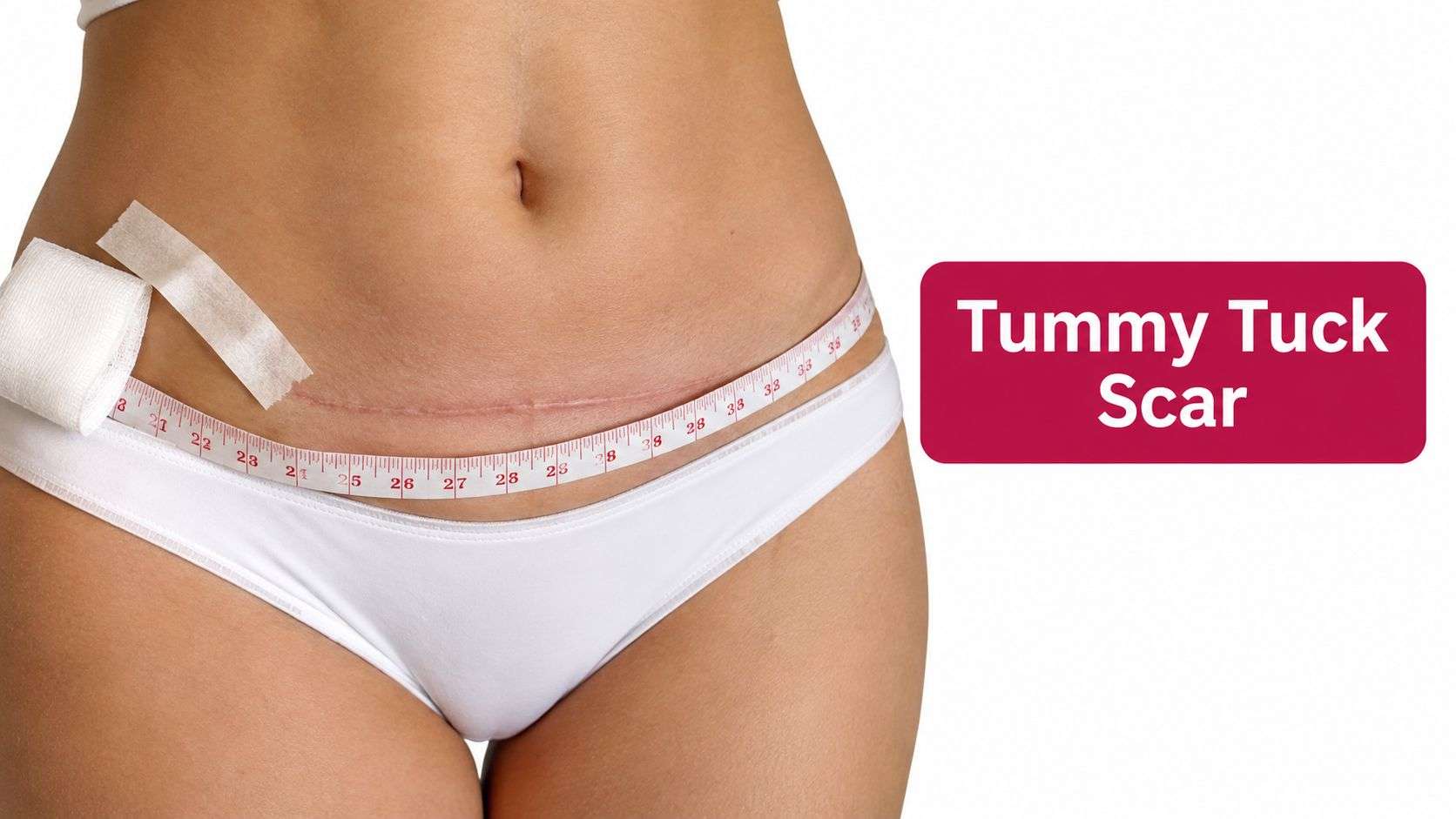
The most popular advice about tummy tuck vs mini tummy tuck is also the least reliable: choose the mini procedure if you want a smaller scar, easier recovery, and a more conservative operation. That advice starts with the amount of surgery a patient wants instead of the anatomy that needs correction.
A mini tummy tuck is not just a reduced version of a full abdominoplasty. It's a focused operation for laxity that is largely limited to the lower abdomen. If looseness, muscle separation, or contour problems extend above the navel, choosing a mini tuck to avoid a longer scar can leave the central or upper abdomen visibly under-corrected.
| Feature | Full tummy tuck | Mini tummy tuck |
|---|---|---|
| Main treatment area | Upper and lower abdomen | Primarily the area below the navel |
| Skin removal | Broad lower-abdominal excision with adjustment of the abdominal skin envelope | Smaller lower-abdominal excision |
| Muscle repair | Can address more extensive rectus diastasis | Usually limited or unnecessary, depending on examination |
| Umbilicus | Brought through a new opening in the tightened skin | Usually left attached and undisturbed |
| Scar | Longer low transverse scar plus a scar around the navel | Shorter low transverse scar without a navel incision |
| Best fit | Diffuse laxity, upper-abdominal excess, or significant muscle separation | Localized lower-abdominal laxity with good upper-abdominal tone |
| Main trade-off | More comprehensive correction with a larger operation | Less extensive recovery, but a narrower correction |
The correct question is not, “How little surgery can I get away with?” It's, “Which operation matches the distribution of my skin excess and abdominal wall changes?”
Table of Contents
- Why a Mini Tummy Tuck Is Not Just a Smaller Full Tuck
- Anatomy and Indications for Each Procedure
- Surgical Technique Differences Explained
- Recovery Timelines and Modern Complication Data
- Scarring and Long-Term Aesthetic Outcomes
- How to Determine Which Procedure Fits Your Body
- Final Recommendations by Patient Profile
Why a Mini Tummy Tuck Is Not Just a Smaller Full Tuck
A mini tummy tuck can be an excellent operation, but only for the right problem. It's designed to correct a localized lower-abdominal pouch, not to tighten every layer of the abdomen from the rib margin to the pubic area. Treating it as a default, easier version of a full tuck is how patients end up with a shorter scar but an incomplete result.
The difference begins with where the laxity sits. A patient with loose skin confined to the area below the navel may benefit from a mini approach. A patient with folds, stretch, fullness, or muscle separation around and above the navel usually needs a full abdominoplasty to address the entire abdominal skin envelope.
The operation must match the deformity
A full abdominoplasty can remove broader excess skin, tighten the abdominal wall across a larger vertical span, and reposition the umbilicus after the skin is redraped. A mini procedure generally leaves the navel in place and concentrates the correction below it. That distinction matters because the navel is a fixed landmark. Pulling only the lower skin downward cannot reliably smooth laxity that originates above the navel.
The history of abdominoplasty helps explain why the modern operation is more than skin removal. The first recorded abdominal skin excision occurred in Paris in 1890, and the term “abdominal lipectomy” was coined in 1899, before the procedure developed into the contemporary operation described in this evidence-based review of abdominoplasty.
Practical rule: A smaller operation is only better when it fully corrects the anatomical problem. Otherwise, the shorter scar becomes the most visible benefit of an incomplete treatment.
The mini tuck also isn't a rare variation that every patient should request first. A 2024 survey of members of a major professional plastic surgery society found that mini tummy tucks increased from 3% to 5% of abdominal contouring procedures over 16 years, while full abdominoplasty with muscle repair and umbilical transposition remained the most common approach, as reported in this discussion of changing abdominoplasty preferences. That pattern reflects patient selection, not a failure of the mini technique.
Anatomy and Indications for Each Procedure
The determining factor between a full and mini procedure is the vertical distribution of laxity, whether it remains below the navel or extends upward. In consultation, three questions guide the recommendation: where the skin is loose, whether the rectus muscles have separated, and how the umbilicus will behave after tightening. Scar length matters, but it cannot substitute for correcting the underlying anatomy.
Location of skin laxity
A mini tummy tuck fits patients whose excess skin and fat are concentrated in the lower abdomen, with relatively firm tissue above the navel and a satisfactory upper contour. A full abdominoplasty becomes more appropriate when stretched skin or a bulge reaches the central or upper abdomen, or when a hanging lower fold occurs with broader tissue excess.
The clinical risk of choosing a mini procedure in that setting is under-correction. The lower abdomen may look flatter while laxity or fullness remains higher up, creating an uneven transition rather than a balanced contour.
Rectus separation and abdominal wall support
Pregnancy, substantial weight change, and other stretching can separate the rectus muscles along the midline. This condition, called diastasis recti, requires assessment of both its width and its vertical extent. Skin removal alone does not restore abdominal wall support.
A full tuck gives the surgeon access for broader fascial plication when separation extends across much of the abdomen. A mini tuck can include selective lower repair in carefully chosen patients, but widespread separation may require the greater exposure of a full operation. The decision therefore depends on the abdominal wall, not on the amount of skin a patient wants removed.
The umbilicus as a planning landmark
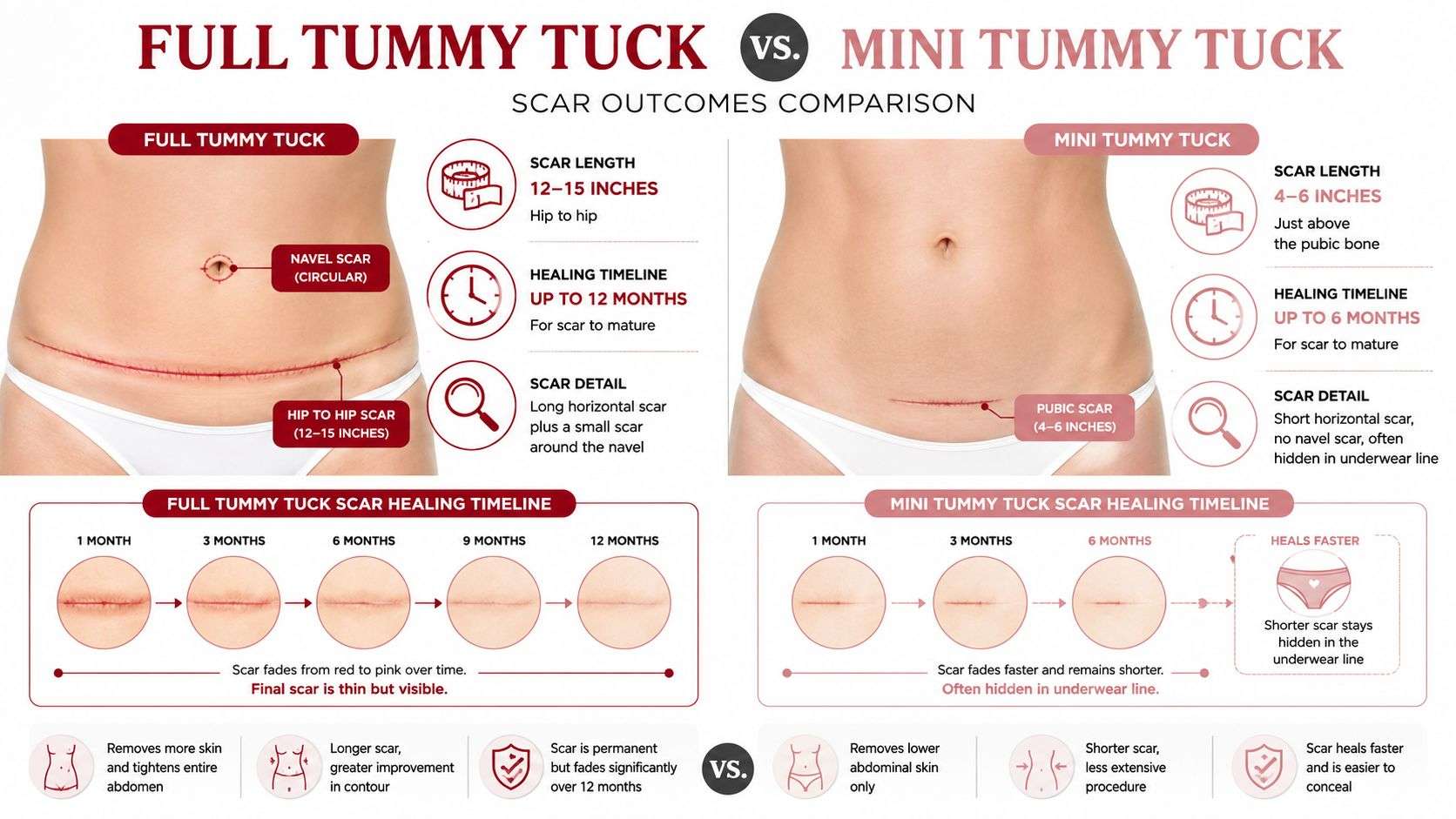
The umbilicus also affects the operative plan. Full abdominoplasty commonly creates a new opening for the navel in the tightened skin, producing a scar around it. A mini tuck generally avoids repositioning the umbilicus, which limits treatment to the area that can be tightened without changing that landmark.
Ask the surgeon how these three findings were assessed and whether the proposed operation addresses the full area you want improved. This guide to who qualifies for a tummy tuck can help structure that discussion, but only an examination can determine which procedure matches your anatomy.
Surgical Technique Differences Explained
The technical difference between the two procedures comes down to three variables: incision length, dissection extent, and whether the navel is transposed. Those choices determine how much skin can be removed, how far the surgeon can address the abdominal wall, and whether correction can extend above the lower abdomen.
What happens during a full abdominoplasty
The surgeon places a low transverse incision, usually designed to sit beneath underwear or swimwear. The abdominal skin flap is lifted across a broad area to expose the abdominal wall. The rectus fascia can then be tightened along the midline, while a broad ellipse of excess skin is removed.
Skin redraping changes the position of the umbilicus relative to the outer skin. The surgeon preserves its attachment to the abdominal wall, creates a new opening in the tightened skin, and brings the navel through that opening. This produces a scar around the umbilicus, in addition to the low transverse scar.
What happens during a mini tummy tuck
A mini tummy tuck uses a shorter, low abdominal incision. Dissection is limited to the lower abdomen, usually below the navel or only as far upward as the identified problem requires. The surgeon removes a smaller amount of skin and may perform selective lower muscle tightening when the examination supports it.
The navel generally remains in its original opening and is not repositioned. Avoiding umbilical transposition reduces the operative area and avoids a periumbilical scar, but it also limits how much skin above the navel can be redraped. If laxity or muscle separation extends higher, a mini procedure may leave that area under-corrected.
| Technical element | Full tummy tuck | Mini tummy tuck |
|---|---|---|
| Incision design | Broad low transverse incision | Shorter low transverse incision |
| Skin flap elevation | Wider abdominal dissection | Limited lower-abdominal dissection |
| Muscle repair | May extend along the abdominal midline | Selective or absent, based on the lower-abdominal anatomy |
| Skin excision | Larger elliptical excision | More focused lower-abdominal excision |
| Umbilical handling | New opening in the redraped skin | Usually no umbilical transposition |
| Adjunctive contouring | May be combined with liposuction when appropriate | May include limited liposuction, but not as a replacement for fascial repair |
| Closure strategy | May use progressive tension sutures and other closure methods | Closure is generally less extensive because the dissection is smaller |
Liposuction changes fat distribution, but it does not tighten separated muscle or remove hanging skin. Each layer therefore needs its own plan: fat, skin, and abdominal wall support cannot be treated as interchangeable problems. Patients considering combined contouring can review lipoabdominoplasty in Atlanta while preparing for consultation.
Recovery Timelines and Modern Complication Data
A mini tummy tuck produces a lighter early recovery because the dissection is smaller and the abdominal wall work is often limited. Recovery still involves swelling, incision care, activity restrictions, and individual healing factors. A smaller operation does not guarantee a dramatically shorter recovery, particularly if the underlying problem was selected incorrectly.
A full abdominoplasty usually creates more tightness and a broader healing area. Drains may be used according to the surgeon's technique and the expected fluid volume. Contemporary approaches may reduce drain dependence through progressive tension sutures and adjuncts such as tranexamic acid or power-assisted liposuction. These changes can narrow the practical recovery gap, but a full tuck remains a more extensive operation.
A realistic recovery comparison
| Recovery milestone or metric | Full tummy tuck | Mini tummy tuck |
|---|---|---|
| Early sensation | More widespread tightness and soreness | Usually more localized tightness |
| Walking | Gentle movement is encouraged according to the surgical team | Gentle movement is also encouraged, often with less abdominal restriction |
| Desk work | Depends on the extent of repair, pain control, and the job's physical demands | May return sooner, but the timing remains individualized |
| Exercise | Resumption requires formal clearance and gradual progression | Clearance may come earlier, but abdominal strain still needs to be avoided |
| Swelling | Can persist across the lower and upper abdomen | Usually concentrated in the lower abdomen |
| Final contour | Develops as swelling resolves and tissues settle | Also evolves gradually, even when the incision is smaller |
Your return to work and exercise depends on the extent of muscle repair, pain control, job demands, and how your tissues heal. Procedure-specific guidance on what to expect during tummy tuck recovery can help with planning, but the operating surgeon's instructions take priority.
What modern complication data shows
A CosmetAssure claims analysis included 55,596 abdominoplasty patients from 2015 through 2022. Of those, 40,493 underwent conventional abdominoplasty and 3,983 underwent mini abdominoplasty. The overall complication rate was 2.1%, according to the published abdominoplasty review. These figures describe a broad claims database, not an individual patient's personal risk.
Seroma, hematoma, infection, tissue necrosis, and wound separation are recognized local complications. A technique review reported local complication rates of 20%, 10.3%, and 13.5% for the methods examined. Systemic complications were reported as under 0.1%, as detailed in this review of abdominoplasty complications.
Results vary by study design and patient selection. One comparative surgical series reported uneventful recovery in 80% of mini-abdominoplasty cases and 66.7% of full-abdominoplasty cases. It reported overall complications in 20% of mini cases and 38.1% of full cases, as shown in the comparative mini and full abdominoplasty series. Those findings apply to that specific series and should not be treated as a universal prediction.
Compression garments can support comfort, but they do not replace appropriate surgical follow-up or correct an under-selected procedure. General postpartum waist support and compression garment guidance may offer background, but the post-operative compression plan must come from the operating surgeon.
Scarring and Long-Term Aesthetic Outcomes
Scar placement follows a practical principle. The incision should sit where the abdominal skin can be tightened without excessive tension, usually within the bikini or underwear line when anatomy allows. A full tummy tuck generally creates a longer low transverse scar plus a scar around the navel. A mini tummy tuck usually uses a shorter low transverse scar and typically avoids a separate belly-button incision.
The final position depends on the amount of skin that can be removed safely, existing scars, the pubic hairline, tissue quality, and closure tension. Scar length matters for concealment, yet a discreet scar does not correct lax skin or bulging above the navel.
The under-correction problem
Two patients may have a similar lower-abdominal pouch but need different operations. One may have firm upper abdominal skin and a flat area above the navel. Another may have upper-abdominal looseness and a visible midline bulge when the abdominal muscles relax. The first may be a reasonable mini-tuck candidate. The second could have a smoother lower abdomen after a mini tuck while retaining the upper bulge that led her to seek surgery.
That mismatch can leave an abrupt transition between tightened and untreated tissue. It may also prompt revision surgery, with additional recovery, expense, and scarring. A full tuck uses a larger scar because it addresses a larger portion of the skin envelope and, when indicated, a broader abdominal wall problem.
Supporting scar maturation
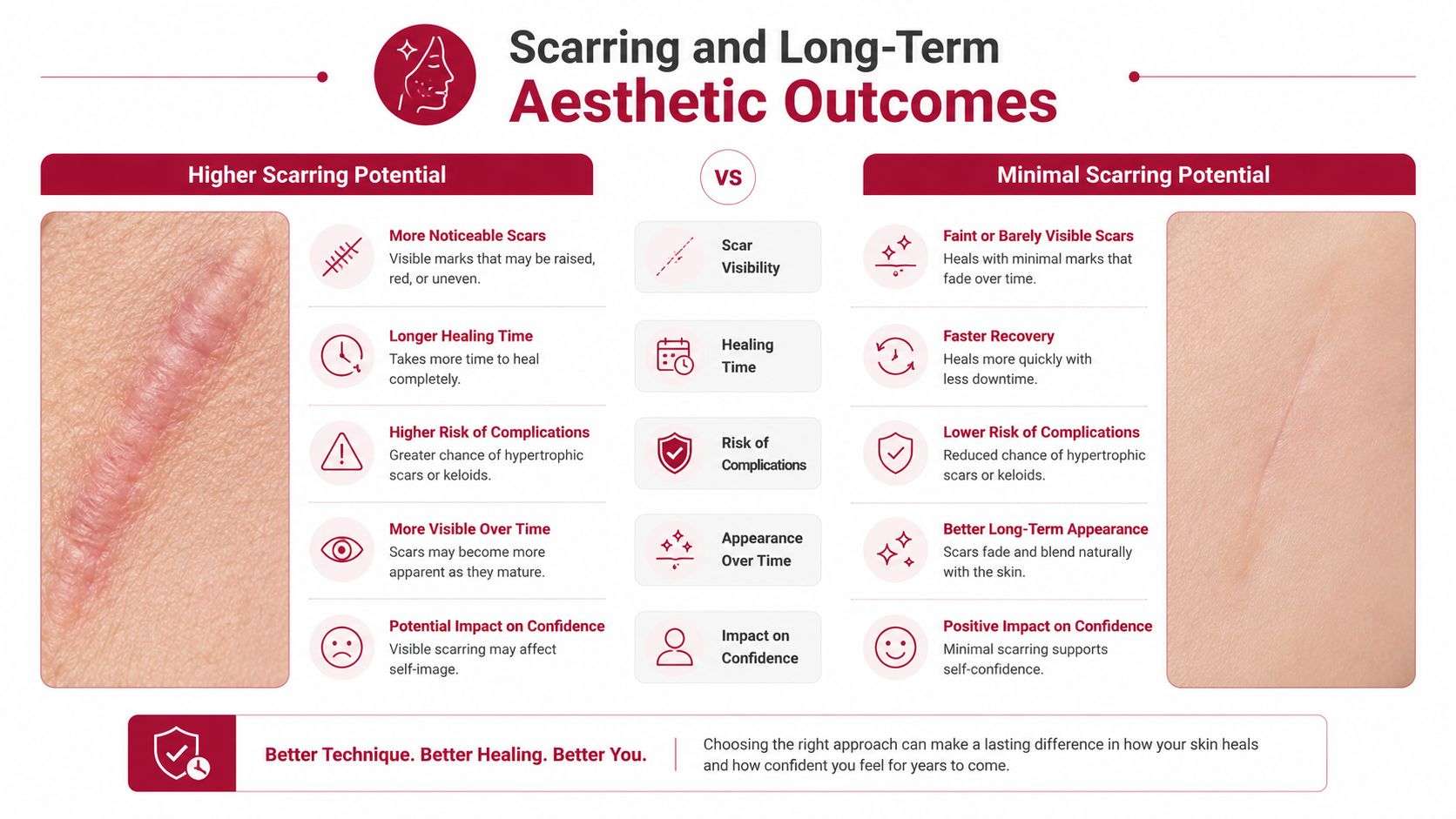
Scars remain biologically active after the incision closes. Color, thickness, firmness, and sensitivity can change as the scar matures. Genetics, skin tone, tension, and wound healing all influence that process.
A practical scar-care plan may include:
- Silicone therapy: Once the incision is fully closed, use silicone sheets or another surgeon-approved silicone product. General information about silicone sheets for scar healing can provide background, but follow the operating surgeon's instructions.
- Sun protection: Shield healing scars from direct ultraviolet exposure, which can make discoloration more noticeable.
- Tension control: Wait for clearance before stretching, lifting, or exercising. Excessive tension can widen or irritate the scar.
- Follow-up assessment: Report increasing redness, drainage, separation, or worsening pain instead of managing those changes independently.
Long-term appearance depends on stable weight, adequate healing, and choosing an operation that matches the actual distribution of laxity. Pregnancy or substantial weight fluctuation can change either result.
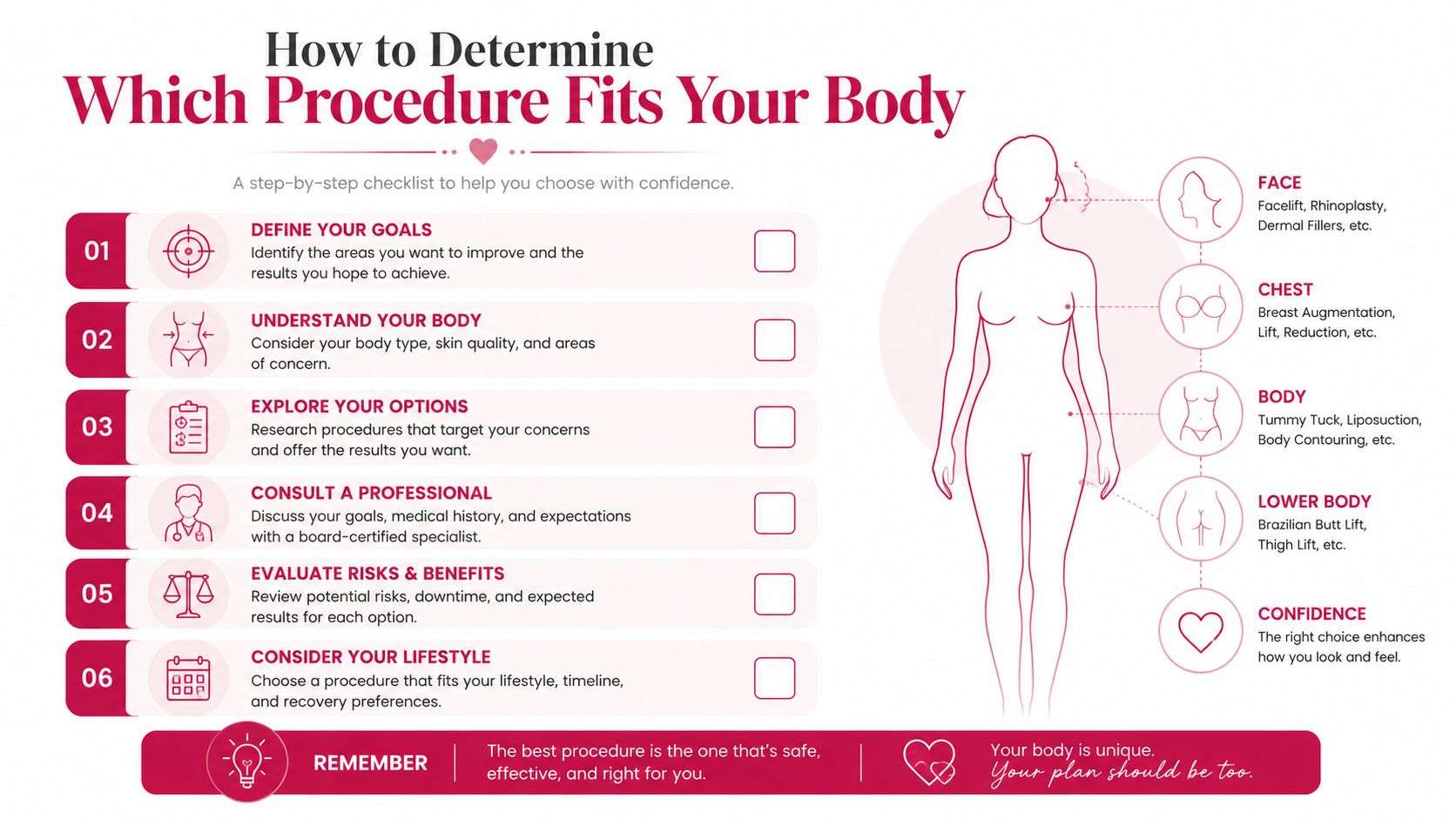
How to Determine Which Procedure Fits Your Body
A patient who can pinch loose skin below the navel but has firm skin above it may fit a mini tummy tuck profile, provided the rectus muscles are intact and the abdominal wall does not bulge higher up. That combination matters more than the amount of skin available for removal. A mini tuck can shorten the incision and limit the treatment area, but it cannot correct laxity or muscle separation outside that area.
Map the skin and tissue pattern
Stand relaxed in front of a mirror and turn to the side. Examine the lower abdomen and the area around the navel separately.
- Below the navel only: A small fold, overhang, or pouch confined to the lower abdomen may support a mini-tuck plan.
- Above and below the navel: Wrinkling, loose skin, or fullness around the navel suggests that a broader skin adjustment may be needed.
- Across the entire abdomen: Skin excess extending widely, particularly after major weight loss, usually exceeds the reach of a limited operation.
During a pinch test, compare the skin below and above the navel. The surgeon is assessing more than thickness. Skin quality includes elasticity, stretch marks, recoil, and whether the tissue remains loose after it is released. Firm upper-abdominal skin with a soft lower fold supports a limited approach. Loose, poorly elastic tissue in several zones would leave visible laxity if only the lower abdomen were treated.
Look for the muscle component
Lie on your back with your knees bent. Lift your head slightly while keeping your shoulders down. A central ridge or bulge can indicate abdominal wall laxity, although this home maneuver cannot establish the diagnosis.
In consultation, the surgeon examines the midline at multiple levels and may measure diastasis in centimeters, from the area above the navel through the lower abdomen. The location, width, and firmness of the separation matter. A mini tuck becomes difficult to justify when diastasis extends above the navel, when upper-abdominal bulging is present, or when tightening only the lower segment would leave the main structural problem untreated.
Bring focused questions to consultation
Ask your surgeon:
- Where is my laxity located? Ask whether the upper abdomen requires treatment, rather than focusing only on whether a mini-tuck incision is possible.
- Do I have diastasis recti? Ask where the separation starts and ends, its measured width, and which portion the proposed repair would address.
- What will happen to my navel? Confirm whether it will remain in its existing position or be brought through a new opening.
- What problem will remain untreated? The answer clarifies the actual trade-off between a limited and full operation.
- What would revision involve? If a mini tuck under-corrects the abdomen, ask what a later revision would require and which tissues would then need to be addressed.
Final Recommendations by Patient Profile
This article's central argument is that anatomy dictates the procedure. Patient preference and perceived invasiveness come after the distribution of laxity, muscle separation, and the area that needs correction.
- Postpartum patient with diastasis extending above the navel: A full tummy tuck is generally more anatomically coherent because it can address broader skin laxity and repair the abdominal wall across the affected region. A mini procedure may leave upper-abdominal bulging or untreated separation.
- Patient with an isolated lower-abdominal pooch: A mini tummy tuck may fit when excess skin is confined below the navel, upper-abdominal tone is good, and examination shows no clinically significant separation requiring broader repair.
- Patient after major weight loss: Global skin excess often calls for a full abdominoplasty or another detailed body-contouring plan. A short incision cannot remove laxity extending beyond its treatment zone.
- Active patient prioritizing minimal downtime: Recovery matters, but anatomy determines whether a limited operation is appropriate. A mini tuck can provide a less extensive recovery when it fully addresses the problem. Choosing it solely to return to activity sooner can leave residual deformity and lead to further surgery.
The most expensive shortcut is an operation that doesn't correct the problem you wanted fixed.
A board-certified plastic surgeon should assess skin quality, tissue distribution, abdominal wall strength, and muscle separation in person before recommending either procedure. The consultation should also clarify the expected scar, navel treatment, repair area, recovery restrictions, and what a later revision would involve if the first operation under-corrects the abdomen.
Georgia Plastic & Reconstructive Surgery offers consultations for full abdominoplasty, mini tummy tuck, and related body-contouring procedures, with individualized surgical planning and recovery guidance. Visit Georgia Plastic & Reconstructive Surgery to review the available options and request an in-person consultation focused on your anatomy and goals.