If you're reading this after a mastectomy, or while you're still deciding what comes next, you're probably carrying more than one question at a time. You may be thinking about cancer treatment, recovery at home, how your chest will look in clothes, whether you want more surgery later, and how much energy you have for one more major decision.
Many patients tell me they feel pressured to choose quickly, even when their emotions haven't caught up to everything that's happened. That response is normal. Some people also struggle with a kind of loss that others don't always recognize, and this perspective on understanding disenfranchised grief can help put words to that experience.
In simple terms, breast reconstruction usually follows one of two paths. One uses an implant. The other uses your own tissue, often from the abdomen, to create a breast mound. Implant reconstruction is still the most common approach, making up about 66% of breast reconstructions globally according to this survey summary in the medical literature. But common doesn't always mean best for every person. Your body, your cancer treatment, your goals, and your tolerance for future surgery all matter.
A lot of confusion starts with the word "flap." Patients often hear "TRAM flap" used as if it means all tissue-based reconstruction. It doesn't. That's one of the biggest reasons this decision can feel harder than it should.
Table of Contents
- The Reconstruction Journey After Mastectomy
- Understanding Your Two Main Options
- The Surgical Process Step by Step
- Comparing Flap Reconstruction and Implants Side by Side
- Recovery and Long Term Outcomes
- Making Your Personalized Decision
- Frequently Asked Questions About Breast Reconstruction
The Reconstruction Journey After Mastectomy
A patient I might see in consultation often starts with a sentence like this: "I know I want reconstruction. I just don't know what kind." That's a very reasonable place to be.
For many women, reconstruction isn't about chasing a perfect result. It's about restoring shape, privacy, confidence, balance in clothing, and a sense of familiarity in their own body. Sometimes it's also about reducing reminders of treatment every time they get dressed or look in the mirror.
There are two broad philosophies behind reconstruction.
One approach uses a medical device, usually an implant. The other uses your own living tissue, called autologous reconstruction or a flap. Neither option is automatically right or wrong. They solve the same problem in different ways.
Two paths with different tradeoffs
Implants usually appeal to patients who want a shorter initial operation and no separate donor site on the abdomen. Flap reconstruction often appeals to patients who want a softer, more natural breast mound made from their own tissue and are willing to accept a bigger surgery up front.
A good reconstruction plan doesn't start with "What's most popular?" It starts with "What matters most to you over the next several years?"
That difference matters because the timeline is different. Implant reconstruction is often easier at the beginning, while flap reconstruction can offer advantages that become more meaningful later.
Where patients often get confused
The most common misunderstanding is this: people hear "flap" and think there's only one version. In reality, "TRAM flap" is an older term that many articles use too loosely. Modern tissue-based reconstruction often centers on DIEP flap surgery, which is different in important ways.
If you're comparing TRAM flap vs implants, you're asking the right question. But to make a current decision, you also need to understand how TRAM differs from DIEP, because most patients who say they want a "TRAM" are trying to understand the broader flap option.
Understanding Your Two Main Options
| Option | What it uses | Typical appeal | Main tradeoff |
|---|---|---|---|
| Implant-based reconstruction | A tissue expander and later an implant, or in select cases an implant directly | Shorter initial surgery, no abdominal donor site | It usually involves stages and may require future implant-related surgery |
| Autologous flap reconstruction | Your own tissue, often from the abdomen | More natural feel and a living breast mound | More complex surgery and recovery, plus donor-site healing |
What implant reconstruction usually involves
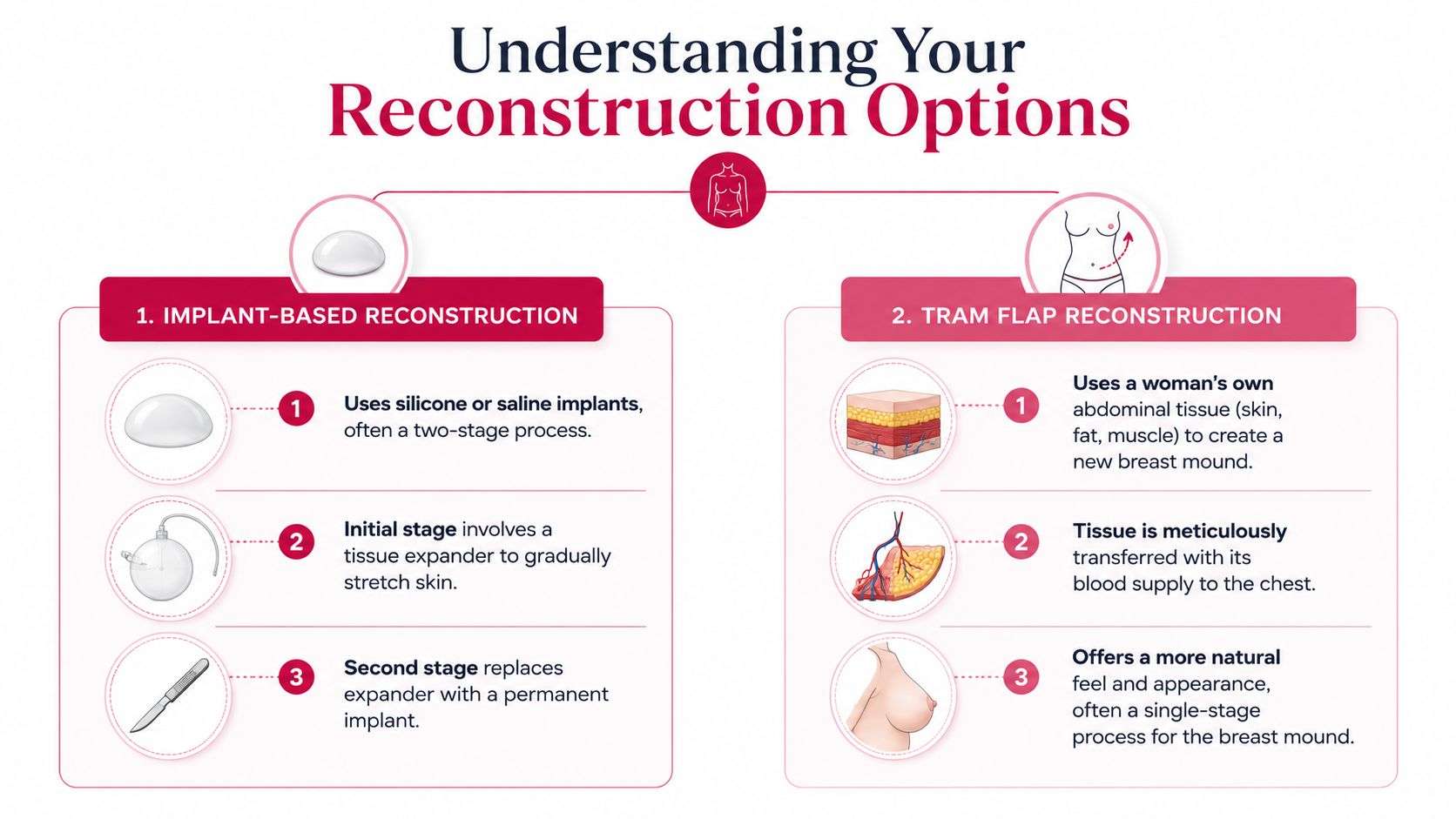
Implant reconstruction rebuilds breast shape with a prosthetic device. In many cases, this happens in stages. The first stage often places a tissue expander under the skin and chest tissues. That expander is gradually filled over time, creating room for the final implant.
Later, a second operation replaces the expander with a permanent implant. Some patients qualify for direct-to-implant reconstruction, but many still go through a staged process.
If you're also trying to understand implant materials, this overview of saline, silicone, and gummy bear breast implants can help you sort through those terms before your surgical consultation.
Why TRAM and DIEP are not the same
This is the part many articles skip. They use "TRAM flap" as shorthand for all abdominal flap surgery, and that isn't accurate.
A TRAM flap is an older abdominal tissue method that uses skin, fat, and some abdominal muscle. A DIEP flap also uses abdominal skin and fat, but it is designed to spare the abdominal muscle. That distinction matters because published data notes that many sources blur the line between older pedicled TRAM flaps and modern DIEP flaps, even though DIEP flaps can be performed with lower morbidity and reduce problems such as fat necrosis and abdominal wall hernias seen more often with TRAM according to this PubMed-indexed review.
For patients, the practical takeaway is simple. If you want your own tissue reconstruction, the question usually shouldn't be "TRAM or implants?" It should be "Is an implant right for me, or am I a candidate for a modern flap such as DIEP?"
When someone says, "I heard flap surgery damages your core," I usually ask which flap they mean. That's not a technical detail. It's often the key detail.
The Surgical Process Step by Step
A common moment in consultation sounds like this: "I can handle surgery. I just need to understand what happens." That is a very reasonable question, because implant reconstruction and abdominal flap reconstruction ask different things of your body, your schedule, and your recovery.
How implant reconstruction unfolds
Implant reconstruction often happens in stages. Many patients start with a tissue expander placed at the time of mastectomy or in a later operation, depending on cancer treatment, skin quality, and whether radiation is part of the plan.
The expander works like a temporary placeholder under the chest tissue. Over time, it is gradually filled in the office to create space for the final implant. Once the skin and soft tissue have stretched enough, a second surgery replaces the expander with the permanent implant.
For many women, that step-by-step path feels easier to absorb because the first operation is usually less involved than a flap procedure. The tradeoff is that reconstruction is often spread across multiple visits and more than one operation.
Before surgery, it helps to know what your surgeon is evaluating, including your skin envelope, scar pattern, body shape, and cancer treatment history. This guide to your breast reconstruction consultation in Georgia explains that planning process in plain language.
How flap reconstruction unfolds
Flap reconstruction is usually a bigger upfront surgery. The surgeon moves living tissue from one part of your body, most often the lower abdomen, to create the breast mound.
It is essential to clearly distinguish the older TRAM flap from the newer DIEP flap.
A TRAM flap uses abdominal skin, fat, and at least some of the rectus muscle. A DIEP flap uses the lower abdominal skin and fat too, but it aims to preserve the abdominal muscle and reconnects the blood vessels under a microscope. For patients, that difference is not a small technical point. It helps explain why many modern microsurgical practices favor DIEP when a patient is a good candidate.
The breast is rebuilt during that same operation using your own tissue. Because the tissue is alive, with its own blood supply, it tends to feel more like soft tissue than a device does. Some patients also like that the reconstructed breast can change with weight gain, weight loss, and aging in a more natural way.
The early recovery is more demanding. You are healing in two places, the chest and the abdomen. You may spend more time in the hospital, and your surgical team will watch the flap closely right after surgery to make sure blood flow remains healthy.
Why the process feels so different
Implant reconstruction usually spreads the work out over time. Flap reconstruction, especially DIEP, puts more of the work into one major operation at the beginning.
A simple way to picture it is this. Implant reconstruction often starts with building the space first, then placing the final implant later. Flap reconstruction usually builds the breast mound with your own tissue during the main surgery, but asks more of you in that first recovery window.
Some women want the shorter initial operation and accept the staged path. Others would rather go through one larger surgery to avoid having a device in the breast long term. Neither approach is the "right" one for everyone. The better choice is the one that fits your health, your cancer treatment plan, and the kind of result you want to live with for years.
Comparing Flap Reconstruction and Implants Side by Side
Implant vs. Flap Reconstruction at a Glance
| Criterion | Implant-Based Reconstruction | Autologous Flap (DIEP/TRAM) |
|---|---|---|
| Look and feel | Can create good shape, but it remains a device-based reconstruction | Often feels softer and more like living tissue |
| Surgical path | Usually staged, often beginning with a tissue expander | More extensive initial surgery, often creating the breast mound in one major operation |
| Recovery burden | Shorter upfront recovery for many patients | Longer and more demanding early recovery |
| Future procedures | More likely to involve future device-related surgery or exchange | Often chosen for long-term durability of the breast mound |
| Donor site | No abdominal donor site | Requires healing of the donor site, usually the abdomen |
| Body changes over time | Implant behavior is separate from natural body tissue | Flap tissue tends to change with your body over time |
| Best fit for some radiation patients | Can be challenging in radiated tissue | Often preferred when radiation has damaged the chest tissue |
| Functional impact early on | Usually less disruption outside the chest area | Can affect abdominal function and daily activity during recovery |
The heart of the tram flap vs implants conversation is not just "Which surgery is better?" It's "Which tradeoff fits your life?"
How these tradeoffs feel in real life
At about 2 years after mastectomy, women who underwent autologous TRAM flap reconstruction reported better long-term aesthetic satisfaction and better breast feel than women with implants, while also reporting more functional impairment in work, vigorous activity, and social interaction, according to this long-term outcome study indexed on PubMed. That's one of the clearest examples of why this decision isn't simple.
A flap can offer a breast that feels more like part of your body. It can drape more naturally, move more naturally, and age with you. For many patients, that matters every day in ways that are hard to measure in a clinic.
But the price of that benefit is real. If tissue is taken from the abdomen, you are recovering from breast reconstruction and abdominal surgery at the same time. Even when the muscle is spared, the donor site still needs healing, and your energy can feel limited for a while.
Some patients care most about how the reconstruction feels in a bra, a swimsuit, or a hug years from now. Others care most about getting through treatment with the least immediate disruption. Both priorities are valid.
Implants create a different experience. They usually involve less surgical trauma up front, especially outside the chest. That can make the initial period easier to manage if you're juggling work, caregiving, or additional cancer treatment. But implants don't become living tissue, and they don't eliminate the possibility of future revision.
The most common side-by-side mistake
Patients are often told "flaps have more complications" without being told which flap that statement refers to. That's incomplete advice. Older TRAM techniques and modern DIEP flaps shouldn't be treated as identical options. If your surgeon recommends flap reconstruction, it's reasonable to ask exactly which flap is being discussed and why.
Recovery and Long Term Outcomes
The first phase of recovery
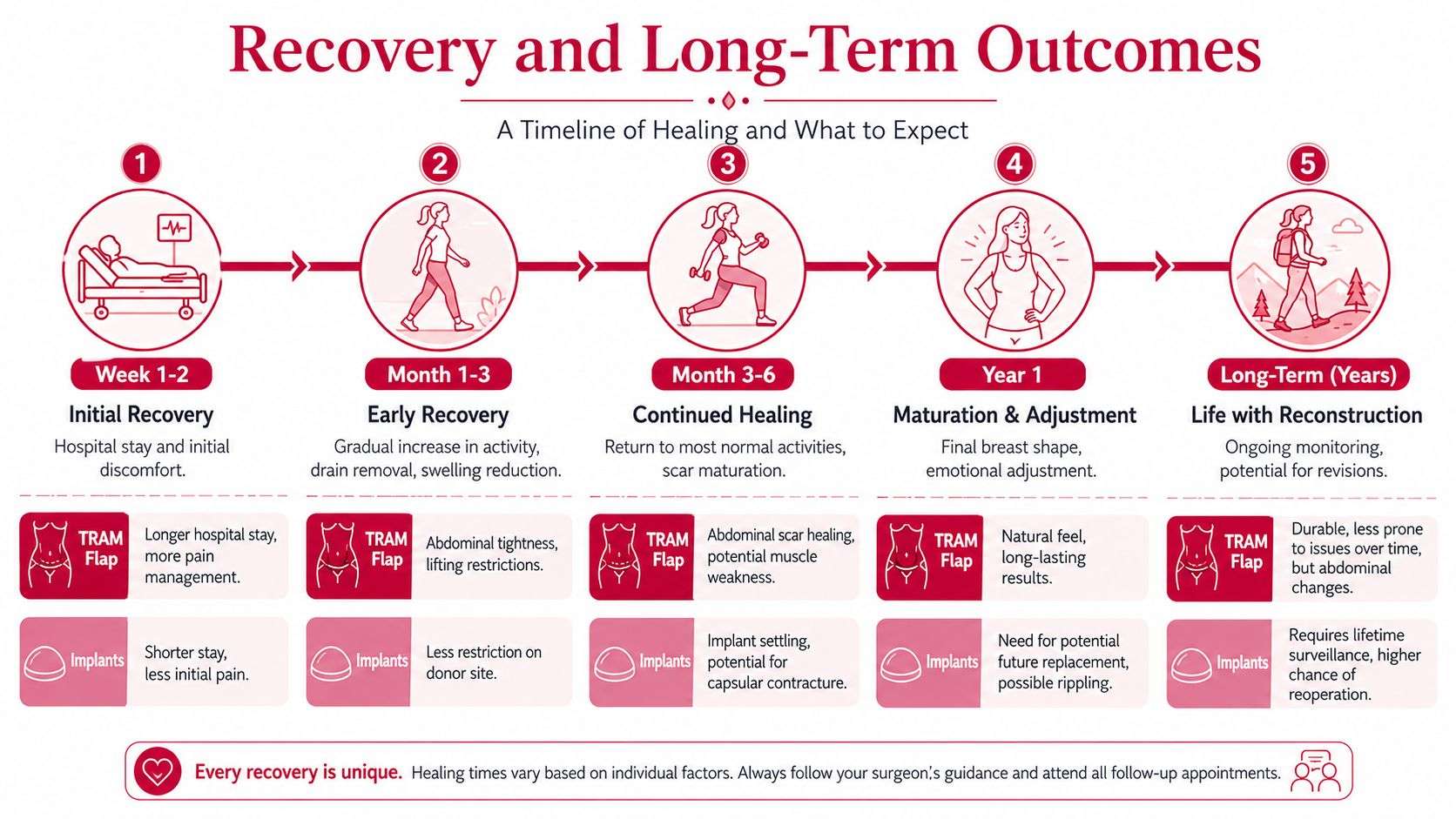
Recovery isn't just about pain. It's about movement, sleep, drains, energy, lifting restrictions, and how confident you feel using your body again.
Implant reconstruction usually has the easier early course. You're recovering mainly from chest surgery, and many patients return to basic daily routines sooner. Flap reconstruction asks more at the beginning because there are two operative areas. The chest has to heal, and the donor site has to heal too.
That makes gentle movement important. Once your surgeon clears you for it, some patients benefit from simple, structured shoulder mobility work such as this active assistive range of motion guide, especially when the chest feels tight after surgery. The exact timing should always come from your own surgical team.
What matters years later
Long-term outcomes are where this decision often becomes more personal.
In broad terms, flap reconstruction tends to ask for more recovery up front, while implants often ask for more attention later. If you're considering implants and want to understand what future surgery can involve, this overview of breast implant removal recovery gives a practical sense of the long-term device relationship some patients eventually face.
There is also the issue of complications in specific situations. Radiation changes the chest tissue in ways that can make implants less forgiving. In irradiated breasts, the 2-year complication rate was 53% for tissue expander or implant reconstruction and 12% for TRAM flap reconstruction in this reported comparison of outcomes after radiation. For patients who have had, or are likely to need, radiation, that difference can strongly influence the recommendation.
If radiation is part of your cancer treatment, reconstruction shouldn't be chosen in isolation. It has to be planned around how radiated tissue heals.
That doesn't mean every patient with radiation must have a flap, or that every flap patient avoids problems. It means radiation can shift the balance. Tissue-based reconstruction often performs better in a chest that has been scarred or stiffened by treatment.
Complications don't all mean the same thing
A higher early complication burden doesn't automatically mean a worse long-term experience. A lower early burden doesn't automatically mean fewer surgeries over the course of your life. That's why "Which one recovers faster?" is only part of the question.
A better question is, "Which recovery profile and long-term maintenance pattern can I live with most comfortably?"
Making Your Personalized Decision
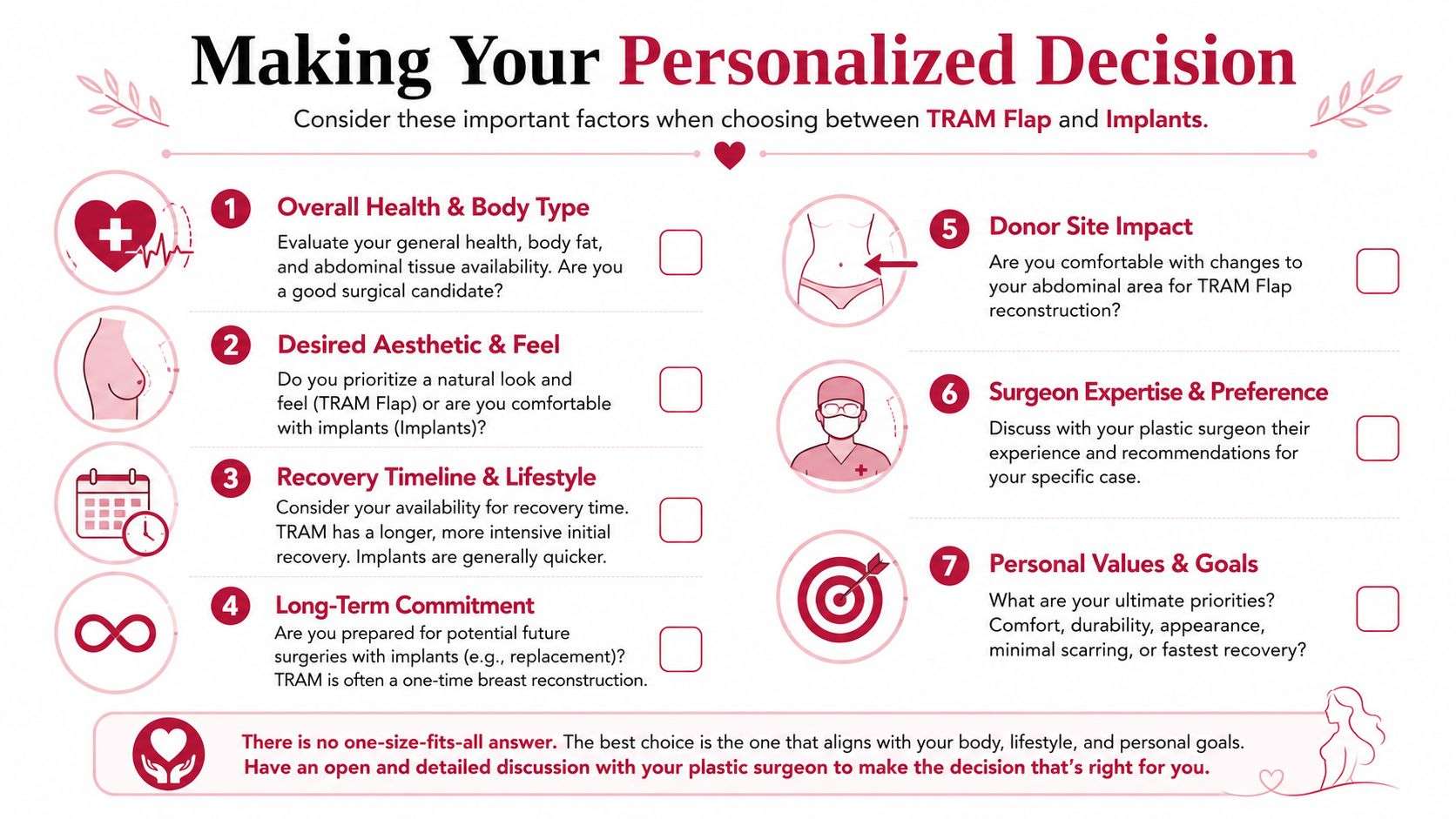
No chart can make this choice for you. It can only clarify what you're really choosing between.
For some women, the deciding factor is body image. For others, it's time away from work, fear of multiple operations, concern about abdominal healing, or the effect of radiation. Cost can also matter. In general, implant reconstruction has a lower upfront cost, while flap reconstruction is more resource-intensive initially because the operation is more complex. At the same time, flap reconstruction may spare some patients the cumulative burden of later implant-related procedures over the years.
Questions worth bringing to your consultation
Bring these questions in writing. When you're overwhelmed, a printed list helps.
- What flap are you talking about exactly. If flap surgery is on the table, ask whether the recommendation is TRAM, DIEP, or another flap, and why.
- How will radiation affect your recommendation. This can change the balance substantially.
- What will recovery look like in my actual life. Ask about lifting children, driving, sleeping position, work, exercise, and help at home.
- What future surgeries are likely with each option. The right comparison isn't only the first surgery.
- What happens at the donor site. If abdominal tissue is used, ask how your core, scar, and contour may change.
How to weigh the decision in a practical way
Some patients do best by choosing the option that minimizes today's burden. Others feel more peace choosing the option that may reduce future device-related decisions.
Here is a simple way to sort your priorities:
- If you value a shorter initial surgery, implants may fit that goal.
- If you value a more natural feel, autologous tissue may be more aligned.
- If radiation is part of your history, flap reconstruction deserves serious discussion.
- If preserving abdominal strength is a major concern, ask specifically about DIEP rather than assuming all abdominal flaps are the same.
- If you want the least future maintenance, a flap may be worth the larger upfront recovery.
The best reconstruction choice is the one that still feels right to you after the details are explained clearly, not the one that sounds easiest in a single sentence.
Your surgeon should help you weigh these factors without pushing you toward whatever is most familiar or most commonly performed. A careful consultation should leave you more informed, not more confused.
Frequently Asked Questions About Breast Reconstruction
A patient often reaches this point with the same thought: "I understand the big picture, but what does this mean for my body and my life?" That is exactly what good questions are for. The answers below are meant to make the choice between implants and flap reconstruction feel clearer, especially if you have heard TRAM and DIEP discussed as if they are the same thing.
Common concerns patients raise
Am I too thin for flap surgery?
Not always. Some thinner patients still have enough tissue for flap reconstruction, but the answer depends on your anatomy, where tissue is available, and whether the amount of tissue matches your reconstruction goals.
What happens to the abdomen after a DIEP or TRAM flap?
The abdomen will have a scar and a recovery period, much like a tummy tuck incision pattern. The biggest difference is under the surface. A TRAM flap uses abdominal muscle or part of it, while a DIEP flap uses skin and fat and aims to preserve the muscle. That difference matters because muscle preservation can help protect long-term core strength and reduce abdominal weakness in the right candidate.
Will the reconstructed breast feel natural?
A breast rebuilt with your own tissue usually feels softer and more natural than an implant because it is living tissue. Many patients also notice that flap reconstruction changes with weight gain and loss more like the rest of the body. Still, "natural" can mean softness, movement, warmth, or appearance, so it helps to tell your surgeon which of those matters most to you.
Will I have sensation in the new breast?
Sensation is harder to predict. After mastectomy, some feeling is often reduced no matter which reconstruction method is used. Some patients regain limited sensation over time, but normal breast sensation is not something reconstruction can promise.
Is implant reconstruction easier?
Implant reconstruction is often a shorter and simpler first step. The tradeoff is that implants are devices, and devices may need future procedures over time. For some patients, that is an acceptable path. For others, it shifts the burden from the first surgery to later years.
Is TRAM flap outdated?
TRAM flap is an older operation and is still used in select situations. But many patients searching for "TRAM flap vs implants" are really trying to compare implants with modern autologous reconstruction, which is often DIEP. Grouping TRAM and DIEP together can blur a very important distinction. They both use abdominal tissue, but DIEP was developed to avoid taking the rectus muscle in appropriate candidates, which is one reason it has become the standard abdominal flap option in many practices.
What if I still don't know what I want?
That is common, and it does not mean you are behind.
A good consultation should slow the decision down enough for you to understand it. Your cancer treatment, body shape, medical history, tolerance for recovery, and feelings about future maintenance all shape the right answer. The goal is not to choose the most popular operation. The goal is to choose the one that fits you best.
If you're weighing implant reconstruction against a TRAM or DIEP flap, a detailed consultation can make the decision far less overwhelming. The team at Georgia Plastic & Reconstructive Surgery offers patient education, reconstructive guidance, and in-person consultations to help you choose the option that fits your body, treatment plan, and long-term goals.