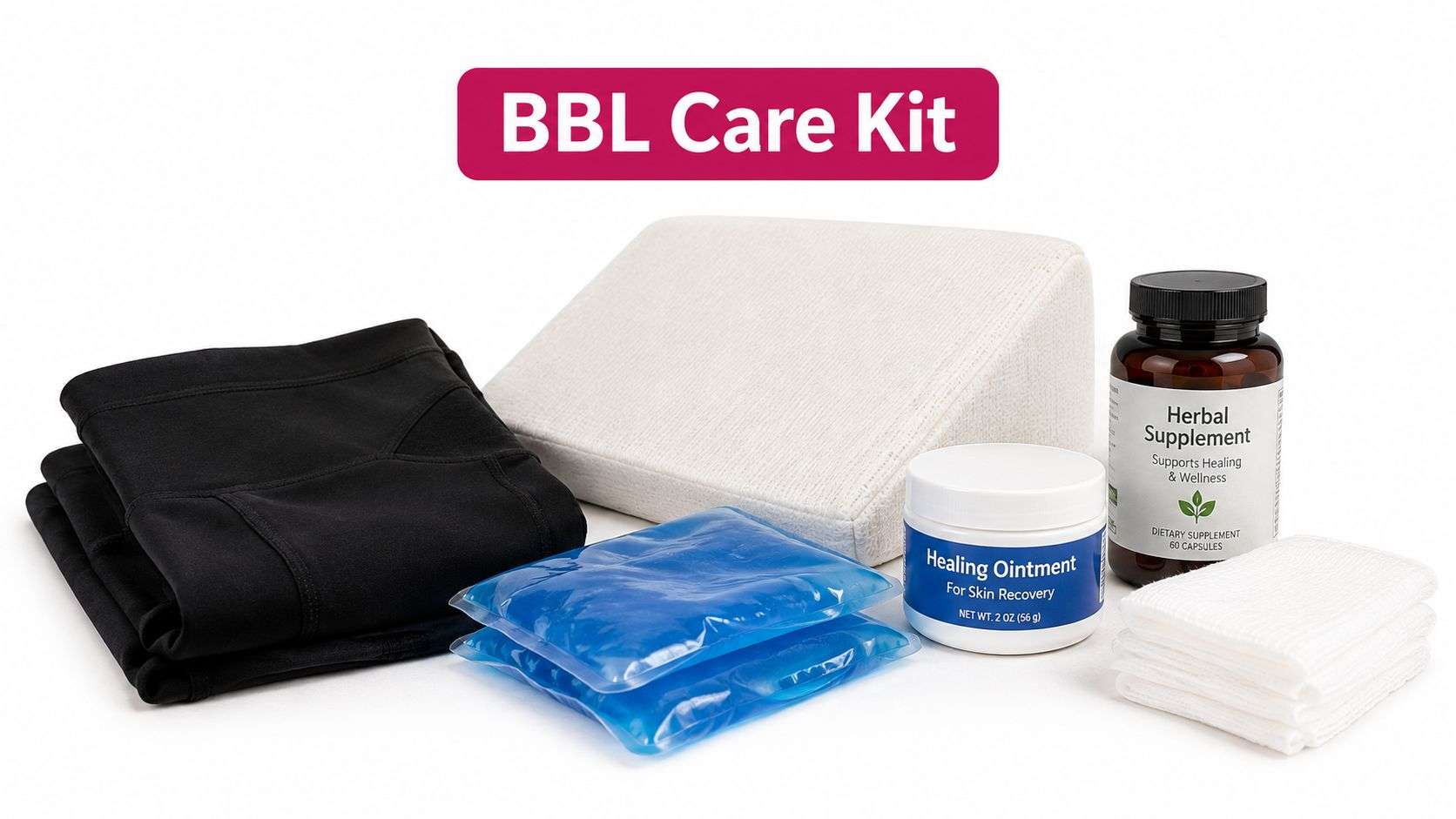
If you're reading this, you're probably in one of two places. Your surgery date is coming up and your mind keeps circling the same questions, or you've already had your implants removed and you're staring at your chest wondering, "Is this normal?"
Both reactions are common. Breast implant removal recovery is physical, but it also affects how you move, sleep, work, dress, and feel in your own skin. Some patients come to this decision after years of discomfort or worry. Others feel ready for a different chapter. Either way, recovery tends to feel easier when you know what belongs to the normal healing process and what needs a call to your surgeon.
Table of Contents
- Your Explant Journey Begins Here
- The First Week What to Really Expect Day by Day
- Weeks Two to Six Reclaiming Your Routine
- Months Two to Twelve Settling into Your New Shape
- Managing the Emotional and Aesthetic Journey
- Your Practical Checklists for a Smooth Recovery
- Your Recovery Partner Georgia Plastic and Reconstructive Surgery
- Frequently Asked Questions About Explant Recovery
Your Explant Journey Begins Here
Many women sit in consultation and say some version of the same thing: "I've been thinking about this for a long time." That's why I want to start with reassurance. Choosing explant surgery is rarely impulsive. It's often the result of months or years of reflection about comfort, health, appearance, or peace of mind.
You're far from alone in making this choice. The number of women choosing explant surgery is growing, with U.S. procedures rising 12% from 2019 to 37,679 in 2022, according to this breast implant removal review in the medical literature. That matters because it reminds patients that explant is not unusual. It's a real and increasingly common part of long-term breast care.
Some of the physical recovery ideas will feel familiar if you've ever healed from an injury that required patience and staged movement. A plain-language guide to muscle strain recovery time can help frame why your body needs support, protection, and gradual return to activity rather than a quick push back to normal.
For women still deciding whether removal is the right next step, this overview of why Atlanta women are saying goodbye to implants gives helpful context around common motivations and expectations.
Recovery goes more smoothly when you stop asking, "When will I look finished?" and start asking, "What is my body healing from today?"
The First Week What to Really Expect Day by Day
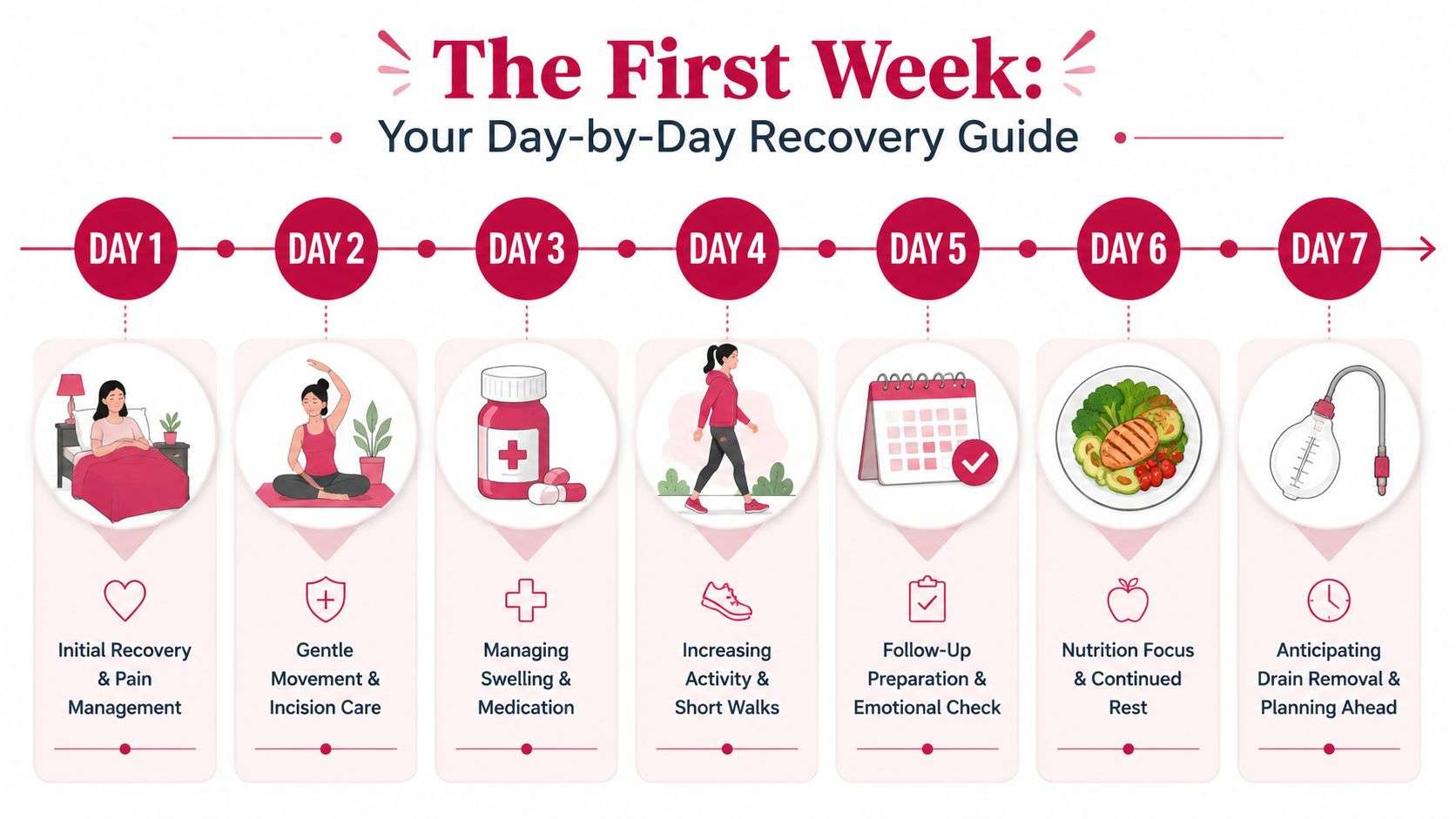
The first week often feels like the strangest part of recovery. One day you have surgery. The next, you are looking at swelling, dressings, soreness, and a chest that does not yet reflect the final result. That early phase can be unsettling if no one has explained the difference between healing well and looking finished.
I tell patients to divide this week into two tracks. The first is functional recovery, which means getting safely through the day, walking to the bathroom comfortably, eating, sleeping, and keeping pain controlled. The second is aesthetic finalization, which is the long process of tissues settling into their new shape. In week one, functional recovery has started. Aesthetic finalization has barely begun.
What your body is doing right away
Right after explant surgery, your body shifts into repair mode. Fluid moves into the area. Swelling builds. The skin and soft tissue begin adjusting to the space change left by implant removal. If capsules were removed or additional lifting or reshaping was done, your chest has even more healing work to do.
That is why the early routine is so structured.
Your compression garment usually stays on around the clock during the early recovery period to limit swelling and support the chest while tissues begin to settle, as outlined in these post-op instructions for breast implant removal. It works like a soft external support. It does not force a final shape. It helps calm the area while healing starts.
Arm restrictions are part of that same logic. Reaching high, pulling, or lifting can tug on healing tissue before it is ready. A laundry basket, a heavy purse, or a child climbing into your arms can all create more strain than patients expect.
If you have drains, they are there to collect extra fluid from the surgical space while your body adjusts. Patients often feel nervous when they see them, but drains are temporary helpers. They lower the chance of fluid buildup and give your surgeon useful information about how healing is progressing.
A realistic day-by-day picture
Every recovery has its own personality, but the first week often follows a pattern.
Day 1: Rest is the main job. You may feel groggy, tight, and sore across the chest. Many patients describe pressure or heaviness more than sharp pain. Keep movement simple and purposeful.
Day 2: Short walks around the house become useful. They help circulation and reduce stiffness. You will still tire easily, and routine tasks such as getting dressed or standing up from bed may require help.
Day 3: This is often the day patients start wondering if something is wrong. Swelling and bruising can look more obvious now. Your chest may appear uneven, high, flat, or strangely shaped. Early appearance is a poor judge of the final result.
Day 4: The fog from surgery often starts lifting. That creates a trap. You may feel clearer mentally and assume your body is ready for more activity than it can handle.
Day 5: Light household movement may feel easier, but fatigue still shows up quickly. If you had drains placed, you may be watching output closely and hoping for removal soon.
Day 6: Many patients feel emotionally better once they can see a daily rhythm forming. Pain is often less intense by now, but tightness, swelling, and tenderness are still normal.
Day 7: You are usually more stable than you were a few days earlier. That does not mean healed. It means the immediate shock of surgery is beginning to settle, and functional recovery is taking hold.
A simple rule helps here. If an activity causes pulling, bouncing, or pressure in the chest, your body is asking for less.
Questions patients often ask in the first week
| Concern | What usually helps |
|---|---|
| "My chest looks swollen and uneven." | Early swelling is rarely symmetrical. One side can settle faster than the other, especially if the surgery was more involved on one side. |
| "I feel emotional and weepy." | That is common after surgery. Anesthesia, poor sleep, discomfort, and a sudden body change can all affect mood. Having one calm support person and a simple daily routine often helps. |
| "I want to see what happens if I raise my arms." | Curiosity is normal. Healing tissue does better when you use your arms gently for daily tasks and avoid testing the limits. |
| "I feel pretty good today." | Good days are encouraging, but they can lead to overdoing it. Recovery is more like climbing a hill with a few dips than flipping a switch. |
Practical and emotional support for this week
Patients often prepare for pain and forget to prepare for inconvenience. Set up a small recovery station before surgery with water, medications, gauze if instructed, your drain log if needed, a phone charger, and pillows that help you stay in a comfortable position. Keep commonly used items at waist or countertop level so you are not tempted to reach overhead.
Emotional support matters too. The first look at your chest can bring relief, sadness, gratitude, doubt, or all four in the same hour. None of those reactions mean you made the wrong decision. They usually mean you are human and you just went through a meaningful body change.
If I could give one message for this week, it would be this: judge your progress by how steadily you are healing, not by how finished you look. In the first seven days, the goal is safety, comfort, and quiet healing. The visible result comes later.
Weeks Two to Six Reclaiming Your Routine
This is the phase I call functional recovery. You're not done healing, but you start getting pieces of regular life back. That difference matters. Feeling more normal doesn't mean your tissues are fully remodeled. It means your body is strong enough to re-enter daily routines in a careful way.
The green lights patients look for
A few milestones tend to shape this stretch of breast implant removal recovery. Initial healing usually happens within 1 to 2 weeks, most patients return to desk-based work after 14 days, and driving often resumes around day 7 to 10 once you're off pain medication and can wear a seatbelt comfortably, according to this breast implant removal recovery timeline.
Patients often ask me what "returning to work" means. It doesn't mean you're ready for long commutes, lifting, rushing through airports, or carrying a heavy laptop bag across a parking deck. It usually means you can sit, think clearly, answer emails, and move through a mostly non-strenuous day.
A good way to judge readiness is to ask yourself three questions:
- Can I get through the day without needing prescription pain medication?
- Can I sit upright and move comfortably without guarding my chest all day?
- Can I avoid lifting, reaching, and overusing my arms at work?
If the answer is yes to all three, you're usually moving in the right direction.
What still needs caution
This middle phase can fool people. The discomfort improves, swelling starts to settle, and your energy begins to return. That's when patients often overestimate how healed they are.
Keep these boundaries in mind:
- Walking is good. Gentle walking supports circulation and can help you feel less stiff.
- Heavy exercise is not ready yet. Your chest tissues still need protection even if you feel restless.
- Support still matters. Continue wearing the garment or supportive bra exactly as your surgeon instructs.
- Fatigue is normal. Healing uses energy. If you need more rest than usual, that's not weakness. That's biology.
Your body heals in layers. The outside often looks calmer before the deeper tissues are ready for stress.
Some patients also notice odd sensations during this period. Pulling, tightness, numb patches, intermittent swelling, or tenderness can all show up as nerves and tissues adjust. Those experiences are often more annoying than alarming.
If your job is physical, this part takes more planning. A teacher who can modify tasks may return sooner than a warehouse worker, hairstylist, or nurse who lifts, reaches, or stays on their feet all day. Breast implant removal recovery isn't measured only by the calendar. It's measured by what your body is asked to do.
Months Two to Twelve Settling into Your New Shape
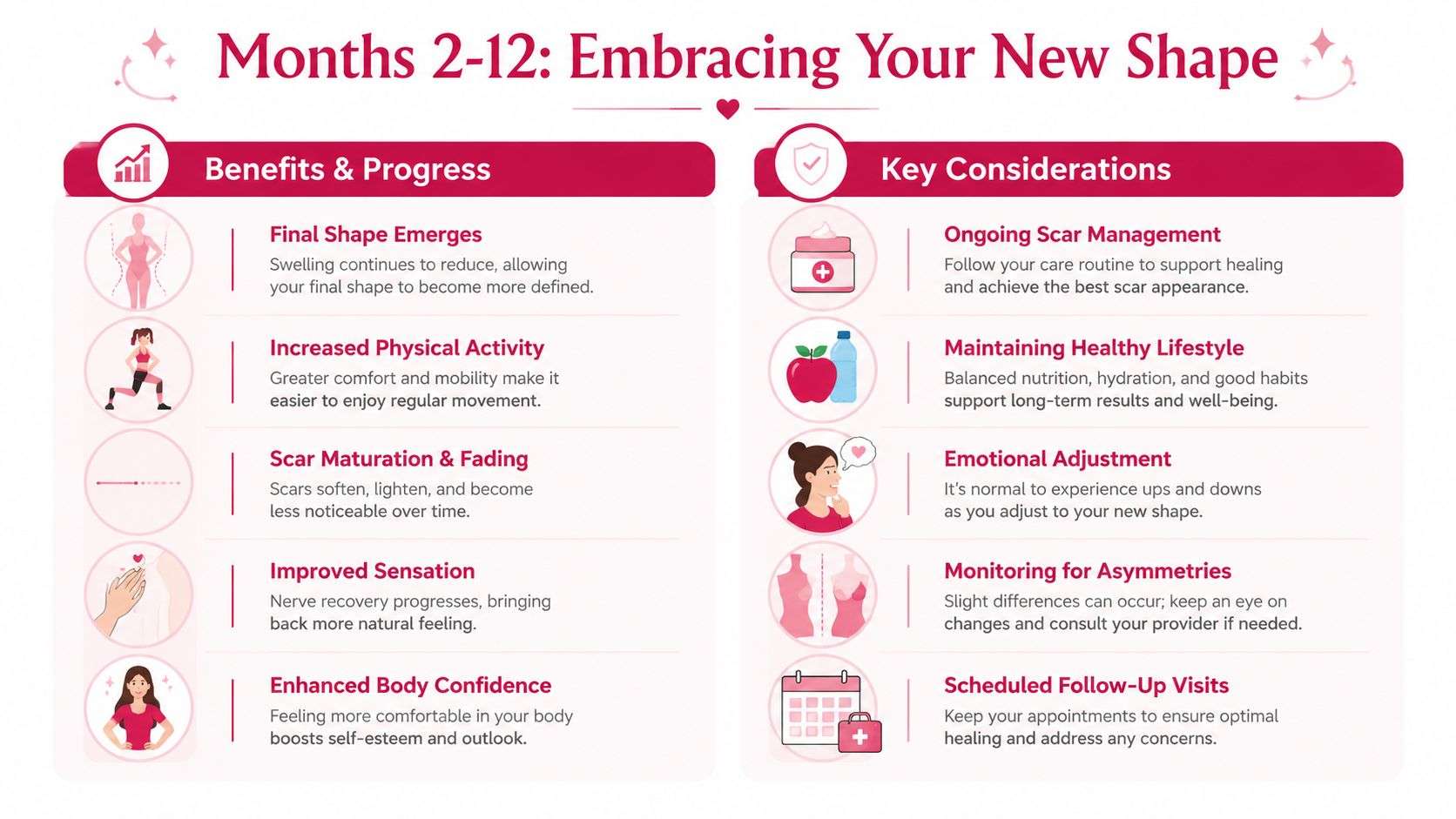
This part of recovery is quieter, but it matters just as much. Your life may feel mostly back on track, yet your results are still evolving. That's where many patients get confused. They assume the six-week mark should also be the final visual result. It usually isn't.
Why your shape changes slowly
Think of your chest like a garden bed after something large has been removed from the soil. The surface may look calmer fairly quickly, but the ground underneath still needs time to settle. After explant, the skin, soft tissue, scar tissue, and internal spaces all adapt at different speeds.
Final breast contour often stabilizes over months three to six, and longer-term skin tightening can continue beyond that. During this period, scars also mature and gradually fade from pink toward a lighter tone as the tissue remodels.
Common changes in this stage include:
- Softening tissue: The chest usually feels less firm as swelling resolves.
- Changing contour: The breast shape can look different month to month, especially without replacement implants.
- Scar evolution: Incisions often look more noticeable before they start looking better.
- Improving comfort: Many patients describe less chest tightness and easier body awareness over time.
If you had symptoms before explant
For patients who chose surgery because of Breast Implant Illness symptoms, the timeline can feel especially personal. According to this recovery guide focused on symptom resolution after explant, energy and "brain fog" often improve within the first month, joint pain may start improving around weeks 4 to 6, and issues like rashes or hair loss can take 2 to 3 months for noticeable change.
That slower pace can be frustrating. Many patients hope everything will lift at once. In reality, symptom improvement often arrives in pieces. First better sleep. Then clearer thinking. Then less body aching. Then skin changes.
Healing doesn't always announce itself dramatically. Sometimes it shows up as small things getting easier.
A simple journal can help here. Not a long diary. Just short notes on sleep, mood, energy, pain, skin changes, and daily comfort. Patients often miss their own progress because they're looking for one big turning point instead of a series of smaller gains.
Managing the Emotional and Aesthetic Journey
The mirror can be the hardest part of recovery. Not because something is wrong, but because your eyes want an immediate answer while your body is still mid-process.
Functional recovery versus aesthetic finalization
This distinction is one of the most important things patients can understand. Functional healing takes about 6 to 8 weeks, while final skin retraction and tightening can take 6 to 12 months, according to this Cleveland Clinic overview of breast implant removal. That means you may feel well enough to live normally long before your chest looks settled.
When patients don't know that, they often become anxious at exactly the wrong moment. They see looseness, flatness, wrinkling, or asymmetry during the in-between phase and assume it's permanent. Often, it's unfinished healing.
For readers dealing with systemic symptoms and trying to understand that part of the picture too, this resource on breast implant illness treatment can help clarify the medical context behind explant decisions.
How to handle the in-between stage
Aesthetic adjustment is not only visual. It's emotional. You may feel relief and grief at the same time. You may love the decision but still need time to get used to your silhouette in clothing, bras, or intimacy.
A few strategies help:
- Limit mirror checking. Looking constantly tends to increase anxiety, not clarity.
- Compare by month, not by day. Day-to-day changes are often too subtle to judge fairly.
- Use supportive clothing. A soft, structured bra or compression garment can make you feel more secure while tissues settle.
- Name the emotion accurately. "I feel unfamiliar" is different from "Something is wrong."
- Keep your follow-ups. Reassurance is most useful when it's specific to your healing pattern.
The body you see at six weeks is often a draft, not the final version.
Patients who removed implants for medical reasons can have an additional emotional layer. Relief from pain, fear, or chronic worry doesn't instantly erase the stress that came before surgery. Give yourself room for that. Recovery isn't only about tissue. It's also about trust returning to your body.
Your Practical Checklists for a Smooth Recovery
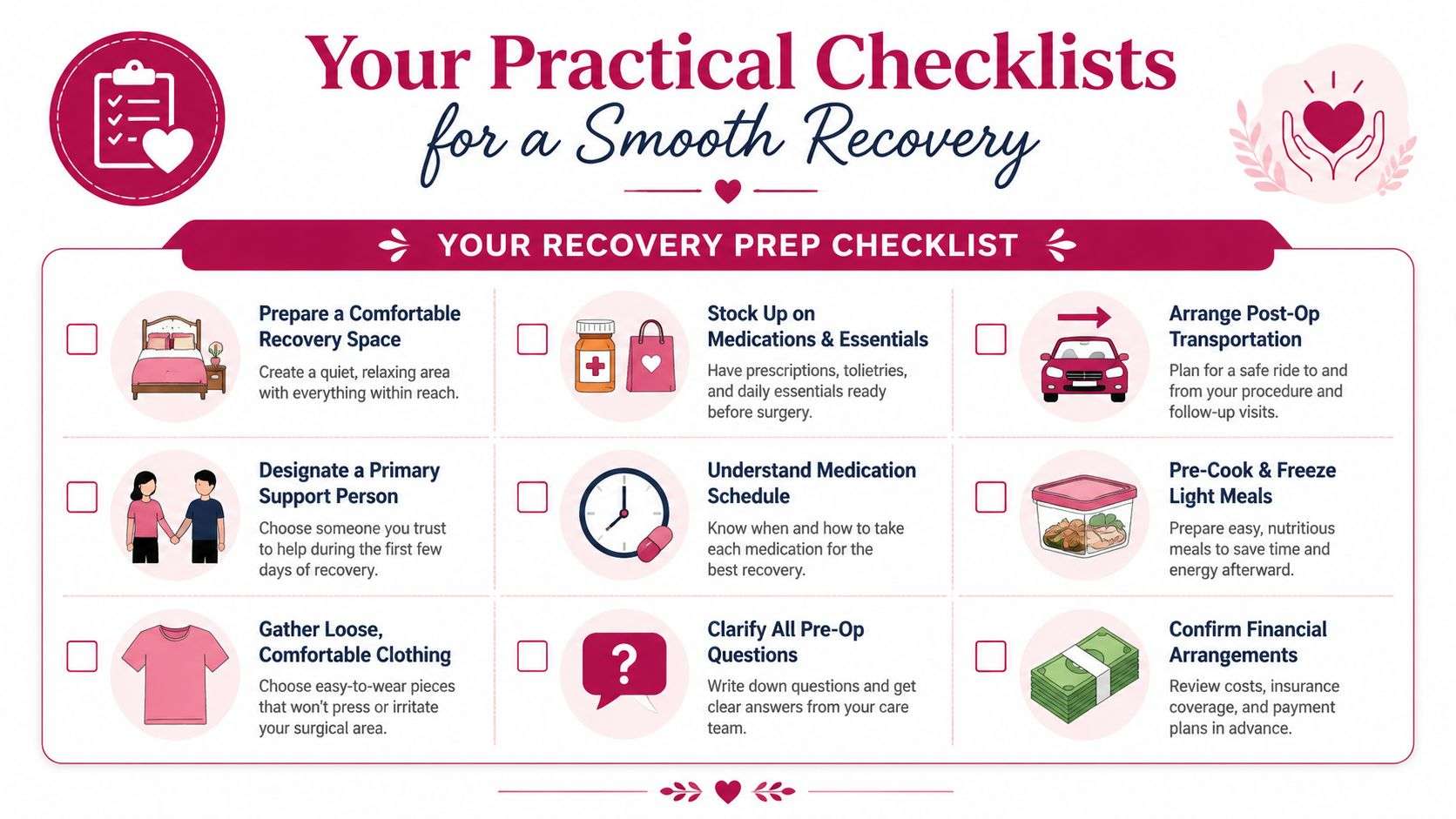
Preparation lowers stress. When your home is ready before surgery, you don't spend the first days healing while also hunting for a charger, lifting a blanket bin, or trying to open a high cabinet.
Your recovery nest
Set up one main rest area before surgery.
- Pillows for upright support: Sleeping slightly propped up can make getting in and out of bed easier.
- Easy-reach essentials: Water bottle, lip balm, medications, phone charger, remote, tissues.
- Front-opening clothing: Button shirts or zip layers are much easier than pulling tops overhead.
- Simple snacks: Crackers, fruit, soup, yogurt, or other easy foods you tolerate well.
Your hospital bag
Keep it light and practical.
- Loose outfit for going home: Soft pants and a top that doesn't require overhead movement.
- ID and paperwork: Have everything organized in one pouch.
- Slip-on shoes: You don't want to bend and fuss with laces.
- Small pillow for the ride home: Some patients like light cushioning between the seatbelt and chest.
Medication and support planning
Here, many recoveries become either smoother or harder.
- Medication schedule written down: Don't rely on memory when you're tired.
- Primary support person assigned: One person should know your instructions, transport plan, and first-day needs.
- Meals prepared ahead: Light, protein-rich meals are easier than cooking from scratch.
- Help with household tasks: Laundry, pets, children, and lifting chores need a plan.
If your surgery is part of breast cancer care or overlaps with post-mastectomy concerns, education around managing lymphedema post-mastectomy can be a useful addition to your broader recovery planning.
For compression and support-wear basics, this post-operative shape wear guide gives a practical starting point for understanding why the right garment makes such a difference.
Your Recovery Partner Georgia Plastic and Reconstructive Surgery

A patient often feels two kinds of uncertainty after explant surgery. One is practical. "When can I drive, sleep comfortably, and get back to work?" The other is visual and emotional. "When will my chest look settled, and how will I feel when I see the changes?" Good follow-up care needs to address both.
A smooth breast implant removal recovery depends on more than the operation itself. Clear instructions, prompt answers, and regular follow-up help patients understand the difference between functional recovery and aesthetic finalization. Those are not the same milestone. You may be ready for daily life well before swelling resolves and tissue shape softens into its longer-term result.
That distinction matters even more in a more involved recovery, such as capsulectomy, drain use, or surgery performed after years of discomfort or health concerns. In those cases, healing works a bit like remodeling a room after removing built-in furniture. The space is usable before every wall and surface has fully settled. Patients need plain guidance on what normal swelling can look like, how to handle activity limits, when to send a photo, and when an in-person visit makes more sense.
Georgia Plastic & Reconstructive Surgery offers explant surgery in Atlanta and Marietta, along with consultation, recovery guidance, patient education resources, financing information, and access to the TouchMD portal for reviewing plans and instructions. For out-of-town patients, a coordinated system for pre-op planning and post-op communication can make the process easier to handle.
Support after surgery should cover more than incisions and appointments. It should also make room for the quieter parts of recovery. Fatigue in the afternoon. Questions about bras and clothing. Concern about contour changes. Relief mixed with grief, especially if implants were part of an earlier chapter of reconstruction, identity, or self-confidence.
That kind of care helps patients feel informed, steady, and less alone while their body catches up to the decision they have already made.
Frequently Asked Questions About Explant Recovery
Some of the questions patients ask most often are not tied to a specific day or week. They still matter because they affect safety, expectations, and peace of mind.
Recovery also has two tracks. Functional recovery is about when your body can return to ordinary life. Aesthetic finalization is about when swelling fades, tissues relax, and your longer-term shape becomes easier to judge. Those tracks often move at different speeds, which is why you may feel fairly capable before your chest looks settled.
FAQ on Explant Recovery
| Question | Answer |
|---|---|
| Will my recovery be longer if scar tissue is removed too? | Often, yes. Removing scar tissue adds more surgical work, so the chest can feel tighter, more sore, and slower to loosen up. It works a bit like taking out both the implant and the lining around it instead of removing only the implant. |
| What if I've had radiation in the past? | Your surgeon may use a more cautious plan. Radiated tissue can behave like fabric that has lost some stretch and softness, so healing may be less predictable and fluid buildup may need closer watching. |
| Is asymmetry normal early on? | Yes. One side may swell more, settle faster, or sit differently at first. Early unevenness is common and does not tell you what the final result will be. |
| When should I call my surgeon? | Call if something changes suddenly or feels clearly outside the instructions you were given. Examples include increasing swelling on one side, new drainage, worsening redness, fever, pain that is getting sharper instead of calmer, or an incision that looks like it is separating. |
| Why do I feel better before I look settled? | Because energy, comfort, and movement often improve before tissue shape finishes adjusting. Functional recovery usually arrives first. Aesthetic finalization takes longer. |
| Is it normal to feel emotional after explant surgery? | Yes. Relief, grief, doubt, gratitude, and impatience can all show up in the same week. That response is common, especially if implants were tied to confidence, reconstruction, or a long period of discomfort. Photos, loose expectations, and honest check-ins with a trusted person can help you see progress more clearly. |
One more reassurance matters here. Breast implant removal recovery rarely moves in a perfectly straight line. You may have a good morning and a swollen, tired evening. That pattern is common.
A helpful way to judge progress is to ask two separate questions: "Can I do more than last week?" and "Does my chest look a little less inflamed than it did before?" The first tracks function. The second tracks appearance. Keeping those questions separate can make recovery feel less confusing and much less discouraging.
If you're considering explant surgery or want a personalized recovery plan, Georgia Plastic & Reconstructive Surgery can help you understand your options, your likely healing timeline, and the kind of support you'll want in place before surgery day.