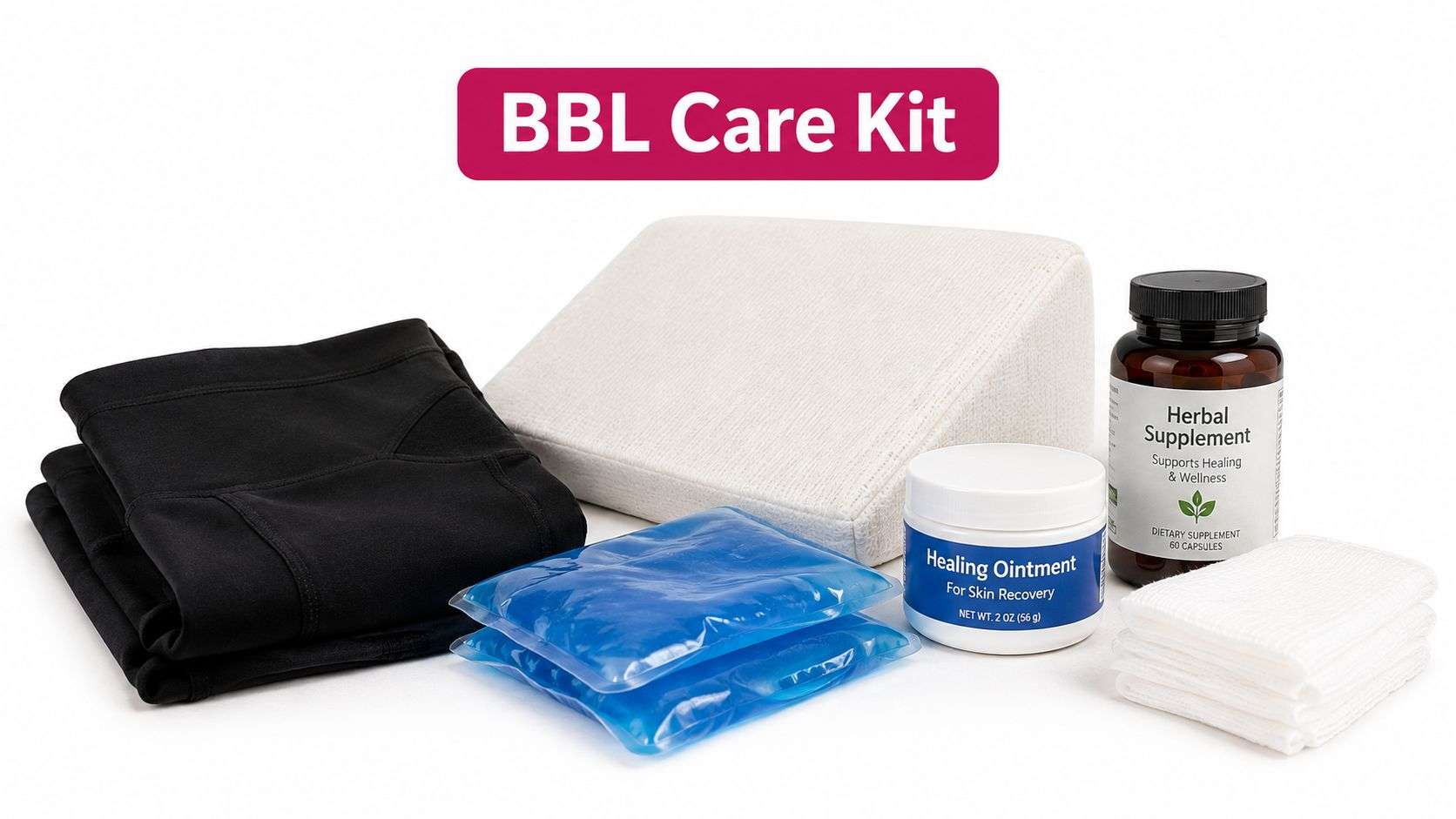
You've booked your surgery, the date is on the calendar, and now the excitement is sharing space with a more practical question: what is recovery going to feel like?
That's the right question to ask. A lift with implants is not the same recovery as a lift alone, and it isn't the same as augmentation alone either. You're healing both the skin tightening and reshaping from the lift, plus the internal settling and support demands that come with an implant. Patients usually do very well, but the smoothest recoveries happen when expectations are realistic from day one.
Table of Contents
- Preparing for Your Combined Procedure at Georgia Plastic
- The First 48 Hours Your Immediate Post-Op Care Plan
- Your Week-By-Week Breast Lift and Augmentation Recovery
- Essential Self-Care for a Smooth Recovery
- When to Call Us Navigating Potential Complications
- Long-Term Results Scar Care and Final Contours
- Frequently Asked Questions About Recovery
Preparing for Your Combined Procedure at Georgia Plastic
The work of recovery starts before surgery. If you prepare well, the first week feels organized instead of chaotic.

A combined procedure asks more of your body because the lift creates incisions that need to heal under tension, while the implant adds weight and internal pressure during early recovery. That's why the first priority is not comfort items. It's reducing avoidable strain.
Set up your recovery before surgery day
Get your home ready as if you'll want everything within arm's reach. Put medications, water, easy meals, pillows, gauze if instructed, lip balm, chargers, and loose front-opening clothing in one area. Move anything heavy off high shelves now. Don't assume you'll “be careful” later.
Plan your ride home and your first follow-up in advance. If a family member isn't available, some patients prefer reliable Atlanta car service options so they aren't scrambling for transportation while sore and groggy.
Arrange help for the right tasks
You don't need a crowd. You do need one dependable adult who can stay with you early, help you get up, keep track of medication timing, and stop you from doing too much because you feel “not that bad.”
Practical help matters most for:
- Children and pets: Lifting restrictions make childcare and dog handling harder than many patients expect.
- Meals and hydration: You'll recover better if food is simple and ready.
- Household chores: Laundry baskets, grocery bags, and reaching overhead are not worth the risk.
Practical rule: If an activity pulls on your chest, raises your elbows high, or makes you brace through your arms, set it aside.
Prepare mentally for a combined recovery
Patients often do best when they stop measuring progress by appearance in the first days. Early swelling, tightness, breast height, and asymmetry can all look strange before they look good. That's normal for this operation.
If you want a broader overview of how the two procedures work together, this guide to combining your breast lift and augmentation helps frame the recovery choices that follow.
The First 48 Hours Your Immediate Post-Op Care Plan
The first two days are about control. Control pain before it spikes, control swelling by positioning well, and control activity so you don't accidentally stress the repair.
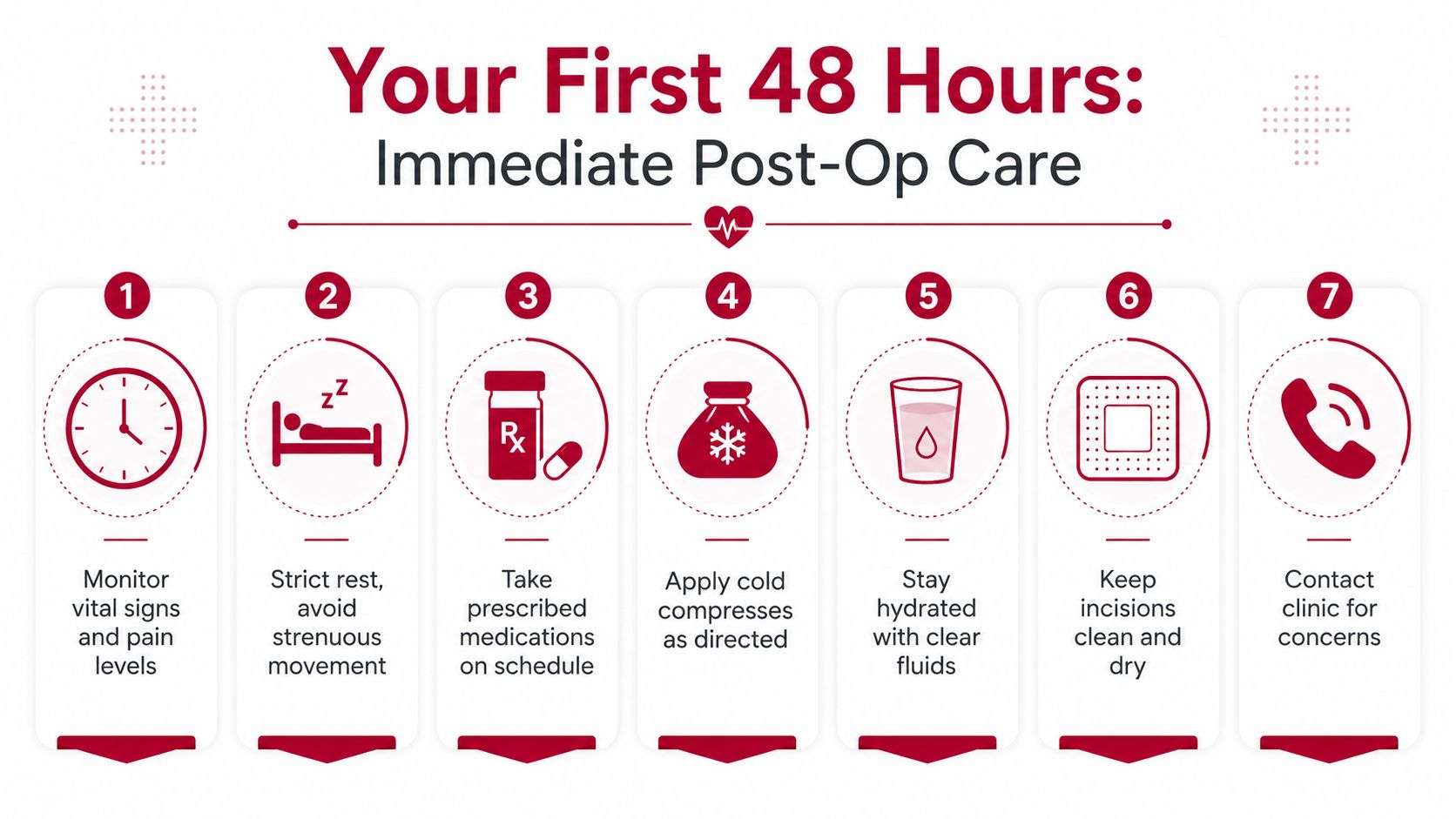
A prospective study on breast augmentation recovery found patients reported an average pain score of 5.9 on a 10-point scale, used prescription pain medication for an average of five days, and were off work for seven days on average, according to the American Society of Plastic Surgeons summary of the study. A combined lift and augmentation often feels more involved than augmentation alone because incision healing adds another layer of recovery.
When you first get home
You'll likely feel tired, tight through the chest, and less steady than usual. That's not the time to test your independence.
Do these first:
- Take medication on schedule: Don't wait for discomfort to build.
- Sip fluids regularly: Small, frequent hydration is easier than forcing a full meal.
- Rest upright or semi-reclined: This usually feels better than lying flat right away.
- Keep movement minimal but not zero: Short assisted walks to the bathroom or around the room are enough.
Your caregiver should stay focused on timing, not guessing. Missed doses, dehydration, and too much activity create unnecessary misery in the first night.
Positioning matters more than patients expect
Back sleeping is usually the easiest and safest position early on because it avoids pressure and twisting through the breasts. Many patients are more comfortable if they slightly support the knees and reduce lower back tension. If you're trying to make that position more sustainable, some patients optimize sleep with a knee pillow so they aren't fighting their setup all night.
Keep the first night simple. Medication, fluids, support bra, careful bathroom trips, and sleep. That's enough.
What's normal in the first two days
A lot can be normal without being pleasant. Expect some tightness, soreness, grogginess, swelling, bruising, and a firm or “high” look to the breasts. It's also common to feel emotionally up and down after anesthesia and surgery.
Use this quick check:
| What to focus on | What to do |
|---|---|
| Pain control | Stay ahead of discomfort with prescribed medication instructions |
| Swelling | Rest elevated and avoid unnecessary arm use |
| Incisions | Keep dressings clean and dry unless told otherwise |
| Mobility | Walk briefly and gently, then rest again |
| Energy | Expect fatigue and protect your sleep |
What doesn't work
Patients usually struggle when they do one of three things too early:
- Reaching and lifting: Even light household tasks can recruit the chest.
- Trying to feel “normal” quickly: That often leads to more swelling by evening.
- Skipping support: A reliable caregiver in this window is not optional.
Your Week-By-Week Breast Lift and Augmentation Recovery
You wake up one morning in week 2, look in the mirror, and wonder whether the breasts are too high, too firm, or slightly uneven. That concern is common after a lift with implants. Recovery after a combined procedure is less predictable than recovery after a lift alone or implants alone because two things are healing at once. The skin envelope is adjusting to the lift, and the implant pocket is settling underneath it.
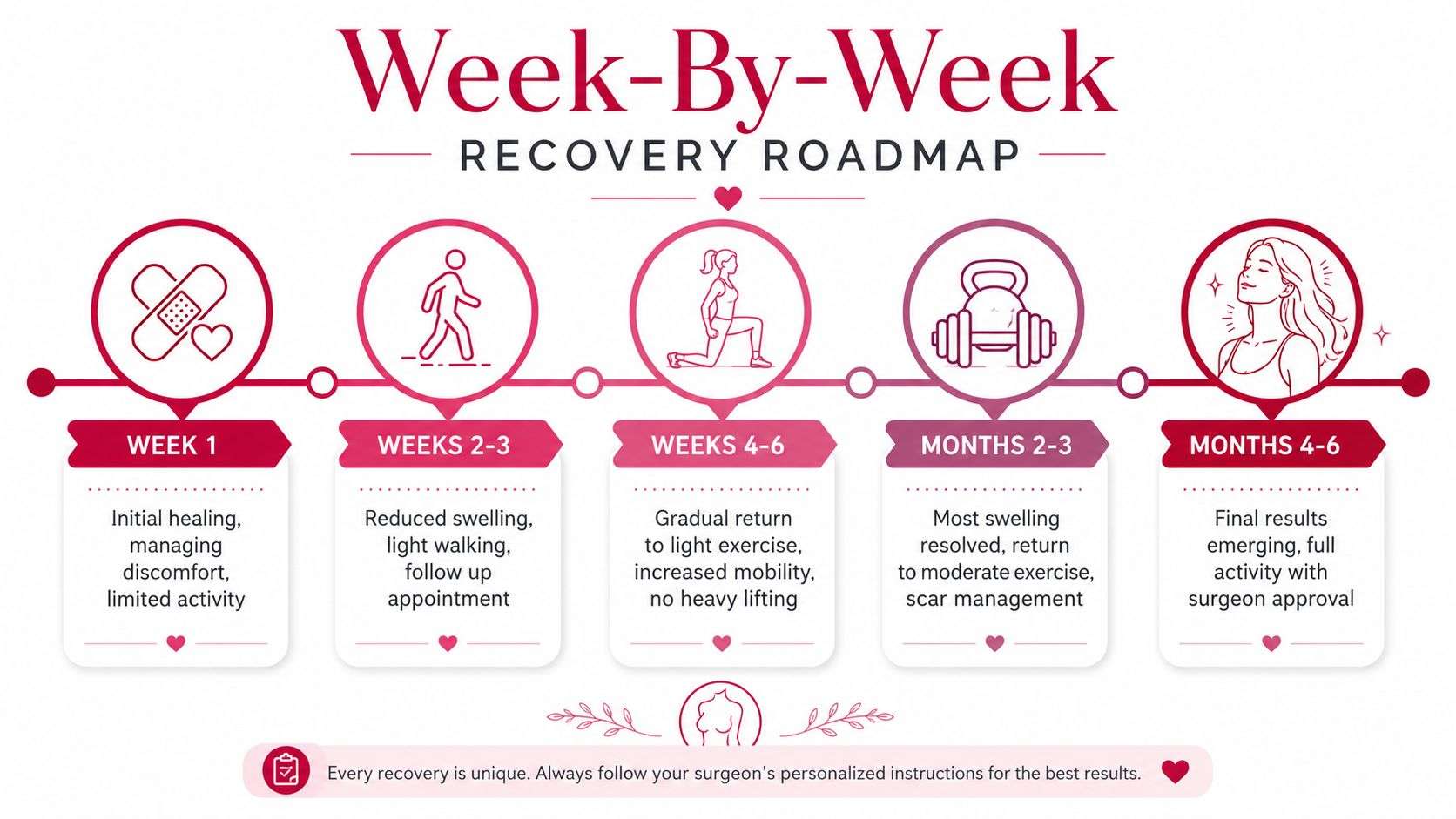
At Georgia Plastic, we prepare patients for that overlap from the start. A breast that looks high early on is not automatically a problem. A breast that feels tight does not mean the implant is in the wrong place. The right question each week is simple: does your healing match the stage you are in?
Week 1 Protect the lift and support the implant pocket
This week is about control. The lift incisions are fresh, swelling is active, and the implant pocket has not stabilized yet. That combination is why recovery rules are stricter than they are for either procedure by itself.
Expect the breasts to sit high on the chest and feel firm. The skin often looks tight, especially in the lower pole. Many patients also notice one side seems to settle differently from the other in the first several days.
Use these rules in week 1:
- Keep arm movement low and close. Reaching overhead, pulling doors, and pushing yourself up from bed all recruit the chest.
- Walk several times a day, but keep it brief. Gentle circulation helps. Long outings usually increase swelling.
- Wear the surgical bra exactly as directed. Do not switch to a sports bra or underwire bra unless we clear it.
- Protect your energy. A combined procedure often causes more fatigue than patients expect.
Weeks 2 to 4 More independence, with limits
This is the stage when patients start feeling better before the tissues are ready for normal activity. That gap matters. In my practice, preventable setbacks often occur. A patient returns to errands, carries groceries, reaches into the back seat, then calls because one breast feels more swollen by evening.
Many patients can return to desk work during this window if they are off prescription pain medication, commuting is manageable, and the job does not involve lifting or repeated upper-body motion. The American Society of Plastic Surgeons guidance on breast surgery recovery supports a gradual return to routine rather than a fast jump back to full activity.
What is usually normal in weeks 2 to 4:
- Swelling that is better in the morning and worse later in the day
- Nipples and lower breast skin that feel numb, sensitive, or both
- Breasts that still look somewhat boxy, high, or uneven
- Incisions that look pink or slightly raised as early scar formation begins
What patients should avoid:
- Heavy lifting
- Chest-focused exercise
- Long shopping trips or full cleaning days
- Testing range of motion because you feel almost normal
Some patients in this phase ask whether post-surgical lymphatic drainage massage after plastic surgery may help with swelling. It can be useful for selected patients, but timing matters. Do not book massage on your own without our clearance.
Weeks 4 to 6 Gradual activity, careful judgment
By now, bruising is usually fading and daily comfort is improving. The breasts often look better in clothing well before they look settled without a bra. That is especially true after a lift with implants, because the implant is dropping while the lifted skin and breast tissue are also relaxing.
Increase activity in a deliberate way. Lower-body exercise may be reasonable before upper-body exercise, but only if it does not make you brace through the chest. Fast transitions matter too. Jogging, jumping, and aggressive stretching can still irritate healing tissue even if you feel strong enough to do them.
A simple way to judge an activity is to ask what it does to your chest. If you have to tense, push, pull, or bounce, it is probably too early.
| Activity type | Better approach in this phase |
|---|---|
| Walking | Increase time gradually if swelling does not spike afterward |
| Lower-body exercise | Choose controlled movement, not impact |
| Upper-body effort | Wait for clearance before resistance work |
| Lifting | Keep it light and avoid any strain through the chest |
Months 2 to 6 Shape, softness, and scar changes
This is the part patients usually underestimate. You will see improvement long before you see the final result. The lifted breast skin continues to relax, implants continue to settle, and the lower portion of the breast develops a softer, more natural contour over time. A mastopexy with augmentation has to balance scar support, implant position, and tissue stretch. That is why final shape takes longer than many online timelines suggest.
By this stage, many patients say the breasts look less operated on and more like their own again. That shift happens in steps, not all at once. Fullness in the upper breast softens. The lower pole rounds out. Side-to-side differences usually become less noticeable.
Scar maturation also continues for months. If you are reading general wellness information about collagen for skin and joints, treat it as supportive reading only. Good protein intake, no nicotine exposure, incision protection, and surgeon-directed scar care do far more for healing.
If I give patients one piece of advice for this period, it is this: judge progress month to month, not day to day. That is the right pace for a combined breast lift and augmentation recovery.
Essential Self-Care for a Smooth Recovery
The hardest recovery day for many patients is not the first one. It is the day you feel good enough to do too much.
That pattern matters even more after a combined lift and augmentation. You are healing skin reshaping, internal pocket work, and implant settling at the same time. Patients who do best usually keep their routine simple, predictable, and a little boring for the first few weeks.
Pain and swelling management
Pain control starts with fewer triggers. Missed rest, long periods upright, overuse of the arms, dehydration, and salty takeout meals commonly lead to more tightness by evening.
Use a steady rhythm instead of testing your limits:
- Start the day slowly: Shower, dress, and eat before adding any extra activity.
- Build in rest periods: Lie back before you feel drained.
- Use your medication plan as prescribed: Do not wait until pain spikes.
- Drink water regularly: Small amounts through the day work better than trying to catch up at night.
Ice is only appropriate if your surgeon has approved it and shown you where it can be placed safely. Do not put pressure directly on the breasts or along the incisions.
Some patients also ask about nutrition support during healing. If you're looking at general wellness reading on collagen for skin and joints, treat it as supportive lifestyle information, not a substitute for protein intake, hydration, and surgeon-directed wound care.
Dressings garments and incision habits
Your surgical bra or recovery garment needs to fit the specific procedure you had. After a lift alone, support is the main job. After augmentation alone, the focus is often implant settling and pocket protection. After both procedures together, the garment has to support fresh incisions while also limiting excess implant motion. That is why we tell Georgia Plastic patients not to swap into a sports bra, bralette, or underwire bra just because the outside looks better.
Keep the garment clean. Wear it exactly as directed. If it rolls, digs, or rubs on an incision, call us rather than trying to fix the problem with padding, tape, or a different bra from your drawer.
The incision line usually does best when patients leave it alone, keep it dry as instructed, and resist checking it repeatedly in the mirror. If you've been advised to add supportive recovery measures later, some patients explore post-surgical lymphatic drainage massage only when their surgeon says the timing is appropriate.
Sleeping activity and daily movement
Sleep position affects swelling, soreness, and breast shape early on. Back sleeping with your upper body slightly raised is usually the safest setup. Side sleeping too soon can place uneven pressure on healing tissue and may be especially uncomfortable if the implant was placed under the chest muscle.
Recovery also feels different depending on implant position. Patients with implants under the muscle often report more tightness with reaching, rolling in bed, or standing up from a reclined position because the pectoralis muscle has to settle after surgery. Patients with implants above the muscle may feel less muscle-related discomfort, but the lift incisions still need protection, so the overall activity restrictions do not disappear.
The rule I give patients is simple. If an activity makes you brace through the chest, pull with the arms, or bounce the breasts, it is too early.
What usually works best:
- Keep elbows below shoulder level during the early phase
- Use your legs, not your arms, to stand whenever possible
- Choose short, easy walks instead of long errands or social outings
- Increase activity one step at a time, only if the last step caused no extra swelling or soreness
- Wait for clearance before yoga, running, strength training, swimming, or chest exercise
Patients often get into trouble with household tasks, not formal workouts. Laundry baskets, grocery bags, pushing a heavy door, lifting a child into a car seat, and wiping down counters can all strain the chest before it feels like “exercise.” During combined recovery, protecting the result often means doing less than you think you should for a little longer than you expected.
When to Call Us Navigating Potential Complications
Most combined breast lift and augmentation recoveries are straightforward. Still, this procedure carries more healing variables than augmentation alone because the lift adds skin and incision management on top of implant recovery.
Published data on combined mastopexy-augmentation reports 15 to 20% incidence of minor complications such as wound-healing delays, and patient satisfaction exceeds 90% when post-operative protocols are followed, according to this review of mastopexy-augmentation outcomes. Those facts should do two things at once. Reassure you that patients are usually happy with their results, and remind you that careful follow-through matters.
What's usually normal
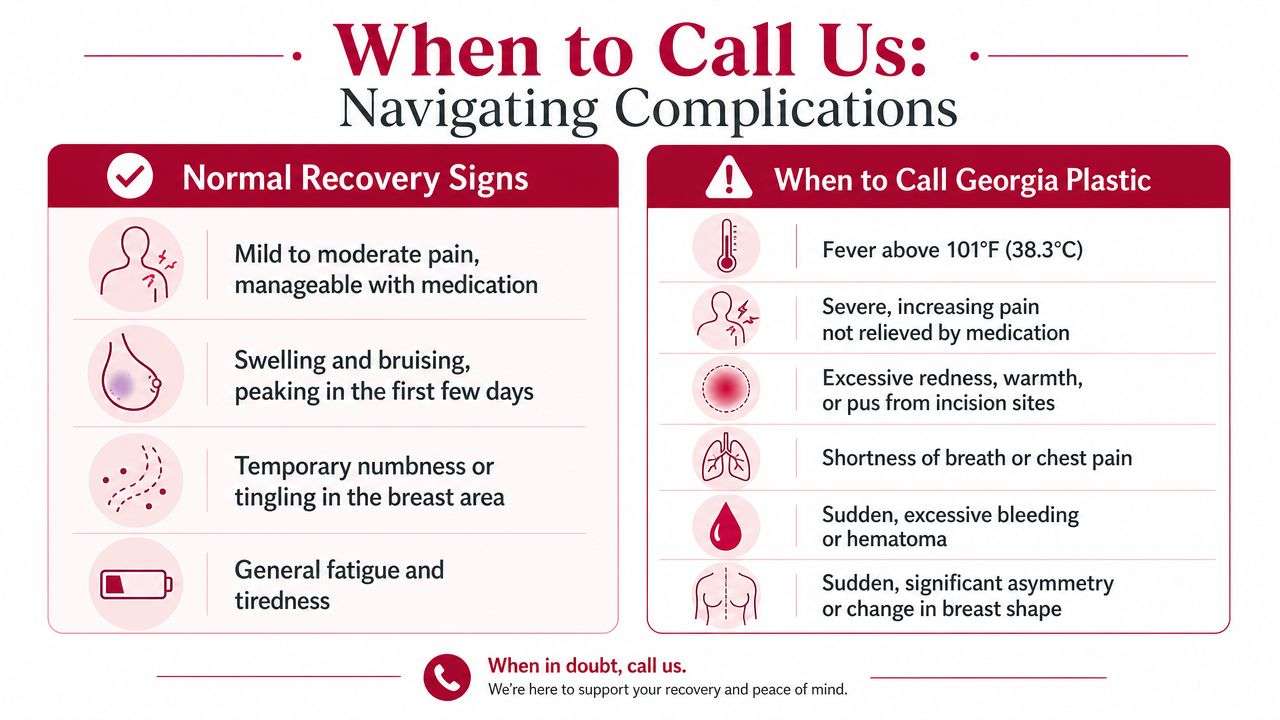
These signs are common in routine healing:
- Mild to moderate soreness: Especially with position changes
- Bruising and swelling: Often worse before it gets better
- Firmness or tightness: Very common early on
- Temporary numbness or tingling: Nerves often need time to settle
- Fatigue: Healing is work
Small side-to-side differences are also common while swelling resolves. Symmetry is judged over time, not during the first weeks.
What deserves a call
Call your surgical team if you notice:
- Fever above 101°F
- A sudden increase in pain that isn't improving
- Spreading redness, warmth, or drainage that looks concerning
- Shortness of breath or chest pain
- Sudden significant swelling on one side
- A rapid change in breast shape
If you want to understand one specific issue that can come up after surgery, this guide to postop seroma explains what fluid buildup can look like and why it should be assessed rather than guessed at home.
When something changes quickly, don't monitor it for days hoping it declares itself. Call.
Long-Term Results Scar Care and Final Contours
A common point in combined lift and augmentation recovery comes around the two- or three-month mark. You feel better, but the breasts still do not look fully settled. One side may sit a little higher. The lower pole may still look tight. Scars may look pinker than expected. That does not usually mean something is wrong. It means healing is still active.
Combined surgery takes longer to declare its final shape than augmentation alone, and for a simple reason. The implant has to settle while the lifted skin and breast tissue adapt around it. Those two processes do not always happen at the same speed. In our Georgia Plastic protocols, this is why we coach patients not to judge symmetry, softness, or cleavage too early. Early position is not final position.
How the breasts settle over time
Patients often hear the phrase drop and fluff. In plain terms, the implant gradually lowers into a more natural position while the breast tissue softens and rounds out over it. The timeline is measured in months, not weeks. The American Society of Plastic Surgeons describes breast shape and scars as evolving over time after surgery, with scars continuing to mature for many months after the operation (ASPS breast lift overview).
Combined cases can look deceptively "done" before they are settled. A breast can appear high and firm early on because the skin envelope was tightened during the lift. As swelling improves and the tissues relax, the contour usually looks less forced and more natural. Patients who had pregnancy-related stretching often notice this even more because the skin starts from a different baseline.
If I am counseling a patient in follow-up, I usually frame it this way. Watch the trend, not the day-to-day changes. Weekly changes are more meaningful than what you see in the mirror every morning.
Scar care that actually helps
Scar care starts with protecting the closure while it is still building strength. Products matter later. Tension and irritation matter first.
Once the incisions are fully closed and your surgeon clears you to begin scar treatment, the routine is usually straightforward:
- Use silicone consistently: Sheets or gel are both reasonable if you will use them as directed.
- Keep scars out of the sun: UV exposure can darken a healing scar and make color changes last longer.
- Massage only if cleared: Too much pressure, too soon, can irritate a scar instead of helping it.
- Wear the support you were told to wear: In combined surgery, support affects both scar tension and breast shape as the tissues settle.
Patients often ask which cream is best. Consistency beats variety. A simple plan followed for several months usually works better than switching products every two weeks.
Post-pregnancy patients often need more specific counseling here. Breast skin can be thinner, lower pole stretch can be greater, and nipple sensation questions are often more nuanced after pregnancy and breastfeeding. Those details should be addressed before surgery and revisited during follow-up, because recovery in that group is not always well covered by generic breast surgery advice.
Scars also change in phases. They usually look redder or firmer before they fade and flatten. Final contour and final scar appearance are among the slowest parts of recovery. Patience helps, but so does knowing what you are waiting for.
Frequently Asked Questions About Recovery
Why does combined recovery feel harder than augmentation alone
Because you're healing two things at once. The implant creates pressure and settling demands, while the lift adds incision healing and skin tension. That combination usually means more swelling management, stricter movement limits, and closer attention to support garments.
When can I buy new bras
Wait until swelling has settled enough that sizing is meaningful. Buying too early is one of the most common ways patients waste money. Start with supportive, non-underwire options unless your surgeon tells you otherwise.
Will nipple sensation feel different
It can. Temporary numbness, tingling, or hypersensitivity can all happen during healing. Improvement is often gradual, and post-pregnancy patients may have more questions here than standard recovery guides answer well.
What if one breast settles faster than the other
That's common. Breasts rarely heal in perfect sync. If the difference is gradual and not paired with pain, redness, or sudden swelling, it's usually part of the normal settling process.
If you're considering surgery or want a personalized recovery plan from consultation through final result, Georgia Plastic & Reconstructive Surgery offers in-person guidance, patient education, and follow-up support for breast lift and augmentation patients in Atlanta and Marietta.