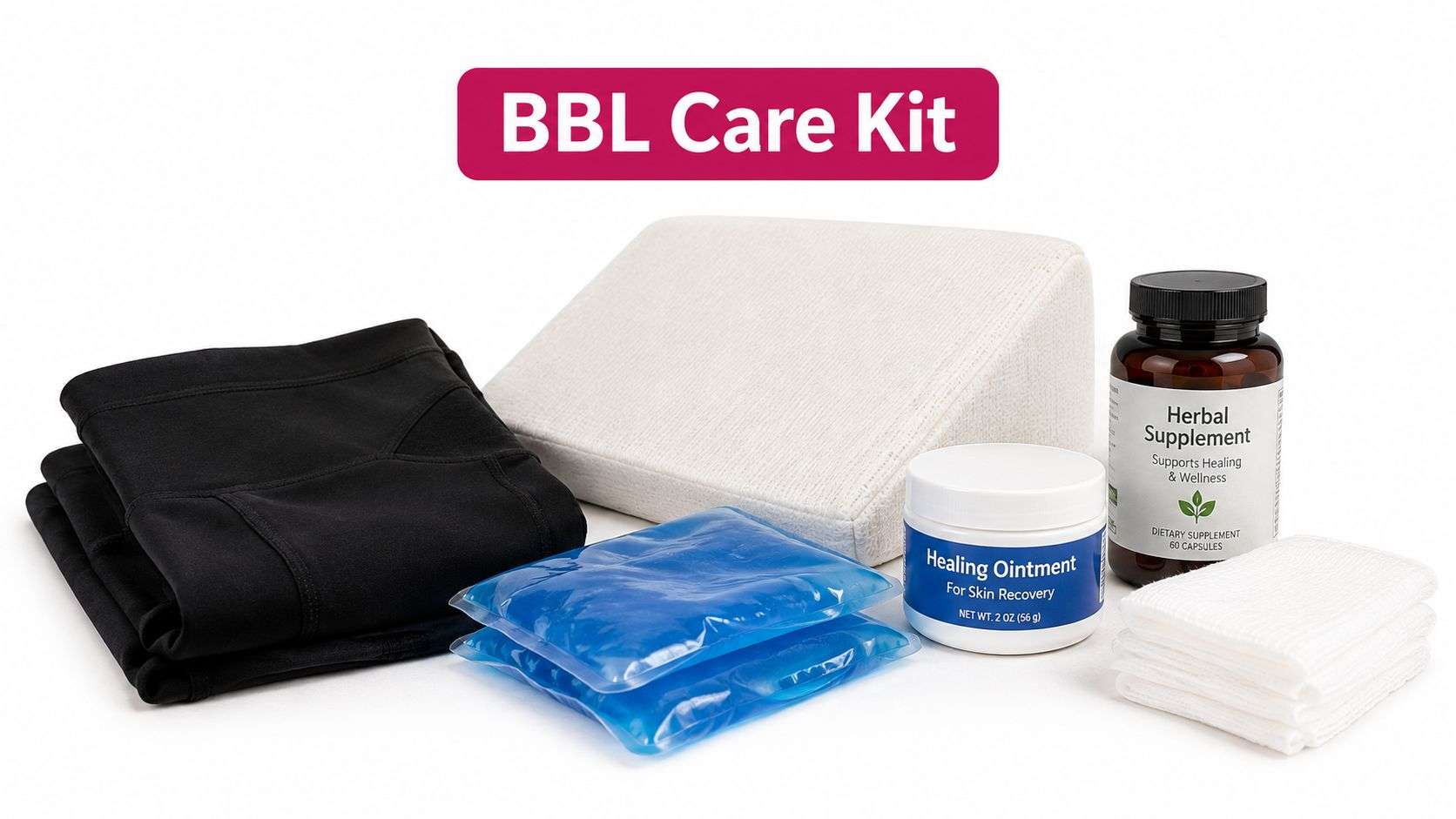
A lot of patients search for post surgery massages near me at the exact moment recovery starts to feel harder than they expected. The procedure is over, but now there's swelling, tightness, bruising, uneven firmness, and that nagging worry that one wrong move could affect the result. You may be a few days out from liposuction, a couple of weeks into breast surgery recovery, or staring at a healing tummy tuck incision wondering when massage is helpful and when it's too soon.
That concern is valid. Post-surgical massage isn't a spa add-on. It's a specific recovery tool that has to match your procedure, your incision status, and your surgeon's instructions. Start too aggressively, or with the wrong provider, and you can irritate healing tissue instead of helping it. Start at the right time, with the right technique, and patients often feel less swollen, more comfortable, and more confident about how healing is progressing.
If you're also recovering from abdominal contouring, this tummy tuck recovery guide gives helpful context for what swelling, posture changes, and early healing usually look like.
Table of Contents
- Your Guide to Post-Surgery Recovery and Massage
- Understanding Post-Surgery Massage and MLD
- The Proven Benefits of Post-Operative Massage
- When to Safely Start Massage After Your Procedure
- How to Choose a Qualified Post-Surgery Massage Therapist
- Find Vetted Post-Surgery Massage Experts in Atlanta
- Your First Session What to Expect and How to Prepare
Your Guide to Post-Surgery Recovery and Massage
A common recovery scenario goes like this. A patient feels reasonably prepared for surgery, but not for the days after. The area feels heavy. Swelling seems worse by evening. Clothing fits differently. The body looks uneven in places that were expected to look smoother. Then the search begins for post surgery massages near me, usually with one question behind it all. "Will this help, and is it safe for me right now?"
The right answer depends on more than the procedure name. It depends on whether your incisions are closed, whether fluid retention is expected, whether you're at risk for complications, and whether the person touching you understands surgical healing instead of general relaxation massage.
That's why recovery massage should be approached like part of your treatment plan, not a last-minute appointment based on a map search.
Practical rule: If a provider can't explain when massage is safe after your exact surgery, they aren't ready to treat a healing surgical patient.
Patients usually need clear guidance in four areas:
- Timing matters: The safest start date for massage after liposuction isn't automatically the right start date after a tummy tuck or facelift.
- Technique matters: Gentle lymphatic work and scar-focused treatment serve different purposes and happen at different points in recovery.
- Safety matters: Open wounds, active infection, fever, and clot concerns change what should happen, or stop treatment entirely.
- Provider training matters: A therapist who understands post-op swelling, fibrosis, seromas, and incision protection is very different from a therapist offering a generic spa service.
The goal is simple. Protect healing, reduce avoidable discomfort, and help your final result settle as smoothly as possible.
Understanding Post-Surgery Massage and MLD
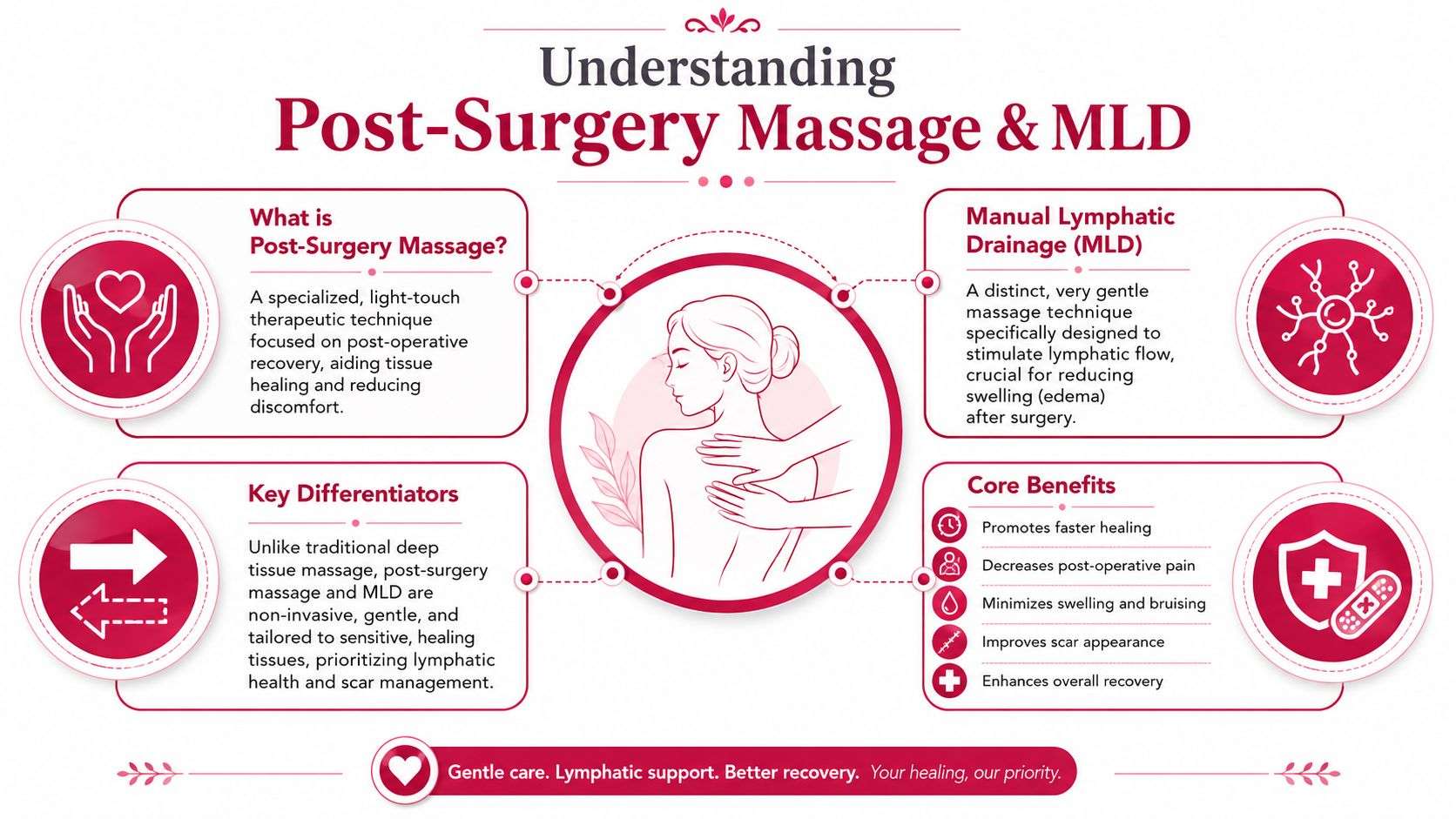
Post-surgical massage uses a very different mindset than standard massage. It doesn't aim to "work out knots" or loosen tight muscles with pressure. It works with tissue that is inflamed, vulnerable, and still organizing itself after surgery.
What post-surgical massage actually is
In practice, post-op massage usually refers to one or both of these approaches:
- Manual lymphatic drainage: Very light, directional strokes meant to encourage lymph fluid movement and reduce edema.
- Scar and soft tissue work: Introduced later, once healing allows it, to improve mobility in firm or tethered areas.
If you think about the body after surgery as a neighborhood under repair, traditional massage tries to move traffic quickly through crowded streets. Post-surgical massage first clears the detours and bottlenecks so normal flow can resume.
That distinction matters because a healing abdomen, breast, face, or flank doesn't respond well to force. Pressure that feels "productive" in a spa setting can be too much after surgery.
Why MLD is different
Manual lymphatic drainage, or MLD, is the technique most patients are really looking for when they search post surgery massages near me. It is gentle by design. The purpose is to help fluid move through the lymphatic system so swelling doesn't linger where tissue is already stressed.
A useful way to picture it is a slow-moving river. When branches and debris collect, water backs up. MLD doesn't pound the water forward. It gently opens pathways so fluid can move where it's supposed to go.
According to guidance on post-surgical timing and recovery, MLD may be introduced earlier than more direct abdominal massage in some cases, primarily to manage swelling and support circulation, but only after physician clearance. The same guidance notes that abdominal procedures such as tummy tucks or C-sections generally shouldn't start broader post-surgical massage until 4 to 6 weeks post-op, when acute inflammation has calmed and incisions are fully closed (post-surgical massage timing and precautions).
For patients who want a simple refresher on how the body is organized beneath the skin, this overview of foundational human anatomy for scientists gives useful context for understanding why light, directional work matters more than pressure.
The best post-op lymphatic session often feels almost too gentle. That's usually a sign the therapist understands the job.
The Proven Benefits of Post-Operative Massage
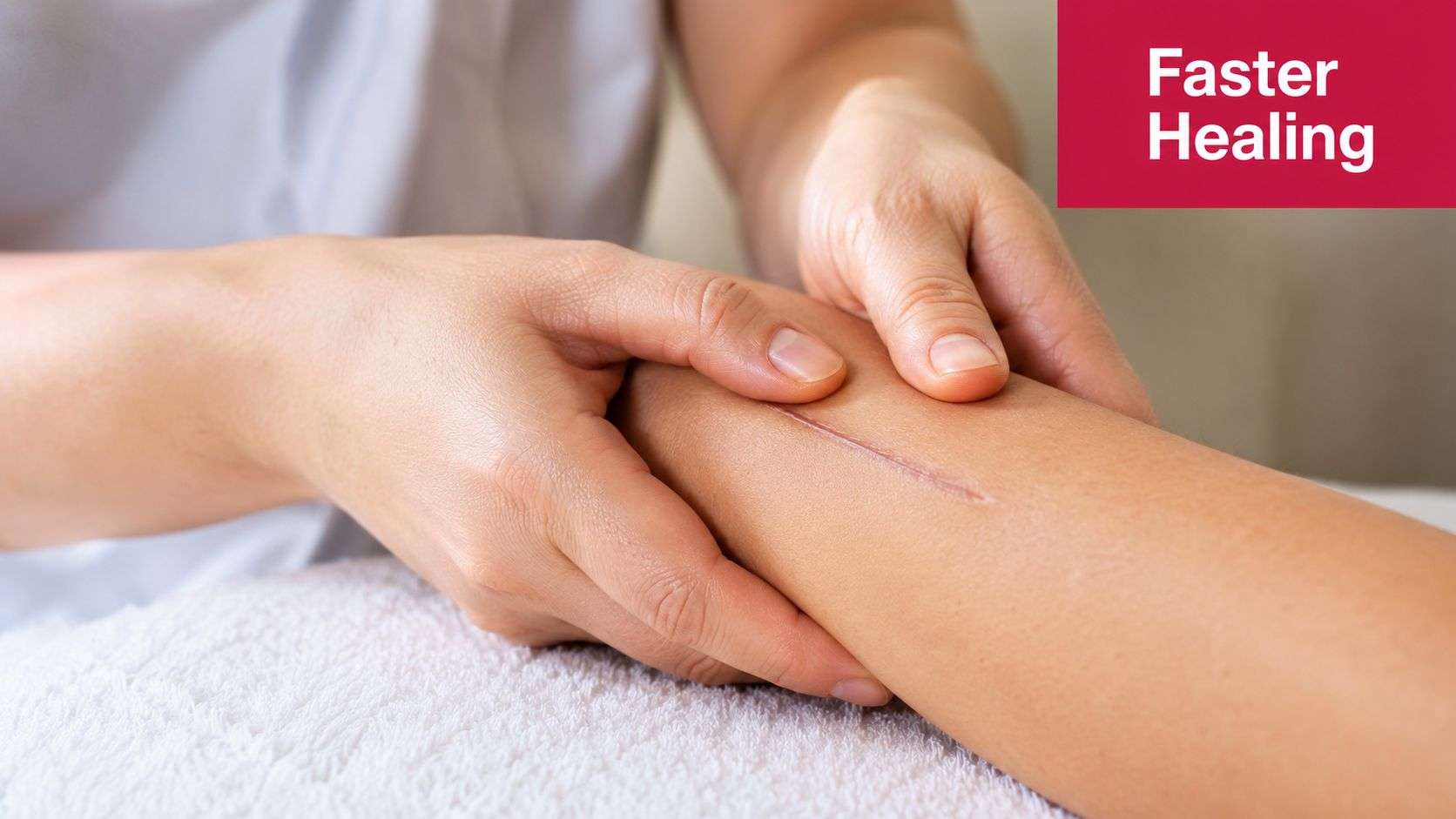
Patients often assume massage is mainly about comfort. Comfort matters, but the evidence points to something broader. Appropriate massage can support pain control, reduce anxiety, and make recovery feel less overwhelming.
Pain relief is the clearest benefit
The strongest data we have is on pain. An extensive meta-analysis of 33 randomized controlled trials found that massage therapy was highly effective in reducing postoperative pain, with a standardized mean difference of -1.32, and that benefit remained present in both short-term follow-up and assessments performed 4 to 6 weeks after the massage session (meta-analysis on postoperative pain reduction).
That finding matters because it answers a practical question patients ask every day. Is this just something that feels nice for an hour, or does it meaningfully help recovery? The data supports the second view.
Another pooled analysis of post-surgical interventions reported an overall standardized mean difference of -1.05 for pain intensity, and one randomized trial within that review found statistically significant short-term decreases in pain unpleasantness and anxiety in the massage group compared with control patients (pain and anxiety outcomes after surgery).
Recovery feels more manageable
Pain isn't the only issue after surgery. Patients also deal with tension, worry, disrupted sleep, and the stress of watching swelling fluctuate. That same clinical literature supports massage as a relatively safe, non-pharmacologic option for easing anxiety and improving how patients function during recovery.
In plain terms, people often cope better when the body feels less congested and less reactive.
That doesn't mean every wellness trend belongs in an immediate post-op plan. If you're curious about broader bodywork approaches outside the surgical window, this guide to CBD massage for wellness helps separate general wellness massage from medically timed recovery care.
A realistic expectation is important here. Massage won't replace compression, walking, wound care, or follow-up visits. It also won't fix a complication that needs medical treatment. What it can do is make the normal parts of recovery easier to tolerate and, in the right setting, support smoother healing.
- Less day-to-day discomfort: Patients often describe reduced tightness and pressure after gentle lymphatic work.
- Better tolerance of recovery routines: When swelling and soreness settle, compression garments and movement tend to feel more manageable.
- Support during an anxious period: Surgery recovery can be mentally draining, especially when appearance changes from day to day.
Good post-op massage doesn't fight the healing process. It reduces the friction around it.
When to Safely Start Massage After Your Procedure
The biggest mistake patients make is assuming there's one timeline for every surgery. There isn't. Safe timing changes based on the operation, where the incisions are, how much swelling is expected, and whether the tissue is still fragile.
The biggest red flag in local search results for post surgery massages near me is vague language like "start right away" without discussing incision closure or clot risk. Mayo Clinic recovery guidance specifically warns patients not to massage incisions, and to avoid working over open wounds or recent surgical incisions because of complication risk, including deep vein thrombosis concerns (Mayo guidance on massage precautions after surgery).
Recommended post-surgery massage timelines
| Surgical Procedure | Typical Start Time for MLD | Initial Recommended Frequency |
|---|---|---|
| Liposuction | After surgeon clearance, often earlier in recovery if incisions are appropriate for gentle lymphatic work | Often twice weekly at first after clearance |
| BBL | After surgeon clearance, with attention to positioning and protected transfer areas | Often twice weekly at first after clearance |
| Tummy tuck | Usually later than lipo. Broader abdominal massage is commonly delayed until incisions are fully closed | Individualized after clearance |
| C-section | Similar caution to tummy tuck. Abdominal tissue and incision healing come first | Individualized after clearance |
| Breast surgery | Varies by procedure and surgeon instructions | Individualized after clearance |
| Facelift or neck procedure | Depends on incision healing, swelling pattern, and surgeon protocol | Individualized after clearance |
Liposuction and BBL
These are the procedures most commonly associated with early lymphatic drainage. For cosmetic body contouring such as liposuction and BBL, guidance commonly starts with twice-weekly lymphatic drainage sessions for the first 2 to 3 weeks after clearance, then transitions to once weekly as swelling subsides. That same guidance is explicit that massage must never be performed over open wounds or areas with deep vein thrombosis risk without medical clearance (post-surgical frequency and contraindications).
That doesn't mean every lipo or BBL patient should start on the same day. It means these procedures often benefit from early, gentle, medically appropriate lymphatic work once the surgeon says the tissue is ready.
For BBL specifically, therapist positioning matters almost as much as timing. Any provider should know how to avoid unnecessary pressure on the grafted area and how to adapt the session to your restrictions for sitting and lying down.
Tummy tucks and C-sections
Abdominal surgery requires more restraint. General post-surgical massage for tummy tucks or C-sections is commonly delayed until 4 to 6 weeks post-op, once acute inflammation has gone down and the incision is fully closed. Earlier MLD may be appropriate in selected cases only to help with swelling and circulation, and only with physician clearance, as noted earlier in this article.
Patients often get conflicting messages online. A provider may advertise "immediate post-op massage" for every body procedure, but a healing abdominal incision changes the rules. If there is tension on the closure, drainage, redness, or delayed healing, more hands-on work is not better.
If you're dealing with swelling pockets or fluid concerns, it helps to understand the difference between normal fullness and a problem that needs assessment. This overview of post-op seroma signs and management is a useful reference.
Breast surgery
Breast procedures vary. Augmentation, reduction, lift, and reconstruction each create different swelling patterns and incision locations. Some patients can start gentle work sooner than they expect, while others need a longer pause because the breast pocket, lower pole, or incision line is still too reactive.
What matters most is what the therapist plans to touch and what they plan to avoid. Early sessions may focus on nearby drainage pathways and upper body congestion rather than direct work over healing surgical sites.
If a therapist treats breast surgery, they should ask where every incision is before they ask you to get on the table.
Facelift and neck procedures
Face and neck surgery creates its own recovery logic. The tissue is delicate, visible, and easily irritated. Gentle lymphatic work may help selected patients with facial puffiness and tightness, but only if the therapist understands facial incision patterns, drain sites, skin sensitivity, and how to avoid traction on healing tissue.
Deep massage has no role early on here. Neither does routine "sculpting" pressure. If a provider uses those terms during the early healing phase, that's a reason to pause.
How to Choose a Qualified Post-Surgery Massage Therapist
The hardest part of the search isn't finding someone who offers post-op massage. It's finding someone who understands it. Many listings use the right words. Far fewer show the right training, judgment, and restraint.
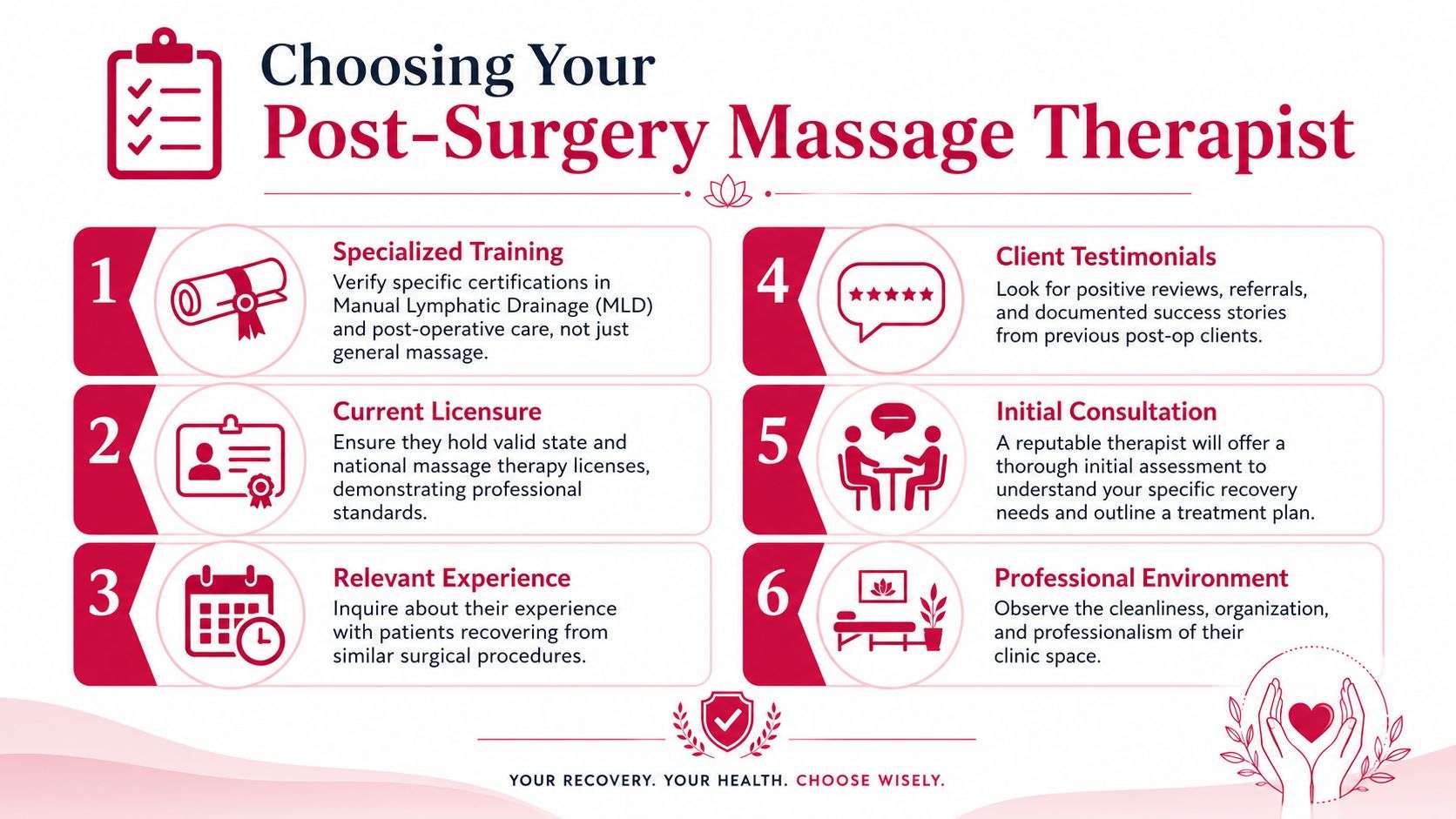
A documented gap in this space is the lack of standardized credential verification. Patients need to look for specific certifications in MLD or surgical recovery, because general "lymphatic massage" at a spa is not the same as the medical-grade therapy used to safely address fibrosis or seromas after surgery (credential gap in post-op massage care).
What credentials matter
Start with training that is specific, not implied.
- MLD education: Ask whether the therapist has formal training in manual lymphatic drainage rather than general massage with a lymphatic label.
- Post-surgical experience: A therapist should be able to describe work with patients recovering from your type of procedure, not just body massage in general.
- Current licensure: State licensure matters, but it isn't enough by itself. It tells you someone can practice massage. It doesn't confirm surgical recovery expertise.
- Clinical communication: The therapist should be comfortable following surgeon restrictions and pausing treatment if symptoms change.
A qualified provider should also understand what not to do. They should avoid open wounds, active infection, fever, areas with suspected clot risk, and any pressure that threatens healing tissue.
Questions worth asking before you book
The right questions expose the difference between a specialist and a generic provider very quickly.
- What training have you had in manual lymphatic drainage and post-operative care?
- How often do you treat patients recovering from my specific surgery?
- When would you refuse treatment or send a patient back to their surgeon?
- Will you avoid direct work over incisions, drains, or areas that aren't fully healed?
- How do you adjust treatment for fibrosis, swelling, tenderness, or asymmetry during recovery?
Listen closely to the tone of the answers. Skilled therapists are usually careful, not flashy. They talk about clearance, precautions, healing stages, and contraindications. They don't promise dramatic reshaping in a single session.
You should also notice the setup before any hands-on care begins:
- Clean environment: The room should feel clinical and organized, not improvised.
- Clear intake process: They should ask about procedure date, surgeon instructions, medications, wound status, and current symptoms.
- Realistic planning: Good providers explain that recovery changes week by week, so treatment should too.
A trustworthy post-op therapist will never be offended by detailed safety questions. They expect them.
Find Vetted Post-Surgery Massage Experts in Atlanta
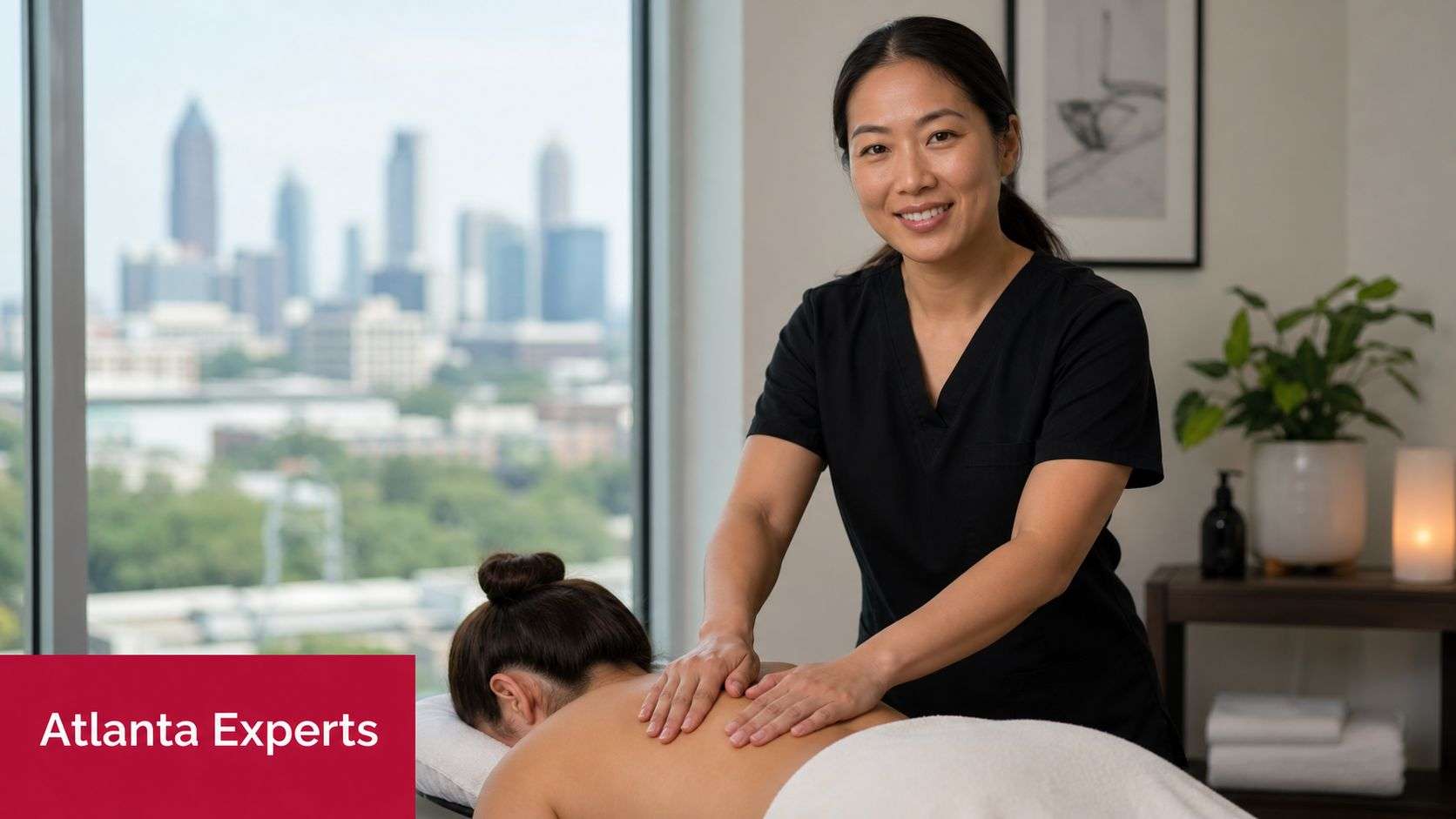
If you're in the Atlanta area, the safest option is often a provider connected to surgical care rather than a general wellness setting. That setup makes communication easier, keeps recovery protocols consistent, and reduces the chance that someone improvises around a healing incision.
Why integrated care matters
When a massage therapist works inside a plastic surgery environment, they're more likely to understand the practical details that shape recovery. That includes compression requirements, drain considerations, surgeon restrictions, scar timing, positioning after BBL, and the difference between expected swelling and symptoms that should be escalated.
Georgia Plastic & Reconstructive Surgery includes on-site post-operative support through AmaChi MedSpa, where patients can seek services such as manual lymphatic drainage and scar massage within a surgical practice setting. That kind of integrated setup can make recovery coordination more straightforward for patients who want massage care that aligns with their procedure and follow-up plan.
Atlanta and Marietta locations
For local patients searching post surgery massages near me, there are two practice locations associated with the surgical team and medspa setting:
- Atlanta: 6125 Roswell Rd, Atlanta, GA 30328
- Marietta: 2285 Asquith Ave SW, Marietta, GA 30008
This type of option makes sense for patients who don't want to guess whether a therapist understands cosmetic recovery. It also helps when questions come up mid-recovery and the care team needs to be on the same page about what's normal, what needs observation, and what should wait.
If you're comparing local providers, keep the standard high. Ask who trained them, what procedures they routinely support, whether they follow surgeon restrictions, and how they handle complications or red flags. The closer massage care is to the medical realities of your procedure, the safer and more useful it usually is.
Your First Session What to Expect and How to Prepare
Most first sessions are much gentler than patients expect. That's a good thing. The therapist should review your procedure, confirm your clearance, look at where incisions are located, and ask about symptoms such as swelling, firmness, tenderness, drainage, or unusual redness.
What the appointment usually feels like
During the session, the touch should be light and deliberate. In early recovery, the therapist may work around the surgical area more than directly on it. The goal is to encourage fluid movement, not to push hard into sore tissue.
You shouldn't expect a deep massage, aggressive kneading, or pain that feels like "breaking things up." If the session feels rough, that's a problem, not a sign that it's working.
How to prepare well
A few simple steps make the visit easier and safer:
- Bring instructions: If your surgeon gave timeline or positioning restrictions, share them.
- Wear loose clothing: You don't want anything tight or difficult to remove over sore areas.
- Stay hydrated: It helps you feel better before and after the appointment.
- Keep compression guidance clear: If you're using garments, ask when to remove and replace them.
- Plan a calm rest of day: Don't book a strenuous schedule right after your first session.
If you're still getting used to recovery garments, this post-operative shapewear guide can help you understand how compression fits into the bigger picture.
After the session, mild tenderness can happen, but worsening pain, increasing redness, drainage, or feeling unwell should prompt a call to your surgical team. Good post-op massage promotes healing. It should never create new problems.
If you're recovering from a cosmetic or reconstructive procedure and want guidance that matches your surgery and healing stage, Georgia Plastic & Reconstructive Surgery offers patient education, consultations, and post-operative recovery support to help you make safe decisions about massage timing, compression, and follow-up care.