You may be trying to make a decision while the cancer treatment plan is still taking shape. Perhaps your surgeon has mentioned an implant, a flap, or waiting until later, and each option seems to lead to a different set of questions. That uncertainty is understandable. Breast reconstruction isn't a single operation with one right answer; it's a plan that has to fit your cancer care, your body, and what matters to you.
The main breast reconstruction types are implant-based reconstruction, autologous reconstruction using your own tissue, and combined procedures. Timing is another choice within that framework: reconstruction can happen during mastectomy or be delayed. The right path depends on how those choices interact, including whether radiation is planned and what recovery you can take on.
Table of Contents
- The First Fork in the Road
- How Implant-Based Reconstruction Works Step by Step
- Autologous Flap Procedures Compared by Donor Site
- What Recovery and Long-Term Results Feel Like
- Fat Grafting and Oncoplastic Techniques as Standalone Options
- Why the Type Decision Is Really About Trade-Offs
- A Decision Framework You Can Walk Into a Consultation With
- Preparing for the Consultation and Knowing What Comes Next
The First Fork in the Road
In a consultation, the first question may be whether to reconstruct during mastectomy or wait. Immediate reconstruction begins in the same operation as the mastectomy, while delayed reconstruction takes place later, sometimes months or years afterward. Neither timing is automatically better. Your cancer treatment plan, health, preferences, and the care team's advice all matter.
Radiation is especially important to discuss early. If your team expects post-mastectomy radiation, ask how it could affect the skin and tissues used for reconstruction, and whether the plan would change if radiation becomes necessary after surgery. Delaying reconstruction can preserve flexibility when treatment plans are uncertain; it isn't a sign that reconstruction has failed or that you've missed your chance. For an overview of when breast reconstruction may be a good idea, consider the potential timing choices alongside your oncology team's recommendations.

Think of the choices as branches
After timing, the plan branches by how the breast is rebuilt:
- Implant-based reconstruction uses a saline or silicone implant, often after a temporary tissue expander stretches the chest skin.
- Autologous reconstruction transfers tissue from another area of your body, such as the abdomen, back, thighs, or buttocks.
- Combined reconstruction pairs an implant with transferred tissue when added volume or coverage is needed.
These approaches can be immediate or delayed. The central question isn't which technique sounds appealing. It's how the technique fits your cancer care, available donor tissue, healing considerations, and preferences about surgery and future care.
Bring questions about radiation timing, recovery, possible additional operations, and appearance goals to the first appointment. Your surgeon should explain how a recommendation could change if the treatment plan changes. The best starting point is a conversation about your body and cancer plan, not a contest between procedure names.
How Implant-Based Reconstruction Works Step by Step
If your surgeon recommends a temporary expander during mastectomy, you may wonder why the permanent implant has to wait. The answer starts with healing: the remaining chest skin needs time to recover and stretch before it can accommodate the planned breast volume.
From expander to implant
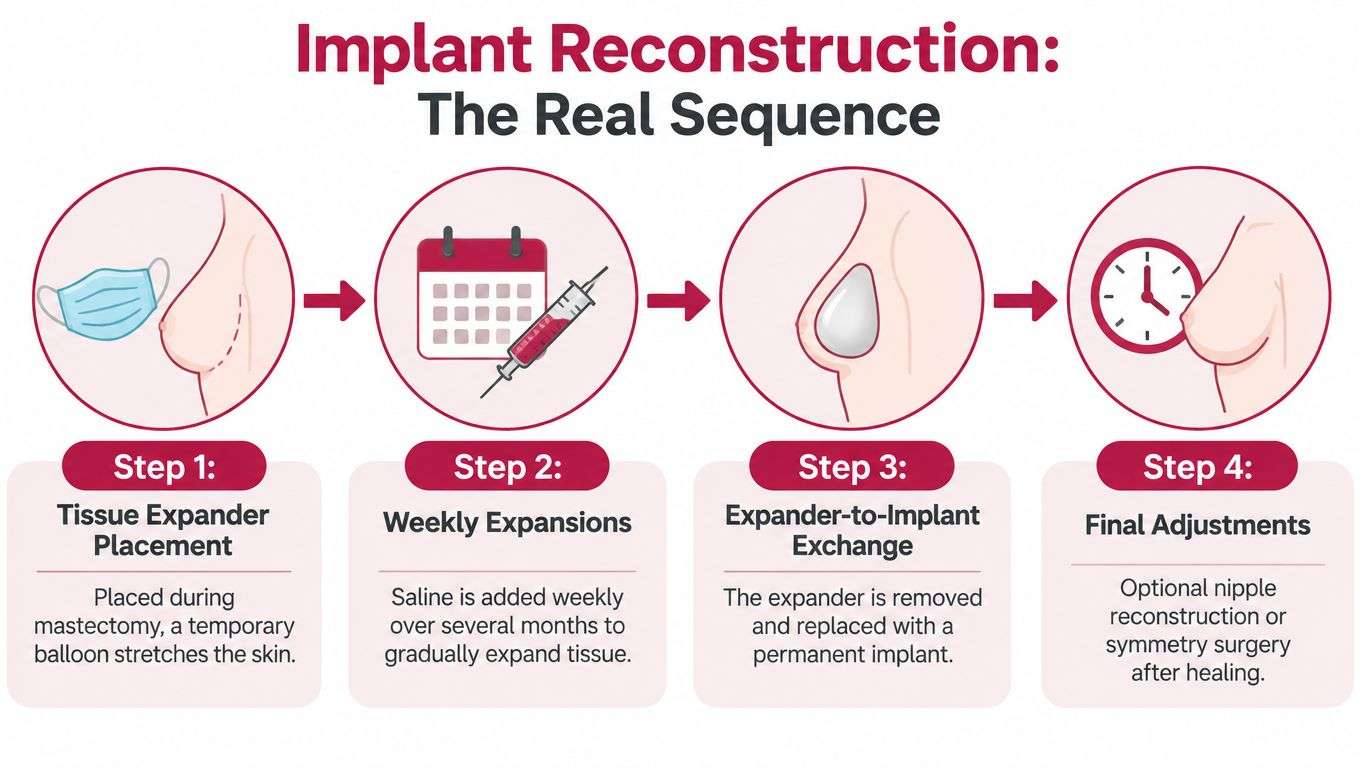
During mastectomy, a surgeon may place a tissue expander beneath the chest skin. It works like an adjustable placeholder, creating room gradually as the tissues heal. The care team adds saline during office visits, with the schedule adjusted to your healing and treatment plan.
Expansion and healing guide the next step.
Once the skin has stretched and the tissues have healed enough, the expander is typically exchanged for a permanent saline or silicone implant after approximately two to six months, although your treatment plan may change that timing. The National Cancer Institute's breast reconstruction overview explains the use of expanders and implants. The exchange requires another operation. Later procedures may address symmetry or reconstruct the nipple, depending on your appearance priorities.
Some patients can receive an implant during mastectomy without an expander. Your surgeon assesses whether the skin condition and cancer treatment plan support that approach.
A pathway that needs follow-up
Choosing implants means considering both the initial reconstruction and future care. Radiation exposure, tissue quality, desired size, and available donor tissue help determine whether an implant-based approach fits your circumstances. Your willingness to undergo later operations also matters, particularly if achieving your preferred shape or symmetry could require adjustments.
Implant complications can develop over time, and further surgery may be needed for capsular contracture, rupture, pain, asymmetry, or implant removal. Capsular contracture describes tightening of the scar tissue around the implant. Ask what follow-up and surveillance your implant would require, and how the plan could change if problems arise.
A comparison of saline and silicone breast implants can help you discuss implant material with your surgeon. Consider that choice alongside the condition of your chest tissues, your appearance goals, and the follow-up you're prepared to maintain.
Autologous Flap Procedures Compared by Donor Site
A flap reconstruction moves your own tissue to the chest, and the donor site shapes the experience. The surgeon considers the amount and quality of available tissue, prior operations, the effect on that area, and whether the tissue transfer can meet your reconstruction goals.
| Flap Type | Donor Site | Muscle Impact | Best Fit |
|---|---|---|---|
| DIEP | Lower abdomen | Uses skin and fat while preserving abdominal muscle | Someone with suitable lower-abdominal tissue who wants to avoid sacrificing abdominal muscle |
| TRAM | Lower abdomen | Uses some rectus abdominal muscle along with tissue | Someone for whom a TRAM approach fits the anatomy and available surgical expertise |
| LAT | Back, using latissimus dorsi tissue | Uses back muscle; an implant may be added for volume | Someone who needs reliable back tissue or added coverage, including in a combined approach |
Donor-site trade-offs
A DIEP flap can be a fit when there's enough lower-belly tissue to create the desired breast volume. Preserving the abdominal muscle doesn't mean the donor site has no consequences: the abdomen still needs to heal, and the surgeon will discuss the scar and recovery. Previous abdominal operations can affect which options are feasible.
A TRAM flap uses some abdominal muscle, so the surgeon needs to discuss possible effects at the donor site as well as the breast reconstruction. It may remain an option where the approach suits the patient and the required microsurgical expertise isn't available. A LAT flap uses tissue from the back and may be paired with an implant when the transferred tissue alone won't provide enough volume.
Ask about both sides of the operation: Where will the tissue come from, what will that area look and feel like afterward, and what activities may be affected during recovery?
Radiation can shift the balance toward considering tissue from elsewhere, because healthy transferred tissue may replace chest skin and soft tissue affected by radiation. That doesn't automatically make a flap the right choice. Your surgeon needs to assess your anatomy, treatment sequence, and willingness to have a longer tissue-transfer operation and donor-site healing.
What Recovery and Long-Term Results Feel Like
A patient preparing for a right-sided mastectomy and a DIEP flap asks whether she'll be able to get out of bed and manage household tasks afterward. Her lower abdomen has suitable tissue, but choosing a reconstruction also means planning for recovery. This hypothetical example shows why practical questions belong alongside discussions about breast shape.
Recovery includes the donor site
After a flap operation, both the breast and the area where tissue was taken need to heal. Recovery is like tending two repair sites: feeling comfortable at one doesn't mean the other is ready for the same activity. Early care includes checks of the reconstructed tissue and surgical wounds, along with instructions for movement and wound care. Abdominal healing may affect getting out of bed, standing upright comfortably, and returning to routines differently from an implant procedure.
The pace varies from patient to patient.
Ask your team which movements to limit, what help you'll need at home, and how drains and follow-up will be managed. Make those questions concrete: who will help with meals, cleaning, or tasks that involve reaching and lifting? For a personal perspective on changing everyday routines, Maid in America shares a personal cleaning reflection about breast cancer. It can prompt practical conversations about support, rather than predict your medical recovery.

The result can keep changing
A flap is living tissue, so the reconstructed breast can change with weight fluctuation and aging. It may feel and move differently from an implant, and a perfect match with the other breast isn't guaranteed. Ask how sensation, swelling, and donor-site strength are expected to evolve during your recovery, and which changes should prompt a call.
Appearance and physical recovery deserve separate conversations. A planned revision may refine shape or symmetry, while a medically needed operation treats a complication. Ask which additional procedures your surgeon anticipates, what each would address, and how they fit around healing and your priorities. Knowing that distinction helps you understand whether a future operation is an optional refinement or treatment your team recommends for a problem.
Fat Grafting and Oncoplastic Techniques as Standalone Options
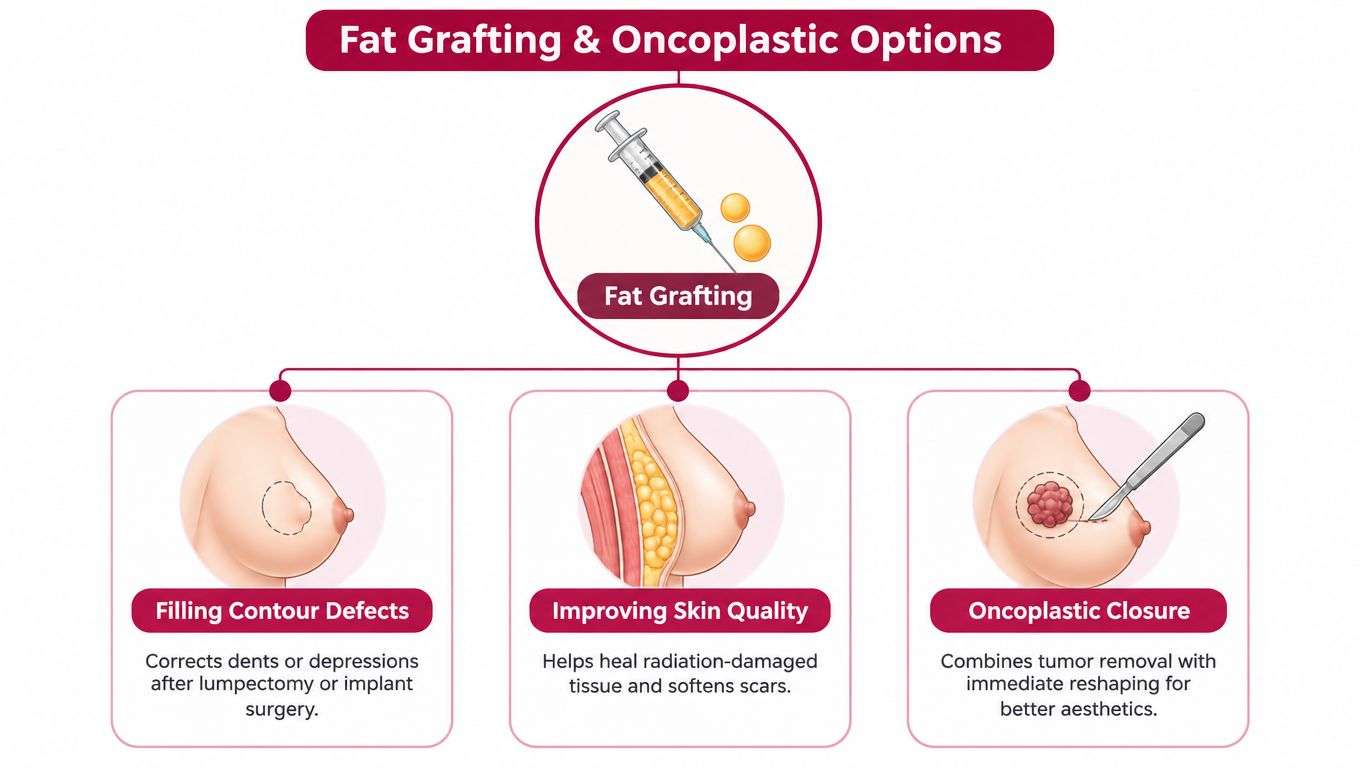
A small hollow after breast-conserving surgery may call for a different approach than rebuilding an entire breast. Fat grafting uses fat collected from another part of the body, purified, and injected into the breast. It can fill a contour gap, refine an existing reconstruction, or provide volume as a primary approach for selected patients. The choice depends on what needs replacing and how much donor fat is available.
Refinement and reshaping
Fat grafting works like filling a shallow depression rather than rebuilding the whole structure. It can soften an uneven contour or address a small volume difference, including around an implant or flap.
The receiving tissue matters as much as the donor fat. Ask how tissue quality, including changes related to radiation, affects whether grafting suits your situation. Some patients need staged treatment, so a modest correction may still involve more than one procedure. Your surgeon should explain the correction they expect and how they would assess healing before further treatment.
Fat transfer has limits: it isn't a reliable way to create dramatic volume or substantially reshape a breast by itself. A guide to breast fat transfer can help you prepare questions about donor-fat availability and realistic appearance goals.
Oncoplastic surgery during lumpectomy
Oncoplastic techniques combine tumor removal with rearrangement of the remaining breast tissue to preserve or improve shape. Here, the surgeon reshapes tissue already in the breast. These techniques accompany breast-conserving surgery and cannot replace full breast reconstruction after mastectomy.
Tumor location and the amount of tissue removed help determine whether reshaping is possible during the same operation.
For patients with larger breasts, the discussion may also include implant reconstruction when breast replacement is needed. Breast size alone doesn't settle that choice. Ask whether your treatment plan calls for reshaping remaining tissue, adding limited volume, or rebuilding the breast, and how planned radiation affects that recommendation.
Why the Type Decision Is Really About Trade-Offs
A useful consultation starts with what you need reconstruction to do, which trade-offs you can accept, and how cancer treatment may change the plan. Healing sets the boundaries: radiation can affect tissue quality, while available donor tissue influences what a flap can provide. Your priorities help shape the choice within those boundaries.
Appearance goals deserve specific conversation. Discuss scars, nipple sensation, breast movement, contour irregularities, symmetry, and donor-site appearance. Reconstruction is like tailoring: matching volume is only part of achieving a balanced result. Your surgeon should explain what is achievable, what may remain different, and how those differences may affect body image and sexual well-being.
Try this question: “What would you recommend if my main priority were fewer future surgeries, and how would your recommendation change if my priority were using my own tissue?”
The sequence of operations also matters.
With implant reconstruction, discuss whether a later stage could include a symmetry procedure on the other breast, and whether that would fit your appearance goals. Combining planned adjustments may appeal to you, but the schedule must account for healing and cancer treatment. Avoiding a donor-site operation comes with accepting ongoing implant care. Using your own tissue means accepting a more extensive operation and healing at the donor site. A combined approach may meet needs neither method addresses alone.
Perfect symmetry or restored sensation cannot be promised. Be direct about whether you value movement, volume, balance with the other breast, or going without reconstruction. These preferences deserve equal respect; the plan should reflect how you weigh them.
A Decision Framework You Can Walk Into a Consultation With
Use four questions to organize the conversation. This isn't a scoring system. It's a way to see how one answer may change the practical fit of an option.
- What is the radiation plan? Ask whether radiation is expected, when it would occur, and how the surgeon would adjust the reconstruction if the plan changes. If treatment remains uncertain, ask whether delaying reconstruction would preserve flexibility.
- What donor tissue is available? Discuss your abdomen, back, thighs, or other possible donor areas, including scars and prior operations. If there's limited donor tissue, ask whether an implant or combined procedure better fits your goals.
- What recovery can you take on? Compare the demands of an implant pathway with a tissue-transfer operation and donor-site healing. Consider work, caregiving, mobility, and the help you'll have at home.
- How do you feel about future maintenance? Ask what follow-up an implant may need, what revisions may be considered after a flap, and how the team would respond if a complication or change in shape occurs.
Ask for the alternative plan: “If radiation is added later, what would you change? If this reconstruction doesn't heal or look as expected, what would the next option be?”
Prior abdominal surgery, very low body fat, uncontrolled diabetes, or active smoking may complicate the options or timing. These factors don't automatically rule out reconstruction, but they deserve a careful individual assessment. If recommendations differ sharply between implant and flap approaches, reviewing your breast cancer diagnosis can be one part of seeking clarity about the treatment plan before finalizing reconstruction.
Ask how often the surgeon performs the specific procedure being proposed and whether a microsurgical specialist should be involved. A useful recommendation explains not only why an option fits, but also what would make the team reconsider it.
Preparing for the Consultation and Knowing What Comes Next
Bring the records that help your surgeons understand both the cancer plan and your anatomy: pathology results, relevant imaging, and notes from your oncology team. Tell the reconstructive surgeon what matters most to you, including your concerns about scars, sensation, symmetry, recovery, and possible future procedures.
Ask direct questions:
- Experience: How often do you perform this specific reconstruction?
- Trade-offs: What are the main risks for me, and what would prompt another operation?
- Timing: How would your recommendation change if radiation is needed?
- Finishing steps: When might nipple reconstruction or fat grafting be considered?
- Support: What help should I arrange during recovery, especially if tissue will be taken from another body area?
Consider a second opinion if you receive conflicting recommendations, don't have a clear plan for coordinating reconstruction with radiation, or feel pressured to decide before your questions are answered. Before scheduling, confirm insurance coverage and ask the office what appointments, preparation, or home support you'll need. A clear plan should leave you understanding the next step and why it fits your situation.
Georgia Plastic & Reconstructive Surgery provides breast reconstruction consultations and patient education in Atlanta and Marietta, with recovery guidance to help you understand the choices and planning involved. If you'd like to discuss how implant, flap, or combined approaches may fit your needs, visit Georgia Plastic & Reconstructive Surgery.