What Is Fat Transfer Breast Augmentation? A Quick Answer
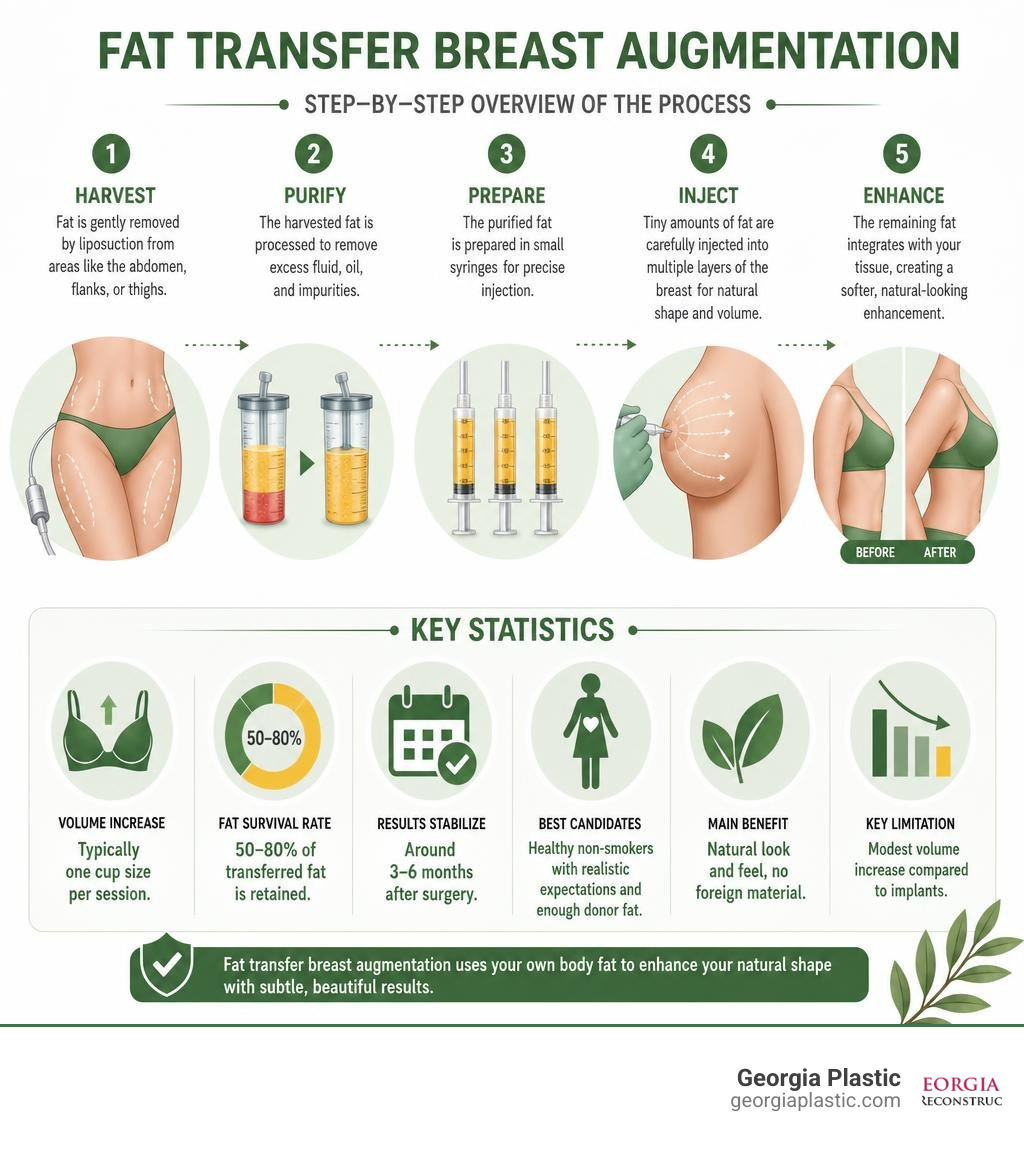
Fat transfer breast augmentation is a procedure that uses your own body fat — removed by liposuction from areas like the abdomen, flanks, or thighs — and injects it into the breasts to add natural volume and shape, without implants.
Here is a quick summary of what you need to know:
| Topic | Key Facts |
|---|---|
| What it is | Breast enhancement using your own harvested fat |
| Volume increase | Typically one cup size per session |
| Fat survival rate | 50–80% of transferred fat is retained |
| Results stabilize | Around 3–6 months after surgery |
| Best candidates | Healthy non-smokers with realistic expectations and enough donor fat |
| Main benefit | Natural look and feel, no foreign material |
| Key limitation | Modest volume increase compared to implants |
This procedure is a strong option for women who want subtle, natural-looking enhancement without the risks tied to breast implants.
Breast augmentation is consistently one of the most requested cosmetic procedures in the United States, and more patients today are asking about natural alternatives to implants. Fat transfer offers exactly that — a way to enhance breast size and shape using tissue that already belongs to your body.
The results are softer and more natural in appearance than implants. And because fat is harvested from an area where you have excess, the procedure delivers a secondary body-contouring benefit at the same time.
But it is not right for everyone. Volume gains are modest, not all transferred fat survives, and patient selection matters enormously. Understanding the full picture before making a decision is essential.
I’m Dr. Stanley Okoro, a double board-certified plastic surgeon and founder of Georgia Plastic and Reconstructive Surgery in Atlanta, with extensive experience performing fat transfer breast augmentation procedures and helping patients achieve natural-looking results. In this guide, I’ll walk you through everything you need to know — from candidacy and procedure steps to recovery, risks, and realistic outcomes.
Understanding Fat Transfer Breast Augmentation
To truly appreciate the magic of a fat transfer breast augmentation (often called autologous breast augmentation), it helps to understand what we are actually doing. In short, we are taking fat from where you do not want it and placing it where you do. Think of it as the ultimate form of anatomical recycling!
For decades, traditional breast augmentation relied almost exclusively on synthetic breast implants (either saline or silicone). While implants are unmatched in their ability to provide dramatic, highly predictable volume increases in a single session, they are not for everyone. Some patients are concerned about foreign materials in their bodies, the potential for capsular contracture, or long-term implant maintenance (implants are not lifetime devices and typically require replacement every 10 to 15 years).
When you choose a natural alternative, we use your own autologous fat. To understand the foundational science behind this, you can read more about What is a Fat Transfer.
The procedure begins with liposuction to harvest fat cells from donor sites such as your abdomen, hips, thighs, or back. This harvested fat is not immediately injected; it must be carefully processed, purified, and filtered to isolate the healthiest, most viable fat cells. Once purified, we strategically inject these living cells into the breast tissue.
Because we use your own tissue, there is absolutely zero risk of allergic reaction or implant rejection. For a deeper look into how this compares to traditional surgical options, the Cleveland Clinic provides an excellent overview of the Fat Transfer Breast Augmentation: Procedure, Results & Risks.
Who is a Candidate for Fat Transfer Breast Enhancement?
While the idea of slimming down your tummy to fill out your bra sounds like a dream come true, not everyone is an ideal candidate. During your consultation at Georgia Plastic, we look at several key factors to determine if you are a Good Candidate Fat Transfer.
- Adequate Donor Fat: This is the most critical physical requirement. If you are extremely lean or have a very low Body Mass Index (BMI), you simply may not have enough excess fat to harvest. We need enough fat to not only inject into the breasts but also to account for the portion of fat cells that will naturally be reabsorbed by your body during the transfer process.
- Realistic Expectations: If you are looking to jump three cup sizes overnight, fat transfer will disappoint you. This procedure is designed for modest, subtle, and incredibly natural-looking volume increases — typically about one cup size per session.
- Good Skin Elasticity: Your breast skin needs to have enough natural “snap” to accommodate the newly injected fat without sagging.
- General Health and Lifestyle: You should be in good overall physical health and maintain a stable weight. Crucially, you must be a non-smoker (or willing to quit completely well in advance of surgery). Nicotine constricts blood vessels, which directly starves the newly transferred fat cells of the oxygen and nutrients they need to survive.
Benefits and Limitations of Natural Augmentation
Every cosmetic procedure involves trade-offs. When you Consider a Fat Transfer for Breast Augmentation, weighing these pros and cons will help you make the right choice for your lifestyle.
The Benefits:
- Dual Body Contouring: You get a slimmer, more sculpted donor site (like a flatter stomach or sleeker thighs) alongside fuller breasts. It’s a true two-in-one “glow-up.”
- Incredibly Natural Feel: Because it is your own fat, the augmented breasts feel completely soft, natural, and warm to the touch. No edges, no rippling, and no artificial firmness.
- No Implant-Related Risks: You completely bypass risks like capsular contracture, implant rupture, or Breast Implant Illness (BII).
- Minimal Scarring: We use tiny, blunt-tipped cannulas for both harvesting and injecting, meaning your incisions are usually only a few millimeters long and fade to almost invisible lines.
The Limitations:
- Modest Volume Gains: A single session typically yields an increase of a half to one full cup size.
- Resorption Rate: Your body will naturally absorb a portion of the transferred fat (usually 20% to 50%) within the first few months.
- Multiple Sessions May Be Needed: If you want a more significant increase, you may need to undergo two or more staged procedures spaced several months apart.
The Fat Transfer Breast Procedure Step-by-Step
Understanding what happens on the day of your procedure can help ease any pre-surgery nerves. A typical fat transfer breast augmentation is performed under general anesthesia or deep twilight sedation and takes between three to five hours, depending on the volume of fat being harvested and transferred.
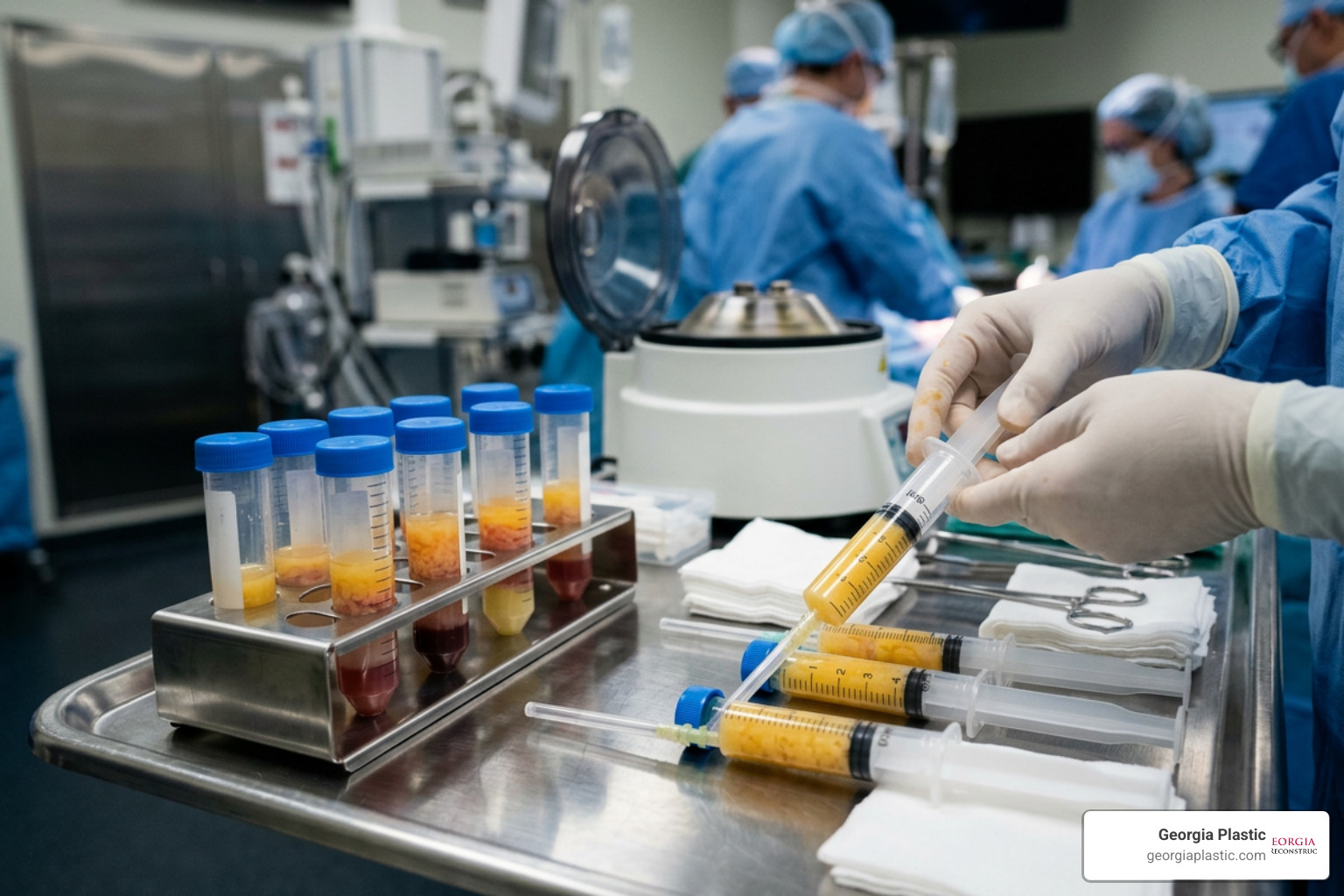
The procedure is broken down into three precise, highly technical steps:
Step 1: Gentle Harvesting (Liposuction)
We begin by infiltrating the donor area (such as the abdomen or thighs) with a tumescent fluid containing saline, a local anesthetic, and epinephrine to minimize bruising and blood loss. Using low-pressure, manual liposuction techniques, we gently harvest the fat. We avoid aggressive mechanical or laser-assisted liposuction because high heat and excessive friction can destroy the delicate cell membranes of the fat cells, rendering them useless.
Step 2: Purification and Centrifugation
The harvested fluid is a mixture of living fat cells, oil, blood, and tumescent fluid. We place this mixture into a closed, sterile filtration or centrifugation system. By spinning or washing the fluid, we separate the damaged cells, excess oil, and fluids from the pure, highly viable fat cells. Standardizing this purification process is key to ensuring the cells remain alive and ready to thrive in their new home.
Step 3: Strategic Micro-Transfer Injection
Using a tiny cannula (often only 1.2mm to 2mm in diameter), we inject the purified fat into the breasts. We do not simply inject a large pocket of fat into one spot, as this would cause the cells in the center to starve and die.
Instead, we use a sophisticated micro-injection technique. We deposit tiny, microscopic droplets of fat in a fan-like pattern across multiple tissue planes — primarily in the subcutaneous space and behind the breast gland (retroglandular space). This ensures that every single transferred fat cell is in direct contact with surrounding tissue, allowing it to quickly establish a blood supply.
For a comprehensive breakdown of these surgical nuances, you can read the clinical guidelines in the textbook chapter 6 Fat Grafting for Primary Augmentation or explore our own Ultimate Fat Transfer Breast Augmentation Guide.
Fat Survival and Volume Retention in Fat Transfer Breast Procedures
One of the most common questions patients ask is: “How much of the fat actually stays?”
The biological reality is that transferred fat cells do not have an immediate blood supply. For the first 3 to 5 days, they survive purely on nutrient diffusion from the surrounding tissues. Within 48 hours, a process called neovascularization (the growth of new blood vessels) begins.
Typically, patients can expect a 50% to 80% fat survival rate. The fat cells that do not establish a blood supply will die and be naturally processed and cleared by your body’s lymphatic system.
This resorption process occurs over the first few weeks, and your breast volume will gradually decrease slightly from its immediate post-op appearance. By the 3-month mark, the remaining fat cells have stabilized, developed a permanent blood supply, and will behave exactly like normal fat cells for the rest of your life. To understand how weight changes affect these long-term results, take a look at our article on How Long Does a Fat Transfer Breast Augmentation Last.
Combining Fat Grafting with Implants or Lifts
You do not always have to choose between fat and implants. In fact, combining the two — known as hybrid breast augmentation — has become incredibly popular.
In a hybrid procedure, we place a smaller silicone implant than originally planned to provide base volume and projection. We then use autologous fat grafting around the edges of the implant. This serves to “camouflage” the implant, preventing visible rippling or a hard “artificial” look, especially in very thin patients with minimal natural breast tissue. If you are interested in this advanced approach, you can read the research paper on the Hybrid Implant and Grafted Fat Breast protocol.
Additionally, we frequently combine fat transfer with a breast lift (mastopexy). If you have mild to moderate sagging, a lift will reposition the breast tissue and remove excess skin, while the fat transfer restores youthful fullness and upper pole cleavage. Discover more about these combined benefits in our guide to Enhance Breasts Naturally Fat Transfer.
Recovery, Risks, and Long-Term Maintenance
Recovery from a fat transfer is generally smoother and less painful than recovery from submuscular implant surgery, but it still requires patience and care.
Week-by-Week Recovery Timeline
- Days 1–3: You will experience mild to moderate soreness, swelling, and bruising, primarily at the liposuction donor sites. Your breasts may feel tight and look larger than your final result due to initial swelling.
- Week 1: Most patients can return to light desk work within 5 to 7 days. You must wear a supportive, non-wire, soft surgical bra that does not compress the breasts, as well as a compression garment on your liposuction donor areas.
- Weeks 2–3: Bruising will begin to fade. You can gradually increase your daily walking, but you must avoid sleeping on your stomach or chest.
- Weeks 4–6: Swelling continues to resolve. You will transition out of your donor-site compression garments. You can usually resume light exercise, but high-impact running or heavy lifting should be avoided until week 8.
Risks and Potential Complications
While highly safe, autologous fat transfer is still a surgical procedure. According to systematic reviews of cosmetic breast fat grafting, there is an overall complication rate of approximately 17.2%.
- Fat Necrosis: If a clump of transferred fat does not get enough blood supply, it can die. This can form a firm lump known as fat necrosis or an oil cyst. While harmless and non-cancerous, these lumps can sometimes require a simple in-office drainage or monitoring.
- Microcalcifications: As dead fat cells heal, they can sometimes form tiny calcium deposits.
- Asymmetry or Contour Irregularities: If fat resorbs unevenly, minor touch-ups may be desired.
Choosing a highly skilled, board-certified plastic surgeon is the best way to minimize these risks. For a comprehensive look at safety protocols, read Restore Volume with Fat Transfer for a Safer Treatment.
Head-to-Head: Fat Transfer vs. Traditional Implants
| Feature | Fat Transfer Breast Augmentation | Traditional Breast Implants |
|---|---|---|
| Material Used | Your own living fat cells | Saline or Silicone cohesive gel |
| Volume Potential | Modest (typically 0.5 to 1 cup size per session) | Dramatic (multiple cup sizes in one surgery) |
| Incision Size | Tiny punctures (2–3 mm), virtually no scarring | 3–5 cm incisions under the breast or armpit |
| Feel & Appearance | Soft, warm, and 100% natural | Firm, highly projected, defined shape |
| Longevity | Permanent once stabilized (behaves like real fat) | Typically need replacement every 10–15 years |
| Secondary Benefit | Body contouring at the liposuction harvest site | None |
Cost, Financing, and Investment Considerations
Because a fat transfer breast augmentation is actually two procedures in one — liposuction of one or more areas followed by specialized breast reconstruction/grafting — the pricing reflects the complexity and time spent in the operating room.
Several factors influence the overall investment:
- The Number of Donor Sites: Harvesting from multiple areas (e.g., abdomen and outer thighs) requires more surgical time.
- Surgeon’s Expertise: Highly experienced, board-certified plastic surgeons who specialize in advanced fat grafting techniques typically command higher fees.
- Anesthesia and Facility Fees: Operating in a fully accredited, state-of-the-art surgical center with a board-certified anesthesiologist ensures your safety but adds to the base cost.
Because this is a purely cosmetic procedure, health insurance does not cover it. However, we believe financial peace of mind is just as important as surgical safety. At Georgia Plastic, we offer several flexible financing options (such as CareCredit®, Alphaeon® Credit, and PatientFi®) to help fit your procedure comfortably into your monthly budget. For a detailed breakdown of what to expect financially, read our guide on Breaking Down the Bill Understanding Fat Transfer Pricing.
Frequently Asked Questions about Fat Transfer Breast Augmentation
How many cup sizes can I gain with a fat transfer?
In a single session, you can realistically expect to gain about one cup size (sometimes a half-cup to one and a half, depending on your anatomy and how much fat survives). If you desire a more dramatic increase, you can undergo a second or third session spaced 4 to 6 months apart, provided you still have adequate donor fat reserves.
Does fat transfer to the breast affect mammograms?
No, it does not prevent accurate breast cancer screenings, and studies confirm that fat transfer does not increase your risk of developing breast cancer. However, fat necrosis can sometimes create microcalcifications that look similar to early-stage cancer signs on older imaging machines. Modern, high-resolution digital mammograms and 3D tomosynthesis allow experienced radiologists to easily distinguish between benign post-surgical fat changes and actual suspicious tissue. Always inform your mammographer that you have had a fat transfer prior to your screening.
Are the results of a breast fat transfer permanent?
Yes! Once the transferred fat cells successfully integrate and establish a blood supply (usually by the 3 to 6-month mark), they are permanent. They are living cells that will age naturally with you. If you gain weight, those cells will expand; if you lose weight, they will shrink. To maintain your beautiful, stable results, we always recommend maintaining a healthy, consistent lifestyle.
Conclusion
A fat transfer breast augmentation offers an elegant, safe, and beautifully natural way to enhance your silhouette using your body’s own resources. By combining the sculpting power of liposuction with the artistic placement of purified fat, we can help you achieve a softer, fuller bust line without the need for synthetic implants.
At Georgia Plastic & Reconstructive Surgery, our double board-certified plastic surgeon, Dr. Stanley Okoro, and our dedicated team prioritize your safety, comfort, and aesthetic goals above all else. We provide highly personalized care, tailored treatment plans, and natural-looking results that celebrate your unique beauty.
If you are ready to explore whether natural breast enhancement is right for you, we invite you to take the next step. Schedule your personalized consultation with us today by visiting our Natural Breast Augmentation Fat Transfer Atlanta page or calling our Atlanta office. Let us help you create the look you’ve always wanted!