You may be sitting in a recovery room after a double mastectomy, trying to absorb two very different realities at once. Your cancer treatment has taken priority, yet you're also being asked to think about shape, sensation, scars, future procedures, and how your body may feel months or years from now. That's a lot to carry, especially when every option seems to come with unfamiliar terms.
Breast reconstruction after double mastectomy isn't one operation or one universal solution. It's a decision journey shaped by your cancer treatment, skin and tissue quality, overall health, body proportions, recovery needs, and personal definition of feeling restored. The right plan may involve implants, your own tissue, immediate reconstruction, delayed reconstruction, or no reconstruction at all.
Table of Contents
- Understanding Your Reconstruction Journey
- Immediate Versus Delayed Reconstruction Timing
- Implant-Based Reconstruction Options
- Autologous Flap Reconstruction Techniques
- The Staging and Recovery Process
- Making Your Personalized Choice
Understanding Your Reconstruction Journey
A patient named Maya might describe the first consultation this way: she knew the mastectomy was necessary, but she didn't yet know whether she wanted to wake up with reconstructed breasts, wait until treatment was complete, or choose a flat closure. She worried that asking about appearance would make her seem less focused on surviving cancer. Her surgeon helped separate those concerns. Wanting reconstruction wasn't vanity, and declining it wouldn't mean giving up. Both were legitimate parts of her recovery plan.
That distinction matters. Reconstruction restores breast contour after tissue has been removed, but it doesn't recreate every aspect of a natural breast. Many patients experience numbness, changes in chest sensation, altered shoulder movement, or emotional reactions that continue after the incisions heal. Information from Susan G. Komen on mastectomy recovery and reconstruction describes pain, numbness, limited shoulder movement, emotional health, intimacy, prostheses, and flat closure as parts of the broader post-mastectomy experience.

Reconstruction is a partnership
Your breast surgeon and plastic surgeon should coordinate before the mastectomy whenever possible. The breast surgeon focuses on removing cancer safely and planning the mastectomy pattern. The reconstructive surgeon considers the remaining skin envelope, chest wall, tissue perfusion, breast size, symmetry, and the type of reconstruction that can be supported.
The mastectomy technique can influence the reconstructive plan. A skin-sparing procedure preserves much of the breast skin for shaping, while a nipple-sparing procedure may preserve the nipple and areola when cancer location, anatomy, and safety allow. These approaches aren't automatically appropriate for everyone, so the breast and plastic surgery teams must evaluate them together.
The emotional goal is personal
Some people want clothing to fit in a familiar way. Others value a softer contour, avoiding implants, retaining the option to go flat, or minimizing the number of major operations. A reconstructed breast may improve body image and psychosocial well-being, but satisfaction depends on expectations as well as surgical appearance.
A useful starting point: Don't ask only, “Which reconstruction looks best?” Ask, “Which recovery, maintenance needs, and long-term result fit the life I want to return to?”
Over several decades, reconstruction after mastectomy has moved from uncommon to mainstream in many major markets. A review in the National Cancer Data Base literature describes rates rising from 8% in 1995 to about 41% by 2013, while another population study found immediate and early delayed reconstruction increasing from 26.4% in 2010 to 41.8% in 2020. Those figures describe broad trends, not a recommendation for any individual patient.
Immediate Versus Delayed Reconstruction Timing
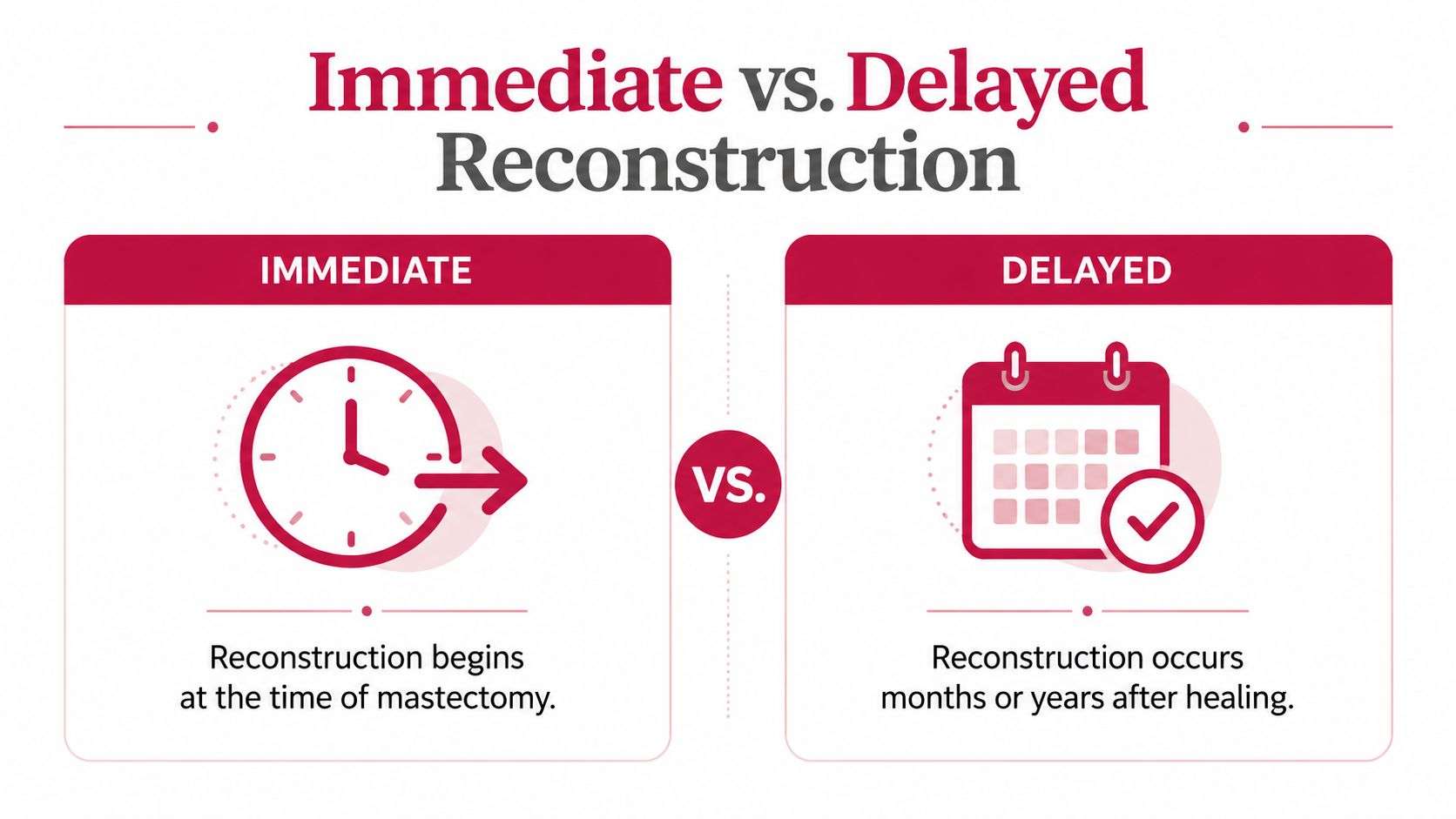
Timing is often the first major decision because it determines how reconstruction interacts with cancer treatment and healing. Immediate reconstruction begins during the mastectomy operation. Delayed reconstruction occurs after the chest has healed, sometimes following chemotherapy, radiation, or other treatment.
Immediate reconstruction can preserve the breast skin envelope and may provide a smoother transition from mastectomy to restoration. It also lets the reconstructive surgeon shape the breast while the mastectomy is being performed. In the multicenter evidence reviewed in this JAMA Surgery cohort, immediate reconstruction was associated with better aesthetic and psychosocial outcomes, while delayed pathways generally reduced overall and major complications while preserving patient-reported satisfaction and quality of life.
When immediate reconstruction may fit
Immediate reconstruction may be considered when the mastectomy can safely preserve enough skin and when the expected cancer treatment won't place the reconstruction under excessive stress. A patient who wants to avoid a flat interval may find this psychologically helpful. The tradeoff is that the body must manage a larger operation while beginning cancer recovery.
Radiation planning is especially important. Radiation can affect the skin, blood supply, implant pocket, and final appearance. If radiation is likely, the team may recommend a temporary approach, delayed reconstruction, or a strategy that accounts for later treatment rather than committing immediately to the final result.
When delay may be strategically safer
Delayed reconstruction gives the body time to recover from mastectomy and allows the oncology team to complete treatment without a definitive reconstruction occupying the center of the plan. It can be useful when wound healing is uncertain, when postoperative radiation is expected, or when medical conditions increase surgical risk.
The same cohort reported a 32.9% overall complication rate, including 19.3% reoperative complications, 9.8% wound infections, and a 5.4% reconstruction failure rate. Those numbers apply to the study population, not to every patient, but they show why timing requires more than a cosmetic discussion. The researchers also identified higher body mass index and immediate surgery as factors associated with greater complication burden.
Questions that clarify the schedule
Ask your team:
- Cancer treatment: Will chemotherapy or radiation follow mastectomy, and when is it expected to begin?
- Skin preservation: Is a skin-sparing or nipple-sparing approach medically appropriate? You can review the considerations in this guide to how a nipple-sparing mastectomy may support reconstruction.
- Healing risk: How do smoking, diabetes, prior operations, body mass index, or circulation affect timing?
- Contingency planning: What happens if pathology changes the radiation plan after surgery?
There's no prize for choosing immediate reconstruction if delay better protects healing or cancer treatment. Timing should serve the entire plan.
Implant-Based Reconstruction Options
Implant reconstruction uses a manufactured device to create breast volume. For many patients, it offers a shorter initial operation and avoids creating a second surgical site on the abdomen, back, or thigh. The process often begins with a tissue expander, a temporary device placed beneath or above the chest muscle and gradually filled to stretch the skin and soft tissue.
Think of the expander as a custom-sized scaffold. It doesn't represent the final breast. Instead, it prepares the pocket so the surgeon can later exchange it for a permanent implant with a planned width, projection, and position. In bilateral reconstruction, the two sides can be developed together, which helps the team pursue symmetry rather than matching a pre-existing breast.
Implant choices involve more than size
Permanent implants may be filled with saline or silicone gel. Shape, firmness, surface characteristics, placement, available skin, muscle coverage, and the patient's desired contour all influence selection. Modern devices, including options such as Motiva implants offered in some reconstructive practices, are selected based on the surgeon's assessment and the patient's anatomy, not by brand name alone.
A patient may prefer implants because the recovery feels more predictable or because she doesn't want abdominal surgery. Another may dislike the idea of a foreign device, future monitoring, or possible revision. Neither preference is medically immature. It's a values-based choice that should be discussed alongside risk.
Implant reconstruction and flap reconstruction
| Consideration | Implant-based reconstruction | Autologous flap reconstruction |
|---|---|---|
| Source of volume | A saline or silicone implant | Tissue transferred from another part of the body |
| Initial recovery | Often less extensive at the donor-site level | More extensive because the chest and donor site heal |
| Maintenance | May require monitoring and revision over time | Avoids implant-specific failure modes |
| Feel and aging | Depends on coverage, position, and tissue quality | Typically changes more naturally with the body |
| Radiation planning | Radiation can increase implant-related complications and aesthetic concerns | Autologous tissue is generally less affected than implants |
The national analysis summarized in this review of breast reconstruction complications found implant-based reconstruction complication rates around 26.6% to 31.3%, with reoperation rates of 15.5% to 18.8% across the cited analyses. Prosthetic infection was estimated at 7% to 14%, while mastectomy-flap necrosis varied widely across studies, reaching as high as 41% in some reports. These ranges reflect different studies and patient groups, so your surgeon should translate them into your personal risk profile.
Implants can leak, become infected, shift, ripple, or develop capsular contracture, in which scar tissue tightens around the device. Implant reconstruction may also require later procedures for exchange, pocket adjustment, fat grafting, or symmetry. A consultation should include not only how the breasts may look initially, but also what maintenance could involve over the long term.
Autologous Flap Reconstruction Techniques
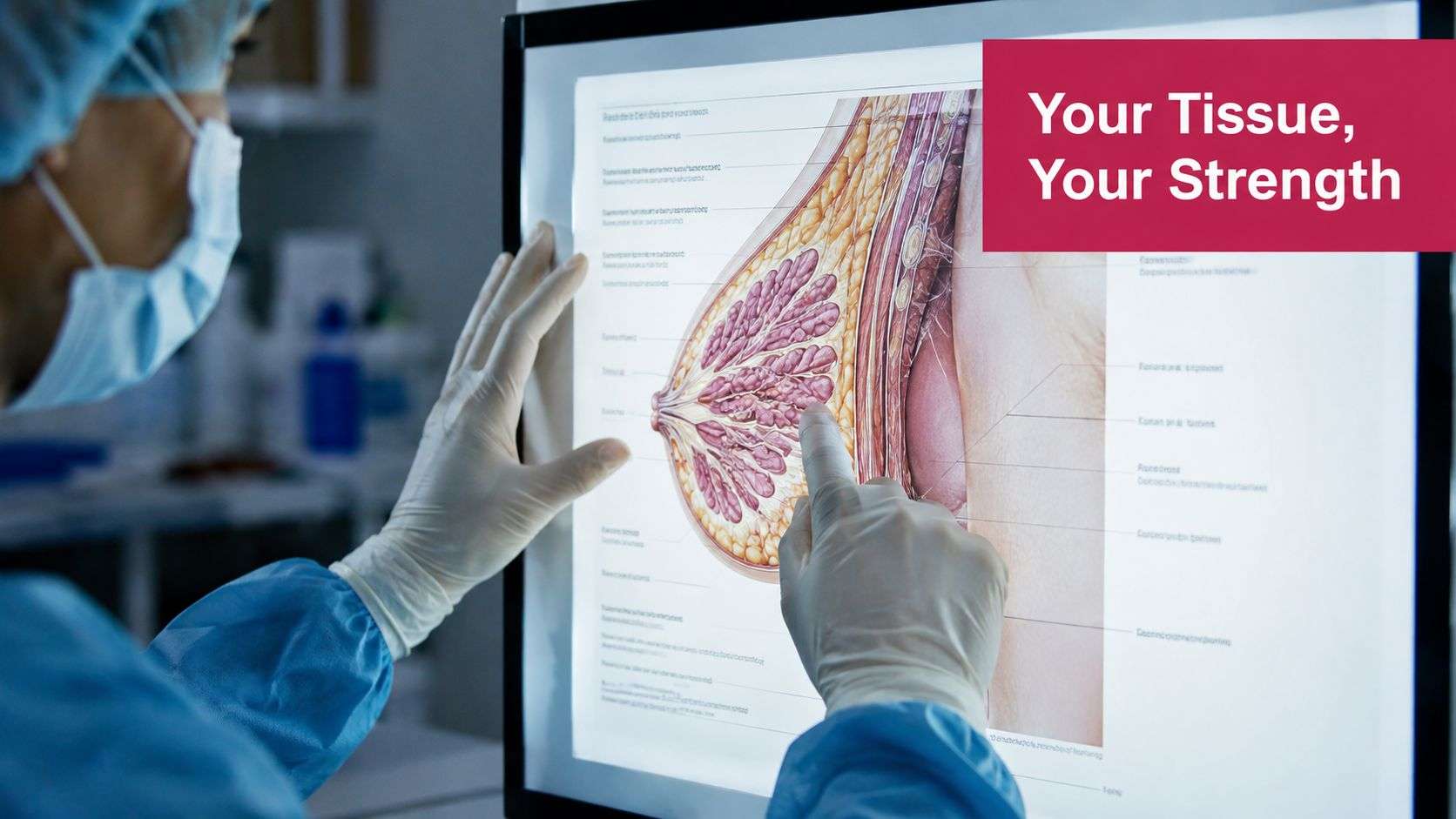
Autologous reconstruction uses your own skin, fat, and blood vessels to build breast volume. The surgeon moves this tissue from a donor area, often the lower abdomen or another region, to the chest and connects its blood vessels under magnification. Because the tissue remains living tissue with its own blood supply, the result can feel softer and change with your body over time.
Common flap approaches
A DIEP flap uses abdominal skin and fat while preserving the abdominal muscle. A TRAM flap uses abdominal tissue with a portion of the rectus muscle, so the effect on abdominal strength and recovery requires careful discussion. An SIEA flap uses tissue supplied by superficial blood vessels, but not every patient has vessels large or suitable enough for this method.
The choice depends on available tissue, previous abdominal surgery, blood vessel anatomy, body proportions, medical history, and the surgeon's microsurgical experience. Thigh-based or other donor-site techniques may be appropriate when the abdomen isn't available or doesn't provide enough tissue.
For a patient who wants a deeper explanation of how tissue is harvested and transferred, the Hirschfeld Oncology flap surgery guide provides additional educational context. It shouldn't replace an individualized consultation, because candidacy depends on anatomy that can't be assessed from general information.
What happens during the procedure
The process usually follows several linked phases:
- Donor-site planning: The surgeon maps the tissue and blood vessels that can support the flap.
- Tissue harvest: Skin and fat are removed with the selected vessels, while the team preserves as much muscle and structural support as the technique allows.
- Microsurgical transfer: The tissue moves to the chest, and the vessels are connected to chest blood vessels.
- Breast shaping: The surgeon folds and positions the flap to create the desired contour on each side.
- Monitoring: The team watches blood flow closely during the early recovery period.
- Refinement: Later procedures may improve contour, scars, nipple shape, or symmetry.
Autologous surgery is more extensive than implant placement and creates a donor-site scar. Recovery may include abdominal tightness, weakness, wound concerns, or flap-related complications. The analysis cited earlier found 18.4% major complications for immediate autologous reconstruction and 19.0% for delayed autologous reconstruction, showing that using natural tissue doesn't eliminate risk.
Some patients also use fat grafting as a refinement tool to soften edges or correct contour differences. A separate overview of fat transfer breast techniques can help explain how transferred fat may complement, rather than replace, a primary flap reconstruction.
The Staging and Recovery Process
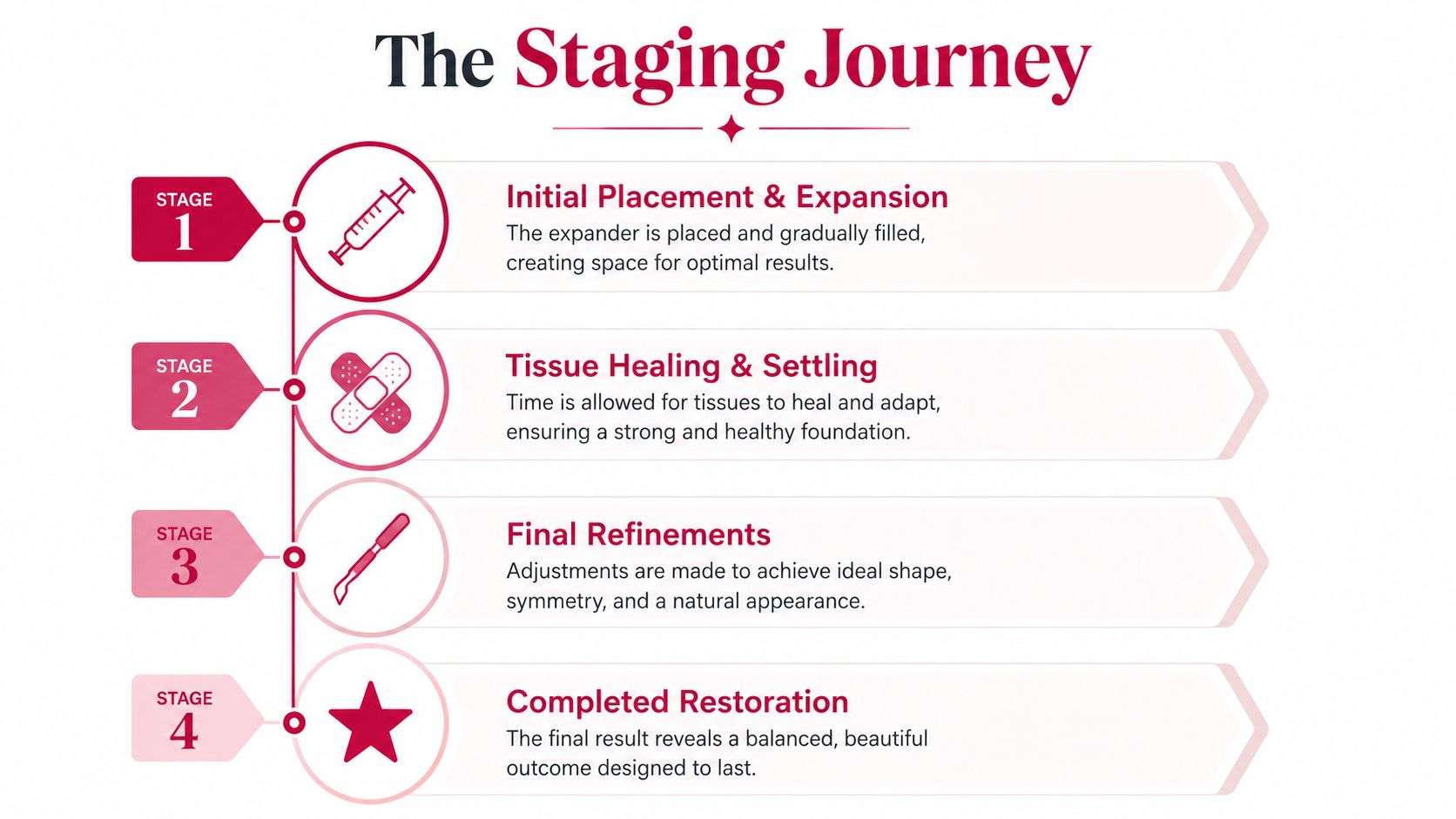
Reconstruction is usually a sequence rather than a single finish line. The exact stages vary by technique, but most patients move through an initial operation, healing and settling, refinement, and long-term adjustment. Seeing the process this way can make the final result feel less mysterious and reduce the pressure to judge the reconstruction before the body has had time to recover.
The early phase
With implants, the first operation may place tissue expanders. Follow-up visits allow the surgeon to add fluid gradually, giving the skin and soft tissue time to adapt. With flaps, the early period centers on microsurgical monitoring, incision care, pain control, movement, and protection of both the chest and donor site.
At home, patients commonly need help with meals, transportation, medication schedules, children, pets, and household tasks. Your surgeon will give specific instructions for drains, dressings, bathing, sleeping position, lifting, arm movement, and signs that require a call. Don't use a generic internet timeline to override those instructions.
Healing changes the appearance
Swelling, bruising, tightness, asymmetry, numbness, and scar firmness can make an early result look unlike the eventual result. The breasts may settle at different speeds, particularly after bilateral surgery. Follow-up appointments allow the team to assess wounds, blood flow, fluid collections, infection, implant position, or other concerns before they become harder to manage.
Your oncology team remains part of this process. If chemotherapy, radiation, or another treatment is planned, the plastic surgeon must coordinate the surgical schedule and wound recovery with the cancer plan. Reconstruction shouldn't delay medically necessary treatment.
Refinement is part of planning
Refinement may involve scar treatment, contour correction, fat grafting, nipple reconstruction, areolar tattooing, implant exchange, or adjustment of the breast pocket. These procedures aren't proof that the first operation failed. Breast reconstruction often requires shaping over time because the body heals, tissues settle, and treatment can change the skin.
A practical recovery plan includes more than medical instructions:
- Build a support schedule: Arrange help for transportation, meals, bathing, and household tasks before surgery.
- Prepare a recovery space: Keep medications, water, chargers, and essentials within easy reach.
- Track questions: Bring a written list to each appointment, especially if anxiety makes it hard to remember details.
- Protect treatment timing: Ask who coordinates your plastic surgery, breast surgery, oncology, and rehabilitation appointments.
Recovery perspective: The first visible result is a starting point, not a final verdict on your body or your decision.
Making Your Personalized Choice
Consider two patients with the same diagnosis. One wants the shortest path back to work and prefers to avoid abdominal surgery, even if implant maintenance may be part of her future. The other accepts a longer recovery because she values using her own tissue and wants to reduce dependence on an implant. Neither patient is choosing incorrectly. Their priorities are different.
Long-term evidence increasingly points to an important tradeoff. Reviews report that autologous reconstruction tends to produce higher long-term BREAST-Q satisfaction and well-being than implant-based reconstruction, although flap surgery usually involves a longer recovery and more extensive operation. The choice isn't just natural versus artificial. It's a balance among recovery, durability, radiation exposure, donor-site effects, revision burden, sensation, and the result you can live comfortably with.
Use these questions at your consultation
- Timing: Should reconstruction happen during mastectomy or after cancer treatment?
- Radiation: How would radiation affect an implant, expander, or flap in my case?
- Technique: Which options fit my tissue, blood vessels, prior surgery, and body proportions?
- Recovery: What help will I need, and when can I resume work, driving, exercise, and caregiving?
- Durability: What future revisions might be expected with each option?
- Sensation: What should I expect regarding numbness, touch, and nipple sensation?
- Team experience: How often does the surgical team perform bilateral reconstruction using the proposed technique?
- Coverage: Which stages, revisions, garments, and related appointments does my insurance plan cover?
Radiation deserves a direct conversation. A recent scoping review found that postmastectomy radiation raises the risks of infection, necrosis, and aesthetic dissatisfaction, while autologous reconstruction is generally less affected than implant-based reconstruction. Emerging approaches, including prepectoral placement, nipple-sparing techniques, and attempts to restore sensation, may be appropriate for selected patients, but the benefit depends on anatomy, treatment, and surgical judgment.
A detailed guide to choosing a breast reconstruction technique can help you organize those questions before your appointment. Bring someone you trust if possible, take notes, and ask the surgeon to explain the plan in plain language. You're allowed to request another consultation or more time when the decision feels rushed.
Reconstruction after a double mastectomy is not only a procedure. It's a sequence of decisions that should protect cancer treatment, respect your body, and support the life you're returning to. Your final choice may change as pathology, radiation planning, healing, or personal priorities become clearer. That flexibility is part of thoughtful care.
Georgia Plastic & Reconstructive Surgery offers breast reconstruction consultations, including options connected with mastectomy and nipple-sparing procedures, at its Atlanta and Marietta locations. Visit Georgia Plastic & Reconstructive Surgery to review reconstruction resources and request a consultation about timing, technique, recovery, and your individual goals.