You've probably looked in the mirror and noticed one specific thing that makeup, moisturizer, and a better skincare routine still haven't fixed. Maybe it's acne scarring that catches the light. Maybe it's rough texture, enlarged pores, or thinning hair that seems more visible every month. And if you've started researching treatments, you've likely seen dramatic promises around the “vampire facial.”
A clear understanding of efficacy outweighs marketing hype. Microneedling with PRP can be an excellent treatment, but it isn't automatically the best answer for every skin concern. The patients who benefit most usually have a clear regenerative target, such as atrophic acne scars, certain types of hair loss, or texture issues where collagen remodeling matters. If your goal is primarily general anti-aging in otherwise non-scarred skin, the added value of PRP may be modest, and another approach may fit better.
That distinction matters. Good aesthetic care isn't about picking the most hyped treatment. It's about matching the technology to the problem. Supportive skincare still plays a role too, especially barrier repair and hydration after treatment. If you want a simple refresher on one ingredient patients often ask about, this ArtNaturals hyaluronic acid overview gives a practical explanation of why hydration products are commonly used alongside collagen-stimulating procedures.
Table of Contents
- What Can Microneedling with PRP Do for Your Skin
- How the Vampire Facial Actually Works
- Clinically Proven Microneedling with PRP Benefits
- What to Expect Your Results Timeline and Recovery
- Is Microneedling with PRP Right for You
- PRP vs Microneedling Alone vs Morpheus8
- Planning Your Treatment at Georgia Plastic
What Can Microneedling with PRP Do for Your Skin
Microneedling with PRP combines two ideas that work well together. Microneedling creates controlled channels in the skin and triggers a repair response. PRP, or platelet-rich plasma, comes from your own blood and contains concentrated growth factors that support healing and tissue regeneration.
For the right patient, that combination can improve more than surface glow. It may help soften acne scars, refine uneven texture, and support healthier remodeling in skin that needs repair rather than just light refreshment. In hair restoration, the same regenerative concept can also be useful in carefully selected patients.
Honest expectations matter
Many online discussions go off track by treating PRP as if it automatically “boosts” every cosmetic outcome. It doesn't. The best microneedling with PRP benefits usually show up when there's a problem that responds to collagen remodeling or regenerative signaling.
If a patient has shallow atrophic acne scars, textural irregularity, or certain forms of hair thinning, adding PRP may make sense. If the issue is loose skin, heavy jowling, or significant lower-face descent, that's a different category of problem. Those concerns often require tightening, lifting, or contouring rather than a regenerative surface treatment.
Clinical mindset: The question isn't whether PRP is popular. The question is whether PRP matches the biology of the concern you want to treat.
Where it fits in a real treatment plan
Microneedling with PRP sits in a useful middle ground. It's more biologically active than basic topical skincare, but it's less invasive than surgery and less focused on contraction than energy-based tightening devices.
That makes it a sensible option for patients who want natural-looking improvement in texture, scar quality, or scalp density without moving straight to more aggressive procedures. It's also a treatment where provider judgment matters. A strong plan often includes deciding when not to add PRP.
How the Vampire Facial Actually Works
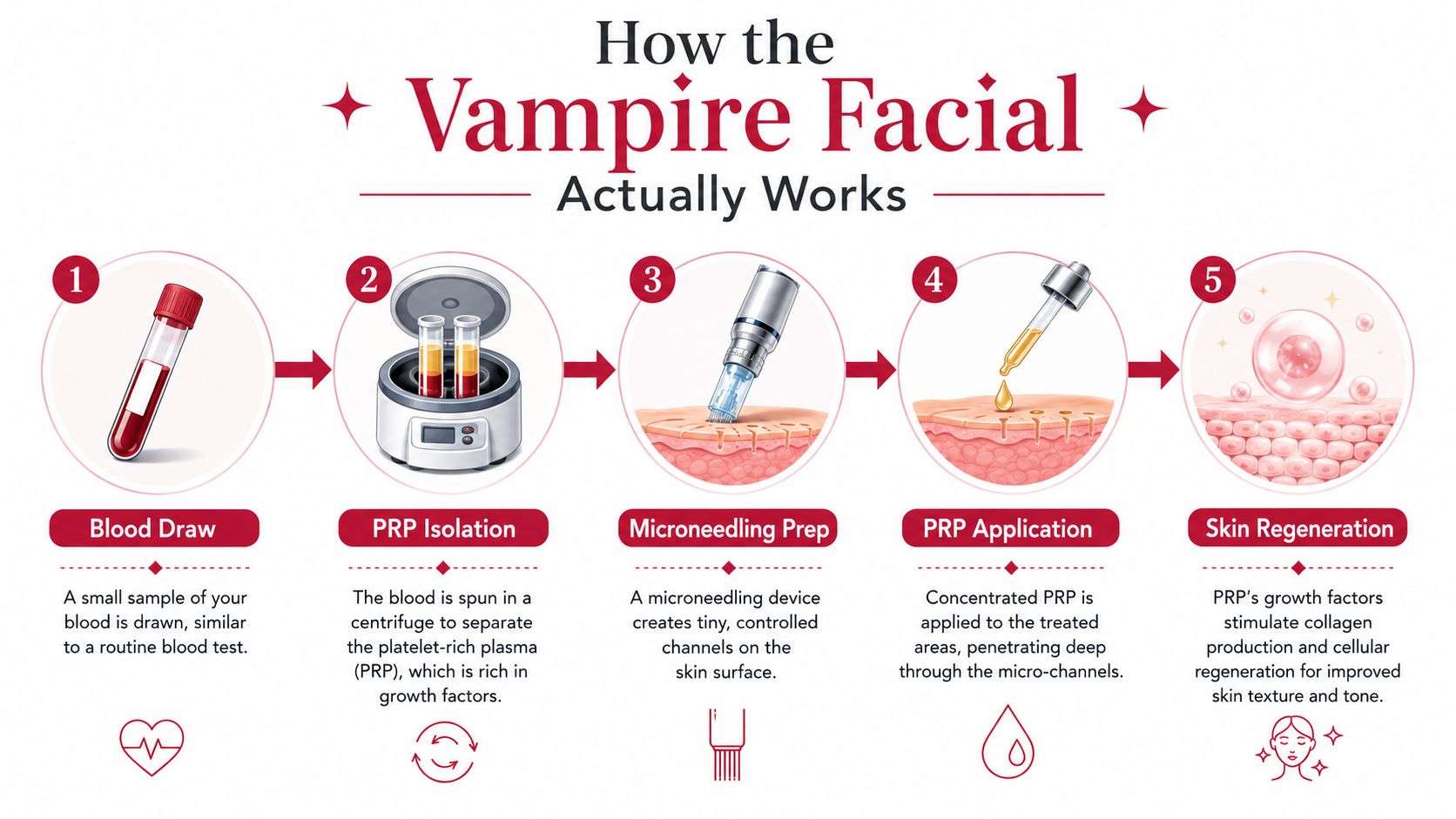
The nickname gets attention, but the process itself is straightforward. Microneedling with PRP works by pairing controlled mechanical stimulation with concentrated healing signals from your own blood.
A simple way to think about it is lawn aeration. When a lawn is compacted, water and nutrients have trouble getting where they need to go. Aeration creates small openings so repair and growth can happen more efficiently. Microneedling does something similar in skin. It creates tiny, controlled channels that trigger the body's wound-healing response and encourage collagen remodeling.
The microneedling step
A professional device passes sterile needles across the treatment area at controlled depths. That matters because depth should match the area being treated and the condition being addressed. The goal isn't random injury. The goal is precise stimulation.
Those microchannels do two things at once:
- They trigger repair: Your skin starts a healing response that supports new collagen formation.
- They create access: They allow applied biologic material to reach deeper than it would on intact skin.
For patients comparing options, a detailed overview of microneedling treatments can help clarify how standard microneedling differs from enhanced approaches.
The PRP step
PRP is prepared from a small sample of your own blood. After processing, the platelet-rich portion is separated and used during the treatment. Platelets release growth factors and cytokines that help regulate healing, tissue repair, and collagen synthesis.
That's why PRP isn't just a trendy add-on. In the right setting, it acts like a concentrated regenerative signal. Some patients also hear about related blood-derived materials in other fields. If you're curious about how these concepts overlap, this explanation of Platelet-Rich Fibrin benefits offers helpful background on another autologous regenerative approach.
The strongest logic for PRP is not “more is better.” It's that microneedling creates the pathway, and PRP supplies biologic support exactly when the skin is primed to respond.
Why the combination can outperform either alone
Microneedling by itself stimulates collagen. PRP by itself delivers growth factors. Together, they create a more coordinated regenerative environment. The microchannels improve delivery, and the PRP supports the healing cascade that follows.
That synergy is the whole reason this treatment exists. Without the channels, topical PRP has less opportunity to penetrate. Without the biologic support, microneedling relies on the skin's standard repair response alone. When a patient is a good candidate, the combination is more purposeful than the nickname suggests.
Clinically Proven Microneedling with PRP Benefits
A common consultation goes like this. A patient wants “the best collagen treatment” for early aging, mild pores, and a little dullness, and asks whether PRP automatically makes microneedling better. The honest answer is more selective. PRP has real value, but its clearest benefit shows up in problems that need tissue repair, not in every patient who wants general skin refreshment.

Where the evidence is strongest
The best data is in atrophic acne scars. A meta-analysis of 14 studies found that adding PRP to microneedling significantly increased the odds of substantial clinical improvement compared with microneedling alone, with an odds ratio of 2.97 (Frontiers in Medicine meta-analysis). A separate review reached a similar conclusion, reporting better acne-scar outcomes and higher patient satisfaction without a higher rate of adverse events (PRP and microneedling acne scar analysis).
That makes clinical sense. Acne scars are a structural issue. They reflect collagen loss and uneven dermal remodeling, so a treatment aimed at repair has a defined role.
There is also support for hair restoration in selected patients. Research on alopecia areata and earlier-stage androgenetic alopecia suggests that combining microneedling with PRP can improve response compared with PRP alone in some settings (PRP and microneedling for hair loss review).
What patients may notice beyond the main target
Patients treated for scars often report that the skin feels smoother and looks healthier overall as remodeling progresses. That secondary improvement is reasonable to expect, but it should be framed correctly. Texture can improve. Tone may look more even. Fine changes in brightness are possible. Those are welcome effects, not the main reason I recommend adding PRP.
If you want a broader explanation of the biologic principles behind autologous treatments, LMI explains regenerative medicine in patient-friendly terms.
Patients may notice:
- Smoother texture: the skin surface can feel more refined as collagen remodeling develops
- Better scar blending: shallow acne scars may look less abrupt at the edges
- A healthier look to the skin: some patients describe a fresher, less tired appearance
- Improved scalp response in hair plans: the goal is better density and shaft quality over time
Who truly benefits from adding PRP
This is the practical decision point. Patients with acne scarring, selected hair-loss concerns, or a history suggesting slower healing often have the strongest case for adding PRP. In those situations, the added biologic support may justify the extra cost and treatment time.
For general anti-aging without significant scarring, the advantage is less clear. Standard microneedling may be enough for mild texture concerns, and patients who need more skin tightening, deeper remodeling, or stronger improvement in laxity may be better served by energy-based treatments such as Morpheus8. A good treatment plan should match the problem being treated, not assume the add-on is always the better choice.
That is why PRP should be recommended selectively. It is a useful tool, but it is not a catch-all answer for pores, fine lines, pigmentation, laxity, and scars all at once.
What to Expect Your Results Timeline and Recovery
A common scenario in consultation is this: a patient feels encouraged the first week because the skin looks smoother and brighter, then worries when that early glow fades. That pattern is normal. Early improvement often reflects swelling and surface hydration. The more meaningful change comes later, after the skin has had time to repair and remodel.
What happens at the appointment
Treatment starts with cleansing and topical numbing. If PRP is part of the plan, a small blood sample is drawn, processed, and then used during the microneedling session. The visit is straightforward, but the skin should still be treated like it has had a controlled injury.
Right after treatment, the skin usually looks pink or red, similar to a sunburn. Warmth, tightness, and mild swelling are also common. Some patients notice pinpoint dryness the next day. Those reactions are expected and usually settle with simple aftercare.
How healing usually unfolds
The first few days are focused on barrier recovery. Skin may feel dry, rough, warm, or mildly tender. Light flaking can happen as the surface renews. Makeup, exercise, retinoids, exfoliants, and heat exposure often need to be adjusted briefly, even if you feel well enough to return to work or normal errands.
A practical recovery pattern often looks like this:
- First 24 to 72 hours: Redness, sensitivity, and tightness are most noticeable.
- Days 3 to 5: Dryness or fine peeling may show up as the skin turns over.
- After the first week: The surface usually looks calmer, and texture begins to look more even.
Use bland skincare, avoid picking or scrubbing, and protect the skin from heat and sun while it heals.
Results develop in stages. The first visible change is often a healthier surface appearance once redness settles. Collagen remodeling takes longer, so textural improvement continues gradually over the following weeks. In practice, patients do best when they judge the treatment at follow-up, not the morning after.
For scalp patients, the timeline is even slower. Anyone considering a hair-focused plan should review our PRP treatment for hair loss page, because response is measured over a series of treatments rather than by a quick cosmetic change.
What patients often underestimate
Aftercare affects outcome. Sun exposure, harsh active products, heavy sweating too soon, and friction from masks or workout gear can prolong irritation and increase the chance of post-inflammatory discoloration, especially in more reactive skin types.
Expectation setting matters too. Microneedling with or without PRP can improve texture and mild irregularity, but it does not create the degree of tightening some patients want. If laxity is the main concern, the better answer may be a treatment designed for deeper remodeling rather than repeating a procedure that is only a partial match for the problem.
Is Microneedling with PRP Right for You
This treatment works best when the problem and the technology line up. Not every patient needs PRP, and not every concern improves meaningfully from microneedling.
Who tends to benefit most
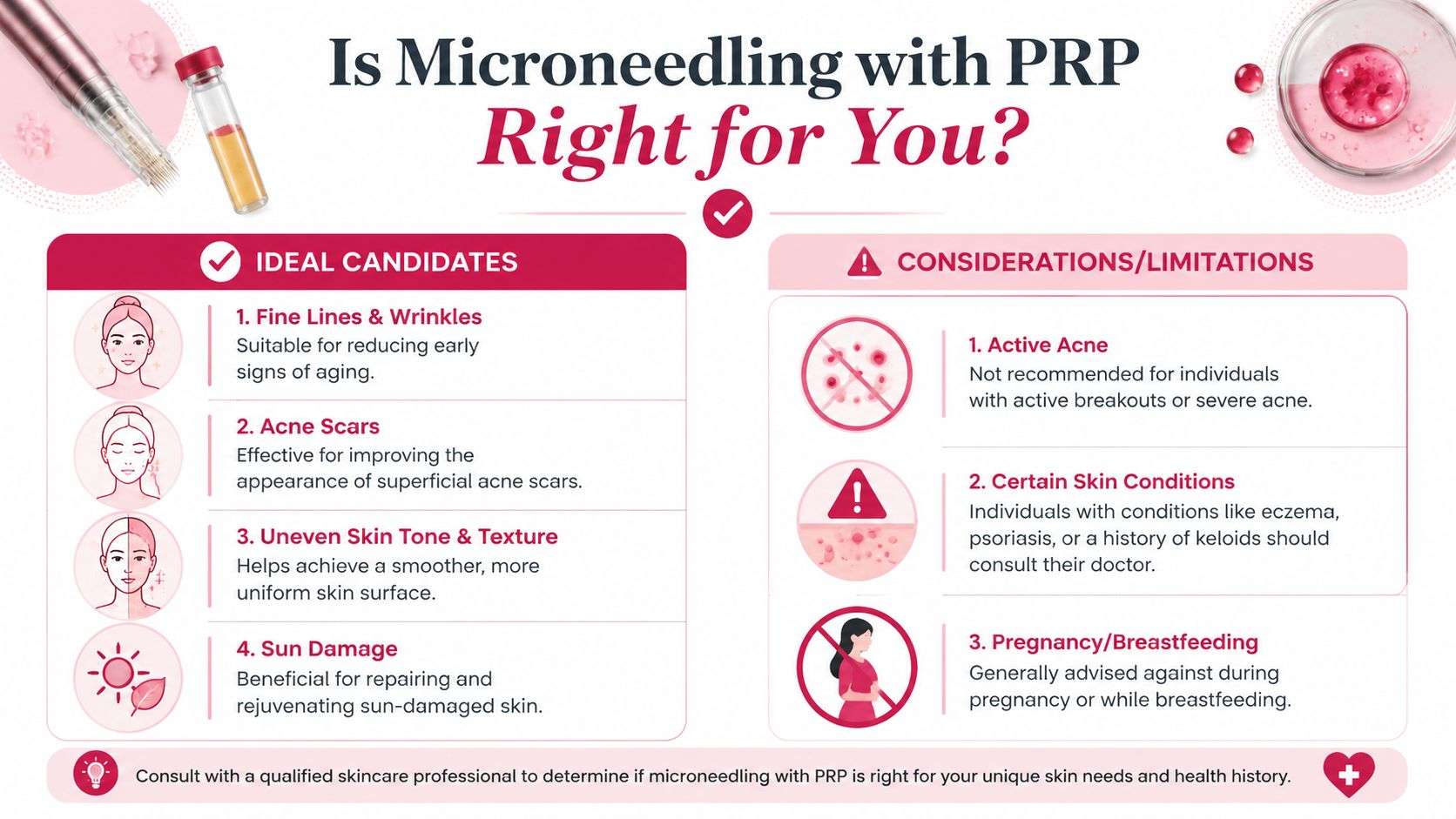
The strongest candidates usually have concerns tied to texture, scarring, or regenerative support.
That often includes:
- Atrophic acne scars: Especially when the goal is gradual softening rather than full resurfacing.
- Uneven skin texture: Mild roughness and superficial irregularity can respond well.
- Enlarged pores and early textural aging: Some patients want refinement more than tightening.
- Certain forms of hair loss: Patients exploring biologic scalp therapies may also want to review dedicated options such as PRP for hair loss.
Patients who prefer a natural mechanism also tend to like this approach because the PRP comes from their own blood rather than a synthetic filler or implantable material.
When to pause or choose something else
Microneedling with PRP isn't appropriate when the skin is actively inflamed or when healing conditions are poor. It's also not the right answer for every cosmetic goal.
Situations that usually call for caution or postponement include:
- Active skin infection: Treatment should wait until the skin is healthy.
- Inflammatory conditions in the area: Facial eczema or psoriasis can worsen with irritation.
- Blood clotting disorders or anticoagulant use: These require medical review before any treatment involving blood draw and skin injury.
- Pregnancy or breastfeeding: Many practices defer elective regenerative treatments during this time.
- Unrealistic tightening goals: If the complaint is laxity, jowling, or sagging, another modality may fit better.
Good candidates don't just want improvement. They have a concern that this specific treatment is built to address.
A consultation should always include a review of skin quality, scarring pattern, healing history, active medications, and overall goals. That's how you avoid doing a reasonable procedure for the wrong reason.
PRP vs Microneedling Alone vs Morpheus8
The most useful comparison isn't which treatment sounds more advanced. It's which one is designed for your actual problem.
The practical difference
Microneedling alone is often enough for patients with mild texture concerns who want collagen stimulation without adding PRP. It can be a sensible choice when skin quality is fairly good and the goal is maintenance or light refinement.
Microneedling with PRP makes more sense when you want a stronger regenerative signal, especially for acne scarring or selected hair-restoration plans. It's less about surface polishing and more about enhancing biologic repair.
Morpheus8 belongs in a different conversation. It combines microneedling with radiofrequency energy and is designed to treat tissue tightening and remodeling at greater depth. Patients with laxity, jawline softening, or a need for more contraction often need this category of treatment rather than PRP-based enhancement. For readers comparing options in that direction, Morpheus8 is typically considered when tightening is part of the goal.
A key reality check comes from the aging data. A 2024 study found a “lack of improvement in signs of skin aging after treatment with PRP” alone, which supports the idea that for non-scarred aging skin, standard microneedling may be enough or PRP's added value may be marginal (2024 PRP aging study).
Comparing Rejuvenation Treatments
| Treatment | Best For | Primary Mechanism | Typical Downtime |
|---|---|---|---|
| Microneedling alone | Mild texture issues, early maintenance, patients who don't need biologic add-ons | Controlled micro-injury that stimulates collagen remodeling | Short downtime with temporary redness and sensitivity |
| Microneedling with PRP | Atrophic acne scars, regenerative texture improvement, selected hair loss cases | Microneedling plus platelet-derived growth factors that support healing and tissue regeneration | Short downtime with temporary redness and sensitivity |
| Morpheus8 | Skin laxity, contour softening, patients needing more tightening than surface improvement | Microneedling combined with radiofrequency energy for deeper remodeling and contraction | Typically more recovery intensity than basic microneedling approaches |
Where patients get confused
Patients often group all of these under “skin rejuvenation,” but they don't solve the same problem. Texture, scar depth, and tissue laxity are different issues.
Recent reporting has also suggested that PRP microneedling can address mild laxity on the abdomen or arms after fat reduction by thickening underlying tissue, but it does not provide the immediate contraction associated with RF-based devices. That's why treatment choice should follow the anatomy, not the trend.
Planning Your Treatment at Georgia Plastic
The most important takeaway is simple. Microneedling with PRP has real value, but its value is specific. It's strongest when used for concerns like atrophic acne scars, selected hair restoration plans, and textural issues that benefit from regenerative remodeling.
It's not the automatic best option for every patient who wants to look younger. If your main issue is non-scarred aging skin, standard microneedling may be enough. If the issue is laxity, jawline softness, or post-pregnancy tissue looseness, an energy-based tightening treatment or a surgical approach may be more appropriate.
That nuance matters in body areas too. Recent data indicates PRP microneedling can “address skin laxity on the abdomen or arms after fat reduction” by thickening underlying tissue, yet it lacks the immediate contraction of RF devices, which is why choosing the right technology requires professional evaluation (discussion of PRP microneedling and laxity after fat reduction).
In practice, many patients do best with a staged plan rather than a one-treatment mindset. A series of 3 to 4 sessions spaced 4 to 6 weeks apart is a common approach for microneedling with PRP, followed by maintenance as needed. The right number depends on the concern being treated, the skin's starting condition, and whether PRP is being used to improve scars, texture, or scalp health.
A thorough consultation should answer a few core questions. What is the target. Is it scar remodeling, tightening, pigment, or volume loss. And which treatment is engineered for that target. That's how you get a plan that is realistic, safe, and worth doing.
If you're considering microneedling with PRP and want honest guidance on whether it fits your skin, hair, or post-pregnancy rejuvenation goals, schedule a consultation with Georgia Plastic & Reconstructive Surgery. The team can help you decide when PRP is the right choice, when standard microneedling is enough, and when a treatment such as Morpheus8 or a surgical option would better match the result you want.