You pull your shirt tight in front of the mirror, brace your stomach, and notice faint lines that disappear as soon as you relax. That moment captures what ab etching lipo can and cannot do. It may sharpen definition that already exists, but it won't create abdominal muscle, remove substantial excess skin, or replace the habits and anatomy that make muscle lines visible.
The procedure sits in a narrow space between conventional liposuction and a tummy tuck. It demands more judgment than reducing fullness alone, because the surgeon must preserve enough fat for a natural surface while selectively deepening the shadows between muscle groups. The most important question isn't whether the operation can produce dramatic photographs. It's whether your starting anatomy can support a balanced result in ordinary lighting, standing naturally, months after surgery.
Table of Contents
- What Ab Etching Lipo Actually Is
- Where the Technique Came From
- Who Makes a Good Candidate
- What Happens on the Day of Surgery
- Ab Etching Compared to Standard Lipo and Tummy Tucks
- Recovery and When Results Show Up
- Risks, Revisions, and the Limits of the Look
- Questions Worth Asking at a Consultation
What Ab Etching Lipo Actually Is
Ab etching lipo is targeted liposuction designed to reveal abdominal definition. Instead of removing fat evenly across the entire abdomen, the surgeon selectively thins the superficial fat along the natural separations between muscle groups. Those landmarks include the central linea alba, the outer linea semilunaris, and the horizontal tendinous intersections that cross the rectus muscles.
The operation doesn't add muscle or make a soft abdomen into a trained one. It removes a limited amount of fat so light creates stronger highlights and shadows over the muscle anatomy you already have. If the underlying abdominal wall is relatively developed and the fat layer is thin, the change may look athletic. If a thicker layer covers the muscles, etching may produce little visible definition or may create lines that look forced.

The difference from ordinary liposuction
Standard liposuction generally reduces broad areas of fullness to improve proportion. Ab etching adds a more delicate layer of work. A thin cannula makes controlled passes through selected planes, preserving surrounding fat while creating shallow grooves over natural muscle boundaries. You can learn more about the broader process in this guide to how liposuction works.
The surgeon isn't carving muscle. The cannula removes fat above the muscle and beneath the skin, and the final appearance depends on swelling, skin recoil, muscle shape, posture, and lighting. The planned lines should follow your anatomy, not a generic six-pack template.
Practical rule: If you don't see at least some abdominal shape when you flex, ask whether weight management or muscle development should come before surgery.
This is a contouring procedure, not a weight-loss treatment. It also can't correct separated abdominal muscles, substantial loose skin, or a protruding abdomen caused mainly by deeper fat inside the abdominal cavity.
Where the Technique Came From
The technique began as a highly selective form of body contouring rather than a routine variation of liposuction. Mentz and colleagues first described abdominal etching in the early 1990s, and historical reviews later identify 1993 as the year the procedure was introduced to enhance abdominal definition in bodybuilders. The original PubMed-indexed report described 25 patients and recorded one complication, which followed placement of a horizontal etching line at the umbilicus. These historical details are summarized in this review of abdominal etching's development.
Early surgeons worked with patients whose low subcutaneous fat made superficial sculpting possible. That experience exposed the central technical problem: removing fat broadly can make the abdomen flatter, but removing it selectively and superficially can create definition only if the surgeon understands how the skin, fat compartments, and muscle landmarks interact.
Why refinement mattered
Early results could look over-marked on patients with softer tissue. Prominent grooves that seemed impressive in a flexed photograph might look unnatural at rest. Modern high-definition protocols evolved by treating the procedure as a problem of restraint, not maximal fat removal. Some surgeons use power-assisted or ultrasound-assisted systems to improve control, while others rely on manual technique. The device matters less than the surgeon's ability to judge depth, preserve transitions, and account for each patient's anatomy.
The technique expanded considerably. The later historical review notes that the senior author had performed the procedure on nearly 1,600 patients by 2019. That growth reflects wider adoption of high-definition liposculpture, but it doesn't erase the original lesson: the method works best when the patient already has a suitable foundation and the surgeon enhances, rather than invents, the abdominal pattern.
Who Makes a Good Candidate
A good candidate is defined more by starting anatomy than by motivation. You may train consistently and still have fat distribution or skin quality that makes etching unsuitable. Another patient may want only a flatter, more balanced abdomen and receive a better result from standard liposuction. If loose skin or separated muscles are the main concerns, a tummy tuck may address the problem more directly.
The published 2018 series included patients with an average age of 36.4 years and an average BMI of 26.7 kg/m². These figures describe one treated group, not an eligibility formula. Your surgeon should examine the thickness and mobility of your tissue, the abdominal wall, skin recoil, and your health rather than approve you from a number alone.
Candidacy at a Glance
| Factor | Good Candidate | Poor Candidate |
|---|---|---|
| Abdominal fat | Relatively thin, pinchable superficial fat | Thick abdominal fat or prominent deeper fullness |
| Skin | Firm enough to redrape over subtle grooves | Significant laxity, hanging skin, or poor recoil |
| Muscle anatomy | Some definition or shape already visible when flexing | Expectation that surgery will create muscle development |
| Weight | Stable and maintainable | Active, substantial weight gain or loss |
| Abdominal wall | No untreated hernia or major muscle separation | Untreated hernia or suspected diastasis needing repair |
| Expectations | Wants refinement and accepts natural variation | Expects a permanent, uniform six-pack in every position |
| Health | Medical conditions controlled and reviewed | Uncontrolled conditions that increase surgical or healing risk |
Etching is selective contouring, not muscle creation. It works best when the underlying landmarks already provide a pattern for the surgeon to refine. A thick layer of fat beneath the skin can conceal those landmarks. Fat inside the abdominal cavity cannot be safely removed with liposuction, so a rounded abdomen from deeper fullness may not flatten as hoped. Weight stabilization may come first.
Symmetry also deserves a realistic discussion. The left and right sides of the abdomen are rarely identical, and posture, breathing, muscle development, scars, and natural skeletal differences affect the final pattern. A surgeon can plan matching grooves, but cannot guarantee a perfectly mirrored six-pack in every position.
Age and skin quality
Older patients can still qualify, although looser skin may soften the grooves after swelling settles. Pregnancy, major weight loss, and previous abdominal surgery can reduce skin recoil or alter the abdominal wall. Etching may improve contour in these situations, but it cannot remove a hanging skin apron or repair separated muscles.
Reconsider the procedure when the primary problem is loose skin, muscle separation, a hernia, substantial deeper abdominal fullness, unrealistic body-image expectations, or an uncontrolled medical condition. A more aggressive cannula cannot correct those problems and may create harsher, less natural transitions.
What Happens on the Day of Surgery
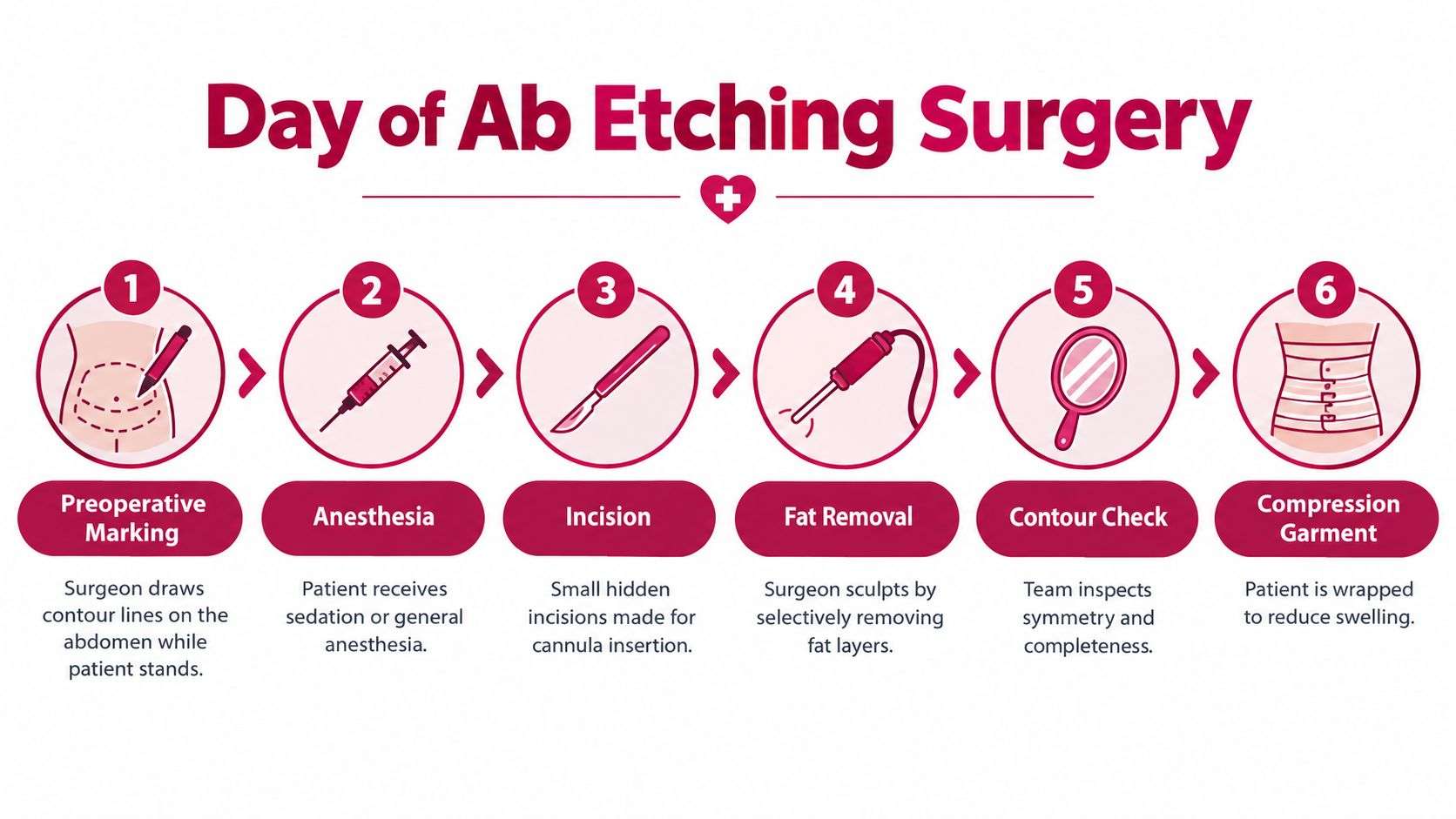
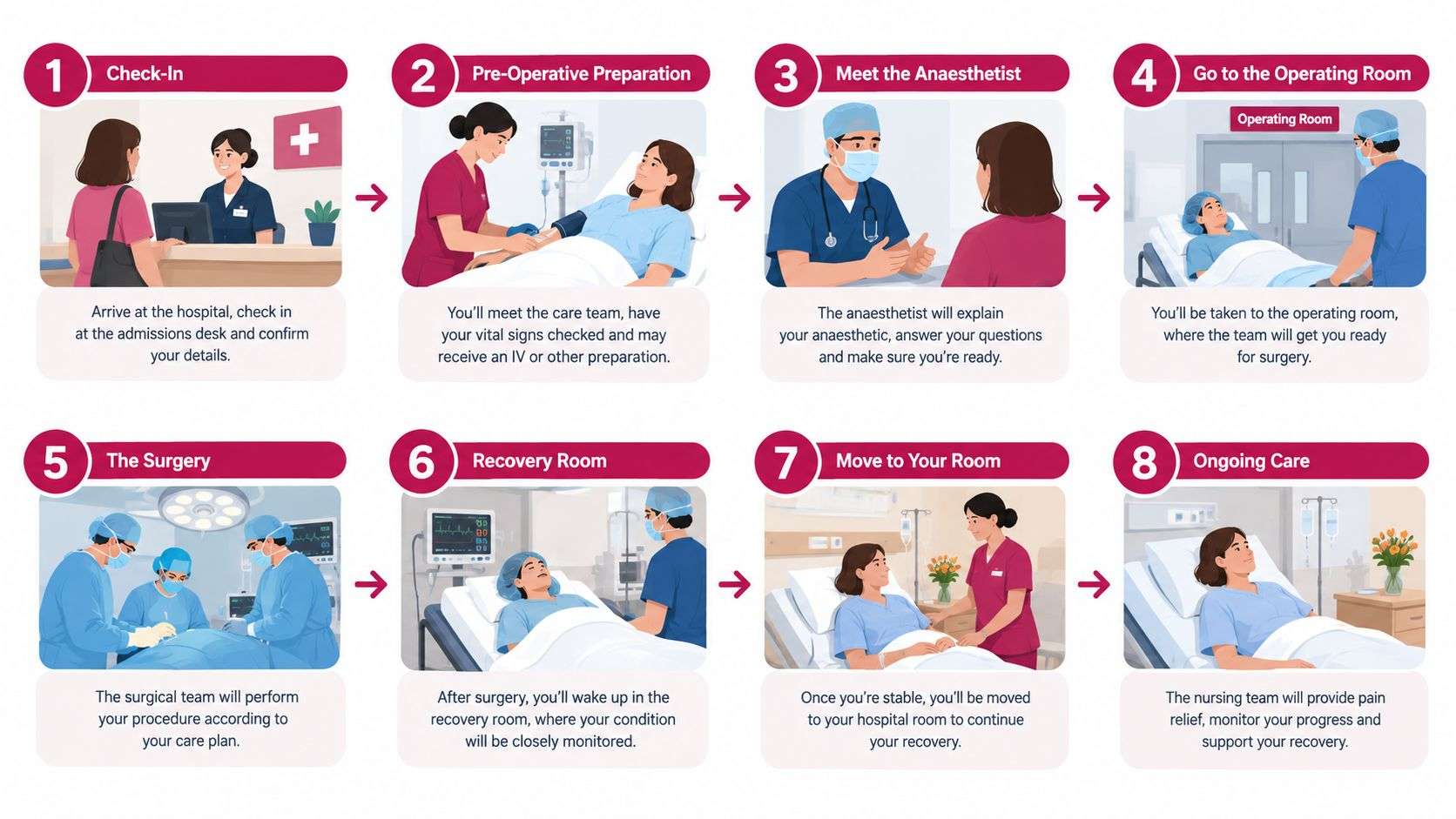
The operation starts before you enter the operating room. While you stand, the surgeon studies your abdomen as you flex, rotate, and relax. Standing reveals how the skin hangs and how the natural shadows change with posture. The surgeon then marks the central line, outer borders, and horizontal intersections that will guide fat removal.
The plan may include the flanks or nearby areas when reducing abdominal definition without balancing the waist would leave the torso looking disproportionate. Ask exactly which areas are included. The anesthesia choice depends on the extent of treatment, your health, and the surgeon's protocol. Some cases use intravenous sedation with local anesthetic, while others use general anesthesia, particularly when a relaxed abdominal wall is important for precise work.
The operative sequence
- Marking: The surgeon draws the planned contours while you're upright, then reviews them again after you lie down.
- Anesthesia and preparation: The team monitors you, cleans the skin, and positions you so the abdomen and any adjacent treatment areas are accessible.
- Tumescent infiltration: A solution containing local anesthetic and epinephrine enters the tissue. It numbs the area, firms the fat, and helps limit bleeding during aspiration.
- Deep contouring: The surgeon removes appropriate volume from broader areas when needed to reduce fullness and establish the overall shape.
- Superficial etching: A smaller cannula makes controlled passes along selected muscle boundaries. This is the high-resolution portion, where excessive removal can produce visible defects.
- Contour assessment: The surgeon compares both sides, checks transitions, and evaluates the abdomen from different angles. Perfect mathematical symmetry isn't possible because native anatomy isn't perfectly symmetrical.
- Incision care: Small access points, often near the navel or pubic region, are managed according to the surgeon's closure plan.
- Compression: Staff apply a garment to support the treated tissue and help control early swelling.
The exact operative time varies with the treatment plan. Your surgeon should explain whether adjacent liposuction is bundled into the same procedure and how that changes anesthesia, recovery, and fees. Waking up, you'll likely notice tightness, soreness, swelling, bruising, and fluid drainage from the access sites. The immediate contour is only an early snapshot, not the final result.
You can prepare more effectively by reviewing this guide to preparing for liposuction surgery, then following the instructions given specifically by your surgical team.
Ab Etching Compared to Standard Lipo and Tummy Tucks
These procedures address different tissue layers, so the right choice depends on what makes the abdomen look full, soft, or loose. Standard liposuction reduces fat volume. Ab etching reduces fat while emphasizing selected muscle lines. Lipoabdominoplasty addresses fat and excess skin, and may include tightening the abdominal wall.
| Feature | Ab Etching | Standard Liposuction | Lipoabdominoplasty |
|---|---|---|---|
| Primary goal | Sharpen existing muscle definition | Reduce localized fat and improve contour | Remove loose skin, reduce fat, and tighten the abdominal wall when indicated |
| Best candidate | Lean patient with firm skin and visible underlying anatomy | Patient with localized fat and adequate skin recoil | Patient with loose skin, post-pregnancy changes, major weight-loss changes, or muscle separation |
| BMI range | No universal cutoff; one published series had an average BMI of 26.7 kg/m² | Assessed individually based on health, fat distribution, and skin | Assessed individually, with attention to skin excess and abdominal-wall condition |
| Skin laxity | Doesn't remove substantial excess skin | Doesn't remove substantial excess skin | Removes selected excess skin |
| Muscle repair | Not included | Not included | May include repair of separated abdominal muscles |
| Scarring | Small cannula access scars | Small cannula access scars | Longer lower-abdominal scar, generally planned within clothing lines |
| Anesthesia | Depends on extent and surgical plan | Depends on extent and surgical plan | Usually requires a more involved anesthetic plan |
| Downtime | Recovery from targeted liposuction and swelling | Recovery from liposuction and swelling | Longer recovery because skin and abdominal-wall work add healing demands |
| Longevity | Fat reduction is durable, but weight changes can alter definition | Fat reduction is durable, but remaining fat can enlarge | Contour can last, but aging, pregnancy, and weight changes still matter |
The key distinction is what each operation can and cannot change. Etching is suited to a patient whose skin already fits the underlying abdominal shape and whose main concern is a modest fat layer hiding muscle contours. Standard liposuction is often more appropriate when the goal is a smoother waist or reduced localized fullness, without deliberately tracing muscle borders.
A patient with loose lower-abdominal skin after pregnancy or major weight loss may need an abdominoplasty component instead. A tummy tuck can remove selected skin and, when indicated, repair separated abdominal muscles. Neither standard liposuction nor etching can substitute for that structural work.
Symmetry also deserves a realistic discussion. Muscle lines are not perfectly identical from side to side, and small differences in fat thickness, rib shape, pelvic position, skin recoil, and healing can affect the final pattern. Etching creates shadows and transitions, much like sculpting a form with light. A slightly deeper pass on one side does not guarantee visual symmetry, and removing too much can leave grooves or depressions that are harder to correct than a less aggressive result.
The procedures may be combined, but they do not compete for the same problem. Etching sits between standard lipo and a full tummy tuck: more targeted and surface-focused than routine fat reduction, but unable to remove substantial skin or repair the abdominal wall. This comparison of liposuction and tummy tuck procedures can help organize the discussion, while an examination determines which tissue layer needs treatment.
Recovery and When Results Show Up
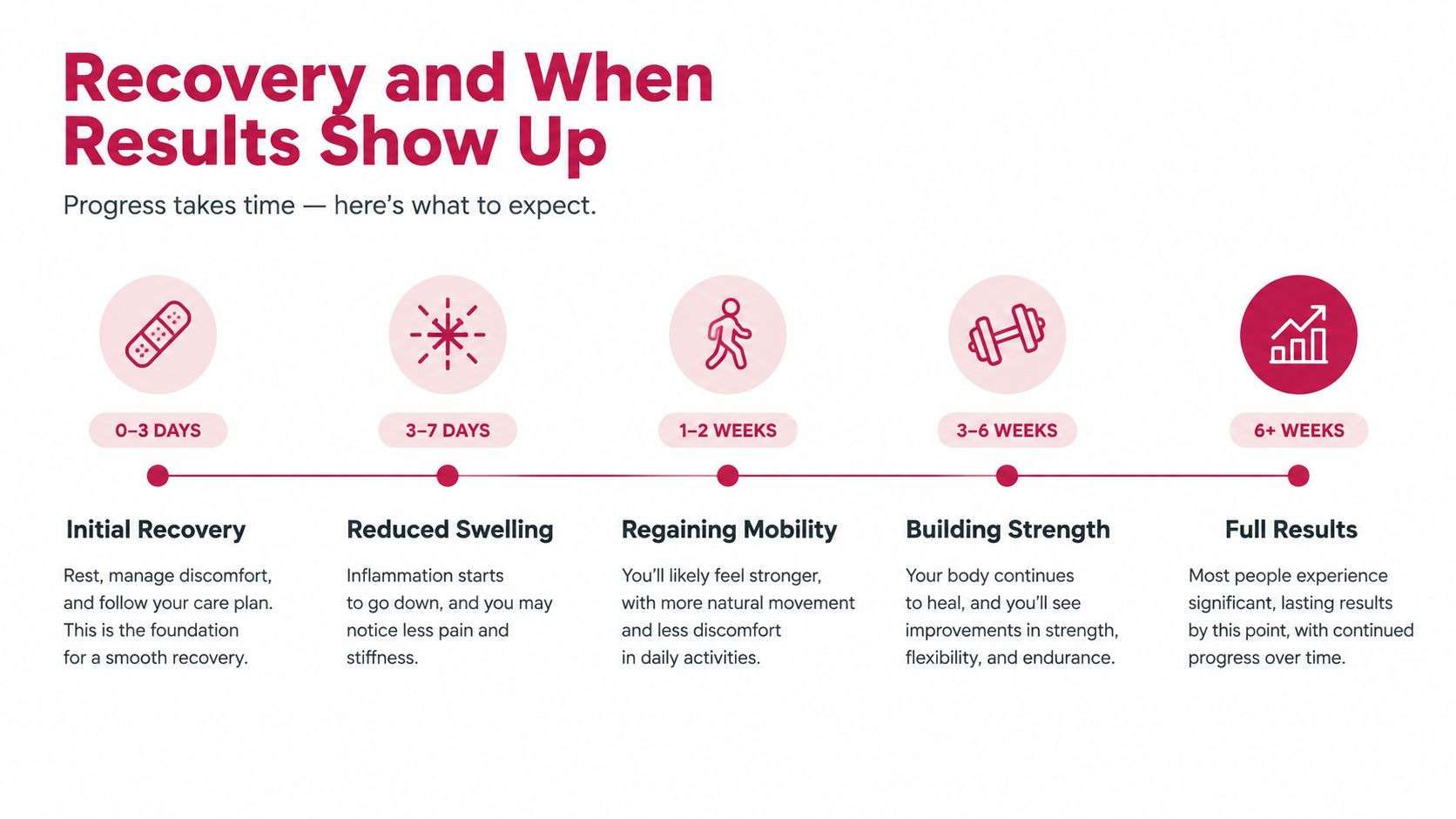
Recovery after ab etching lipo has two timelines. The first is functional, meaning when you can walk, work, and exercise. The second is visual, meaning when swelling and firmness stop obscuring the grooves. Those timelines don't move together, so an abdomen that looks uneven early may still be healing normally.
In the 2018 series of 50 patients, reported minor complications included contour irregularities in 12%, seromas in 10%, and hyperpigmentation in 2%, while the study reported no major complications such as fat embolism, deep venous thrombosis, or intraabdominal injury. Patient satisfaction was 98%, with average follow-up of 27 months. These figures come from a specific series and shouldn't be treated as a personal prediction. Review the published abdominal etching outcome data with your surgeon.
The usual progression
- First week: Expect compression, tightness, bruising, soreness, and possible drainage from the incisions. Light walking is usually encouraged, but your surgeon will set limits based on your operation and health.
- Weeks two and three: Bruising generally begins to settle, while firmness and swelling may remain. Desk work may be possible once your surgeon agrees, but don't assume that feeling better means the tissues are ready for strenuous activity.
- Weeks four through six: Activity usually increases gradually. Numbness, sensitivity, and uneven swelling can persist around the etched areas, and the surface may not yet look smooth.
- Three to six months: Residual swelling and internal firmness continue to resolve. Definition becomes easier to judge, and photographs become more meaningful as the skin adapts to the new contour.
Contact your surgeon promptly for asymmetric swelling that is rapidly worsening, fever, increasing pain after the early recovery period, spreading redness, unusual drainage, or skin discoloration. Chest pain or shortness of breath requires urgent medical attention.
A compression garment isn't interchangeable with a postpartum wrap. If you're comparing support garments or thinking about abdominal support after pregnancy, read this practical resource on safe use of belly wraps after birth. After surgery, follow your surgeon's garment instructions rather than adapting advice from another setting.
Risks, Revisions, and the Limits of the Look
Ab etching isn't a shortcut to a six-pack. It can deepen visible lines, but it can't build the rectus muscles, change their natural insertions, or guarantee definition when you're relaxed, seated, or under flat lighting.
The main technical risk is over-resection, meaning too much fat is removed from a narrow channel. That can create a groove that looks sharp in a photograph but artificial in daily life. The skin may tether to deeper tissue, rippling may become visible, or the abdomen may develop a grid-like pattern instead of soft, believable shadows.
Why symmetry is difficult
Your left and right abdominal halves aren't identical. Muscle insertions, fat thickness, skin recoil, posture, and prior scars can differ from side to side. The surgeon marks you standing, operates with you lying down, and evaluates the final result after swelling and compression affect each side differently.
A review of abdominal etching literature reported 4% irregularities or asymmetries associated with superficial liposculpture, while another report described three contour defects requiring revision and no thromboembolic events. These findings are discussed in this review of abdominal etching risks and outcomes.
A revision can soften an overly deep line, improve a visible depression, or add volume in a defect when appropriate. It can't make naturally different muscle anatomy perfectly identical.
Revision planning should wait until the tissues have substantially settled unless a serious complication requires earlier treatment. A secondary procedure may involve selective fat grafting, additional liposuction, scar management, or simple observation. Sometimes the most honest conclusion is that the original operation was not appropriate for the patient's anatomy, and further surgery would add risk without producing the imagined result.
Questions Worth Asking at a Consultation
Bring questions that force a specific answer. A surgeon who performs high-definition contouring should be able to explain what your anatomy allows, where the proposed lines will sit, and what happens if the result is less even than planned.
A consultation checklist
- Experience: How often do you perform abdominal etching, and can I see unedited before-and-after photographs of patients with a body type, skin quality, and age similar to mine?
- Candidacy: Is my abdominal fullness mainly superficial fat, deeper fat, loose skin, muscle separation, or a combination?
- Technique: Will you use manual, power-assisted, or ultrasound-assisted liposuction, and why is that method appropriate for my tissue?
- Marking: Will you mark the abdomen while I'm standing, flexing, twisting, and relaxed?
- Scope: Are the flanks, waist, or other adjacent areas included, or would treating them require a separate plan?
- Anesthesia: Who provides anesthesia, where will surgery take place, and how will the facility handle monitoring and emergencies?
- Accreditation: Is the surgical facility appropriately accredited, and what observation or discharge arrangements apply?
- Expectations: What will the result look like at rest, without flexing or dramatic lighting? What won't surgery correct?
- Recovery: How long should I expect compression, swelling, numbness, activity restrictions, and follow-up visits to continue?
- Imperfect results: What do you do when one side heals differently, a seroma develops, or a groove looks too deep?
- Revision policy: If revision is medically appropriate, what costs are included and what costs remain my responsibility?
- Total cost: Does the estimate include anesthesia, facility fees, garments, medications, laboratory work, and postoperative appointments?
Ask the surgeon to draw the proposed lines on your abdomen and explain which areas will remain untouched. That conversation often reveals more than a heavily edited gallery. A clear answer may be that you need weight stabilization, muscle repair, skin removal, standard liposuction, or no operation at all.
Georgia Plastic & Reconstructive Surgery offers abdominal etching for men and women as part of its body-contouring services, along with liposuction and tummy-tuck options. You can use the consultation to compare those approaches with your anatomy rather than deciding from photographs alone.
A useful standard: Leave the consultation understanding what the surgeon will remove, what will remain, how symmetry will be judged, and what the plan is if healing doesn't follow the ideal path.
If you're considering ab etching lipo in Atlanta or Marietta, schedule an evaluation with Georgia Plastic & Reconstructive Surgery to discuss your fat distribution, skin quality, abdominal-wall anatomy, and realistic alternatives. Their team can help you determine whether targeted etching, standard liposuction, a tummy tuck, or a non-surgical plan best matches your goals.