The most popular explanation of Smartlipo is also the least complete: “the laser melts the fat away.” That phrase may be easy to remember, but it leaves out the parts that determine whether the result is smooth, natural, and safe. Smartlipo is a minimally invasive surgical technique that uses heat inside the fat layer to disrupt adipose tissue, coagulate small blood vessels, and encourage a degree of collagen remodeling. Suction may then remove the treated fat.
Understanding how Smartlipo works matters because the procedure isn't just a smaller version of traditional liposuction, and it isn't a guaranteed replacement for loose-skin surgery. The outcome depends on your anatomy, skin elasticity, treatment area, energy settings, and the surgeon's control of the fiber beneath the skin.
Table of Contents
- The Science Behind Laser-Assisted Lipolysis
- Step-by-Step Breakdown of the Smartlipo Procedure
- Comparing Smartlipo to Traditional Liposuction Techniques
- Identifying the Ideal Candidate and Treatment Zones
- Navigating the Recovery Timeline and Final Results
- Evaluating the Safety Profile and Thermal Risks
- Preparing for Your Body Contouring Consultation
The Science Behind Laser-Assisted Lipolysis
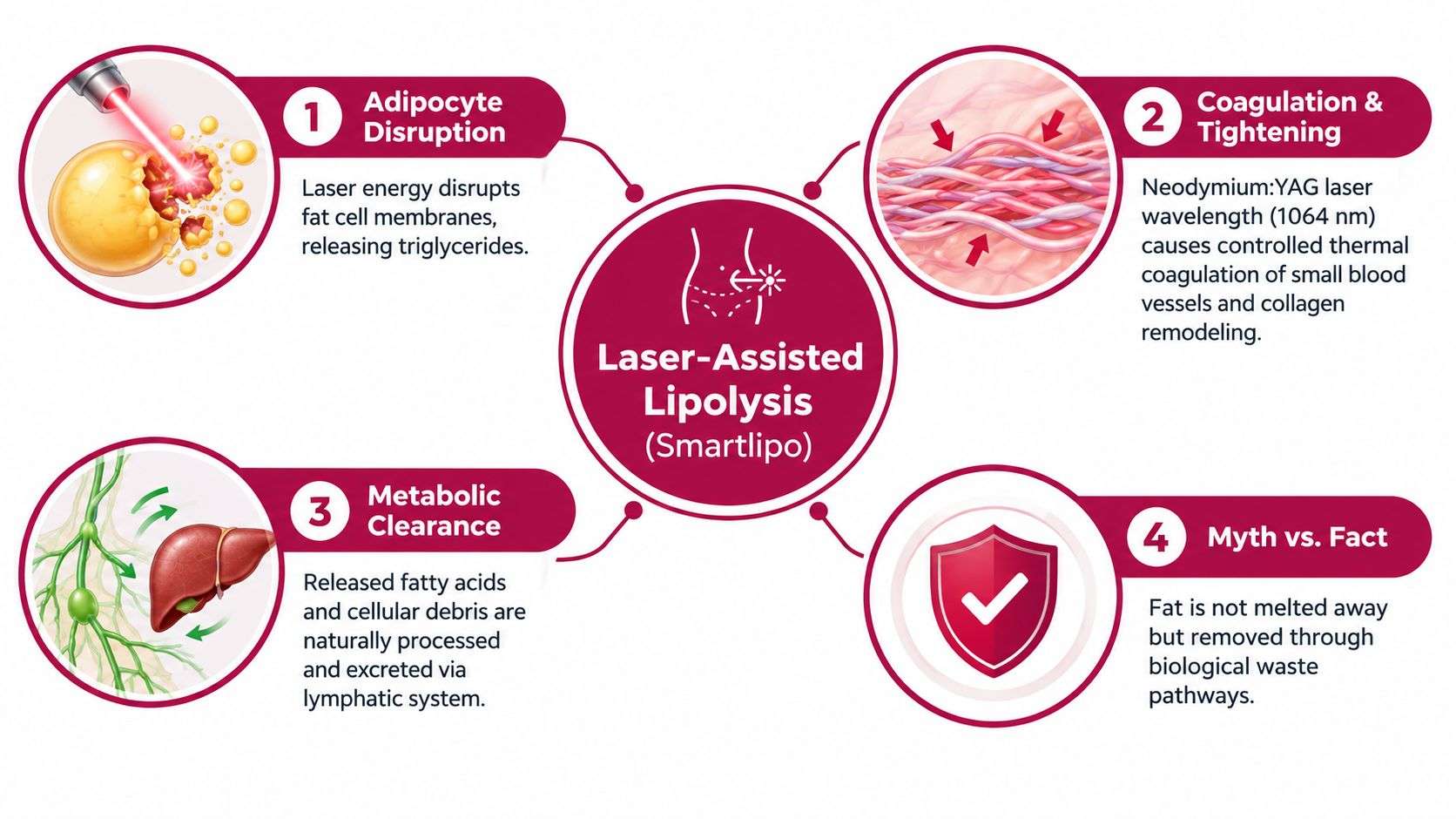
Smartlipo is often described as a laser that “melts fat,” but that explanation misses the procedure's two distinct thermal effects. Laser energy is delivered inside the subcutaneous fat layer, where it changes fat tissue and also affects small blood vessels and collagen. The result depends on wavelength, tissue depth, energy settings, fiber movement, and the surgeon's ability to control heat.
Clinical use expanded after the FDA cleared a 1064 nm Nd:YAG system in October 2006. Later systems added a 1320 nm wavelength and sequential firing, giving surgeons more ways to adjust tissue interaction. This approach is called interstitial photothermal energy because the heat is applied within the fat rather than from the skin's surface. Clinical research on Smartlipo wavelengths and tissue interaction describes the deeper penetration of the 1064 nm wavelength and the more localized heating associated with 1320 nm in fat, water, and collagen.
The fiber does not turn a firm pocket of fat into liquid. Heat disrupts fat-cell membranes and changes the tissue's consistency, which can make cannula removal easier when suction is appropriate. Thermal exposure can also coagulate small blood vessels and affect the collagen network beneath the skin. A clinical review describes heat-driven fat liquefaction and vessel coagulation as the primary effects, with later collagen remodeling that may contribute to limited tightening. A review of laser-assisted lipolysis mechanisms and clinical use therefore supports viewing Smartlipo as a dual-action contouring technique, rather than a standalone fat-melting treatment.
Fat disruption and collagen response
The first effect is fat disruption. Heating makes targeted adipose tissue easier to manipulate and, when indicated, aspirate. The second is thermal coagulation and tissue response. Collagen heating can produce some contraction and later remodeling, but visible tightening is usually modest and depends heavily on technique and skin quality. Smartlipo cannot reliably remove a large amount of hanging skin.
A comparative wavelength study found that lasers in the 900 to 1320 nm range have a penetration depth of roughly 1.5 mm. The wavelength comparison published in clinical literature helps explain why different wavelengths may produce similar lipolysis when heating is controlled. Wavelength alone does not determine the outcome. Depth, fiber movement, exposure time, and total energy also shape the result.
Practical rule: If a consultation focuses only on how much fat the laser can “melt,” ask how the surgeon will protect skin quality, maintain contour balance, and manage heat exposure.
A patient-friendly beginner's guide to laser liposuction can clarify basic terminology. Smartlipo may support both volume reduction and mild tightening, but it is not a universal substitute for traditional liposuction or surgery that removes excess skin.
Step-by-Step Breakdown of the Smartlipo Procedure
Smartlipo is more deliberate than the phrase “laser fat removal” suggests. The laser does not melt fat and finish the job on its own. The procedure combines controlled heating, tissue assessment, and, when appropriate, suction-assisted removal. Your surgeon first examines the treatment area, marks the intended contour, and selects an anesthesia plan based on the location, treatment extent, and medical history. Because the procedure uses an incision, it is minimally invasive surgery, not a surface spa treatment.
Preparation and access
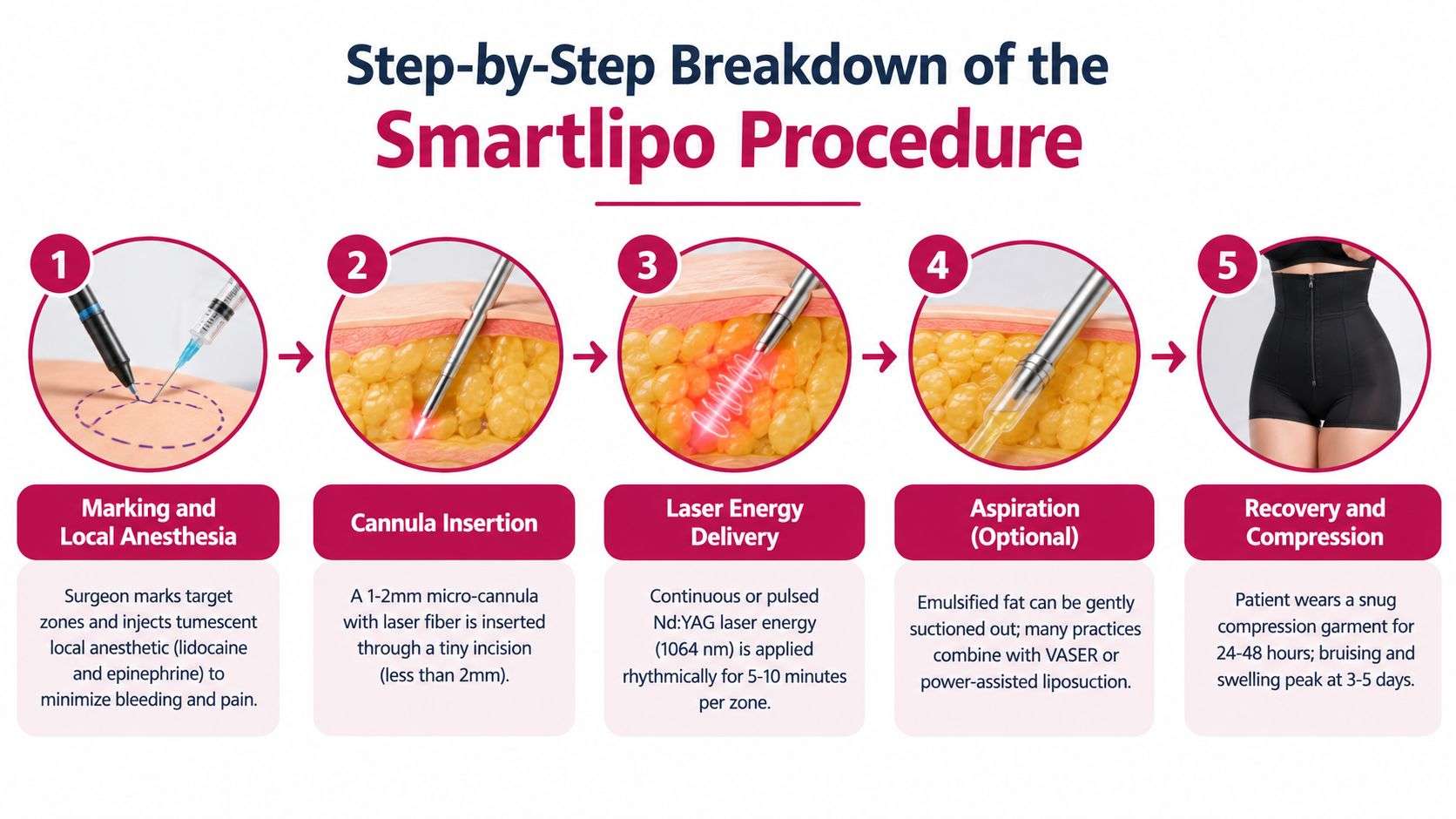
The surgeon usually injects tumescent fluid containing local anesthetic and medication intended to limit bleeding in the treatment field. After the area becomes numb and the markings are confirmed, a small access point permits insertion of a microcannula carrying the laser fiber.
The Smartlipo delivery system uses a microcannula and a 600-µm fiber to direct energy through subcutaneous tissue. Fiber position matters. It must stay within the intended tissue plane as the surgeon moves it methodically through the fat, rather than remaining concentrated in one spot.
Energy delivery and fat removal
The surgeon applies laser energy in a controlled pattern. Wavelength and power settings are selected according to the treatment goal, such as disrupting deeper fat, heating more superficial tissue, or addressing both layers. Clinical descriptions of the Smartlipo MPX system include 20 W of 1064 nm energy plus 10 W of 1320 nm energy for deeper bulk lipolysis, and 10 W plus 10 W for more superficial collagen heating. These settings illustrate why treatment parameters must match tissue depth and the intended effect.
Heat changes the fat, while the surgeon continually assesses tissue response and contour. A suction cannula may then remove the disrupted material. Smartlipo therefore does not always depend on the body processing all treated fat on its own. The laser can assist suction-assisted contouring before or during aspiration.
Technique determines how evenly energy reaches the treatment plane. Excessive exposure in one location can increase thermal injury, while insufficient or uneven treatment may limit the intended tissue response.
What the patient usually feels
With appropriate anesthesia, patients generally notice pressure, movement, or vibration more than sharp pain during the procedure. Tenderness, swelling, bruising, and temporary sensory changes can occur afterward. Follow your surgeon's instructions for compression, wound care, medication, and activity.
The final contour comes from several factors: tissue assessment, controlled fiber movement, selective aspiration, and the body's healing response. The laser contributes to the process, but it does not replace surgical judgment.
Comparing Smartlipo to Traditional Liposuction Techniques
Patients often ask whether laser-assisted liposuction is automatically better than standard suction-assisted liposuction. That isn't the right question. The better question is whether adding controlled laser energy serves your specific goals, particularly when the treatment involves a smaller area or mild skin laxity rather than a large volume of fat.
Traditional liposuction uses a cannula to separate and remove subcutaneous fat. Smartlipo adds an internal laser step that heats the tissue before or alongside aspiration. That added heat may help with tissue coagulation and modest tightening, but it also introduces a procedure-specific thermal risk that standard suction alone doesn't create.
| Feature | Smartlipo, laser-assisted | Traditional suction-assisted |
|---|---|---|
| Primary mechanism | Laser energy disrupts fat and heats the surrounding tissue, followed when appropriate by suction | Mechanical cannula movement loosens and removes fat |
| Skin response | May support modest collagen contraction and remodeling | Relies mainly on the skin's natural retraction after fat removal |
| Typical strength | Precision in selected areas where limited fat reduction and some tightening are desired | Efficient removal of a larger or more substantial fat burden when clinically appropriate |
| Heat exposure | Requires careful control of energy, depth, and temperature | Doesn't add laser heat to the treatment plane |
| Fat removal | Treated fat may be aspirated | Fat is aspirated directly |
| Best decision factor | Whether the patient may benefit from the laser's added tissue effect | Whether direct suction provides the more suitable contouring method |
The two methods are often complementary rather than mutually exclusive. A surgeon may use laser energy in one region and conventional suction in another, depending on tissue thickness and skin quality. Patients comparing options can also review this general resource on body fat reduction by Venus Health, while remembering that a treatment label can't replace an examination.
Where laser energy adds value
Smartlipo may be attractive when the surgeon wants to address a localized deposit and create some thermal effect beneath the skin. It may be considered for areas where access and precision matter, but the benefit won't be identical for every patient. Thick fat, extensive contouring needs, or substantial skin excess can call for a different plan.
A useful comparison of the techniques appears in this guide to laser lipo versus liposuction for fat removal. The decision should rest on the amount of fat, the quality of the skin envelope, the desired degree of contour change, and the surgeon's ability to perform the selected technique safely.
Identifying the Ideal Candidate and Treatment Zones
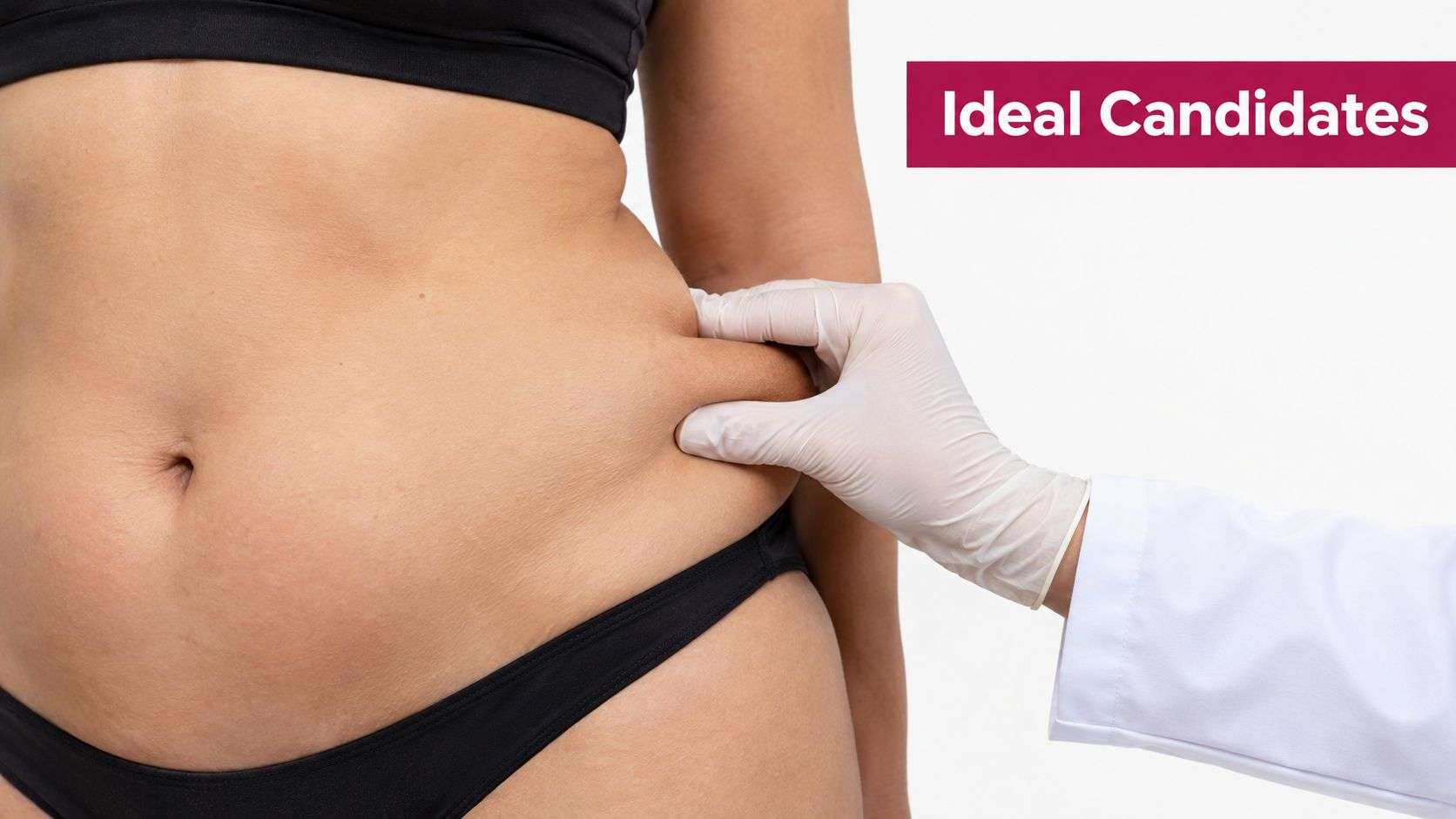
Smartlipo is best suited to a localized contouring problem, not a request for major weight reduction. The strongest candidates generally have a relatively stable weight, a discrete pocket of subcutaneous fat, and enough skin elasticity to adapt after the volume is reduced. A consultation should also rule out fullness caused primarily by loose skin, muscle, visceral fat, or another anatomical feature.
Areas that may respond well
Surgeons may consider laser-assisted lipolysis for carefully selected regions such as:
- Under the chin and neck: A small, localized deposit may benefit from precise contouring when the skin has reasonable elasticity.
- Inner thighs: The surgeon must account for thin tissue, surface irregularity, and the direction in which the skin may settle.
- Bra-line and upper back areas: Small pockets can be assessed for whether they represent removable fat or a combination of fat and skin laxity.
- Arms and abdomen: These areas may be candidates when the concern is localized subcutaneous fullness rather than extensive excess skin.
- Waist and flanks: Treatment requires attention to surrounding transitions so the result doesn't look abruptly hollowed.
The treatment zone isn't selected just because it bothers you in photographs. The surgeon must determine whether the fat lies in a safe, accessible plane and whether removing it will improve proportion. A thin layer of fat beneath loose skin may not produce the smooth result a patient expects.
When another operation may fit better
Significant hanging or folded skin may require an excisional procedure rather than more heat or more suction. For example, a patient with substantial abdominal skin excess may need an abdominoplasty or another body-contouring operation to remove skin directly. Laser energy can't replace that step.
Likewise, Smartlipo isn't a weight-loss procedure. The purpose is to refine a contour after a patient has addressed overall weight and health goals, not to treat generalized obesity. Medical conditions, medications that affect bleeding or healing, smoking, pregnancy, breastfeeding, and prior operations all belong in the candidacy discussion.
A realistic candidate isn't defined by a generic body type. They're defined by a specific fat deposit, workable skin quality, appropriate health, and expectations that match what the technique can accomplish.
Your surgeon should assess both the tissue you want reduced and the tissue you want preserved. Natural contour depends on restraint as much as removal.
Navigating the Recovery Timeline and Final Results
Recovery after Smartlipo unfolds in stages, and the early appearance can be misleading. Swelling may make the treated area look fuller or uneven before the tissues settle. Compression can support the healing tissue planes and help manage edema, but it doesn't make the final contour appear immediately.
The early phase
During the first several days, patients commonly notice soreness, bruising, swelling, tightness, and altered sensation. Small access sites require routine wound care, and your surgeon may recommend compression for a period that reflects the treatment area and extent. Light walking is often part of postoperative instructions, while strenuous activity should wait until your surgical team says it's appropriate.
The first week isn't the time to judge success. Fluid accumulation and inflammation can obscure the fat reduction, and one side may look different from the other while healing progresses.
The settling phase
Over the following weeks, tenderness usually becomes less intrusive, but swelling can remain. Work, driving, exercise, and other activities should be resumed according to your surgeon's instructions rather than a fixed internet schedule. A patient's recovery depends on the treated region, the amount of fat removed, the technique used, and individual healing.
The visible change often becomes easier to assess as the swelling recedes. However, the tightening component develops more gradually because collagen remodeling takes time. The guide to when Smartlipo results become visible can help frame the difference between an early change and a settled result.
What “final” means in practice
A good result is usually evaluated after the tissues have had time to heal and remodel, not during the first postoperative check. Small firmness, numbness, or contour variations may improve as inflammation resolves. Persistent irregularity, fluid collection, increasing redness, worsening pain, or another unexpected change deserves prompt contact with the surgical team.
Don't schedule Smartlipo around the promise of a particular calendar date. Schedule it around the recovery support you'll have available if swelling or tenderness lasts longer than expected.
Maintaining a relatively stable weight helps preserve the contour, but it doesn't stop normal aging or future changes in the body. Your surgeon should explain the likely recovery pattern for your specific area before you consent.
Evaluating the Safety Profile and Thermal Risks
“Minimally invasive” describes the access points, not the absence of risk. Smartlipo places a heat source beneath the skin, so the distinctive concern is thermal injury. Excessive or uneven energy can damage skin, fat, nerves, or other tissue, particularly when the fiber is too superficial, moves too slowly, or delivers more energy than the tissue can safely absorb.
A technical report describes a 1064 nm Nd:YAG system and published clinical use of about 450 joules at 20 Hz and 3 W for lower-blepharoplasty fat reduction. The same FDA material notes that keeping local tissue temperature below roughly 47°C helps reduce burn risk, while higher energy delivery can increase complications such as burns, seroma, edema, and temporary sensory changes. The FDA technical documentation on Smartlipo energy and thermal considerations shows why settings must be individualized rather than treated as a universal recipe.
What the available complication data can and can't tell you
In a report involving 537 cases, laser-assisted lipolysis had a 0.93% local complication rate, including four skin burns and one infection, with no systemic complications reported. The 537-case report on laser-assisted lipolysis complications provides useful context, but it shouldn't be interpreted as a guarantee for an individual patient or practice.
A later review of 88 studies found that reported complications across liposuction-assisted technologies included skin burns, seromas, hematomas, infections, and scars. The review also noted that differences in methods and follow-up make direct comparisons difficult. That uncertainty is important. A low reported rate in one series doesn't mean the technique is risk-free, and it doesn't prove that laser-assisted treatment is safer than standard liposuction for every patient.
A nationwide analysis of 69,424 liposuction patients found an overall complication rate of 1.5%, with laser-assisted liposuction at 0.9%. The analysis and discussion of Smartlipo's role among liposuction techniques also underscore why a lower overall rate shouldn't be confused with a lower chance of contour irregularity or later refinement.
Why the operator matters
Safe treatment depends on tissue thickness, fiber depth, movement, energy selection, temperature awareness, sterile technique, and the surgeon's ability to recognize when to stop. The brand name can't compensate for poor judgment or inadequate monitoring.
Ask who will perform the procedure, how they monitor heat, how they handle a suspected burn or seroma, and what follow-up is included. A consultation should address both common recovery effects and the less common but more serious possibility of thermal damage.
Preparing for Your Body Contouring Consultation
A productive consultation should end with a treatment plan you understand, not just a device name. Bring a complete medication and medical history, mention prior procedures, and describe your goal in practical terms. “I want a smoother jawline” or “I want less fullness at the bra line” gives the surgeon a better starting point than a request for a predetermined amount of fat removal.
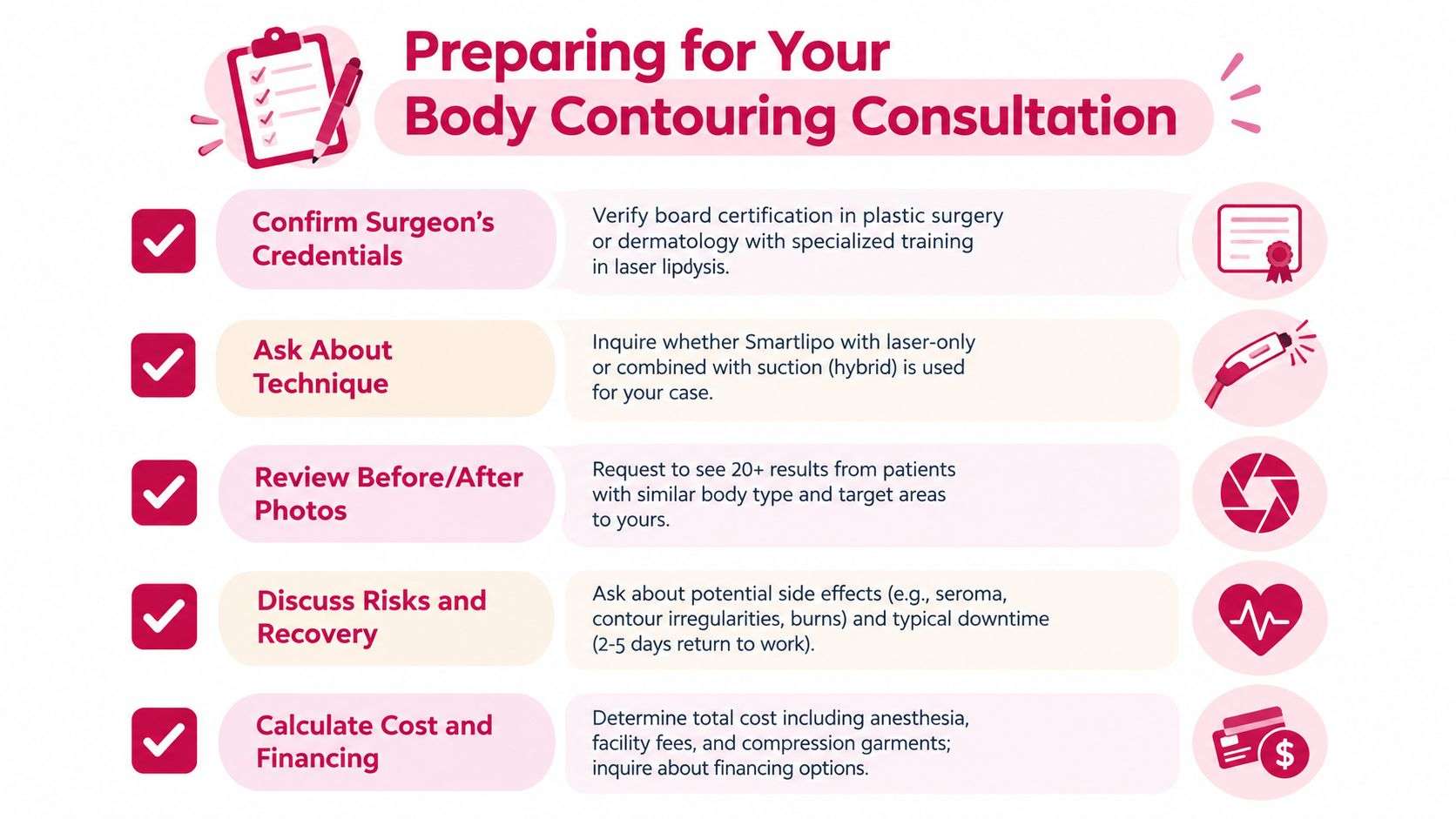
Questions that deserve direct answers
- Who performs the procedure? Confirm the operating clinician's surgical credentials, training, and experience with laser-assisted lipolysis.
- What exactly is the plan? Ask whether the laser will be used alone or combined with suction, and why that choice fits your tissue.
- How is heat controlled? Ask about energy settings, fiber depth, movement, and temperature monitoring.
- What happens if the contour isn't even? Discuss follow-up, observation, and the approach to persistent irregularity or fluid collection.
- Would skin excision fit better? If laxity is substantial, ask whether a body-contouring operation would address the actual problem more effectively.
- What will recovery require? Clarify compression, activity limits, wound care, warning signs, and access to the team after surgery.
Georgia Plastic & Reconstructive Surgery offers Smartlipo and other body-contouring options, including surgical and energy-based approaches. A consultation should compare those choices according to your anatomy rather than assume that one technology suits every patient.
Preparing your body and home
Follow the surgeon's instructions about hydration, medications, supplements, nicotine, and any required medical clearance. Don't stop a prescribed medication without direction from the clinician who manages it. Arrange transportation if required, prepare comfortable clothing, and create a recovery area where you can rest without lifting or rushing.
Bring written questions and take time to consider the answers. The safest decision is an informed one that includes a clear understanding of the mechanism, the thermal risks, the expected degree of tightening, and the possibility that another procedure may be more appropriate.
Georgia Plastic & Reconstructive Surgery provides consultations for Smartlipo, liposuction, and broader body-contouring concerns, with treatment planning based on your anatomy and goals. Visit Georgia Plastic & Reconstructive Surgery to review available options and request a consultation with the practice's plastic surgery team.