The American Society of Plastic Surgeons lists an average surgeon fee of $5,587 for gynecomastia surgery, but the all-in price typically ranges from $4,800 to $15,000 or more once anesthesia, facility charges, and supplies are included. That headline fee is only one part of what you'll pay.
The gap matters because many patients compare surgeon fees as if they were complete surgical prices. They aren't. A safe, properly planned procedure produces a bill built from several separate services, and the extent of tissue removal can shift the final number by thousands of dollars.
Table of Contents
- The All-In Price of Gynecomastia Surgery
- Breaking Down Every Line Item on Your Bill
- How Severity Grade Drives Your Final Cost
- Geography and Surgeon Credentials as Price Multipliers
- Insurance Coverage and the Approval Reality
- Financing Options and Smart Budgeting Strategies
- Your Next Steps Toward a Confident Decision
The All-In Price of Gynecomastia Surgery
The $5,587 ASPS average surgeon fee is a useful professional benchmark, but it excludes anesthesia, operating-room or facility charges, and related expenses. The American Society of Plastic Surgeons cost guide identifies it as a surgeon-fee figure, not the amount that necessarily leaves your bank account.
Published consumer estimates place the broader U.S. procedure range at roughly $4,800 to $15,000, with all-in averages reported around $8,825 and $9,115. The figures vary with geography, surgeon credentials, and case complexity. Independent national pricing guidance provides market context, not a personalized quote.
Why the headline number falls short
Your final bill usually combines three central charges:
- Surgeon fee: Examination, treatment planning, operative skill, and the procedure itself.
- Anesthesia: The anesthesia professional's fee, medications, and monitoring required for your operation.
- Facility: The operating room, staff, equipment, recovery area, and facility overhead.
Post-operative supplies, including compression garments, may appear separately. Prescriptions, pathology, additional testing, and revision-related care may also sit outside the initial estimate, depending on the practice.
Severity changes the balance between these charges. Fatty fullness treated with liposuction requires a different operative plan from firm glandular tissue requiring excision. Significant skin excess or revision surgery adds planning, operating time, and follow-up needs. Your quoted price should identify which of these services your case requires.
A low surgeon fee does not guarantee a low total. One practice may quote only its portion, while another presents a bundled figure that includes anesthesia and facility charges. You are comparing different scopes of care until each quote lists the same line items. This breakdown of plastic surgery fees explains how those charges are commonly structured.
What you should budget for
Use the full U.S. market range for planning, not the isolated surgeon fee. Mild cases may sit near the lower end. Combined liposuction and gland excision, substantial skin removal, or revision work can push the total toward the upper end or beyond it.
Practical rule: Ask for your complete patient responsibility in writing before comparing practices. Confirm whether anesthesia, facility use, garments, pathology, prescriptions, follow-up visits, and possible revision care are included.
Ask one precise question: “What is my total cost, what treatment does it cover, and which charges could still be added?”
Breaking Down Every Line Item on Your Bill
A transparent quote should let you trace the total from the operating plan to the final payment. The surgeon fee is often the largest visible component, but it usually accounts for only 40% to 60% of the total bill, according to published gynecomastia pricing guidance from Gynecomastia.org.
Facility fees commonly add about $1,000 to $2,500, while compression garments may add $200 to $500, from the same pricing reference. These aren't trivial extras. They can determine whether a quote that looks affordable remains affordable after the remaining charges arrive.
The four charges to compare
| Cost Component | Typical Range | Share of Total |
|---|---|---|
| Surgeon fee | $5,587 average | 40% to 60% |
| Anesthesia | Varies by procedure and operating time | Part of remaining total |
| Facility fee | About $1,000 to $2,500 | Variable |
| Compression garments | About $200 to $500 | Variable |
The surgeon fee reflects the technical work. Liposuction, gland excision, skin removal, and contour refinement require different levels of planning and operative time. A case involving only fatty fullness won't be priced the same way as a case requiring firm glandular tissue removal and skin management.
Anesthesia charges rise when the operation becomes longer or more involved. The exact amount depends on the anesthesia plan, the professional providing it, and the facility arrangement. Don't assume anesthesia is included just because someone says the procedure costs a certain amount.
Facility charges deserve close attention
Facility pricing covers more than a room. It can include operating-room equipment, nursing personnel, sterile supplies, monitoring, recovery services, and the facility's operating expenses. Two surgeons may quote similar professional fees while using facilities with very different pricing structures.
Ask whether your quote includes:
- Anesthesia: Confirm whether the anesthesia professional's fee is included.
- Facility services: Ask for the operating-room and recovery charges.
- Garments: Find out whether one or more compression garments are provided.
- Follow-up care: Confirm which routine post-operative visits are included.
- Additional treatment: Ask how pathology, prescriptions, complications, and revisions are handled.
A bundled quote can be convenient, but itemization still matters. It lets you compare like with like and shows whether a lower advertised price leaves more charges outside the package.
A quote isn't transparent because it has one total. It's transparent when you can see what created that total.
How Severity Grade Drives Your Final Cost
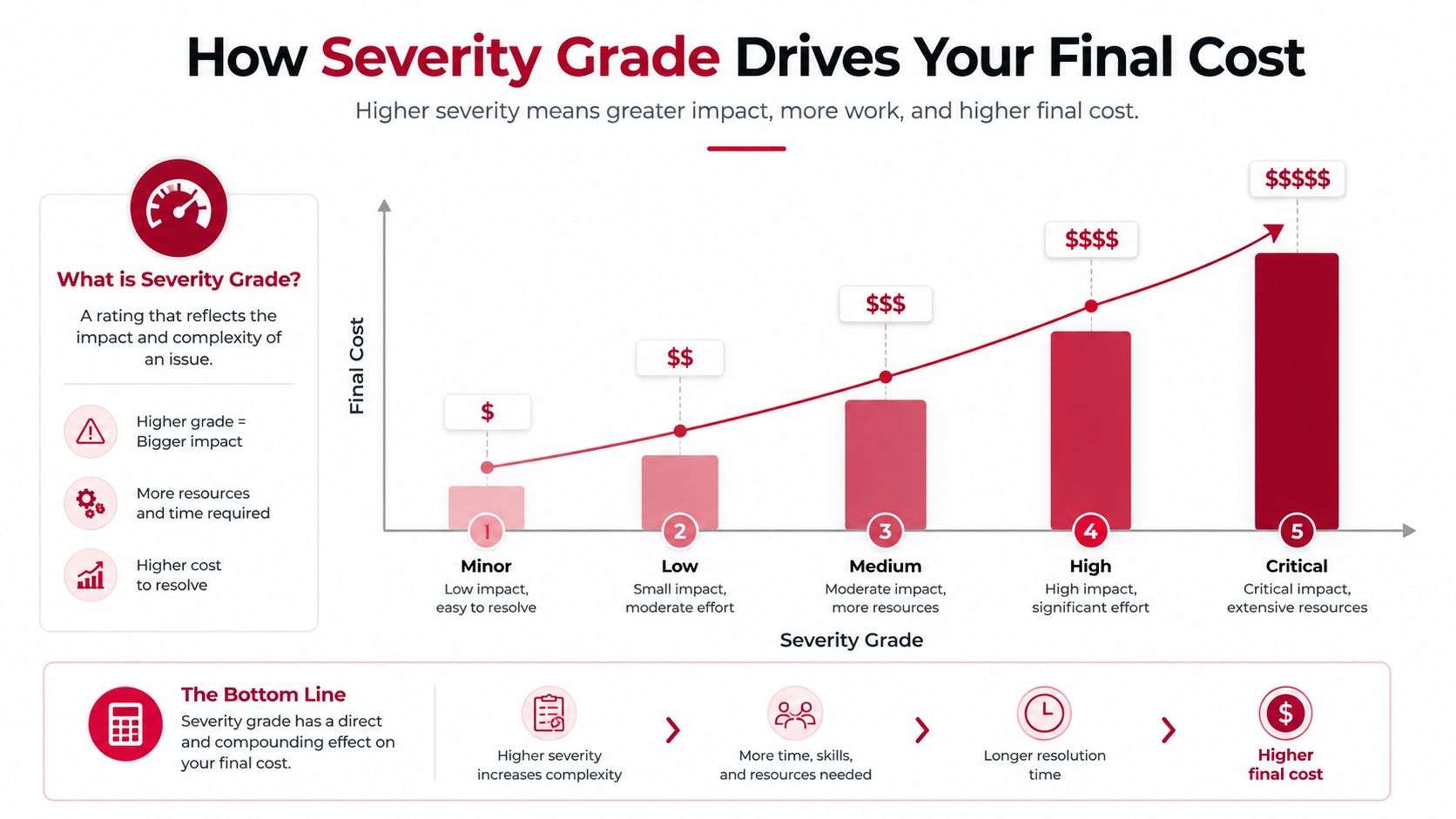
The most useful way to predict gynecomastia surgery cost is to start with case complexity, not a generic average. A small puffy-nipple presentation may need limited excision or liposuction. Advanced enlargement can require gland removal, broader contouring, skin excision, and more extensive management of the nipple-areola area.
Published pricing guidance shows a stepwise increase from about $7,750 to $8,500 for mild type 1 cases to approximately $15,000 to $16,500 for severe type 5 cases. When front-and-back upper-body contouring is added, estimates can reach $16,000 to $18,000, as outlined in severity-based gynecomastia cost guidance.
Mild cases need less operative work
In a mild case, the enlargement may be concentrated behind the nipple with minimal skin laxity. Liposuction can address fatty fullness, while a small incision may allow removal of firm glandular tissue. Because the treatment area and operative plan are limited, anesthesia exposure and facility use are usually lower than they are in advanced cases.
That doesn't mean the surgeon can accurately price the operation from a photo alone. The surgeon must determine whether the chest contains fat, gland, loose skin, or a combination. The treatment plan, not the label “mild,” controls the quote.
Advanced cases add time and technique
More severe cases may involve a larger skin envelope, chest-roll deformity, or substantial tissue redundancy. The surgeon may need to combine liposuction with gland excision and skin removal, then manage the remaining contour carefully. Each additional step adds operative complexity and can increase anesthesia and facility costs.
Patients should also understand that “liposuction only” isn't appropriate for every chest. Firm glandular tissue generally requires direct excision, while loose skin may need a separate strategy. You can review the procedural options in this guide to how male breast reduction surgery is performed.
Ask for a grade-specific quote
Your consultation should produce more than a price. Ask the surgeon to identify the severity of your case and connect that assessment to the planned technique. Then request separate figures for surgeon, anesthesia, facility, garments, and any possible revision coverage.
A quote that says “gynecomastia surgery” without explaining the technique is incomplete. Two patients can have the same diagnosis and receive very different recommendations because their tissue distribution and skin quality aren't the same.
Geography and Surgeon Credentials as Price Multipliers
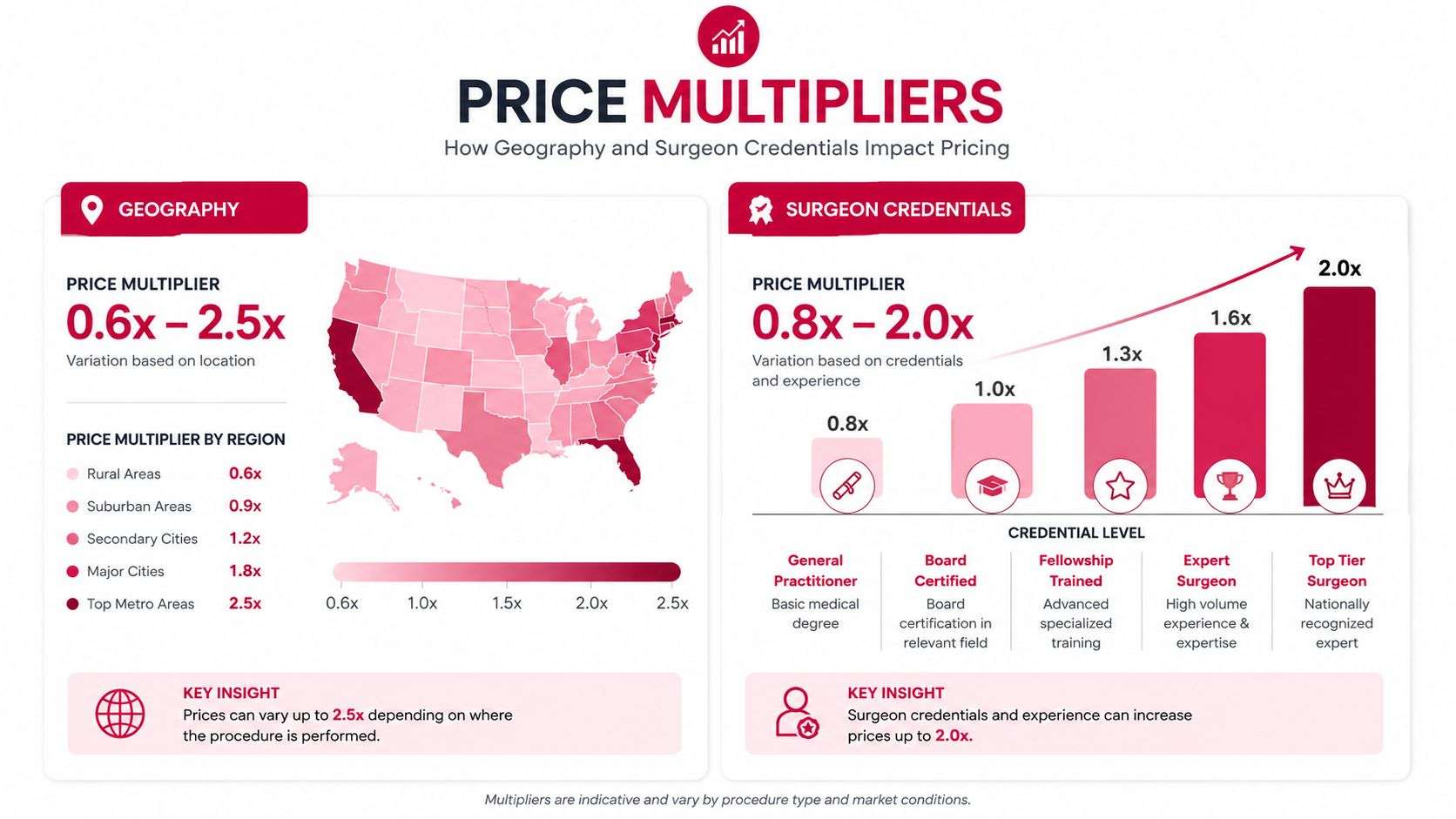
Geography can shift the baseline price substantially. National all-in estimates sit around $8,825, while high-cost markets such as New York City commonly reach $6,800 to $13,000 or more, according to market-specific gynecomastia pricing data. Treat those figures as market context, not a personal quote. Your anatomy and surgical plan still determine the final bill.
Regional overhead, staffing, facility expenses, and local demand drive much of that difference. A surgeon's fee may look similar across cities, while operating-room charges, anesthesia, garments, and follow-up arrangements create a different all-in total. Compare the complete estimate, not the headline fee.
Credentials affect more than the fee
A board-certified plastic surgeon with focused experience in male chest contouring may charge more than a provider who performs the procedure infrequently. That higher fee can reflect surgical training, operating-room standards, anesthesia coordination, judgment about gland and fat removal, and experience correcting asymmetry or contour problems.
Verify the details behind the advertised credentials. Ask who performs the operation, where it takes place, how the surgeon distinguishes gland from fat, and how often the practice treats cases like yours. Experience with straightforward cases does not establish experience with skin excess, revisions, or major asymmetry.
Request the surgeon's credentials, facility information, and a written explanation of what the fee includes. A higher surgeon fee can be reasonable when it comes with an appropriate technique, qualified support, and defined follow-up.
Travel requires a complete cost calculation
Travel can make the quoted procedure look cheaper while raising your actual spending. Add transportation, lodging, meals, time away from work, and the cost of returning for examinations if swelling, fluid buildup, wound problems, or contour concerns develop.
Local care has practical value. You can attend appointments without flights, and your surgeon can assess healing in person. If you travel, ask who handles complications after you return home, how urgent examinations are arranged, and whether follow-up visits are included in the quote.
Compare the surgeon, technique, facility, anesthesia, follow-up, travel, and revision terms together. The lowest advertised fee is not the lowest total cost when necessary care sits outside the estimate.
Insurance Coverage and the Approval Reality
Most patients should assume gynecomastia surgery will be self-pay until their insurer confirms otherwise. Coverage often depends on whether the policy recognizes the procedure as medically necessary, and many plans treat male breast reduction as cosmetic.
The approval process is less consistent than patients expect. A review of 61 insurer policies found that 38% had no well-defined gynecomastia policy and instead evaluated cases individually, as reported in the policy review indexed by PubMed. That uncertainty can create a second cost problem, because patients may spend time and money pursuing documentation without knowing whether the claim fits the policy.
Medical necessity requires documentation
Pain, persistent tenderness, functional limitation, or an underlying medical condition may support an argument for coverage in some policies. None of those factors guarantees approval. The insurer will apply its own criteria, exclusions, pre-authorization rules, and documentation requirements.
If you want to pursue coverage, gather records before scheduling surgery:
- Medical history: Document how long the enlargement has persisted.
- Symptoms: Record pain, tenderness, skin irritation, or functional limitations.
- Prior evaluation: Include relevant examinations, testing, and treatment of possible causes.
- Policy criteria: Request the insurer's written requirements for pre-authorization.
- Appeal process: Ask how a denial can be challenged and what supporting records are needed.
A surgeon's office may help organize clinical records, but the insurer makes the coverage decision. Don't confuse a consultation, a submission, or a pre-authorization request with an approved benefit.
Self-pay may be the more predictable route
When policy language is vague, self-pay can provide a clearer financial path. You still need an itemized quote, but you won't be waiting for an insurer to interpret an undefined policy after you've invested in appointments and paperwork.
If your symptoms are significant, pursue medical evaluation first. Treating an underlying cause may change the surgical plan, and a complete medical record gives any coverage request a stronger foundation.
Financing Options and Smart Budgeting Strategies
Financing should make a carefully chosen procedure manageable, not push you toward an unsafe bargain. Start with the complete surgical total, then evaluate the monthly payment, interest rate, promotional terms, fees, and consequences if you need more time to repay.
Common pathways include medical credit lines, personal loans, and payment plans offered through a surgical practice. Each option can work, but the lowest advertised monthly figure may hide a longer repayment period or higher total cost.
Build the budget from the final quote
Before applying for financing, request a written estimate that separates:
- Surgical services: Surgeon, anesthesia, and facility fees.
- Supplies: Compression garments and other required items.
- Medical preparation: Any consultation, testing, or medication costs.
- Recovery expenses: Prescriptions, transportation, and time away from work.
- Contingencies: The practice's policy for complications and revisions.
A practice may offer a financing pathway for gynecomastia surgery. You can review the available financing options and compare their terms with independent borrowing.
Questions to ask before signing
Promotional zero-interest periods require careful reading. Confirm the deadline, the regular rate after promotion, the minimum payment, and whether interest can be charged retroactively under the agreement. Ask what happens if the surgery is postponed or canceled.
For an in-house plan, ask whether the practice requires a deposit, when the balance must be paid, and whether the plan covers only the procedure or also garments, medications, and follow-up. Get every promise in writing.
Save money without cutting safety
Cost-conscious decisions should focus on waste, not on the surgeon's qualifications or the facility's safety standards. An itemized quote prevents you from paying for services you don't need, while a clear revision policy protects you from misunderstandings later.
Avoid choosing a provider solely because the advertised price is dramatically lower. A lower number may reflect a simpler technique, excluded facility charges, limited follow-up, or a different standard of care. Financing a properly planned operation is safer than financing a bargain that leaves you needing additional surgery.
Your Next Steps Toward a Confident Decision
Two patients can walk into the same practice with the same diagnosis and receive different gynecomastia surgery cost estimates. One may need limited liposuction and gland excision, while another may need broader contouring and skin management. The difference comes from anatomy, technique, operative time, facility use, geography, and the completeness of the quote.
Your consultation should answer practical questions, not just confirm that surgery is possible.
- What exactly is present? Ask whether your fullness is fat, glandular tissue, loose skin, or a combination.
- What technique is planned? Confirm whether the surgeon recommends liposuction, excision, skin removal, or combined treatment.
- What is the total price? Request separate surgeon, anesthesia, facility, garment, and follow-up charges.
- What isn't included? Ask about prescriptions, pathology, additional testing, complications, and revisions.
- Who will provide care? Verify the surgeon's board certification, facility setting, anesthesia arrangements, and follow-up plan.
Don't accept a bundled estimate that gives you no way to compare it with another quote. The best financial decision is the one based on a clear operative plan and a complete patient responsibility, not the lowest number on a search page.
Georgia Plastic & Reconstructive Surgery provides gynecomastia surgery consultations, individualized treatment planning, recovery guidance, and financing information for patients evaluating male breast reduction. Schedule a consultation when you're ready to have your anatomy assessed and your total cost explained in writing.
Visit Georgia Plastic & Reconstructive Surgery to request a consultation for gynecomastia surgery and receive a treatment plan based on your severity, technique, and line-item costs. Their team can also explain available financing and what your quoted price includes before you commit.