Most breast implant sizing advice starts with the wrong question: “What cup size do you want to be?” A request to go from a B cup to a D cup sounds specific, but it doesn't give a surgeon a dependable implant volume or tell them whether that volume will fit your chest. Bra labels vary across manufacturers, while implants are measured in cubic centimeters, or cc, and must also match your breast width, tissue coverage, and desired projection.
A useful breast implant sizing guide should help you replace a fashion-size target with a clinical plan. The right implant isn't the largest volume you can choose. It's the implant whose dimensions and shape fit your breast envelope while supporting the look you want and the long-term health of your tissues.
Table of Contents
- Why Bra Cup Size Is a Misleading Starting Point
- The Measurements That Actually Determine Your Implant Size
- Understanding Cubic Centimeters and Visual Volume
- Preview Tools and How to Use Them Effectively
- Balancing Aesthetic Goals with Long-Term Tissue Health
- Building Your Personalized Sizing Plan for Consultation Day
Why Bra Cup Size Is a Misleading Starting Point
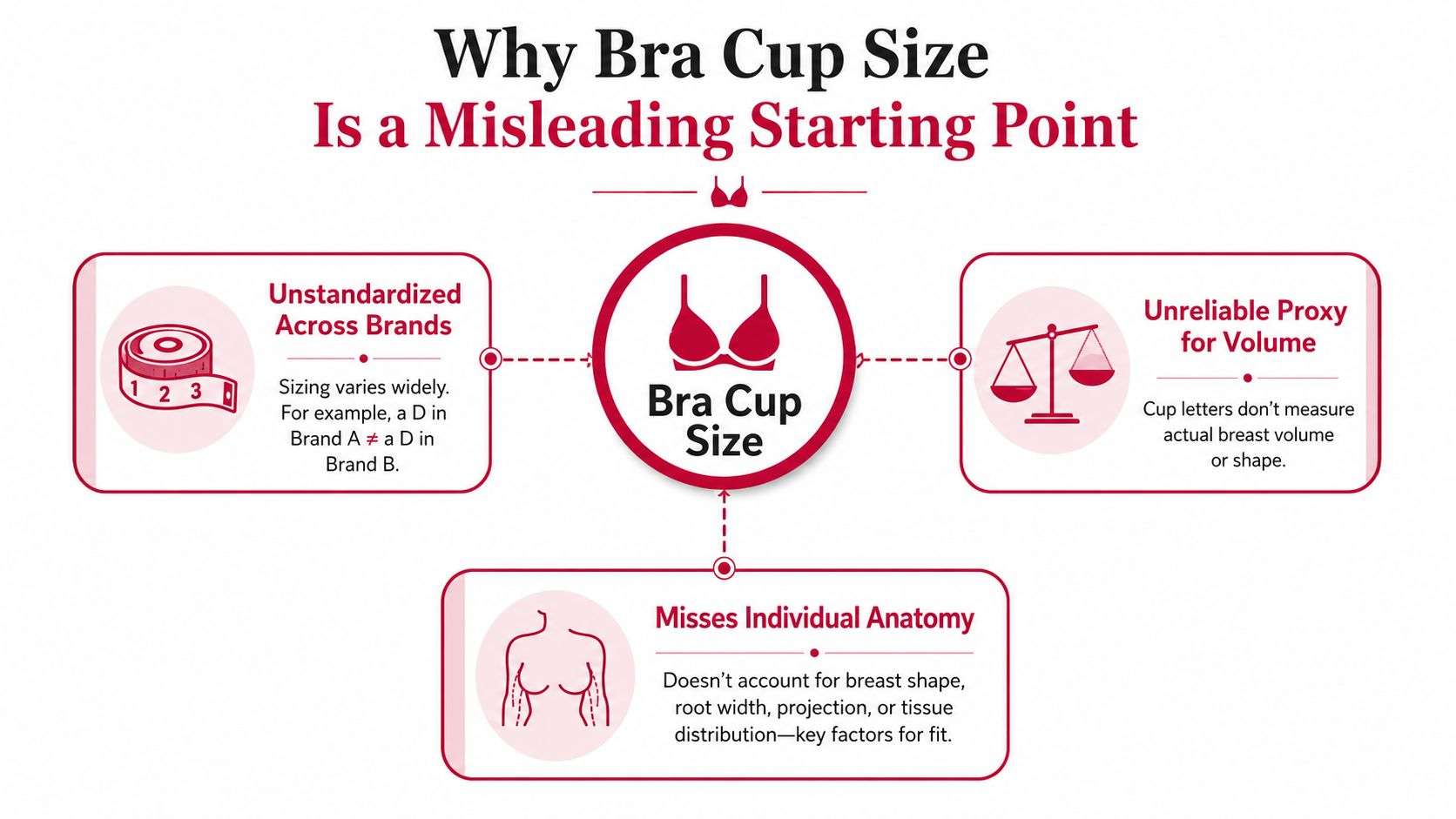
Bra cup size looks objective because it appears on a tag. In practice, it combines a band measurement with a cup label that isn't standardized across manufacturers. A D cup in one brand may have a different volume and shape from a D cup in another, so the letter can't be converted into one fixed implant size.
A 2017 study comparing bra brands found that one cup-size increase represented an average of 135 cc in the laboratory arm and 138.23 cc in the clinical arm. The researchers advised patients that roughly 130 to 150 cc generally corresponds to one cup-size increase, with narrower band widths tending toward the lower end and wider bands toward the higher end. That range is useful context, not a promise about your postoperative bra size. Read the PubMed study on bra cup volume differences.
Why the same implant looks different
Two patients can receive the same volume and see very different results. A wider chest may distribute that volume across a broader base, creating a softer visual change. A narrower chest may show more projection and upper-pole fullness from the same implant.
Your existing tissue matters just as much. A patient with more breast tissue may have a gradual transition over the implant, while someone with thin coverage may show implant edges or rippling more readily. Skin elasticity, breast shape, muscle anatomy, and the position of the fold all affect the final contour.
Practical rule: Use your preferred cup size to describe an aspiration, not to prescribe an implant.
What surgeons mean by volumetric planning
Surgeons discuss cc because it provides a consistent unit for comparing implant options. But volume alone still isn't enough. A complete plan considers the implant's base width, height, projection, profile, placement, and relationship to your tissue envelope.
A systematic review found stronger support for tissue-based planning than for older industry-standard approaches. It also noted that bra sizing could underestimate implant volume by an average of 246 cc, which reinforces why a cup-size conversion isn't a sound surgical method. Review the evidence on tissue-based implant planning.
The Measurements That Actually Determine Your Implant Size
A breast implant consultation should be an anatomical assessment, not a shopping exercise. The surgeon measures your breast envelope, examines the tissue available to cover the implant, and then compares those findings with your aesthetic goals. A preferred cup size can describe the result you want, but it cannot determine which implant dimensions your body can support.
Start with the breast base
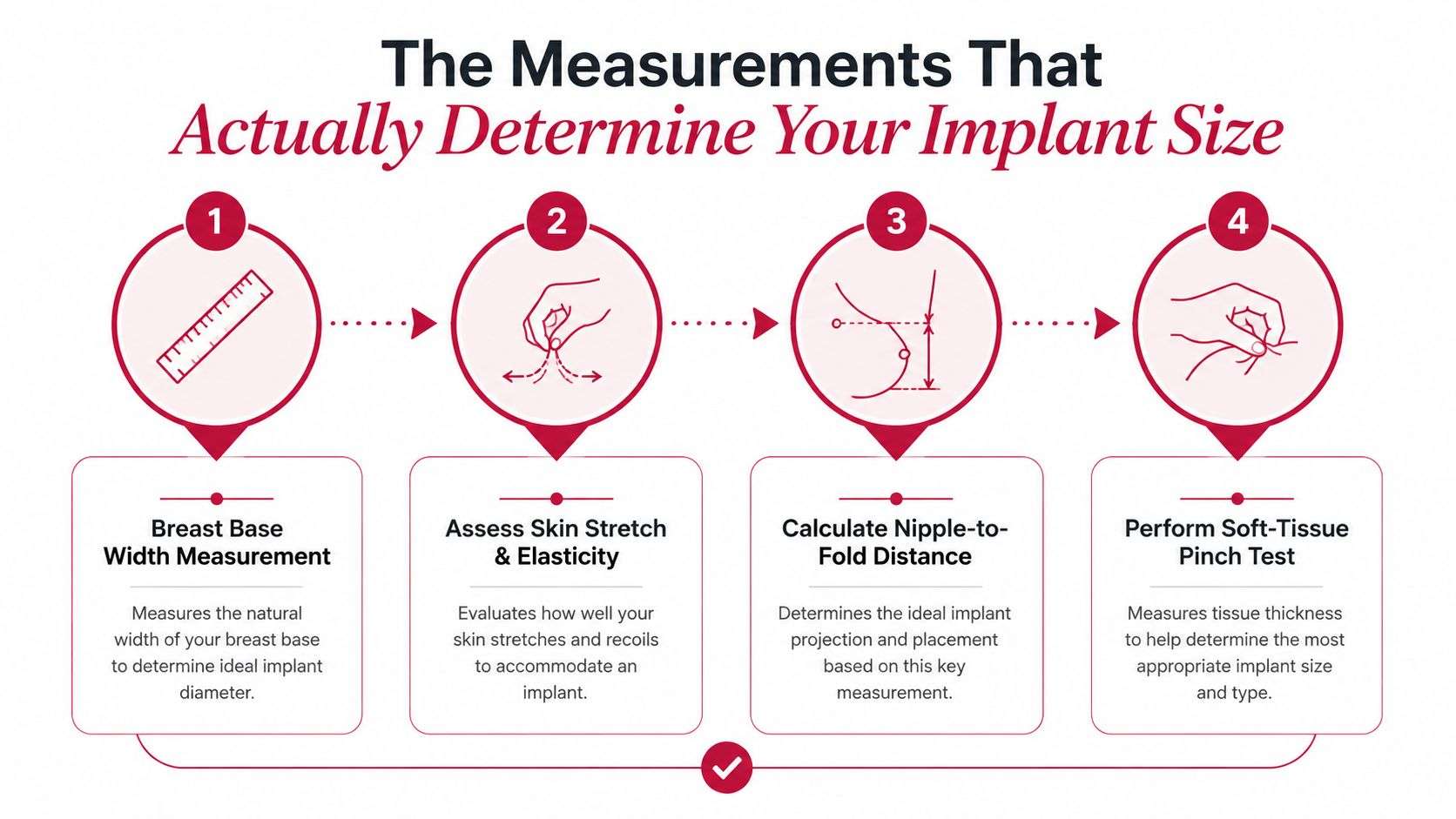
Breast base width is one of the main measurements because it defines the horizontal footprint available for the implant. An implant that is too wide may extend toward the armpit or beyond the natural breast boundary. An implant that is too narrow may leave the outer breast underfilled, even when its volume appears suitable.
Breast height, chest-wall shape, and asymmetry also affect the plan. The two breasts may have different widths, heights, or tissue thicknesses, so each side may require a different volume or implant dimension. A volume chart cannot account for those anatomical differences.
Assess the soft-tissue envelope
Skin stretch and elasticity help determine how much expansion your tissues can tolerate and how naturally they may drape over the implant. The surgeon assesses skin quality, existing breast tissue, and the coverage available over the implant.
A soft-tissue pinch test adds a practical measurement. By checking tissue thickness at selected points, the surgeon estimates how much coverage you have and whether an implant's profile may become visible or palpable. Thin coverage does not automatically rule out augmentation, but it can affect the choice of implant material, placement, profile, and volume.
Measure the lower breast boundary
The nipple-to-inframammary-fold distance helps establish the vertical space available for the implant and indicates how the lower pole may respond to expansion. The fold position, breast shape, and nipple location all influence whether the implant can create the lower-pole fullness you want.
The surgeon may also measure the distance between the breasts, evaluate nipple position, and document natural asymmetry. These findings help determine whether an implant alone is likely to meet your goal or whether a lift, fold adjustment, or another procedure deserves discussion.
Measurements set the boundaries. External sizers and your preferences help refine the choice, while tissue dimensions determine which options are reasonable. Evidence reviews support matching implant dimensions to the breast envelope rather than selecting by volume alone. See the evidence review on implant-size selection systems.
Understanding Cubic Centimeters and Visual Volume
Cubic centimeters measure implant volume, not the final appearance of the breast. A particular cc number tells you how much space the implant occupies, but it doesn't tell you how broadly that volume will spread or how far it will project from the chest.
Profile is central to that distinction. A lower-profile implant generally distributes volume over a broader base with less forward projection. A higher-profile implant can create more projection while keeping the base narrower. That can be useful for a patient with a narrow chest, but it may not create the right proportion for someone with a broad breast base.
The table below is a conversational framework, not a prescription. The ranges are intentionally broad because the same volume can look subtle on a larger frame and pronounced on a smaller one.
| Aesthetic goal | Typical volume range (cc) | Visual effect |
|---|---|---|
| Subtle restoration | 200 to 300 cc | Adds modest fullness while preserving a restrained contour |
| Moderate enhancement | 300 to 400 cc | Creates a noticeable increase in volume with flexibility in profile |
| Fuller augmentation | 400 to 500 cc | Produces a more prominent result, depending on tissue and dimensions |
| Dramatic enlargement | Above 500 cc | Creates substantial volume and demands careful assessment of tissue limits |
These ranges shouldn't be treated as a cup-size calculator. The bra-volume study discussed earlier found that approximately 130 to 150 cc may correspond to one cup-size increase in general, but the result still varies with band width and individual anatomy. A surgeon may choose a lower-volume, higher-profile implant for one patient and a broader, lower-profile implant for another, even when both want similar fullness.
Existing breast tissue changes the visual transition as well. More tissue can soften the implant outline, while limited coverage may make projection and implant edges more noticeable. Placement also affects the result, particularly in the upper pole and along the inner and outer breast.
Material and construction influence feel and behavior, too. Patients comparing implant categories can review this guide to saline, silicone, and gummy bear implants before discussing which option fits their anatomy and priorities.
Ask about dimensions, not just volume: “What are the implant's width, projection, and profile, and how do those dimensions fit my breast base?”
Preview Tools and How to Use Them Effectively
Preview tools can clarify your preferences, but none can reproduce the final breast perfectly. Surgery changes how the implant, tissues, pocket, and skin interact. Use these methods to communicate goals, not to promise an exact result.
External sizers
External sizers placed inside a supportive bra let you experience approximate added weight and assess how clothing fits. They can answer practical questions: Does the proposed size feel comfortable while moving? Does it change how you see your proportions?
A sizer rests on the body rather than inside a surgically created pocket. It may therefore exaggerate upper-pole fullness or fail to show how your tissues will drape around the implant. A UK surgeon survey found that external sizers were the most common preoperative assessment method, used by 74% of surveyed surgeons. Read the review of implant selection methods.
Three-dimensional simulation
3D imaging helps compare overall proportions, asymmetry, and the projected relationship between your breasts and torso. Its strongest role is communication. You can point to the simulated breast width, slope, or upper-pole fullness and explain what looks appropriate or excessive.
The image cannot show the true feel of the tissue, final softness, or every change that occurs as swelling resolves. Its usefulness also depends on scan quality and the assumptions built into the software. Treat the simulation as a discussion aid, not a guaranteed postoperative image.
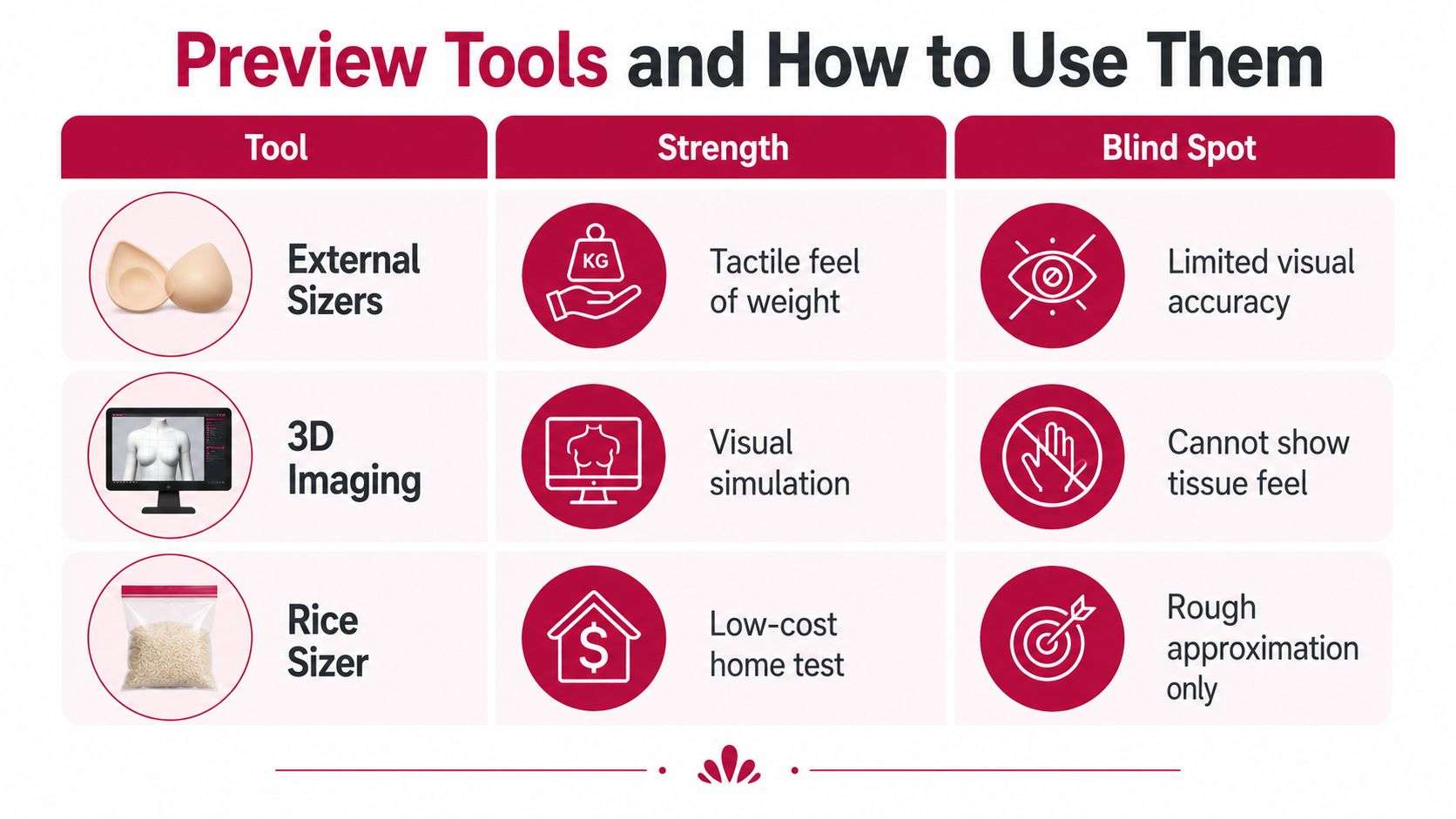
Rice testing at home
A rice test offers a rough impression of added weight under clothing. It does not reproduce implant shape, profile, firmness, position, or the way breast tissue stretches around an implant. Use it for a casual perception exercise, not as a sizing measurement.
Bra and sizer previews can also overstate the volume or contour you ultimately see. The difference arises because an external test cannot fully model implant placement, tissue coverage, and the surgical pocket. This limitation matters when a small change in apparent size could influence your expectations.
Bring your observations to the consultation. Note what you liked while standing, sitting, and wearing fitted clothing. A virtual aesthetic planning session can help organize those goals before an in-person examination, but it does not replace physical measurements and tissue assessment.
Balancing Aesthetic Goals with Long-Term Tissue Health
A larger implant can create the fullness you want immediately, but the decision also affects the tissues that must support that weight over time. Skin, breast tissue, the lower fold, and the implant pocket all respond to mechanical stress. A surgeon may recommend a smaller volume than you requested because the proposed dimensions exceed your breast base or place too much strain on limited coverage.
What the risk data means
A 2023 study of primary augmentation linked larger implant volume and a higher implant-volume-to-BMI ratio with increased risks of rupture and asymmetry. Rupture risk rose with volume, with an odds ratio of 1.012 per unit increase, and with the volume-to-BMI ratio, with an odds ratio of 1.282. Asymmetry also increased with volume, with an odds ratio of 1.005 per unit increase, and with the volume-to-BMI ratio, with an odds ratio of 1.151. Review the study on implant volume and complications.
These figures don't establish one universal cc cutoff. They show why implant volume should be treated as a risk variable, not only an aesthetic preference. A high implant-to-BMI ratio deserves particular caution, especially when skin elasticity and soft-tissue coverage are limited.
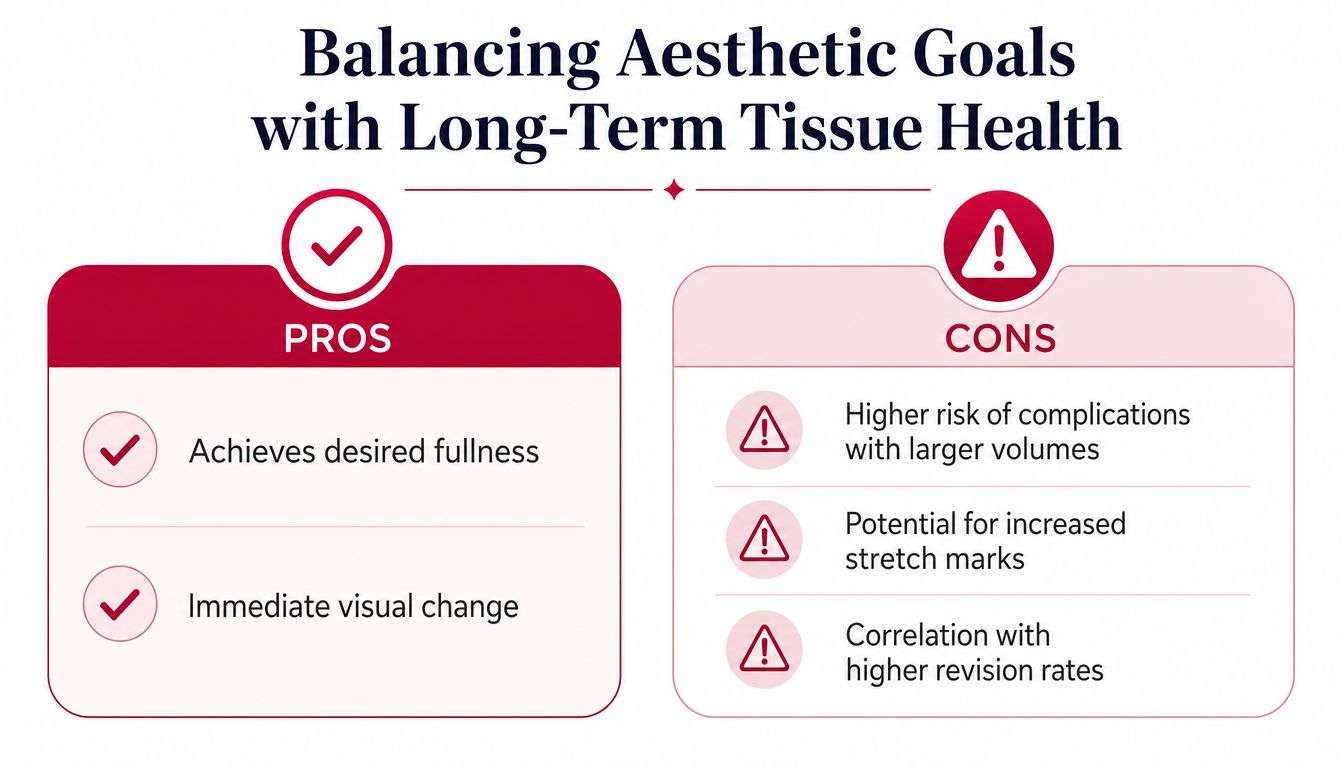
The trade-off behind “bigger”
The benefits of a larger implant are straightforward, including more fullness and a more immediate visual change. The costs can include greater tissue stretch, increased visibility or palpability, and a higher likelihood that future changes will require revision.
Your activity level matters. Running, strength training, and physically demanding work may make excessive weight or movement more troublesome. Pregnancy, weight fluctuations, and aging can also change the breast envelope, even if the original implant remains intact.
A durable result isn't defined by the biggest acceptable implant. It's defined by an implant that achieves your priority without exceeding what your tissues can support.
Visual anatomy tools can make these conversations easier. For readers curious about how scan-based anatomy visualization works in another context, this resource explains how to create a muscle model from scans. The same general principle applies to consultation communication, visual models can clarify anatomy, but a surgeon still has to interpret the measurements and the patient's goals.
Building Your Personalized Sizing Plan for Consultation Day
Arrive with a desired look, not just a desired letter. Decide whether your priority is upper-pole fullness, a gradual natural slope, improved symmetry, restored post-pregnancy volume, or a more athletic proportion. Those descriptions give your surgeon something actionable.
Bring useful visual references
Bring a small selection of photographs showing proportions and contours you like. Use them to explain what attracts you, such as the amount of cleavage, the lower-pole shape, or the transition from chest to breast. Don't treat another person's result as a template, because their width, tissue coverage, skin quality, and starting anatomy may be different.
You can also prepare practical information about your daily life:
- Exercise: Explain the activities you do and whether breast weight or movement would affect them.
- Clothing: Mention the garments you want to fit differently, including workwear, swimwear, or athletic clothing.
- Timing: Discuss pregnancy plans, weight changes, or other events that could alter your breast tissues.
- Symmetry: Identify whether matching the breasts or increasing overall volume matters more to you.
Ask questions that lead to a real plan
A productive consultation should leave you understanding the reasoning behind the proposed size range. Ask:
- Which implant widths fit my breast base?
- How would a moderate profile differ from a higher profile on my frame?
- How much of the final fullness would come from the implant versus my existing tissue?
- Would an implant alone address my breast position, or should we discuss a lift?
- What changes might occur if I gain weight, lose weight, or become pregnant?
- Which risks increase if I choose the larger option?
- How will you account for asymmetry?
The final choice should combine measurements, preview tools, and your lifestyle. Patient participation in implant selection has been associated with very low long-term dissatisfaction with breast size, under 1% in a large analysis of 1,840 primary augmentations. Review the analysis of patient involvement and satisfaction.
For preparation, follow your surgeon's instructions for consultation photographs and review the photographic instructions in advance. Organized images and specific questions make it easier to discuss implant brand, profile, placement, and the boundaries created by your tissues.
Georgia Plastic & Reconstructive Surgery offers breast augmentation consultations that connect your aesthetic goals with breast measurements, implant dimensions, and long-term considerations. Visit Georgia Plastic & Reconstructive Surgery to request a consultation and discuss a sizing plan customized to your anatomy and lifestyle.