Lip fillers usually last 6 to 12 months, but that range is only an average. Clinical meta-analyses show 74% of patients still have a measurable improvement at 6 months, while 46% do at 12 months, which is why the more honest answer is that filler often remains present longer than it looks at its absolute best.
If you're reading this, you're probably trying to answer a very practical question before booking anything: if I do this now, when will it fade, when will I need a touch-up, and will my lips suddenly look "gone" one day? Those are the right questions to ask.
The problem is that most online answers stop at "6 to 12 months" and leave out the part that matters in real life. There is a difference between how long filler is detectable, how long it keeps obvious volume, and how long it gives you that polished, hydrated, freshly-done look. Those are not the same timeline. Product choice matters. Your metabolism matters. Technique matters. Lip movement matters.
That nuance matters for long-term planning, too. Patients who care about facial aging more broadly often do better when they think beyond one appointment and build a full skin-quality strategy around sun protection, tissue health, and maintenance habits. If you're interested in that bigger picture, this discussion on expert advice on slowing the aging process is a useful companion resource.
Table of Contents
- Your 2026 Guide to Lip Filler Longevity
- How Long Each Type of Lip Filler Lasts
- Why Your Lip Filler Results May Vary
- How to Make Your Lip Fillers Last Longer
- The Timeline From Injection to Fading
- Plan Your Custom Treatment at Georgia Plastic
Your 2026 Guide to Lip Filler Longevity
Most patients want one clean number. Medicine rarely works that way, and lip filler is a good example.
A careful answer starts with the evidence. A clinical review found that 74% of patients achieved measurable improvement in lip fullness at 6 months, and 46% still did at 12 months according to this meta-analysis on hyaluronic acid lip augmentation outcomes. That drop doesn't mean filler vanishes at month twelve. It means visible effect tapers over time.
What patients usually mean when they ask
When someone asks how long lip fillers last, they may mean one of three things:
- How long will my lips look noticeably fuller
- How long will they look their best
- How long until the filler is fully gone
Those are different endpoints. In practice, many patients continue to carry some filler after the peak cosmetic look has softened.
Practical rule: Expect a period of best appearance, then a period of gradual decline, not a cliff where everything disappears at once.
That matters because disappointment often comes from timeline mismatch, not bad filler. A patient may still have product in the lips, yet feel their result has "worn off" because the crisp border, fullness, or hydration they liked most has started to soften.
The better way to think about longevity
Lip filler longevity sits on a spectrum shaped by product design, placement, anatomy, and your body's turnover rate. Two patients can receive similar treatment and still have different maintenance schedules.
This is why a good consultation isn't only about syringe count. It's about deciding whether you want subtle smoothing, border definition, central volume, or a softer movement pattern. Each goal can point to a different product and a different expected lifespan.
How Long Each Type of Lip Filler Lasts
Not all hyaluronic acid fillers behave the same way in lips. Some are built to move easily and feel soft. Others hold shape a bit more firmly. The difference isn't just branding. It affects how the lips look in motion and how long the result tends to stay satisfying.
What the product choice really changes
Two product examples have clearer longevity benchmarks in available clinical and market guidance. Restylane Kysse typically lasts up to 1 year, and Juvéderm Volbella can also last up to 12 months, though many patients choose a touch-up within that year to preserve the original look, as noted in this review of lip filler product duration.
For patients comparing categories beyond fillers, this discussion of comparing peptides with HA fillers can help clarify what topical or regenerative approaches can and cannot do relative to volume replacement.
If you're reviewing options in a clinical setting, Georgia Plastic & Reconstructive Surgery outlines available Juvéderm filler treatments in Atlanta as one example of how product families are matched to facial goals.
Lip Filler Longevity at a Glance
| Filler Brand & Product | Primary Technology | Average Lifespan | Primary Use in Lips |
|---|---|---|---|
| Restylane Kysse | XpresHAn | Up to 1 year | Flexible volume with natural movement |
| Juvéderm Volbella | Vycross | Up to 12 months | Subtle smoothing, refinement, softer volume |
| Standard HA lip fillers | Hyaluronic acid gel formulations | Often 6 to 12 months | General lip augmentation and shaping |
| Longer-lasting HA fillers used more selectively | Advanced cross-linking formulations | Can last longer in some facial areas, but lips usually average a shorter window | Selected cases where structure is a priority |
Product selection is less about picking the "longest lasting" filler and more about choosing the filler that matches your lip anatomy and the look you want in motion.
Why one patient loves a soft filler and another does not
A softer filler can look beautiful early on but may feel too subtle for someone who wants stronger definition. A more structured product may hold shape better for the right anatomy but can feel less forgiving if overused in a mobile lip.
That is why experienced injectors don't treat lips like a one-product procedure. The same amount of filler can look different depending on where it is placed, how much support the natural lip already has, and whether the goal is border definition, body fullness, or hydration.
Why Your Lip Filler Results May Vary
One reason patients get conflicting answers is that duration isn't controlled by the syringe alone. Your result reflects the interaction between the filler and your own tissue.
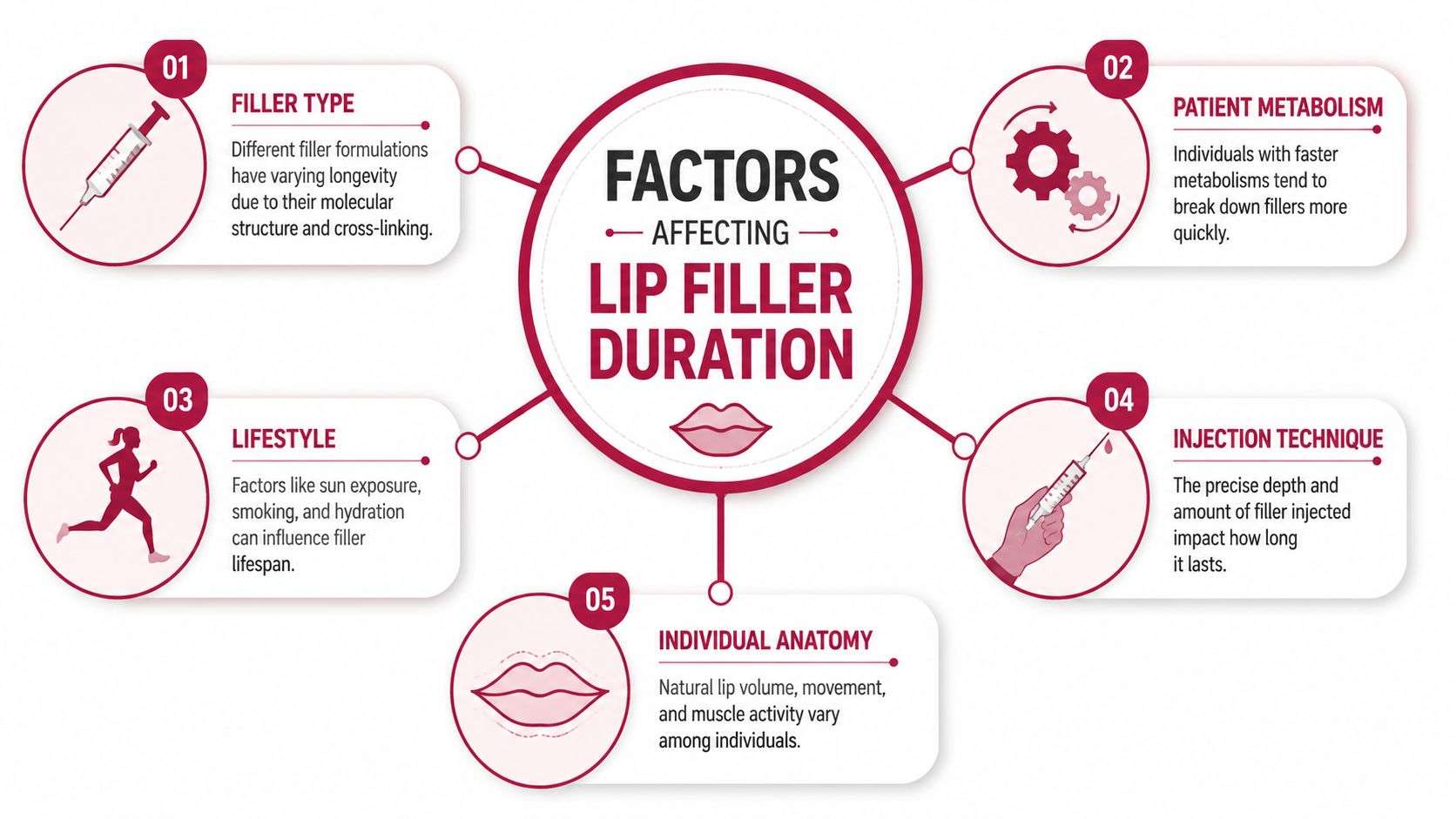
The five factors patients notice most
Here are the variables that most often change the timeline in practice:
- Filler formulation affects how the product behaves under constant lip motion. Some are designed for flexibility, while others prioritize support.
- Injection technique matters because depth, distribution, and restraint all influence how naturally the lips move and how evenly the product settles.
- Amount placed changes how long the visible effect stays obvious. A subtle enhancement may look elegant but fade from notice sooner.
- Lifestyle and tissue stress can influence how quickly the lips stop looking freshly augmented.
- Individual anatomy matters more than many patients expect. Thin lips, strong muscle movement, and frequent pursing can all change wear patterns.
A filler can be technically present and still no longer deliver the aesthetic you paid for. That's why follow-up timing should be based on appearance, not just the calendar.
Why metabolism is not the whole story
Patients often hear that younger people "burn through filler faster." That's too simple. According to this Cleveland Clinic overview of lip fillers, youth may increase breakdown speed, but it also correlates with higher collagen turnover and tissue resilience, which can sometimes make volume seem to last better than expected.
That distinction is important. Faster metabolism doesn't automatically mean poor longevity. Better tissue quality can support shape and softness even as the filler gradually declines.
A practical consultation looks at more than age. It considers how expressive your mouth is, whether you want subtle or noticeable volume, whether this is your first treatment, and how your lips respond over time. That is why fixed maintenance schedules often disappoint people. Some need earlier refinement. Others do better waiting longer and reassessing the shape rather than repeating treatment by habit.
How to Make Your Lip Fillers Last Longer
No aftercare routine can make hyaluronic acid filler permanent. But patients can absolutely protect their result and reduce avoidable early fading.
Protect the filler early
The most evidence-based advice is straightforward. The American Academy of Dermatology guidance summarized here notes that lip filler results often soften around 6 to 9 months, and experts recommend SPF lip protection and avoiding high-heat environments like saunas in the first few weeks.
That advice works because lips are exposed tissue. Sun, heat, inflammation, and repeated stress don't help the filler hold its most polished appearance.
Use this approach:
- Wear SPF on the lips every day, not only at the beach. UV exposure works against longevity.
- Skip saunas and similar heat exposure early on while the area is settling.
- Protect the lips from irritation if you're using active skin products around the mouth.
- Follow the aftercare instructions you were given instead of copying what a friend did. Technique and placement differ.
Maintain results without overdoing it
A maintenance plan should keep your lips consistent, not progressively overfilled.
For many patients, the smartest move is a review visit when the lips begin to soften, not when they are completely flat again. That lets the injector assess shape, symmetry, and whether you need actual volume or just a small refresh in a specific area.
Small, well-timed maintenance is usually more predictable than letting lips fade extensively and trying to rebuild the entire look at once.
What doesn't work is chasing longevity with more product than your anatomy can support. Overcorrection doesn't create elegant longevity. It creates stiffness, migration risk, and a result that often looks less natural even before it begins to fade.
The Timeline From Injection to Fading
Patients do better when they know what the arc looks like. Lip filler doesn't move from "done" to "gone" in one step.
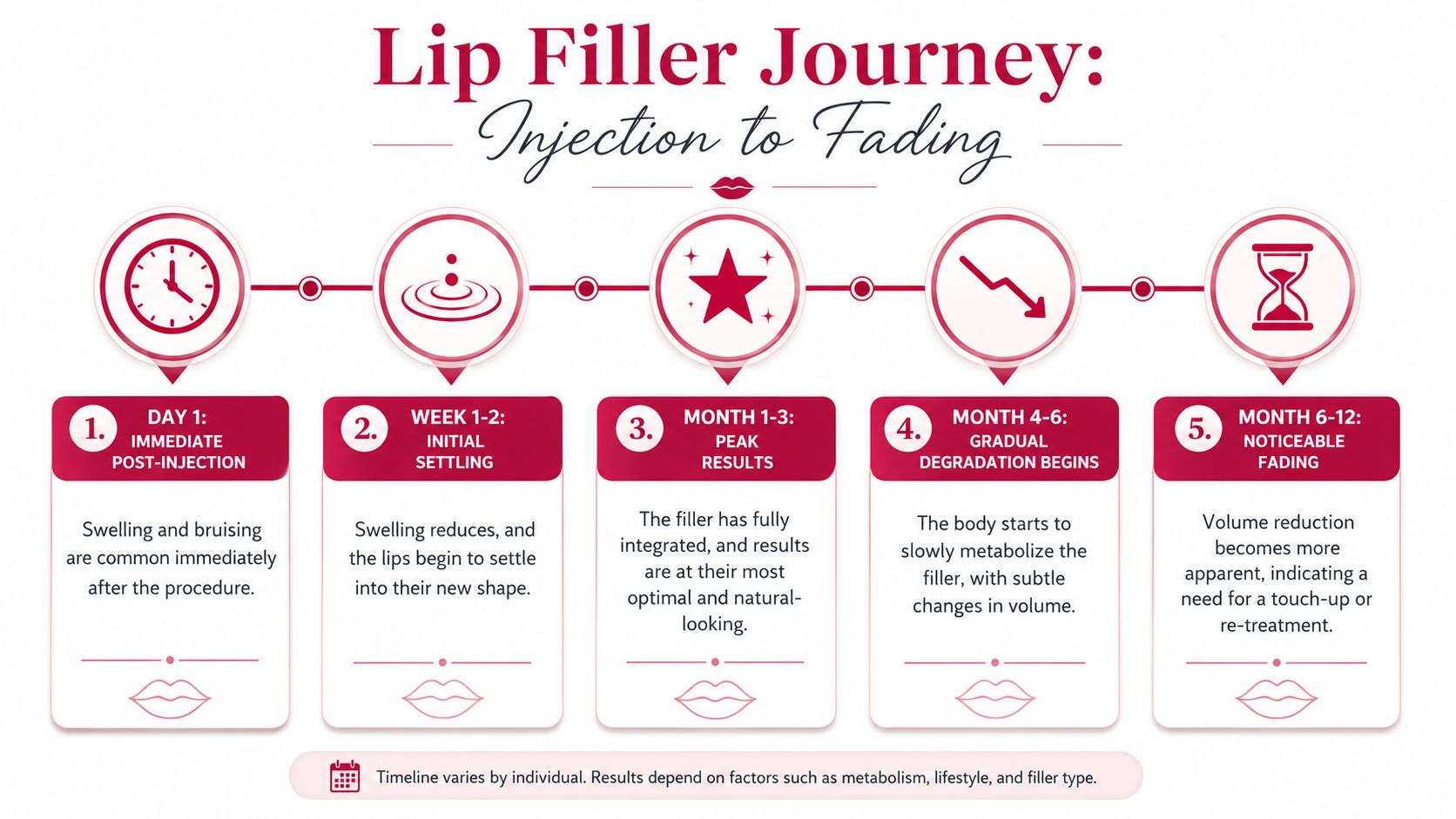
What usually happens after treatment
The first days are about swelling and settling. Lips often look fuller than the final result early on, which is why snap judgments right after treatment are unreliable.
Then the filler integrates. Shape looks more balanced, movement feels more natural, and the lips enter the period most patients think of as their best result. Later, volume reduction becomes gradual rather than dramatic. The border may soften first. Hydration effect may seem less obvious. Central fullness may slowly decline.
If you're considering treatment, this overview of lip injections and lip filler options helps frame what the treatment process usually involves.
The residual filler paradox
One of the least discussed points in lip filler education is that fading doesn't always mean complete disappearance. According to this discussion summarizing MRI-based observations, microscopic filler residue can persist for years in some cases, even when patients assume the filler is fully gone.
That doesn't mean lips stay visibly filled for years. It means technical presence and visible effect are not the same thing.
Many patients are surprised to learn that "I can't see it anymore" and "there is no filler left" are not interchangeable statements.
This matters for repeat treatment. If trace product remains, it can subtly affect contour, softness, or how the next treatment should be layered. That is one reason long-term lip care should be deliberate rather than automatic.
Plan Your Custom Treatment at Georgia Plastic
The right treatment plan starts with anatomy, not trend photos. Lip shape, skin quality, tooth show, lip mobility, and proportion all influence how filler should be used and how long the result is likely to satisfy you.
A consultation is where those variables become specific. Some patients need a soft, conservative first treatment and a reassessment after settling. Others already have residual product and need shaping more than volume. Others may be better served by waiting, dissolving prior filler, or adjusting goals.
For patients exploring augmentation in more detail, Georgia Plastic & Reconstructive Surgery provides an overview of lip augmentation treatment options in Atlanta, including how filler-based enhancement fits into a broader facial planning discussion.

The practical takeaway is simple. If you want to know how long do lip fillers last for you, the answer won't come from a generic online average alone. It comes from matching the right product to the right lip, setting a realistic endpoint for "looks best" versus "still present," and planning maintenance based on what your lips do over time.
If you're ready to discuss lip filler options with a surgical and aesthetic team, schedule a consultation with Georgia Plastic & Reconstructive Surgery. An in-person evaluation can help determine which filler approach fits your anatomy, your goals, and the maintenance schedule you're comfortable with.