You're getting dressed and you pause in front of the mirror again. One side sits higher than the other. The reconstructed breast feels firmer than it used to, or a bra that once fit comfortably now gaps on one side and digs in on the other. It's been months or years since mastectomy and reconstruction, and you may be asking yourself a difficult question. Is this just how it is now, or is another operation reasonable?
Table of Contents
- Understanding Why Breast Reconstruction Revision Happens
- The Most Common Revision Procedures Explained
- Timing Your Revision Surgery
- Risks and Complications to Consider
- What to Expect During Recovery
- How to Prepare for Your Revision Consultation
- Setting Realistic Expectations for Your Results
- Frequently Asked Questions About Revision
Understanding Why Breast Reconstruction Revision Happens
That mirror moment doesn't mean your first reconstruction failed. Think of reconstruction less like a single finished product and more like building something in stages on ground that's still settling. Tissues heal, swellings fade, weight changes, and the natural breast keeps aging while a reconstructed breast changes in different ways.
Breast reconstruction revision is any later operation that refines or corrects an earlier reconstruction. It's planned to address a specific concern, not to start over from nothing unless that's needed.
The Reasons Surgeons See Most Often
- Asymmetry: The two sides differ in size, height, projection, or how they move in clothing.
- Capsular contracture: Scar tissue around an implant tightens, so the breast feels firm, sits higher, or hurts.
- Contour irregularities: Dents, step-offs, rippling, or visible implant edges show through thin skin.
- Implant problems: An implant shifts, drops, ruptures, or turns out to be the wrong size for your frame.
- Changes in the opposite breast: A natural breast changes with age, hormones, or weight, so a match that worked at first drifts apart.
Women who've had reconstruction after a double mastectomy face a slightly different version of this problem. There's no natural breast to match, but the two reconstructed sides can still heal unevenly.
Why Reported Rates Look So Different
You may see very different numbers online, and that confusion is understandable. One large U.S. commercial-insurance database of 58,264 patients from 2003 through 2019 found revision in 6.2% after autologous reconstruction, compared with 3.8% after immediate implant-based reconstruction and 3.6% after two-stage implant-based reconstruction.
That same analysis found implant-based reconstruction had a 51% lower incidence rate of revision than autologous reconstruction. Yet a separate long-term study described in that review found 69.5% of women with implant-only reconstruction had at least one revision by eight years, compared with 49.3% in other groups.
A short window counts early coded operations. Long follow-up counts the slow, ordinary refinements that accumulate over years. Both can be true at once.
The practical lesson isn't a single percentage. It's that your likelihood of revision depends on your reconstruction method, radiation history, tissue quality, and what counts as a revision in the first place.
The Most Common Revision Procedures Explained
Surgeons don't choose a revision from a menu. They first name the mechanical problem, then pick the smallest operation that fixes that problem. A breast that's too firm needs different work than a breast that's too low.
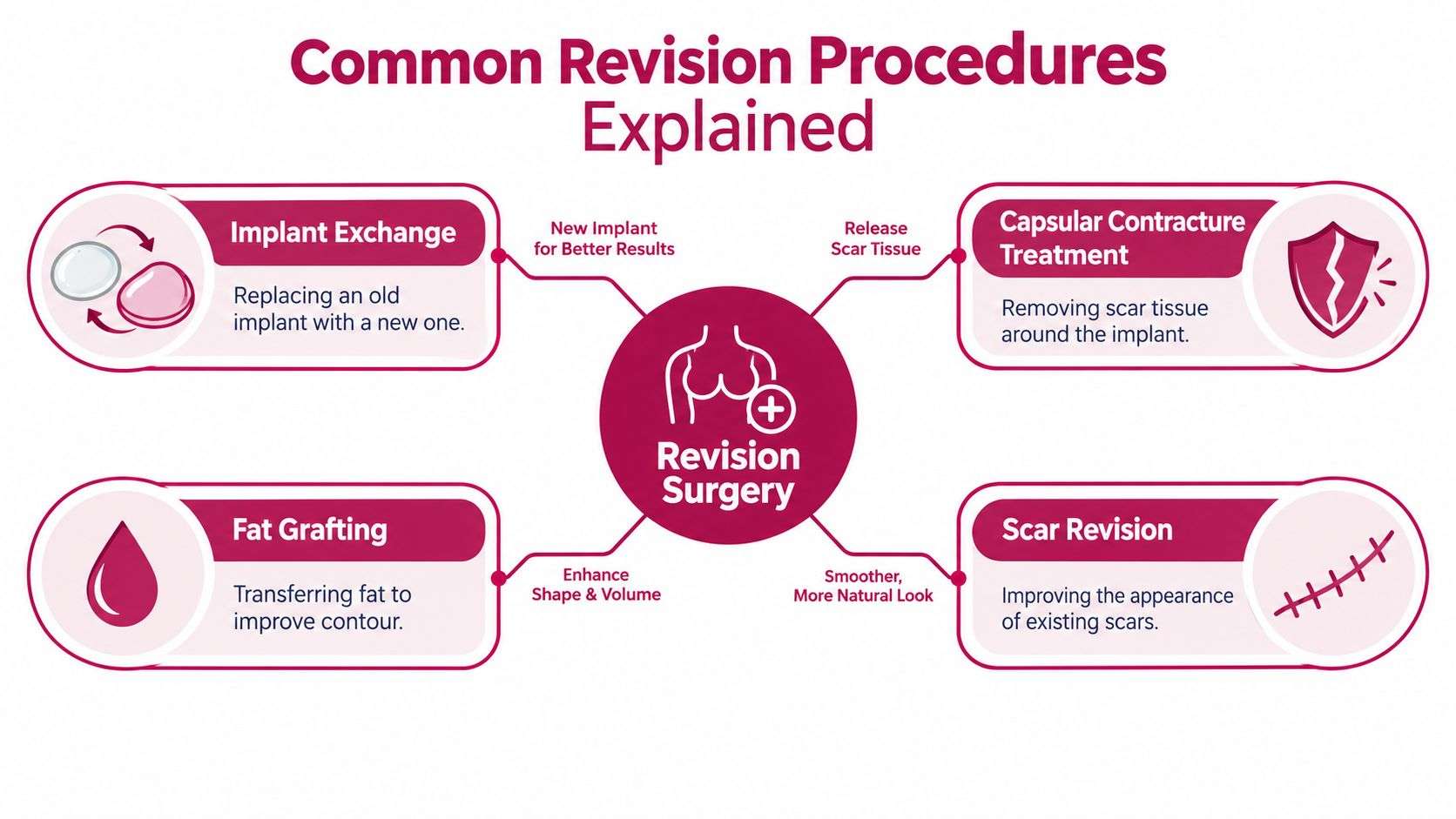
Implant Exchange and Pocket Work
Implant exchange means removing the current implant and placing a different size, shape, or type. It's a bit like swapping a cushion insert that's too large for its cover. The cover, your skin envelope, may also need adjusting.
Pocket adjustment changes the internal space that holds the implant. If an implant has drifted sideways or dropped, your surgeon can tighten one side of the pocket and release another. For capsular contracture, treatment may involve scoring the scar capsule, called capsulotomy, or removing it, called capsulectomy.
Fat grafting works differently. Your surgeon liposuctions fat from your abdomen or thighs, processes it, and injects small amounts around the reconstruction. Think of it as adding padding under a thin blanket so edges underneath don't show. It softens dents and rippling, but it adds modest volume rather than rebuilding a whole breast.
Symmetry procedures operate on the other breast instead, lifting, reducing, or enlarging it to match. Sometimes matching the healthy side is safer than forcing the reconstructed side to do all the work. If you're weighing tissue-based options as part of that plan, understanding how flap reconstruction compares with implants helps frame the trade-offs.
A Special Case Called Animation Deformity
Some women notice the implant jump or flatten whenever they flex their chest, push open a heavy door, or exercise. That's animation deformity, caused by the pectoralis major muscle contracting over an implant placed beneath it.
One documented fix moves the implant from under the muscle to in front of it. In a review of 102 reconstructed breasts in 57 patients, surgeons re-secured the muscle to the chest wall, created a prepectoral pocket, and used acellular dermal matrix plus fat grafting for coverage. Animation deformity resolved completely in all treated breasts, with complications in 4 of 102 breasts (3.9%).
That option isn't right for everyone. If your skin is thin, irradiated, or poorly perfused, your surgeon may stage fat grafting first or recommend a different plan entirely. Tissue quality, not preference alone, sets the limits.
Timing Your Revision Surgery
Timing confuses many patients because two clocks run at once. One clock is medical, based on healing, radiation effects, and whether a problem is getting worse. The other clock is personal, based on work, family, and whether you're emotionally ready for another recovery.
Early Versus Late Revision
Early revisions usually address mechanical or healing problems that declare themselves soon after surgery. An implant sitting clearly in the wrong place, a tightening capsule, or a wound problem can't always wait for tissues to settle. Your surgeon weighs the benefit of acting against operating on tissue that's still inflamed.
Late revisions are more often about fit and comfort over time. Weight change, aging of the opposite breast, or gradual implant changes can make a once satisfactory result feel wrong years later. There's rarely urgency, which gives you room to plan around your life.
| Factor | Early Revision | Late Revision |
|---|---|---|
| Typical trigger | Malposition, contracture, healing problems | Asymmetry, aging, weight or volume change |
| Tissue condition | Still healing, possibly swollen or inflamed | Settled, scars mature, shape stable |
| Decision pressure | Sometimes time-sensitive | Usually elective and schedulable |
| Planning advantage | Corrects a problem before it worsens | Clearer picture of the lasting result |
Why Symmetry Work Often Takes More Than One Stage
It's tempting to balance the opposite breast during the first operation and be done. Evidence suggests patience doesn't cost you satisfaction. In a prospective comparison of symmetrization timing after autologous reconstruction, simultaneous surgery produced similar two-year breast satisfaction to delayed surgery, with a non-significant difference (P = 0.714).
Even so, 51.4% of patients who had simultaneous symmetrization still needed another operation under general anesthesia to complete reconstruction. Matching a moving target is hard while the reconstructed side is still settling.
Radiation, donor-site changes, implant position, and weight fluctuation all shift that target. If you're still deciding on the broader reconstructive path, it helps to revisit when reconstruction timing makes sense in the first place before locking in a revision date.
Practical rule: Schedule revision when the problem is stable and clearly defined, not simply at the earliest available date.
Risks and Complications to Consider
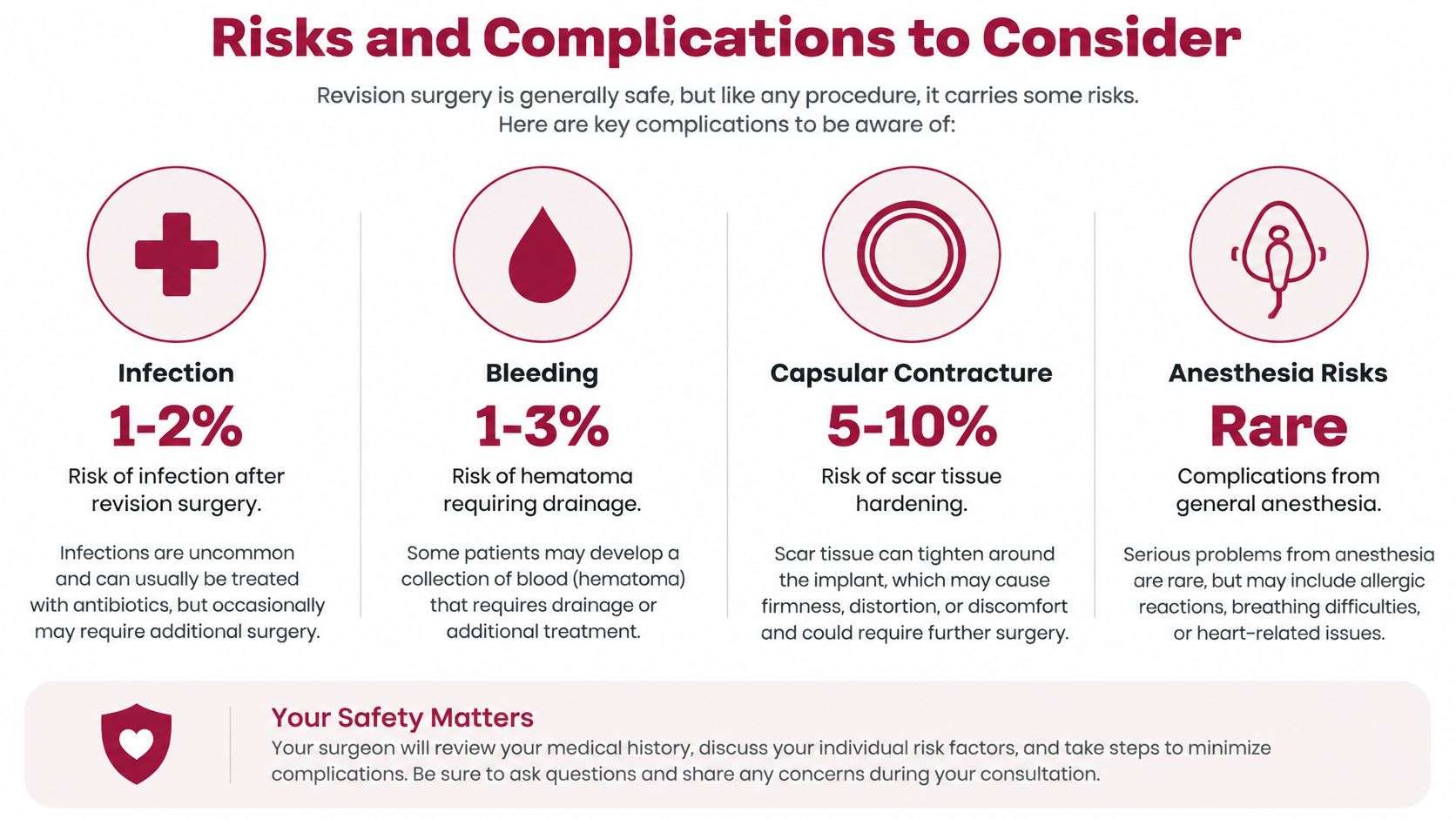
Revision surgery operates through scar tissue, on skin that may have been stretched, thinned, or irradiated. That doesn't make it unsafe. It does mean your risk profile isn't identical to someone having a first operation, and a single headline number can't describe it.
General Surgical Risks
- Infection: Bacteria can reach the surgical site or an implant, sometimes requiring antibiotics, drainage, or temporary implant removal.
- Seroma and hematoma: Fluid or blood can collect in the pocket, causing swelling and pressure that may need drainage.
- Delayed healing: Incisions in previously operated or irradiated skin may open or heal slowly, occasionally exposing deeper tissue.
- Scarring and sensation change: New work through old incisions can still widen scars or alter feeling in the skin.
- Anesthesia effects: Most revisions use general anesthesia, which carries its own uncommon but real risks.
Risks Specific to Doing the Work Again
Capsular contracture can come back after it's treated, especially in an irradiated breast. An implant can drift again if the supporting tissues are weak. Transferred fat can partially resorb, so a contour that looks full at first may soften more than expected.
Flap revisions carry their own concerns. Reshaping transferred tissue means respecting its blood supply, and aggressive thinning or repositioning can compromise it. Your surgeon may stage changes deliberately rather than chase a perfect shape in one sitting.
How do surgeons lower these risks? They review your radiation and complication history, assess skin perfusion, choose conservative fat volumes, reinforce pockets when needed, and sometimes recommend against a requested change if the envelope won't support it. A surgeon who explains why a smaller step is safer is protecting your result, not withholding care.
Ask what happens if a complication occurs. Knowing in advance whether the backup plan is drainage, implant removal, or a later staged repair makes an unexpected phone call far less frightening.
What to Expect During Recovery
Most patients find recovery after revision less demanding than recovery after mastectomy with reconstruction. The surgery is usually narrower in scope, and you already know the basics of drains, surgical bras, and sleeping on your back. Less demanding doesn't mean trivial, so plan as if it matters, because it does.

The First Days and Weeks
Expect soreness, tightness, and fatigue at first, managed with prescribed or over-the-counter pain relief as your surgeon directs. Short walks around your home help circulation. You'll likely limit arm movement and lifting while incisions and any pocket work gain strength.
Over the next few weeks, patients gradually return to desk work and light daily tasks. Compression garments or a supportive bra help control swelling and hold a reshaped pocket in position. Follow-up visits let your surgeon check incisions, remove drains if you have them, and adjust activity limits.
The Longer Settling Period
Swelling fades unevenly, so early asymmetry doesn't predict your final shape. Fat grafts need time to establish a blood supply, and some volume loss during that process is normal. Scars often look firmer and darker before they soften and lighten.
Judge a revision by how it looks and feels after tissues have settled, not by the first week in the mirror. Early photos record healing, not the outcome.
Prepare practically before surgery. Cook or freeze a few meals, place essentials at waist height, arrange help with driving and childcare, and set up pillows so you can rest semi-upright. Small preparations remove the daily decisions that drain energy during recovery.
Call your surgeon promptly for fever, rapidly increasing swelling on one side, spreading redness, worsening pain, or drainage that changes in amount or odor. Those signs don't always mean a serious problem, but they always deserve a same-day conversation.
Emotionally, recovery can stir up feelings from your original diagnosis and surgery. That's common and doesn't mean you've made a mistake. Tell a partner, friend, or support contact in advance that you may need company as much as practical help.
How to Prepare for Your Revision Consultation
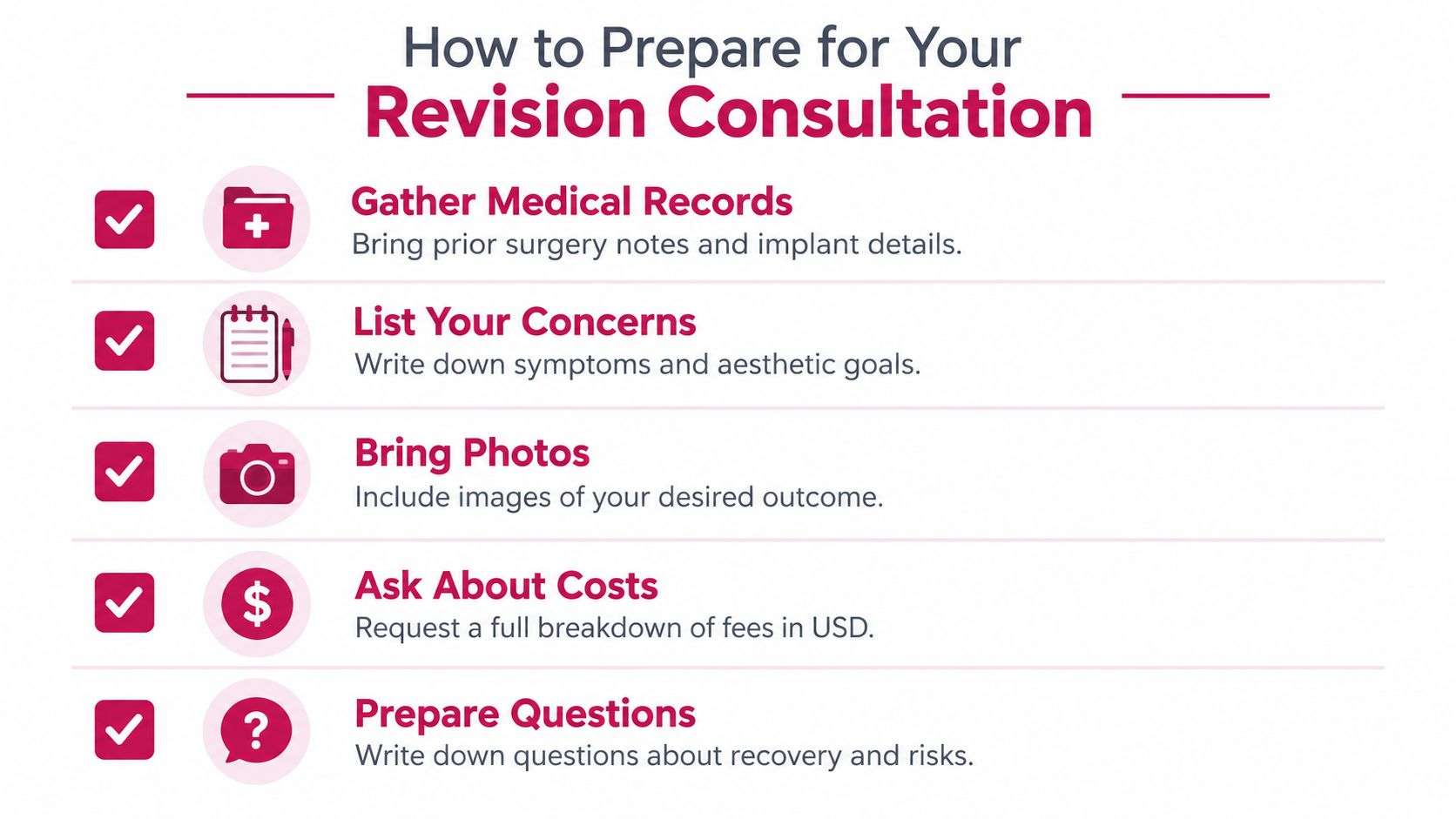
A productive consultation starts before you enter the room. Your surgeon needs to reconstruct what was done previously, sometimes by a different team years earlier, and connect that history to what you feel now. The records you bring can change the plan you're offered.
What to Bring
- Operative reports: Notes from your mastectomy and reconstruction describe flap type, implant placement, and materials used.
- Implant details: An implant card or record of size and type helps with exchange planning.
- Treatment history: Radiation, chemotherapy, infections, hematomas, and prior revisions all shape your options.
- A symptom list: Note firmness, pain, rippling, tightness, movement with exercise, and when each started.
- Photos: Pictures showing the concern in different positions or clothing can clarify what words miss.
Questions Worth Asking
Ask what specific problem your surgeon believes is causing your concern. Then ask what options exist, including doing nothing, and what each option can and can't change. Ask how many stages are likely, what recovery involves, and which result would count as success.
Be candid about your emotional state as well. In a 2024 study of 775 reconstruction patients, 15.6% underwent elective revision, while depression alone was associated with higher odds of revision (OR 3.20) and combined generalized anxiety and depression also showed an association (OR 2.63).
That doesn't mean distress disqualifies you or that your concern isn't physical. It means a good consultation covers body image and expectations alongside anatomy. A practice such as Georgia Plastic & Reconstructive Surgery, which offers revision breast surgery including implant replacement and capsulectomy, is one example of where that conversation can happen, and seeking a second opinion is reasonable if you leave uncertain.
Choose a board-certified plastic surgeon who regularly performs revision reconstruction. Ask directly about experience with your specific problem, such as irradiated tissue or animation deformity, rather than breast surgery in general.
Setting Realistic Expectations for Your Results
Revision can improve symmetry, soften contours, relieve tightness, and make clothing fit more comfortably. It rarely produces two identical breasts, because a reconstructed breast and a natural breast are built from different materials and age on different schedules. Even two reconstructed breasts heal as individuals.
Define Success in Your Own Words
Before surgery, decide what would make the operation worthwhile for you. Is it wearing a fitted top without adjusting it? Exercising without watching the implant move? Ending the ache from a tight capsule? A concrete goal lets you and your surgeon judge the result fairly.
A useful test: If the operation achieved a clear improvement but not perfection, would you still be glad you did it? Your honest answer shapes whether to proceed.
How a breast feels matters as much as how it photographs. Firmness, rippling you can feel through skin, and persistent tightness are legitimate reasons to seek evaluation, even when other people tell you the result looks fine. You're the one living in the body.
Accepting Staged, Imperfect Progress
Fat grafting may need repeating because not all transferred fat survives. Pocket adjustments can settle differently than expected once swelling resolves. Balancing surgery on the opposite breast may reveal a smaller mismatch that only becomes visible after the larger one is corrected.
None of that means revision isn't worthwhile. It means you should budget your time, energy, and hope for a process rather than a single reveal. Patients who expect one operation to erase every trace of mastectomy are set up for disappointment, even after technically good surgery.
Revision also has emotional limits. Improving shape can ease daily reminders and restore comfort, but it may not resolve grief, anxiety about recurrence, or every difficult feeling about body image. Support for those concerns isn't a detour from surgical care. It's part of deciding what surgery is being asked to do.
Frequently Asked Questions About Revision
Is Revision Surgery Covered by Insurance
Coverage varies by policy and by the reason documented for surgery. Revisions addressing a complication such as painful capsular contracture, implant rupture, infection, or significant malposition are more likely to be treated as medically necessary. A change requested purely for size preference is less likely to be covered, so ask for documentation and preauthorization guidance early.
How Long Should I Wait After My Initial Reconstruction
There's no single waiting period that fits everyone. Your surgeon considers whether healing is complete, whether radiation effects have stabilized, and whether the problem is still changing. Some mechanical problems justify earlier intervention, while refinements for symmetry are usually judged better after tissues have fully settled.
Can Revision Be Done With Local Anesthesia
Most revisions involving implants, pockets, or flaps require general anesthesia because the work is extensive and your comfort and stillness matter. Very small adjustments, such as limited fat grafting or a minor scar correction, may sometimes be possible with local anesthesia and sedation. Your surgeon decides based on the scope of the planned work.
Will I Need More Than One Revision
Possibly, and planning for that possibility isn't pessimism. Symmetry work, fat grafting, and irradiated tissue often respond best to staged changes rather than one large operation. Ask your surgeon at the consultation how many stages your specific plan might involve.
If asymmetry, firmness, rippling, or implant movement is affecting your comfort or confidence, a consultation can separate what revision can realistically fix from what observation or support may handle better. The team at Georgia Plastic & Reconstructive Surgery offers breast reconstruction and revision consultations in Atlanta and Marietta, including implant replacement, capsulectomy, and correction of asymmetry. Visit their website to request an appointment and discuss a plan built around your anatomy, history, and goals.