You're looking at your calendar, trying to decide how much time to take off, who'll handle school pickup, and whether that upcoming trip is still realistic. The hardest part of planning SmartLipo recovery is that being able to answer emails isn't the same as being ready to lift a toddler, work a long shift, or get back under a barbell.
A useful recovery plan accounts for your procedure and your actual responsibilities. It also leaves room for swelling, garment adjustments, and follow-up appointments instead of treating an early return to routine as proof that healing is finished.
Table of Contents
- What SmartLipo Recovery Actually Looks Like
- A Realistic Day-by-Day SmartLipo Recovery Timeline
- Managing Pain, Swelling, and Garment Wear After SmartLipo
- Returning to Work, Exercise, and Daily Activities
- Why Final Results Take Months Not Weeks
- Practical Tips That Shape a Smoother SmartLipo Recovery
- Red Flags and When to Call Your Surgeon
What SmartLipo Recovery Actually Looks Like
SmartLipo recovery starts with a discharge plan, not a promise that you'll feel normal by morning. Same-day discharge may be appropriate, but your team should first assess how you're doing after anesthesia, help you get moving safely, and explain what requires a phone call.
In a 10-year series of laser-lipolysis patients, 95.08% were treated as ambulatory cases and 84.6% returned to routine activities by postoperative day 2. Those figures describe that particular group, not a deadline your body needs to meet.
Before you leave the surgical facility
Ask your nurse to review your instructions with the person taking you home. Anesthesia, discomfort, and fatigue aren't ideal conditions for remembering a detailed conversation.
- Transportation and support: Arrange a driver and clarify whether someone needs to stay with you afterward.
- Medication instructions: Have prescriptions available and confirm what to take, what to avoid, and whom to call if the plan isn't controlling discomfort.
- Garment and dressings: Have the team show you how the garment should sit and what your incision coverings should look like.
- Movement and hydration: Follow instructions for supervised walking, drinking, and eating rather than assuming complete bed rest is safer.
Your incisions may be covered, so you might not see them clearly before going home. Ask whether your particular technique is expected to produce fluid leakage, what appearance and amount the team considers acceptable, and how to replace absorbent pads. Don't assume all drainage is normal, especially if it changes or accompanies worsening symptoms.
Think in two recovery tracks
Visible recovery includes bruising, swelling, and how comfortably you move. Internal healing includes the slower settling of treated tissue and development of your contour.
For the first night, focus on following the written plan, getting assistance when standing, and keeping necessities within reach. Don't chase a universal “peak soreness” day. Ask what discomfort pattern your surgeon expects for your treatment and report pain that's escalating rather than becoming manageable.
Practical rule: Leave with instructions you and your caregiver can explain back, not just paperwork you haven't read.
A Realistic Day-by-Day SmartLipo Recovery Timeline
A short remote-work session may be manageable after a small treatment area, while a patient recovering from several treated areas and a tummy tuck may need help with basic tasks. Those are different recovery demands, so plan leave, childcare, and household support around the procedures being done, not a single SmartLipo timeline.
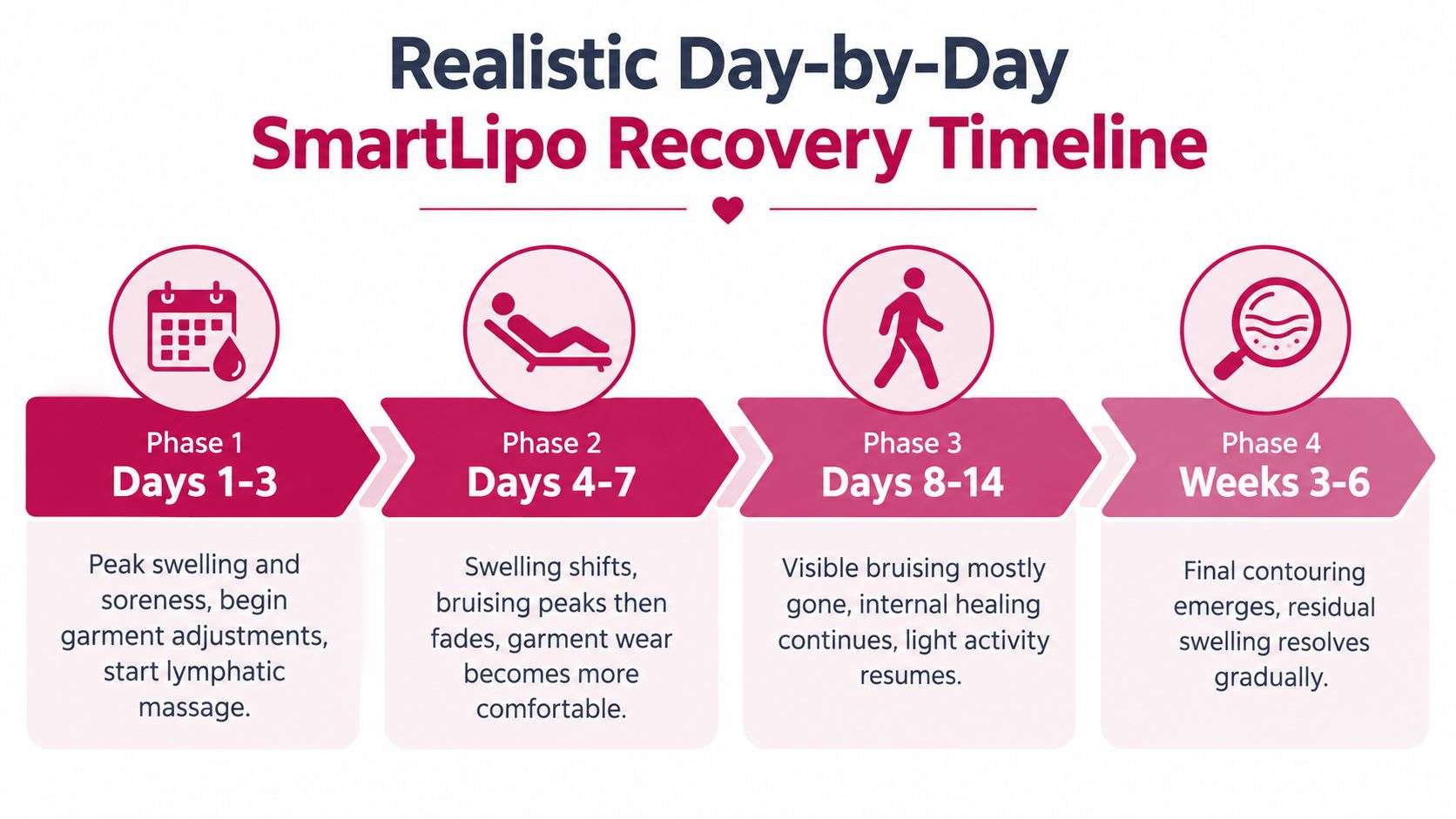
The phases below are checkpoints for you and your surgical team to reassess. They are not automatic clearance dates. Treatment extent, anesthesia, additional surgery, and individual healing all affect the pace.
First days: protect your schedule
During the first few days, movement and daily tasks may take more effort than expected. A small chin treatment can make the treated area visible and neck movement uncomfortable. After combined procedures, getting dressed, preparing food, or caring for children may require practical help.
Keep activity within your surgeon's instructions. Don't start lymphatic massage because a general timeline suggests it; your surgeon should approve when to begin, how it should be done, and who should provide it.
Judge progress by function as well as appearance. Can you walk and change position safely? Are routine tasks becoming easier, or are symptoms getting worse? A person with limited treatment might manage a brief remote-work session while still swollen. Someone recovering from combined surgery may need more time away, even if they feel ready to work.
Following weeks: reassess before making plans
Improving bruising does not automatically mean you're ready to stop compression, return to the gym, or travel. Ask your surgeon to assess healing and advise you before changing activity. Build flexibility into work leave and childcare arrangements, especially if your job involves lifting, long periods on your feet, or a commute.
For treatment beneath the chin, the chin liposuction recovery guide can help you prepare questions about garment visibility, neck movement, and returning to public-facing work. Abdominal or multi-area treatment brings different practical demands.
Later follow-ups can help determine when more strenuous activity and travel are appropriate. Contour changes may appear as healing progresses, but an early change is not a promise of a finished result. Use the infographic as a broad orientation, not as clearance to resume your usual routine.
Managing Pain, Swelling, and Garment Wear After SmartLipo
The first night at home can bring soreness, drainage, and a garment that feels tighter as swelling develops. Follow the care instructions from your surgical team, and call if the discomfort is worsening rather than settling or the garment causes concentrated pressure.
Before discharge, clarify which medication is taken on a schedule and which is used as needed. Follow the prescribed directions and limits. Check with your team before adding pain relievers, supplements, or leftover prescriptions, since they may conflict with your instructions.
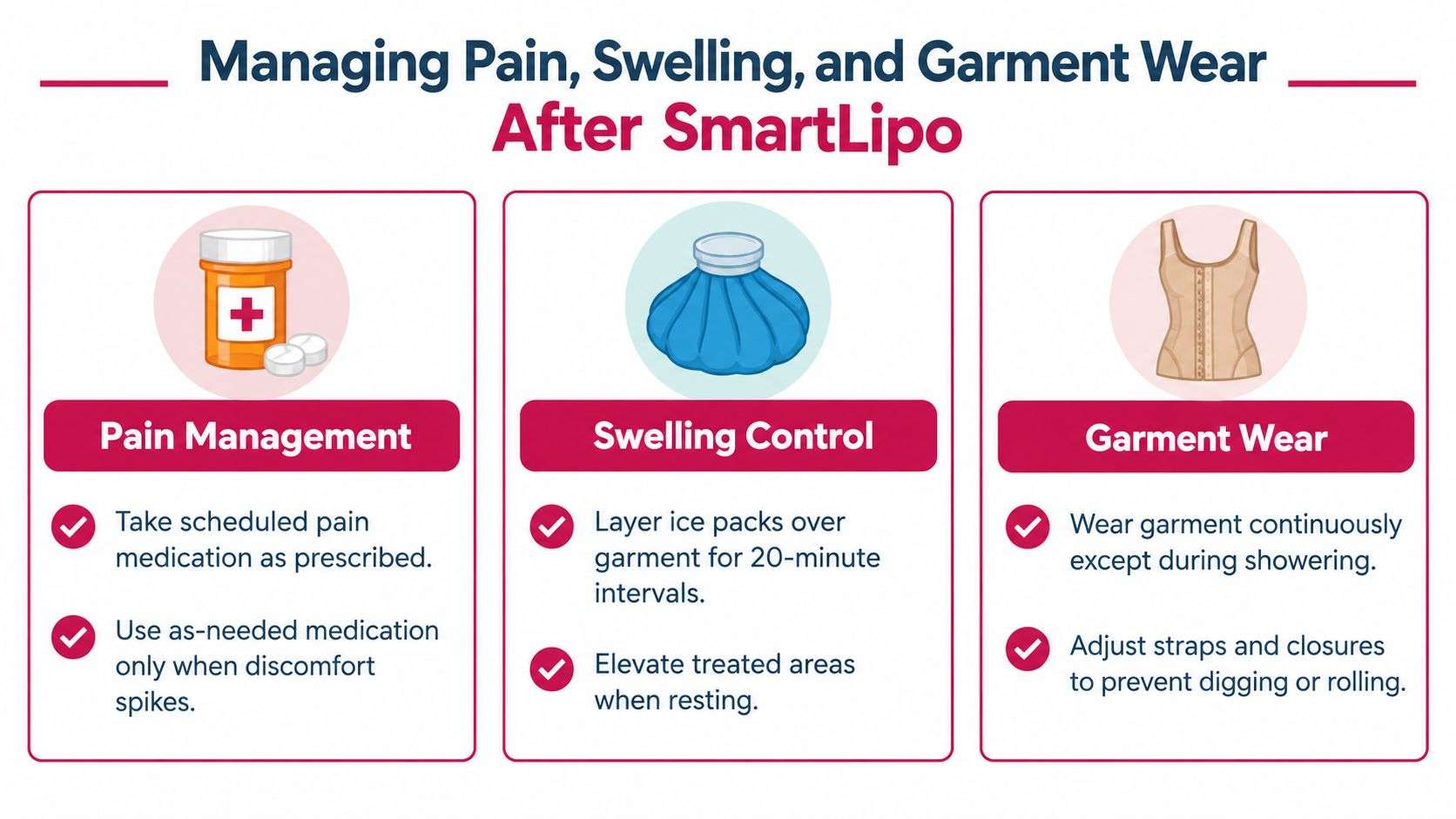
Garment fit needs attention throughout the day. Pressure should feel even, not sharp or pinched. A garment can sit comfortably at the waistband while a seam presses into a treated area. Follow your surgeon's schedule for wearing it, removing it, washing it, and changing the schedule. The postoperative shapewear guide can help you prepare questions about fit and care.
If fabric rolls or repeatedly folds in one spot, smooth it as your team demonstrated and ask for advice if the problem continues. If a seam digs in or leaves a new indentation, request a fit check rather than tightening the garment. Ask how to manage washing and any approved time out of compression. Check with your surgeon before adding foam or silicone inserts.
Cooling and massage also need individualized instructions. Ask whether a cool compress is appropriate, how to protect your skin, and when to stop. Avoid direct ice and temperature treatments over areas with altered sensation unless your surgeon approves them. Don't use handheld massagers or rub firmly over treated areas or near incisions without clearance.
For drainage pads, showering, and incision care, use the technique your team showed you. Clarify whether dressings should be changed or left in place, how to dry the area, and which products to avoid. Follow the resting position recommended for your procedure, especially if you had more than one area treated. If an instruction is unclear, call the surgical team before trying something new.
Returning to Work, Exercise, and Daily Activities
The most useful return-to-work question isn't “How many days?” It's “What will my body have to do during that shift?”
A desk worker may have the option to change position, take breaks, and wear loose clothing. A retail worker, nurse, warehouse employee, or parent caring for a young child may face lifting, prolonged standing, bending, and limited control over breaks. Those differences matter even when the treated area is identical.
Broader liposuction recovery guidance places many patients' return to work around weeks 2–3, with gradual exercise resumption around week 4 or later. These are planning references, not SmartLipo-specific guarantees.
Return-to-Activity Comparison by Lifestyle
| Activity | Typical Window | Key Conditions to Clear First |
|---|---|---|
| Remote or seated work | Potentially earlier than physical work | Comfortable positioning, adequate concentration, breaks, manageable symptoms |
| Retail or healthcare duties | Often requires more recovery or modified duties | Standing tolerance, uniform comfort, lifting and bending clearance |
| Childcare and pet care | Arrange assistance during initial recovery | Safe handling of lifting, pulling, carrying, and unexpected movements |
| Driving | After anesthesia and medication restrictions are resolved | Alertness, safe turning, and ability to brake without hesitation |
| Low-impact cardio | After walking is comfortable and the surgeon approves progression | Wound status, swelling, pain, and mobility assessed |
| Weight training, running, or hot yoga | Later, with explicit clearance | Tolerance for loading, impact, stretching, and heat |
| Air travel or long journeys | Individually planned | Follow-up access, mobility needs, and clot-risk assessment |
Match your leave request to your duties
Ask your employer about a phased return: shorter shifts, seated tasks, remote work, or temporary lifting restrictions. Explain job demands to your surgeon using concrete examples rather than a job title alone. “I transfer patients” gives more useful information than “I work in healthcare.”
At home, arrange help for car seats, laundry baskets, groceries, and dog walking. Feeling capable while resting doesn't necessarily mean you can safely manage a sudden pull on a leash or an upset child who wants carrying.
Being comfortable enough to sit at a laptop isn't clearance for a physically demanding day.
Exercise should progress by activity, not by enthusiasm. Ask separately about stationary cycling, incline walking, resistance training, inversions, and heated environments.
For travel, discuss the journey itself and what happens if you need an examination away from home. Don't book around an advertised minimum downtime without checking that the plan allows appropriate postoperative review.
Why Final Results Take Months Not Weeks
Looking better and being ready for final assessment aren't the same milestone. Once the obvious bruising fades, it's easy to expect the mirror to show a stable result. That expectation can create unnecessary worry.
Early clinical research on laser lipolysis illustrates the slower evaluation period: an MRI-based study reported a 17% reduction in fat volume, while patients reported 37% improvement after 3 months. Those were different measures in early research, not a prediction of what any individual patient will achieve.

Why early mirror checks mislead
Swelling can obscure the shape your surgeon intended to create. Tissue settling and skin retraction continue beyond the point when you can comfortably complete ordinary tasks.
The laser's heat component doesn't turn that process into an instant lift. Any tightening benefit develops progressively, and substantial loose skin may require a different surgical approach rather than more patience or more compression.
- An early asymmetry isn't automatically permanent: Ask your surgeon to assess it instead of deciding from a photograph.
- Firmness needs context: Mention where it is, whether it's changing, and whether it's painful.
- Altered sensation deserves documentation: Don't dismiss persistent or worsening changes just because you expected some numbness.
- A delayed result isn't permission to ignore symptoms: New or deteriorating findings still need review.
Assess progress without chasing daily changes
Use the same lighting, posture, camera distance, and clothing when documenting progress. Keep the photographs private and bring them to follow-up if they show a change you can't easily describe.
Daily comparisons can magnify small differences without helping you make a sound decision. Ask your surgeon when photographs will become useful for evaluating contour and when it would be reasonable to discuss any residual concern.
Revision decisions belong after an appropriate assessment, not during a swollen, uncomfortable stretch when you're understandably impatient. Equally, don't let reassurance about gradual healing replace an examination of a persistent fluid collection, skin change, or worsening asymmetry.
Practical Tips That Shape a Smoother SmartLipo Recovery
A childcare handoff, a ride home, and meals that do not require much preparation can make the first days easier to manage. Arrange those details before surgery, then leave room in your schedule for recovery to take longer than you hope. These steps support your care plan; they do not determine your cosmetic result.
Set up one resting area with your discharge instructions, medication list, dressings, phone charger, and the surgical team's contact information. If someone is helping you, show them where these items are.
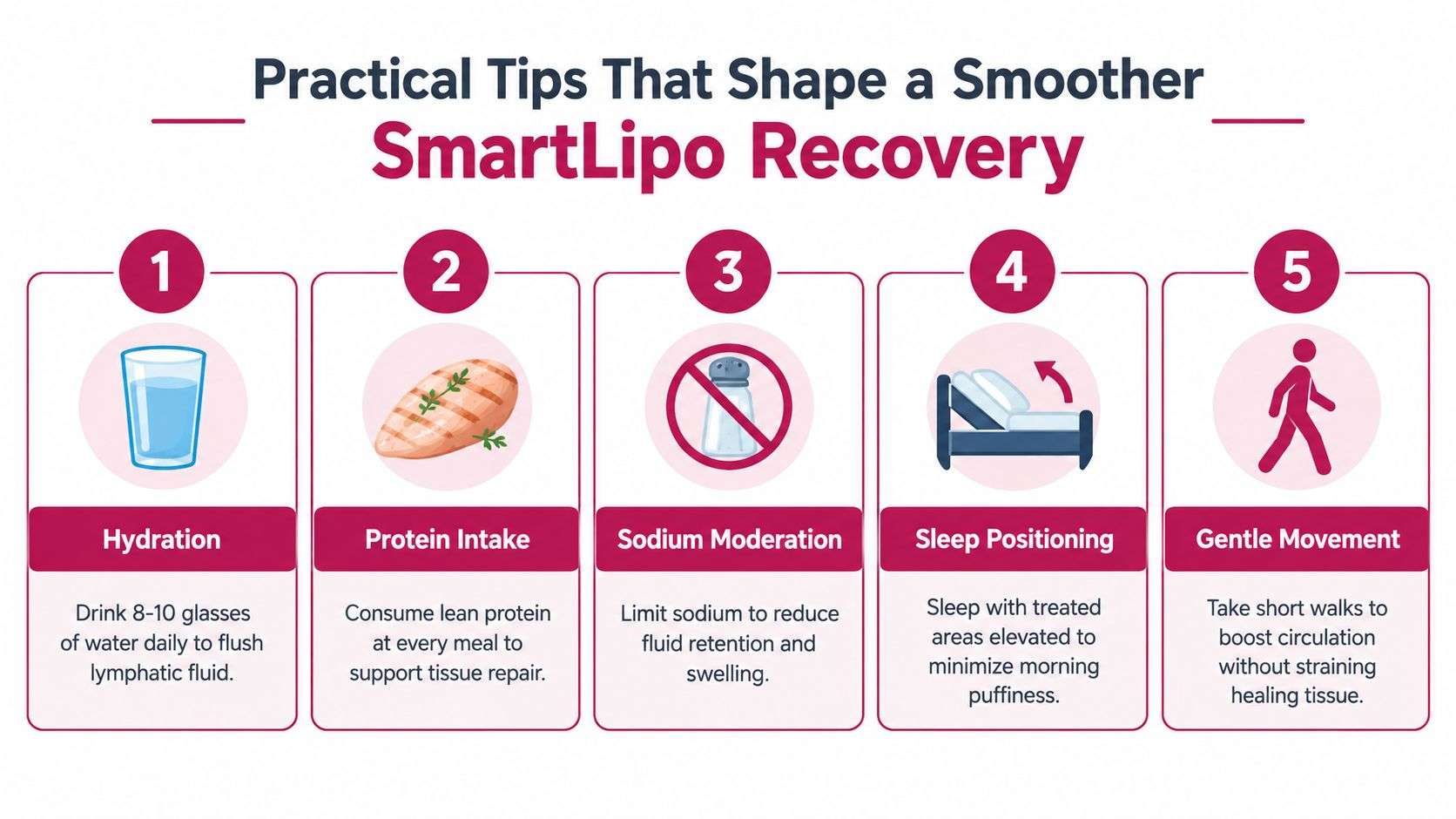
Use the infographic as a prompt for questions, not as a prescription for fluid intake. Your needs can vary with your health, medications, and dietary restrictions. Follow your surgeon's directions.
Before your procedure, stock a few easy meals with foods you tolerate and a convenient protein source. Avoid starting a restrictive diet or taking new supplements during recovery unless your care team approves. Loose clothing can make dressing easier over compression garments, while help with childcare or household tasks can prevent avoidable exertion. Keep a brief record of medication use and any meaningful changes to share at follow-up.
Massage is not appropriate for everyone or at every stage. Ask your surgeon whether it is recommended, who should perform it, and when it should begin. The guide to post-surgery massage can help you prepare questions for that conversation.
Plan around uncertainty, not a best-case return
A review of laser-assisted lipolysis reports potential reductions in early pain and time away from normal activities, while also discussing burns, infections, hematomas, seromas, and secondary procedures. An easier first stretch does not remove the risks associated with surgery or heat from the laser.
If you have a wedding, trip, or work deadline, make plans you can change. You may be able to attend an event before you feel comfortable in fitted clothing or ready to have the treated area photographed. Keep follow-up appointments and prescribed garment use in your schedule, rather than treating them as optional when life gets busy.
Red Flags and When to Call Your Surgeon
Sudden shortness of breath or chest tightness requires emergency medical attention. Don't wait for a routine callback or try to determine at home whether the cause is related to surgery. Tell emergency clinicians about your recent procedure.
Laser-assisted treatment also requires attention to skin changes. A clinical report on laser lipolysis discusses postoperative symptoms and the importance of technique-related safety considerations; laser energy doesn't eliminate the need to monitor healing carefully.
Symptoms that need prompt assessment
- New one-sided calf pain or leg swelling: Seek urgent assessment for a possible blood clot.
- Fever with worsening local symptoms: Contact the surgical team promptly because infection needs evaluation.
- Rapidly increasing swelling or expanding bruising: A collection of blood or fluid may need examination.
- New drainage, particularly with odor or worsening pain: Ask for prompt review rather than changing products yourself.
- Skin discoloration, blistering, or a burn-like area: Heat-related injury or compromised healing needs assessment.
- Increasing pain despite the prescribed plan: Call rather than repeatedly escalating medication on your own.
Make the call easy to act on
Have your procedure date, treated areas, medication list, symptom onset, and description of the change ready. Send photographs only through the communication method your team recommends. If you can't reach the practice and symptoms are urgent, seek urgent or emergency care.
When in doubt: Report a concerning change. You don't need to diagnose the complication before asking for help.
Before discharge, confirm your follow-up schedule and after-hours contact route. Keep planned visits even if you feel well; they're the right place to review sensation, contour, garment changes, and scar-care questions.
Georgia Plastic & Reconstructive Surgery offers SmartLipo consultations, recovery guidance, and postoperative follow-up. Visit Georgia Plastic & Reconstructive Surgery to discuss your treatment areas and build a recovery plan around work, childcare, exercise, and travel before choosing your surgery date.