
Understanding Insurance Coverage for Vaginal Rejuvenation
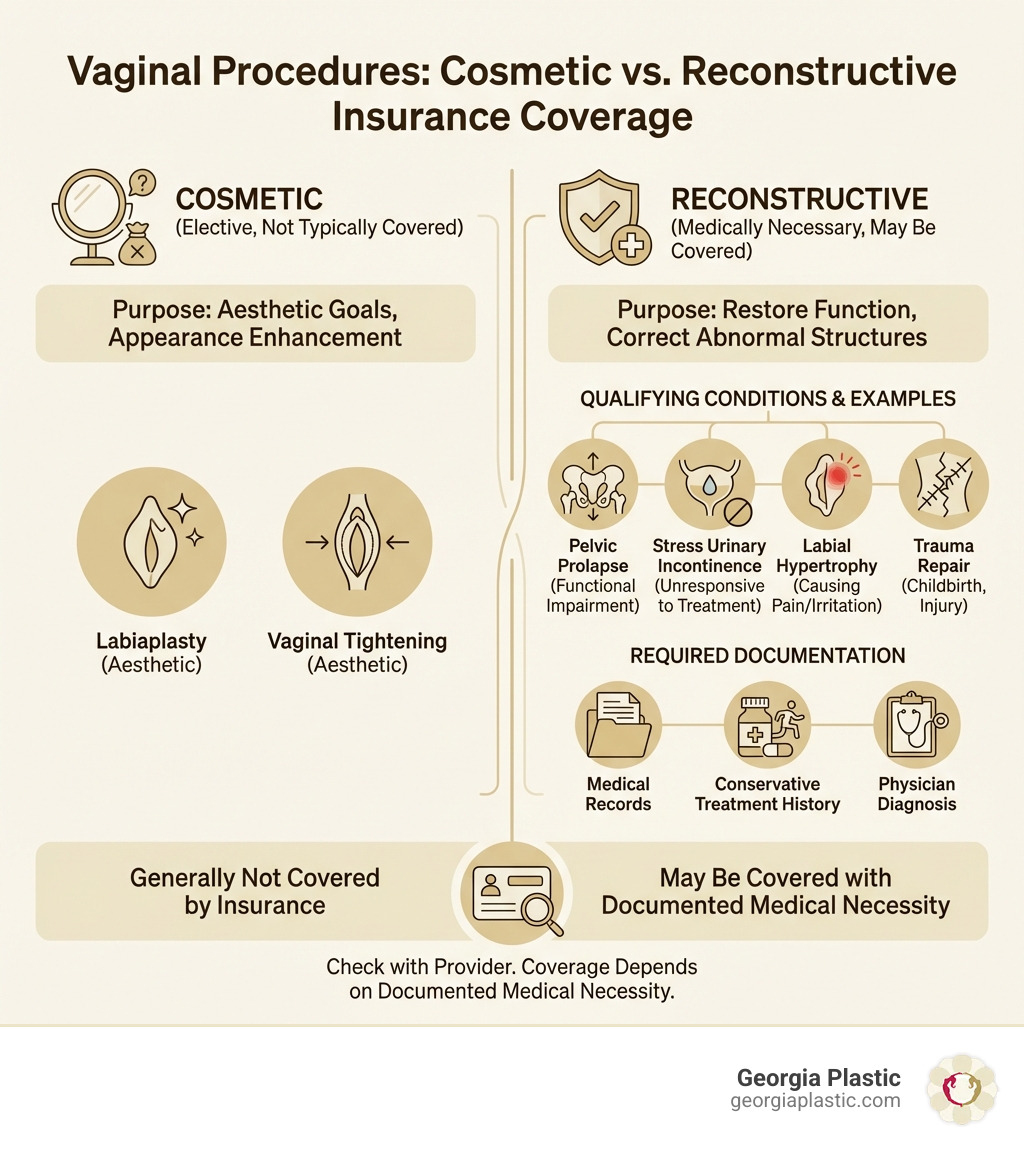
Is vaginal rejuvenation covered by insurance? In most cases, no—insurance does not cover vaginal rejuvenation when it’s performed for cosmetic or elective reasons. However, insurance may cover the procedure when it’s medically necessary to correct functional problems, such as pelvic organ prolapse, stress urinary incontinence, or complications from childbirth trauma.
Quick Answer:
- Generally not covered: Cosmetic procedures like labiaplasty or vaginal tightening for aesthetic purposes
- May be covered when medically necessary for:
- Pelvic organ prolapse causing functional impairment
- Stress urinary incontinence unresponsive to conservative treatment
- Labial hypertrophy causing chronic pain, irritation, or dyspareunia
- Reconstructive surgery after childbirth trauma or injury
- Congenital defects affecting normal function
- Required steps: Pre-authorization, medical documentation, proof of conservative treatment attempts, and physician diagnosis
The confusion around insurance coverage stems from the term “vaginal rejuvenation” itself. This umbrella term covers everything from purely cosmetic procedures to medically necessary reconstructive surgeries. Insurance companies draw a clear line between these two categories. Cosmetic surgery reshapes normal structures to improve appearance and self-esteem. Reconstructive surgery corrects abnormal structures caused by birth defects, trauma, injury, or disease to restore function.
When procedures address real medical diagnoses—not just aesthetic preferences—insurance coverage becomes possible. The key is demonstrating that your condition causes significant functional problems in your daily life, not just discomfort with appearance.
Understanding this distinction helps you navigate conversations with both your doctor and your insurance provider. Many women suffer for years with conditions like vaginal laxity after childbirth, recurrent infections, or pain during exercise and intimacy, not realizing that treatment may be covered when properly documented as medically necessary.
As Dr. Stanley Okoro, a double board-certified plastic surgeon, I regularly guide patients through the process of determining is vaginal rejuvenation covered by insurance based on their specific medical conditions and functional concerns. My practice focuses on helping patients understand both the medical and financial aspects of their care, ensuring they make informed decisions about their treatment options.
Understanding Vaginal Rejuvenation Procedures
Vaginal rejuvenation isn’t just one thing; it’s a collection of procedures designed to address changes in the female anatomy caused by aging, hormonal shifts, and childbirth. While the term sounds like it’s strictly about “looks,” it often involves deep functional restoration.
The most common procedures include:
- Labiaplasty: This is the surgical reduction or reshaping of the labia minora (inner lips) or labia majora (outer lips). While often sought for aesthetic reasons, many women choose this because elongated labia can cause significant physical discomfort, chafing during exercise, or chronic irritation.
- Vaginoplasty: This procedure involves vaginal tightening by removing excess vaginal lining and tightening the underlying muscles and soft tissues. It is frequently requested by women who experience vaginal laxity after multiple vaginal deliveries, which can lead to decreased sensation and sexual dissatisfaction.
- Vulvaplasty: This focuses on the external vulvar area, often correcting asymmetry or structural changes resulting from trauma or aging.
- Non-Surgical Energy Treatments: Technologies like Thermiva or CO2 lasers (like V-Lase) use radiofrequency or laser energy to stimulate collagen production. This heat-based therapy triggers the body’s natural healing response, leading to increased blood flow, improved lubrication, and tissue tightening without the need for incisions or downtime.
The ACOG clinical guidance on elective genital surgery emphasizes that while interest in these procedures is growing—labiaplasty rates in the U.S. increased by more than 50% between 2014 and 2018—patients must be counseled on the difference between elective cosmetic changes and medically indicated surgeries.
Is Vaginal Rejuvenation Covered by Insurance?
The short answer to is vaginal rejuvenation covered by insurance is: it depends on your “why.” Insurance companies generally view procedures that improve appearance as “elective” or “cosmetic.” Much like a facelift or breast augmentation, these are paid for out-of-pocket.
However, if the procedure is classified as reconstructive, the doors to coverage may open. According to medical necessity guidelines, reconstructive surgery is intended to correct abnormal structures of the body to improve function. We have seen many cases where plastic surgery is covered by insurance when it moves beyond aesthetics and into the realm of health restoration.
When is vaginal rejuvenation covered by insurance for medical necessity?
To get an insurance company to pay, we have to prove that the condition isn’t just a “source of discomfort” but a “provable health issue.” Common medical indications include:
- Pelvic Organ Prolapse (POP): When the muscles and tissues supporting the pelvic organs (bladder, uterus, or rectum) weaken, these organs can drop into the vaginal canal. Procedures like vaginoplasty or perineoplasty are often medically necessary to repair this structural failure.
- Stress Urinary Incontinence (SUI): If you leak urine when you cough, sneeze, or exercise, and conservative treatments (like Kegels) haven’t worked, certain rejuvenation procedures that support the bladder neck may be covered.
- Labiaplasty for Functional Impairment: According to the Oklahoma Health Care Authority vulvectomy guidelines, labiaplasty may be covered if the patient has labial hypertrophy (enlarged labia) causing:
- Dyspareunia: Pain during sexual intercourse that has not responded to conservative treatment.
- Chronic Irritation: Severe chafing, odor, or recurrent infections (like yeast infections or UTIs) directly caused by the excess tissue.
- Trauma Repair: Correcting tears or scarring from childbirth or accidental injury.
- Congenital Defects: Conditions present from birth that affect normal urinary or reproductive function.
Steps to determine if vaginal rejuvenation is covered by insurance
If you believe your case is medically necessary, you can’t just book the surgery and send the bill later. You must follow a specific administrative path:
- Consultation and Diagnosis: You need a formal diagnosis from a specialist (like Dr. Okoro or a urogynecologist) documenting the functional impairment.
- Documenting Conservative Treatment: Insurance companies usually want to see that you tried non-surgical options first. This might include pelvic floor physical therapy, topical creams, or lifestyle changes.
- Prior Authorization: Your surgeon’s office will submit a request to your insurance company before the procedure. This includes medical records, photos (if applicable and required), and a letter of medical necessity.
- CPT Code Identification: Billing depends on specific codes. CPT 56620 (Vulvectomy, partial) is often used for labia minora reduction, while CPT 57240 (Anterior colporrhaphy) might be used for bladder repair. Using the right code is essential for a successful claim.
Costs and Financing for Elective Procedures
If your insurance provider determines the procedure is cosmetic, you will be responsible for the full cost. Prices vary significantly based on the complexity of the surgery, the type of anesthesia used, and the facility fees.
| Procedure Type | Estimated Out-of-Pocket Cost |
|---|---|
| Labiaplasty | $3,500 – $6,000 |
| Vaginoplasty | $4,500 – $8,500 |
| Thermiva (per session) | $1,000 – $1,200 |
| Combined Procedures | $8,000 – $12,000+ |
Factors that influence these costs include:
- Anesthesia: General anesthesia is more expensive than local anesthesia with sedation.
- Facility: An outpatient surgical center is generally more cost-effective than a major hospital.
- Technology: Non-surgical options like regain sexual confidence with Thermiva typically require three sessions to see full results, which can add up to $3,000 or more.
Because these costs can be a hurdle, we offer several financing options. Many patients use CareCredit or Alphaeon, which function like credit cards for healthcare expenses and often offer 0% interest for a set period. Flexible payment plans and medical loans are also common ways patients manage the investment in their well-being.
Risks, Effectiveness, and Patient Expectations
Before undergoing any procedure, it is vital to have a realistic outlook. While many women report a massive boost in confidence and comfort, no surgery is without risk.
Potential risks associated with surgical vaginal rejuvenation include:
- Infection and Bleeding: Standard risks for any surgical intervention.
- Scarring and Adhesions: In rare cases, excessive scarring can cause discomfort.
- Altered Sensation: While many patients report improved performance and sensitivity, there is a small risk of temporary or permanent numbness.
- Dyspareunia: If tissues are overtightened, it could lead to pain during intercourse.
The ACOG FAQs on vaginal rejuvenation suggest that patients undergo a psychological assessment if there are signs of body dysmorphic disorder. It’s important to remember that “normal” comes in many shapes and sizes. In fact, a study of 657 females showed that the mean length of the labia minora exceeded 30–40 mm in more than 50% of individuals—meaning what you might think is “abnormal” is often perfectly healthy variation.
For those choosing non-surgical paths, the goal is often to tighten and moisturize with Thermiva. These treatments are highly effective for mild laxity and menopausal dryness but won’t provide the same dramatic structural change as surgery. Recovery for non-surgical treatments is usually zero days, while surgery typically requires 1–2 weeks off work and 6 weeks of “pelvic rest” (no tampons or intercourse).
Frequently Asked Questions about Insurance Coverage
Does Medicare cover vaginal rejuvenation?
Medicare follows strict “medical necessity” guidelines. It will generally cover procedures like vulvectomy or repair of pelvic prolapse if they are required to treat a functional impairment or a congenital defect. However, Medicare will not pay for procedures performed for cosmetic reasons or sexual enhancement. Medicare also uses “Medically Unlikely Edits” (MUEs) to limit the number of units billed for certain codes to prevent over-utilization.
What is the difference between cosmetic and reconstructive billing?
Cosmetic billing is for aesthetic enhancement—reshaping normal anatomy to look “better.” Reconstructive billing is for structural correction—fixing anatomy that is “broken” or malfunctioning. Insurance companies often look for “provable health issues” like chronic pain, recurrent infections, or documented incontinence. If you are seeking vaginoplasty purely for a “tighter feel” without a medical diagnosis of prolapse, it will likely be denied.
How much does vaginal rejuvenation cost out-of-pocket?
If you are paying out-of-pocket, a single Thermiva treatment often costs around $1,000 per session. Surgical procedures like labiaplasty or vaginoplasty typically range from $4,000 to $9,000 depending on the surgeon’s experience and the geographic location. Many clinics offer “package discounts” if you are combining multiple treatments or scheduling a series of laser sessions.
Conclusion
Navigating the question of is vaginal rejuvenation covered by insurance can be complex, but you don’t have to do it alone. At Georgia Plastic & Reconstructive Surgery, we believe that every woman deserves to feel comfortable and confident in her own body. Whether your concerns are functional, aesthetic, or a mix of both, Dr. Okoro and our all-female support team provide personalized care that prioritizes your safety and natural-looking results.
If you are struggling with physical discomfort, laxity, or other feminine health concerns, the first step is a professional evaluation. We can help you determine if your condition meets the criteria for insurance coverage or help you explore our flexible financing options.
Schedule your consultation for vaginal tightening today and take the first step toward reclaiming your comfort and confidence.


