
Why Choosing the Right Facelift Surgeon Matters More Than You Think
Selecting the best facelift surgeon is unequivocally the most critical decision you’ll make on your facial rejuvenation journey. This choice goes far beyond credentials; it’s about entrusting your face—your identity—to a professional who possesses a rare blend of surgical precision and artistic vision. The right surgeon understands that the goal isn’t to look different, but to look like the best version of yourself: rested, vibrant, and confident. Look for these non-negotiable qualities:
- Board Certification: This is the gold standard. Certification by the American Board of Plastic Surgery (ABPS) or the American Board of Facial Plastic and Reconstructive Surgery (ABFPRS) ensures the surgeon has completed extensive, specialized training and passed rigorous examinations focused on aesthetic and reconstructive surgery.
- Specialization in Facial Procedures: A surgeon who performs a high volume of facelifts, such as the deep plane and SMAS techniques, has encountered a wide range of facial structures and aging patterns. This experience translates into a refined ability to customize the procedure and steer complex anatomical challenges.
- Proven, Natural-Looking Results: A top surgeon’s portfolio should be a gallery of rejuvenation, not alteration. Scrutinize their before-and-after photos. Do the results look natural and refreshed? Are the incisions well-hidden? Do the outcomes look consistent across various patients?
- Verifiable Patient Testimonials: Genuine reviews offer insight into the entire patient experience, from the initial consultation to the final follow-up. Look for consistent themes of satisfaction, excellent communication, and compassionate care.
- Accredited Surgical Facilities: Your safety is paramount. The best surgeons operate exclusively in accredited facilities, which adhere to the strictest standards for equipment, staff, and emergency preparedness.
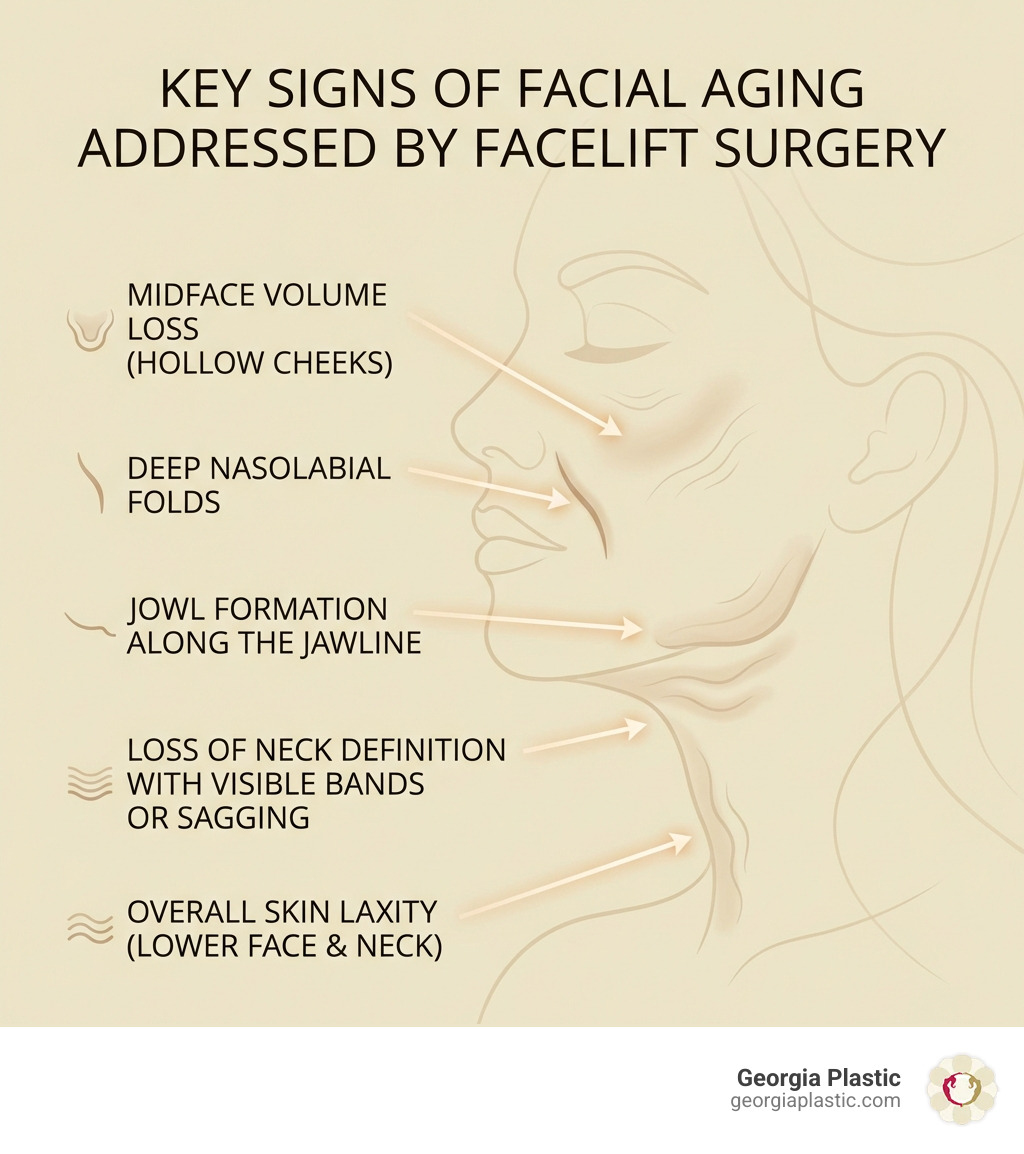
When you’re considering a facelift, you’re not just seeking a medical procedure—you’re looking for someone who understands that your face tells your story. The effects of aging, gravity, and sun exposure can create a disconnect between how you feel inside and what you see in the mirror. While over 120,000 people undergo facelift surgery each year, their satisfaction and safety depend almost entirely on their choice of surgeon.
The best facelift surgeons don’t just tighten skin; that’s an outdated approach that leads to a ‘pulled’ or ‘wind-tunnel’ look. Instead, they carefully reposition the deeper foundational tissues (the SMAS layer), restore youthful volume to areas like the cheeks, and redrape the skin naturally. They understand facial harmony, customize techniques to your unique anatomy, and prioritize your safety above all else.
As Dr. Stanley Okoro, a double board-certified plastic surgeon and founder of Georgia Plastic and Reconstructive Surgery, I’ve dedicated my career to advanced facial rejuvenation techniques that deliver natural-looking, long-lasting results. I have guided countless patients through the process of finding the best facelift surgeon for their individual needs. My approach combines surgical precision with artistic vision, ensuring each patient achieves outcomes that improve their unique features while maintaining their facial authenticity.
In the sections that follow, we’ll explore exactly what defines surgical excellence, break down modern facelift techniques, and guide you through the patient journey—so you can make an informed, confident decision about your facial rejuvenation.
The Anatomy of Excellence: What Defines the Best Facelift Surgeon?
Finding the best facelift surgeon is a journey that begins with understanding what truly defines excellence in this highly specialized field. It’s not just about technical skill; it’s about a combination of rigorous qualifications, extensive experience, and an innate artistic sensibility. We believe the truly exceptional surgeons possess all these attributes, leading to results that are both transformative and natural. To help you in your search, the American Society of Plastic Surgeons offers valuable tips for choosing a facelift surgeon.
The Non-Negotiables: Board Certification and Credentials
When evaluating a facelift surgeon, board certification is your first and most crucial filter. This isn’t just a fancy title; it signifies that a surgeon has met stringent educational, training, and examination requirements. A facial plastic surgeon should be certified by the American Board of Facial Plastic and Reconstructive Surgery (ABFPRS), which often follows a residency in Otolaryngology – Head and Neck Surgery. For plastic surgeons, certification by the American Board of Plastic Surgery (ABPS) is paramount. These boards ensure that the surgeon has undergone extensive training—often including at least six years of surgical training with a minimum of three years dedicated to plastic surgery—and passed comprehensive oral and written exams. This rigorous process guarantees a deep understanding of both the aesthetic and functional aspects of facial anatomy.
At Georgia Plastic, we emphasize the benefits of seeing a board-certified plastic surgeon. It assures you that your surgeon is committed to the highest standards of patient care, safety, and ethical practice. They are also required to complete continuing medical education annually, including patient safety, ensuring they stay at the forefront of surgical advancements and modern techniques.
Experience and Specialization: Why a Facial Expert Matters
While board certification is foundational, experience and specialization lift a surgeon to the “best” category. A surgeon who focuses primarily or exclusively on facial procedures brings a deeper level of expertise. This specialization means they perform a high volume of facelifts, constantly honing their techniques and developing a nuanced eye for the subtleties of facial harmony. Think of it like choosing a heart surgeon for heart surgery; you want the expert who lives and breathes that specific craft.
We pride ourselves on our expert surgeons, such as Dr. Stanley Okoro, who has dedicated years to mastering complex facial rejuvenation. Extensive experience isn’t just about the number of surgeries performed; it’s about the breadth of that experience. It means successfully managing diverse cases, from patients with subtle early aging to those requiring more extensive correction or even revision surgery to fix a previous unsatisfactory result. A seasoned surgeon understands how to customize procedures for different skin types, ethnicities, and facial structures, anticipating challenges and refining techniques for beautiful, long-lasting results.
The Artistic Eye: Blending Science with Aesthetics
A facelift is as much an art as it is a science. The best facelift surgeon possesses an exceptional artistic eye, coupled with a profound knowledge of facial anatomy. This allows them to visualize how your facial features will harmonize post-surgery, ensuring a refreshed and natural appearance rather than a generic or “operated” look. They understand that true beauty lies in balance, proportion, and the subtle interplay of light and shadow across the facial planes.
This artistic vision is critical to avoiding the dreaded ‘pulled’ or ‘wind-swept’ look. Instead of simply tightening skin horizontally, an expert surgeon repositions the underlying tissues vertically, against the pull of gravity. This restores a youthful, heart-shaped facial contour that respects your unique facial structure. Their goal is to make you look like a younger, more vibrant version of yourself, not a different person. This delicate blend of surgical precision and refined artistry is what separates a good result from a truly exceptional one, allowing for authentic and beautiful outcomes.
Mastering the Craft: A Guide to Modern Facelift Techniques
The world of plastic surgery is constantly evolving, with surgical innovation and technology continuously refining facelift techniques. Modern facelifts are far more sophisticated than those of previous decades, focusing on personalized surgical plans that address your unique aging patterns. Understanding the different approaches is key to finding the best facelift surgeon who can tailor the procedure to your needs. We invite you to explore what type of facelift surgery is right for you.
Comparing Facelift Procedures: Deep Plane vs. SMAS vs. Mini-Lift
When considering a facelift, you’ll likely encounter several terms describing different techniques. The most advanced methods focus on repositioning the underlying Superficial Musculoaponeurotic System (SMAS), the supportive tissue layer beneath the skin. This is the key to achieving a natural, long-lasting lift. Here’s a quick overview of the most common approaches:
- Deep Plane Facelift: This is often considered the gold standard for comprehensive facial rejuvenation. The surgeon works beneath the SMAS layer, lifting the muscle and skin together as a single unit. This allows for powerful repositioning of sagging mid-face tissues, including cheek fat pads, and provides the most dramatic and natural-looking correction for deep nasolabial folds and jowls. Because the tension is on the deeper supportive structures, not the skin, the result is exceptionally smooth and long-lasting.
- SMAS Facelift: In a SMAS lift, the surgeon first separates the skin from the underlying SMAS layer. They then lift and tighten the SMAS layer with sutures before redraping the skin and removing any excess. This is a highly effective and widely performed technique that provides excellent, natural-looking results for the jawline and neck, significantly improving jowling and skin laxity.
- Mini-Facelift: Also known as a short-scar facelift, this is a less invasive option ideal for patients with mild to moderate signs of aging, typically concentrated in the jowl area. It involves shorter incisions, usually just around the ear, and focuses on tightening the SMAS and skin in the lower face. While the recovery is often quicker, the results are less dramatic and may not be as long-lasting as a full facelift. It’s an excellent choice for younger patients or those not yet ready for a more extensive procedure.
| Facelift Type | Candidates | Technique | Recovery | Results |
|---|---|---|---|---|
| Deep Plane Facelift | Individuals with significant mid-face sagging, deep nasolabial folds, and prominent jowls. | Lifts the skin, fat, and muscle (SMAS) as a single unit, repositioning deeper facial tissues. | 2-4 weeks of social downtime. Swelling can persist longer but results are very natural. | Most comprehensive and long-lasting results, particularly for the mid-face and neck. |
| SMAS Facelift | Patients with moderate to severe jowling and neck laxity but good mid-face volume. | The surgeon lifts and tightens the SMAS layer separately from the skin. | 2-3 weeks of downtime. | Excellent, durable improvement for the jawline and neck. A widely used, reliable technique. |
| Mini-Facelift | Younger patients (40s-50s) with early signs of aging, like mild jowls and minimal neck sagging. | A less extensive procedure with shorter incisions, focusing on the lower face and jawline. | 1-2 weeks of downtime. | Subtle, natural refreshment. Less dramatic and less longevity than a full facelift. |
Comprehensive Rejuvenation: Combining Procedures
Facial aging is a multi-faceted process that often affects the entire face, not just the lower third. The best facelift surgeons recognize this and often recommend a holistic approach for the most harmonious and balanced results. A facelift primarily addresses jowls, the jawline, and the neck. However, signs of aging in the upper face, like drooping brows or hollowed, tired-looking eyes, will remain. Combining procedures can create a complete and cohesive rejuvenation.
Commonly combined procedures include:
- Eyelid Surgery (Blepharoplasty): To remove excess skin and fat pads from the upper and lower eyelids, creating a more alert and youthful eye area.
- Neck Lift: While a facelift improves the neck, a dedicated neck lift may be needed to address significant muscle banding (platysmal bands) or excess fat and skin.
- Brow Lift: To lift a heavy or sagging brow, opening up the eyes and smoothing the forehead.
- Fat Grafting: To restore lost volume in areas like the cheeks, temples, and under-eyes, which is a key component of a youthful face that lifting alone cannot achieve.
- Injectables like Botox and Fillers: Often used as a finishing touch to smooth fine lines or further improve volume in specific areas.
Customizing the Approach for Male vs. Female Patients
Men and women have fundamentally different aesthetic goals and facial structures, and an expert surgeon tailors their technique accordingly. A one-size-fits-all approach is a hallmark of an inexperienced surgeon. For men, the goal is typically to restore a strong, chiseled jawline and a defined neck angle while preserving masculine features. Incisions must be carefully planned to be hidden within the natural creases around the ear and to avoid disrupting the beard line or sideburns. The direction of the lift is also different, aiming for a more angular, rather than a soft, heart-shaped result.
For female patients, the objective is often to restore softer, more neat contours, recreating the ‘upside-down egg’ or heart shape of a youthful face. The surgeon focuses on creating a graceful jawline and a smooth, slender neck. Incision placement is equally critical but is planned around feminine hairlines and styles. The ability to understand and execute these gender-specific nuances is a key differentiator of a top-tier facelift surgeon.
For more information, you can explore our approach to cosmetic surgery for men.


