
You look in the mirror and notice a few things that weren't there before. The jawline isn't as crisp. The cheeks seem a little flatter. Lines around the mouth or eyes linger even when your face is at rest. You may want improvement, but you may not be ready for surgery, anesthesia, or weeks of recovery.
That's usually when people start searching for what is a non surgical face lift. It sounds simple, but the term causes a lot of confusion. Many patients assume it means one treatment that lifts the face the way surgery does. It doesn't. A non-surgical facelift is better understood as a category of treatments that can refresh, firm, plump, and smooth the face without large incisions or general anesthesia.
Some people call this a “liquid facelift” when injectables are involved. Others use the phrase more broadly to include skin-tightening devices, resurfacing, threads, and targeted fat reduction. The common thread is that these treatments aim to improve appearance with less downtime than surgery. If you're comparing options, a practical overview of a Beaconsfield non-surgical face lift can also help you see how different clinics describe this category of care.
According to the Cleveland Clinic overview of non-surgical facelifts, providers performed more than 13 million minimally invasive cosmetic procedures in the U.S. in 2020, with the majority focused on the face. If you want a broader look at the treatment categories available in practice, Georgia Plastic also outlines its non-surgical facial rejuvenation options.
Table of Contents
- Your Introduction to the Non Surgical Facelift
- How Non Surgical Treatments Rejuvenate Your Face
- The Main Types of Non Surgical Facelift Procedures
- Comparing Your Options Longevity Cost and Results
- Are You a Good Candidate for a Non Surgical Lift
- When a Surgical Facelift Is the Better Choice
- Your Next Step Toward Facial Rejuvenation
Your Introduction to the Non Surgical Facelift
A non-surgical facelift isn't one procedure. It's a treatment strategy.
That distinction matters because facial aging doesn't happen in one layer. Skin gets thinner and looser. Collagen declines. Fat pads shrink or shift. Muscles keep pulling on the skin in ways that deepen expression lines. A single treatment usually improves one part of that picture, not the whole thing.
Why people choose this route
Most patients considering non-surgical options want one or more of these benefits:
- Less downtime: They want to return to normal life quickly.
- Less invasiveness: They'd rather avoid large incisions and anesthesia if possible.
- A softer change: They want to look refreshed, not dramatically different.
- A stepwise approach: They prefer to make gradual improvements over time.
Those are reasonable goals. Non-surgical options can be very effective for the right person.
Practical rule: Think of a non-surgical facelift as facial rejuvenation without structural surgery, not as a replacement for every surgical result.
What the term usually includes
When patients use this phrase, they're usually talking about some combination of:
- Neuromodulators: to soften muscle-driven wrinkles
- Fillers or biostimulators: to restore support where the face has hollowed
- Energy-based treatments: to encourage collagen remodeling and improve firmness
- Surface treatments: to improve texture, pigmentation, and fine lines
- Selected contouring treatments: to refine areas like the jawline or under the chin
A good consultation focuses less on the label and more on the anatomy. Where are you losing support? Where is skin laxity mild, moderate, or significant? Which change bothers you most when you smile, talk, and rest?
If you understand that framework, the term “non-surgical facelift” becomes much less mysterious. It's a shorthand for a customized plan designed to make the face look more rested and supported without traditional facelift surgery.
How Non Surgical Treatments Rejuvenate Your Face
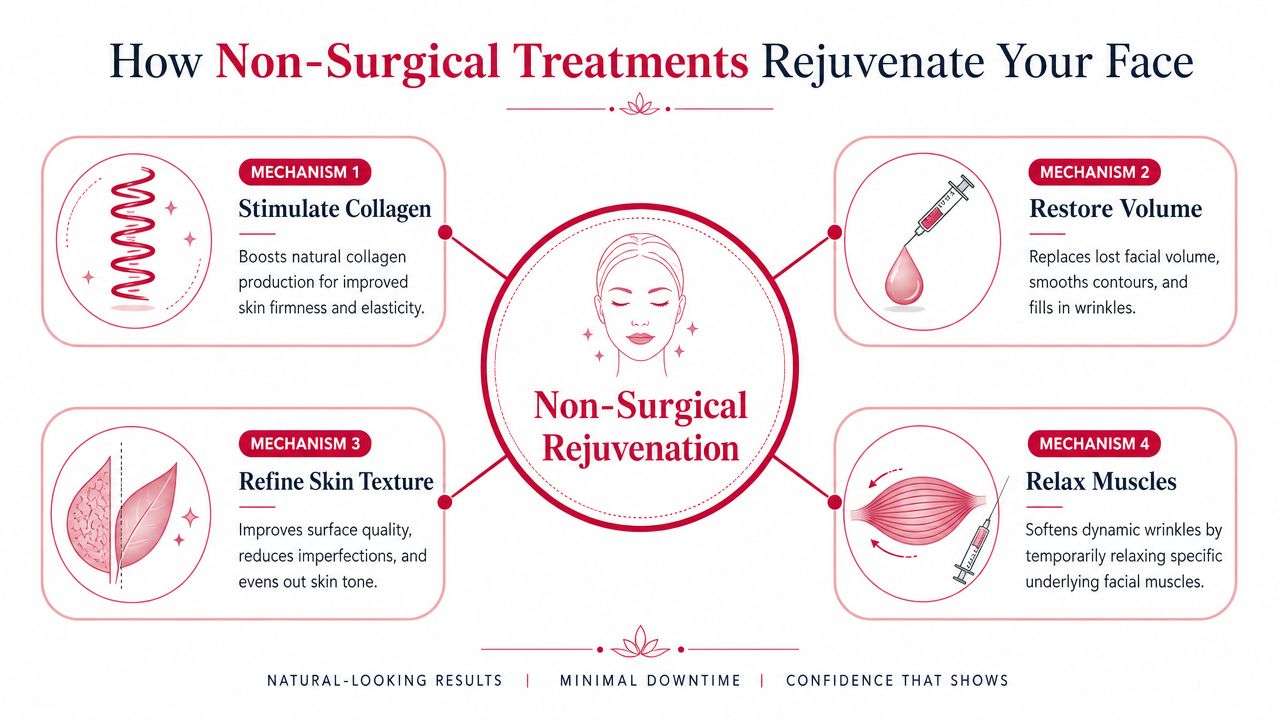
A useful way to understand these treatments is to think of facial aging like an older house that still has strong bones but needs selective renovation. One contractor doesn't do every job. You need different tools for the foundation, the walls, and the finish.
Volume support changes facial shape
When the face loses volume, especially in the cheeks, temples, or around the mouth, the skin can look heavier even if the problem isn't only loose skin. Restoring volume can create a fresher contour and a subtle lifting effect because the overlying tissue gets better support.
Hyaluronic acid fillers are a common example. They act a bit like replacing missing padding under upholstery. The outside looks smoother because the support underneath has been restored. If you want a patient-friendly example of this approach, this overview on restoring facial volume with Juvéderm shows how volume replacement fits into a larger rejuvenation plan.
Collagen remodeling tightens gradually
Energy-based treatments work differently. They don't work by filling space. They create controlled heat or mechanical stimulation in targeted layers so your body starts repairing and rebuilding collagen. That process is called neocollagenesis.
Collagen remodeling is slow. It's more like reseeding and strengthening a lawn than rolling out a carpet. According to Sofwave's explanation of non-surgical face lift mechanisms, these treatments produce gradual improvements that fully manifest over 3 to 6 months, while fillers provide immediate but non-permanent structural support.
Collagen remodeling is why some treatments don't give a dramatic same-day “lift,” but can make skin look firmer and more resilient over time.
Surface refinement and muscle relaxation
Not every aging change is about sagging. Sometimes the issue is rough texture, fine etched lines, or uneven tone. In that case, resurfacing treatments help the skin surface look smoother and more reflective.
Neuromodulators address another piece of the puzzle. If a muscle keeps folding the skin in the same way, lines deepen. Relaxing selected muscles can soften those creases and reduce downward pull in certain areas. That's why combinations often work better than chasing one treatment alone.
For people comparing professional care with home-maintenance tools, a detailed Currentbody mask analysis can be useful for understanding where at-home devices may support skin care, but they aren't substitutes for physician-guided correction of volume loss or laxity.
The Main Types of Non Surgical Facelift Procedures
When people ask what is a non surgical face lift, they're usually asking which treatments fall under that umbrella and what each one does. The simplest way to answer is to group them by job.

According to the global statistics on non-surgical cosmetic procedures, botulinum toxin injections accounted for 7.8 million procedures globally, and hyaluronic acid fillers accounted for 6.3 million. That tells you something important. Injectables remain the cornerstone of non-surgical facial rejuvenation.
Injectables
Neuromodulators soften movement-related wrinkles. These are the lines that come from repeated muscle activity, such as frown lines, forehead lines, and crow's feet. In some treatment plans, they're also used to reduce downward pull that contributes to a tired expression.
Fillers restore lost volume and improve contour. They may be placed in the cheeks, temples, jawline, lips, or folds around the mouth, depending on what the face needs. The goal shouldn't be puffiness. The goal is support.
A simple way to think about the difference:
- Neuromodulators calm motion
- Fillers replace support
- Biostimulators encourage your skin to rebuild support gradually
Some practices also offer products such as Botox, DAXXIFY, Juvéderm, Restylane, RHA, Sculptra, or Radiesse. The product matters, but the injector's understanding of anatomy matters more.
Energy-based treatments
These treatments use heat or focused energy to trigger remodeling beneath the skin. They're often chosen when the main concern is mild to moderate laxity, early jowling, or skin that feels thinner and less springy than it used to.
Common categories include:
- Radiofrequency-based treatments: often used to tighten and remodel tissue
- RF microneedling: combines controlled injury with energy delivery
- Ultrasound-based treatments: target specific depths to stimulate support
- Laser resurfacing: focuses more on the skin surface and texture
Each has a different target depth and different strengths. Some are better for firmness. Others are better for texture. Others sit somewhere in between. If you want an example of a treatment designed specifically for lifting support in a non-surgical plan, Georgia Plastic discusses that approach in its page on getting a non-surgical facelift with Ultherapy.
Threads and contour-focused treatments
Thread lifts are a more mechanical option. Dissolvable threads are placed beneath the skin to create a subtle repositioning effect and stimulate collagen as they dissolve. In the right patient, they can help with modest tissue descent. In the wrong patient, they can overpromise and underdeliver.
Targeted contour treatments focus on balance rather than generalized lifting. If fullness under the chin is blurring the jawline, reducing that area may improve the overall appearance of the lower face. The result isn't a facelift, but it can make the face look cleaner and more defined.
The best plan often mixes categories. A patient may need muscle relaxation in the upper face, volume support in the midface, and collagen stimulation along the jawline. One tool rarely handles all three well.
Comparing Your Options Longevity Cost and Results
Patients often ask for the single best treatment. That's usually the wrong question. The better question is which combination matches your anatomy, your timeline, and your tolerance for maintenance.
A source discussing integrated planning notes that optimal non-invasive results require “strategic, personalized plans” and reports that 68% of patients have unrealistic expectations when offered only one modality, while also describing FDA-cleared Ultherapy as the only non-invasive procedure proven to “lift skin” in that context, as outlined in this non-invasive facelift guide.
Non-Surgical Facelift Treatment Comparison
| Treatment Type | Best For | Results Last | Downtime | Relative Cost |
|---|---|---|---|---|
| Neuromodulators | Expression lines, selected facial muscle pull | Temporary, requires maintenance | Minimal | $ |
| Hyaluronic acid fillers | Volume loss, contour support, fold softening | Temporary, requires maintenance | Minimal to mild | $$ |
| Biostimulatory injectables | Gradual support and collagen-building | Temporary, develops over time | Mild | $$ |
| Ultrasound skin tightening | Mild laxity, brow or neck support, collagen remodeling | Temporary, gradual | Minimal | $$$ |
| RF-based tightening or RF microneedling | Mild to moderate laxity, texture plus firmness | Temporary, gradual | Mild to moderate | $$ to $$$ |
| Laser resurfacing | Texture, tone, fine lines, surface quality | Varies by treatment plan | Mild to moderate | $$ to $$$ |
| Thread lift | Subtle lift in selected patients | Temporary | Mild | $$ to $$$ |
| Under-chin contour treatment | Fullness under the chin, jawline definition | Varies by treatment plan | Mild to moderate | $$ |
The table is intentionally broad because results vary with facial anatomy, skin quality, and how much aging you're trying to correct.
Why combination plans usually win
A single modality can only solve the problem it was designed to solve. If your cheeks are hollow, a tightening device won't restore volume. If your jawline is soft because of laxity, filler alone can make the lower face look heavier. If your skin surface is rough, volume restoration won't improve texture.
That's why combination planning matters. A thoughtful plan may use one treatment to soften muscle pull, another to restore support, and a third to improve collagen quality. That's more honest, and usually more natural-looking, than trying to force one procedure to do everything.
Are You a Good Candidate for a Non Surgical Lift
Not everyone who wants a non-surgical facelift is a good candidate for one. That isn't bad news. It means the right answer depends on what your face needs.

Signs you may benefit
You're often a reasonable candidate if your concerns fall into the early or moderate range and you want improvement rather than a dramatic reset.
Common examples include:
- Mild skin laxity: The jawline is softening, but there isn't a large amount of loose skin.
- Early volume loss: The cheeks or temples look flatter, or folds seem deeper because support has diminished.
- Fine lines and dynamic wrinkles: You notice lines from facial movement or early resting lines.
- A preference for less downtime: You want to get back to normal activities quickly.
- A gradual mindset: You're comfortable building results in stages and maintaining them.
Signs you may need a surgical consult instead
If you have heavier jowls, significant neck laxity, or obvious excess skin, non-surgical care may improve details but won't fully address the main issue.
A useful self-check is this: if you gently lift the skin near the sides of the face and the improvement you want comes mostly from repositioning and removing loose tissue, surgery may be the more accurate solution.
A good candidate for non-surgical treatment wants enhancement. A good candidate for surgery often wants correction.
The consultation matters more than the menu of treatments. An experienced, physician-led evaluation looks at skin quality, facial support, fat distribution, and your goals in motion and at rest. That's how you avoid overtreatment, undertreatment, and disappointment.
When a Surgical Facelift Is the Better Choice
This is the part many articles avoid. If your aging changes are advanced, a non-surgical facelift may not be the most truthful answer.

What non-surgical treatments cannot do
Non-surgical options can improve skin quality, soften wrinkles, restore selected areas of volume, and create modest lifting effects. What they cannot do is duplicate the structural work of surgery.
A discussion of this limitation, referencing a 2023 study, explains that the term non-surgical facelift can be misleading because these interventions cannot reposition deep facial tissues like a true facelift and may create an “unnatural, overdone” appearance when used for advanced laxity, while surgical results are described as “dramatic, permanent” and non-surgical results as “short-term” in this analysis of why the term can be misleading.
Here's the practical meaning of that:
- They don't remove excess skin
- They don't reposition deeper muscle and fat the way surgery can
- They can't reliably correct significant jowling or neck banding
- They require maintenance because aging continues
Where surgery becomes the more honest answer
Surgery is often the better choice when the main problem is tissue descent, excess skin, or pronounced laxity in the lower face and neck. In that setting, continuing to stack non-surgical procedures can become expensive, frustrating, and less natural-looking.
A surgical facelift works on a different level. It allows the surgeon to lift and reposition deeper structures and remove redundant skin. That's why the result is more thorough. It addresses the cause of advanced sagging, not just the visible surface effects.
This is also where expectations matter. If a patient says, “I want my jowls gone,” or “I want my neck tightened in a lasting way,” I would rather give a clear answer than sell a softer treatment that can't realistically deliver that outcome.
That honesty builds trust. It also protects patients from the cycle of repeated temporary treatments aimed at a problem that really needs structural correction.
Your Next Step Toward Facial Rejuvenation
The most useful way to think about a non-surgical facelift is this. It's not a product. It's not one device. And it's not a promise that you can recreate surgery without surgery.
It's a personalized facial rejuvenation strategy.
For some patients, that strategy may mean a few well-placed injectables and a skin-tightening treatment. For others, it may mean improving texture, restoring volume, and refining the jawline over time. And for some, the right plan begins with an honest conversation that surgery will produce the cleaner, more lasting result.
That's why combination planning matters so much. Faces age in layers, so treatment should be layered too. The best outcomes usually come from matching each concern to the right tool instead of chasing a single trendy fix.
If you're still asking what is a non surgical face lift, the simplest answer is this: it's a custom approach to helping your face look fresher, firmer, and more balanced without traditional facelift surgery. The important next question isn't “Which treatment should I pick?” It's “What does my face need?”
A thoughtful consultation with Georgia Plastic & Reconstructive Surgery can help you sort that out. The practice offers both surgical care and non-surgical options through its physician-led setting, which makes it easier to compare approaches directly and build a plan that fits your anatomy, goals, and comfort level.


