
Why Natural Facelift Results Are the Gold Standard Today

Natural facelift results are achieved when a surgeon addresses the deeper layers of facial tissue—not just the skin—to restore youthful contours without creating a “pulled” or artificial appearance. Here’s what defines a truly natural outcome:
- You still look like yourself, just refreshed and rested—not different
- Your face moves naturally with expressions, appearing soft and supple
- The underlying SMAS muscle layer is lifted, providing structural support
- Skin is gently redraped without tension, avoiding the “stretched” look
- Facial harmony is maintained, preserving your unique features
- Results last 8-10 years on average, turning back the clock without stopping it
One of the biggest hang-ups people have about facelift surgery is the fear of looking unnatural. You’ve seen the images online—the overly tight, windblown faces that scream “I had work done.” The good news? Those days are over. Modern facelift techniques have evolved dramatically, and today’s results focus on one simple goal: helping you look like yourself on your best day.
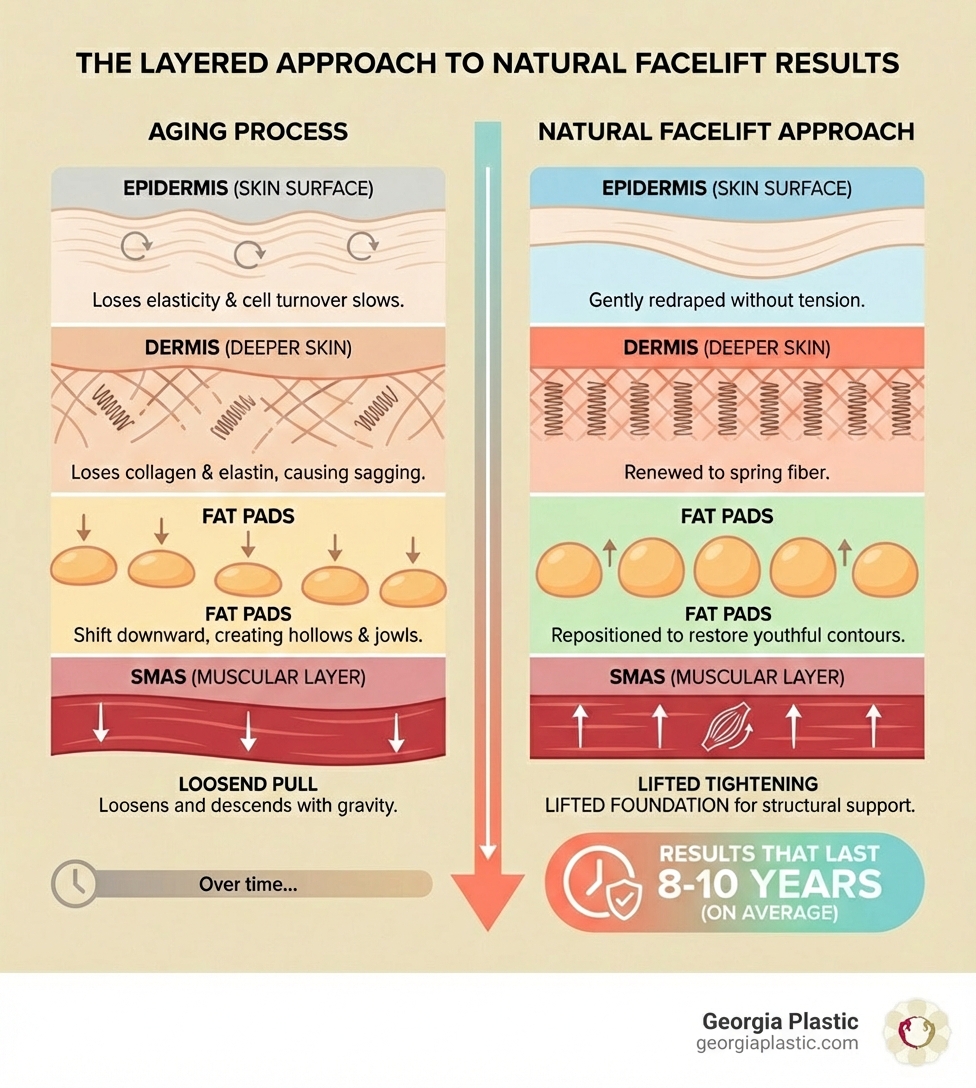
The secret lies in understanding that facial aging happens in layers. Your skin loses elasticity, yes—but beneath it, the SMAS (superficial musculoaponeurotic system) muscle layer loosens and descends. Fat pads shift. Volume disappears from your cheeks and temples. A natural-looking facelift addresses all of these changes, not just the surface.
This is exactly what we do differently at Georgia Plastic. As Dr. Stanley Okoro, a double board-certified plastic surgeon, I’ve spent years perfecting techniques that deliver natural facelift results by working with your facial anatomy, not against it. My approach combines surgical precision with an artistic eye, ensuring every patient achieves a refreshed appearance that honors their unique features.
The Evolution of the Facelift: From “Pulled” to Perfectly Natural
The journey of the facelift has been a fascinating one, moving from rudimentary skin-tightening procedures to sophisticated, multi-layered approaches that redefine facial rejuvenation. For many years, the primary complaint about facelift surgery was the “overdone” or “pulled” look. This was largely because older methods focused almost exclusively on tightening the skin. Imagine trying to fix a sagging mattress by simply pulling the sheet tighter – it might look smoother for a moment, but the underlying problem remains, and the sheet quickly becomes taut and unnatural.
Modern Techniques vs. Older Methods
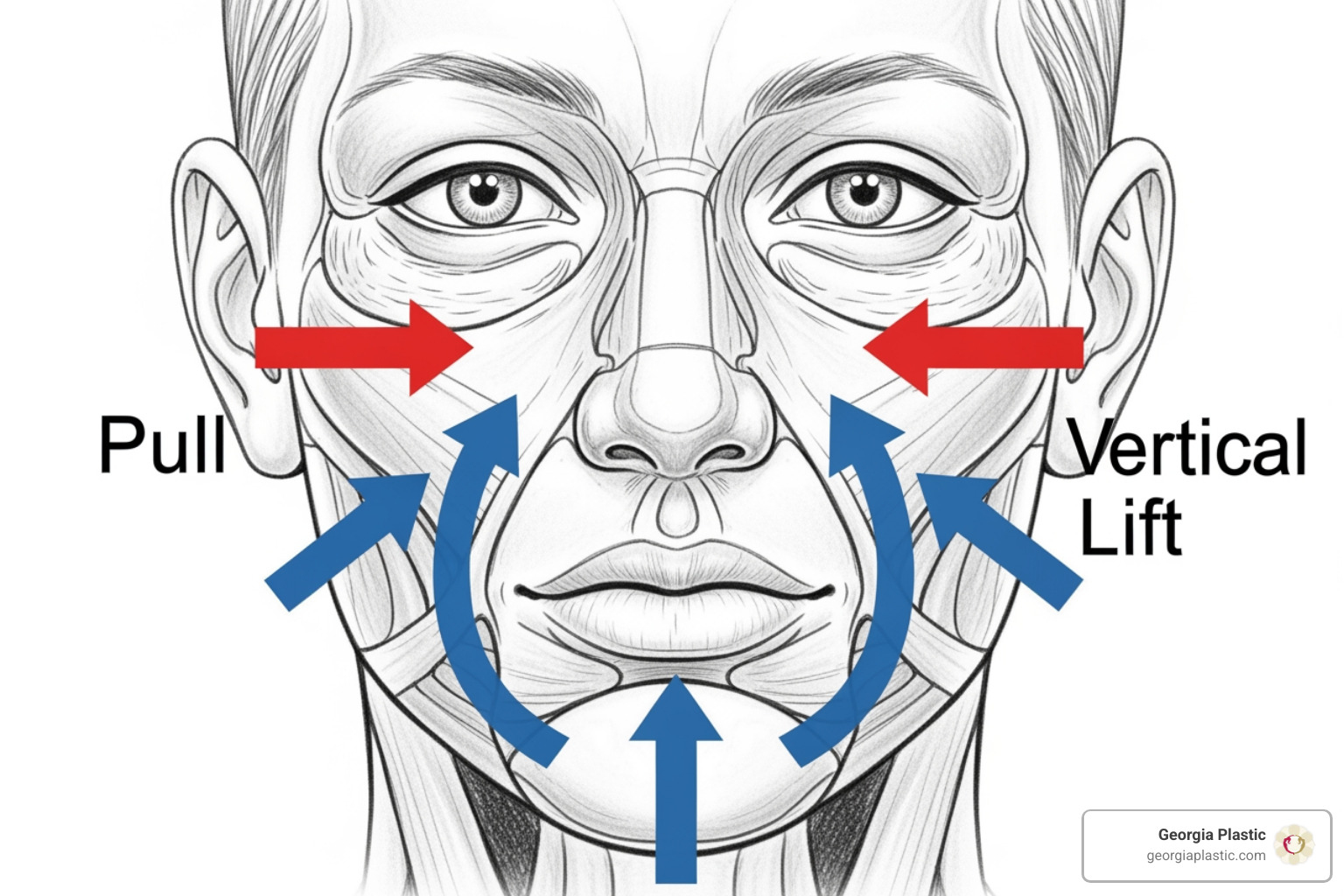
The days of overly stretched, tight, or “windblown” facelifts are thankfully over. Modern facelift techniques reach deeper, addressing the underlying structures of the face, not just the skin. While older facelifts primarily tightened only the skin, today’s approaches involve manipulating the deeper tissues to create longer-lasting and more natural-looking results. This shift in methodology is critical. Instead of pulling the skin horizontally across the face, which can distort features, modern techniques lift tissues vertically, counteracting the effects of gravity more effectively.
This deeper tissue manipulation allows us to restore a more youthful face shape. As we age, our face often transitions from a more heart-shaped or oval appearance to a pear-shaped look, characterized by jowls and heaviness in the lower face and neck. By tightening and repositioning the underlying structures, we can subtly re-establish those youthful contours, reducing jowls and creating a lifted, more defined jawline.
Crucially, modern facelifts prioritize maintaining your unique features. The goal is to make you look like a younger, refreshed version of yourself, not a different person entirely. This involves a keen understanding of facial harmony – ensuring that all facial features remain balanced and proportionate. It’s about enhancing your natural beauty, not erasing it.
To dig deeper into the various techniques and advancements in facelift surgery, you can learn more about facelift techniques from The Aesthetic Society.
The Anatomy of a Natural Look: Key Surgical Techniques
Achieving truly natural facelift results is a sophisticated dance between surgical precision and artistic vision. It’s not just about removing excess skin; it’s about understanding the intricate anatomy of the face and addressing the root causes of aging at multiple levels. Key techniques involve the careful management of the SMAS layer, avoiding excessive tension on the skin, and tailoring the approach to each individual’s unique facial structure. Often, a comprehensive approach involves combining the facelift with other complementary procedures such as fat transfer to restore lost volume or eyelid surgery (blepharoplasty) to refresh the eyes, creating a holistic and harmonious rejuvenation.
Beyond the Skin: The Importance of the SMAS Muscular Layer
The SMAS, or superficial musculoaponeurotic system, is arguably the unsung hero of the natural facelift. It’s a continuous layer of fibrous tissue and muscle that extends from your neck up into your face and forehead. Think of it as the foundational support system for your facial skin and fat.
What is the SMAS? It’s the layer that connects your facial muscles to your skin. When we’re young, this layer is firm and holds everything snugly in place. But as gravity, time, and genetics take their toll, the SMAS begins to loosen and descend. This descent is a primary contributor to sagging cheeks, the formation of jowls along the jawline, and the deepening of nasolabial folds (the lines running from your nose to the corners of your mouth).
The SMAS is the true foundation of the face. If we only address the skin, we’re essentially just pulling on a loose covering without fixing the underlying support. This is why skin-only lifts often lead to that “pulled” or “stretched” look, and why their results tend to be short-lived. The skin is under tension, but the foundational issues haven’t been resolved, so the skin eventually succumbs to gravity again, often looking taut but not truly youthful.
Our approach focuses on lifting the SMAS layer back to its more youthful position and securing it. By repositioning this muscular layer, we create long-lasting structural support for the entire face. The skin can then be redraped gently over this newly liftd foundation, without excessive tension. This “lifting” of the muscle, rather than merely “pulling” the skin, is the secret to achieving those authentic, long-lasting natural facelift results.
The Art of Tension: How Surgeons Avoid an Overstretched Appearance
Avoiding the dreaded “overstretched” or “mask-like” appearance is paramount for achieving natural facelift results. This is where the surgeon’s artistry and meticulous technique truly come into play, particularly when handling the skin.
Once the underlying SMAS layer has been lifted and secured, the skin is then carefully redraped over the newly contoured facial structures. The key here is gentle redraping. We want the skin to lie precisely where it should, smoothly covering the repositioned tissues without any undue tension. This tension-free closure is vital for several reasons:
- Preserving Natural Movement: Youthful skin is supple and moves fluidly with facial expressions. Overstretched skin, on the other hand, can feel tight and restrict natural movement, leading to a stiff or unnatural look. By avoiding tension, we ensure that your face can still convey the full range of emotions, from a joyful smile to a thoughtful frown, without appearing taut or immobile.
- Supple Skin Quality: When skin is redraped gently, it retains its natural softness and flexibility. Over-tightening can make the skin appear thin, shiny, and unnatural, especially around the ears and jawline.
- Avoiding a “Mask-Like” Appearance: The goal is to improve your natural contours, not to flatten them or create a generic, unexpressive face. Proper skin redraping allows for subtle shadows and highlights that contribute to a natural, three-dimensional facial appearance.
- Incision Placement: A skilled surgeon will carefully plan incisions to be inconspicuous. These are typically hidden within the hairline, in the natural creases around the ear, and behind the ear. When the skin is redraped without tension, these incisions heal more gracefully and are far less noticeable, contributing significantly to the overall natural outcome.
It’s a delicate balance: achieving significant rejuvenation while respecting the inherent elasticity and movement of the skin. This “art of tension” is a hallmark of truly exceptional natural facelift results.
Tailoring the Technique for Each Patient
One of the most crucial aspects of delivering natural facelift results is recognizing that facelifts are absolutely not one-size-fits-all. Each patient comes to us with a unique facial anatomy, distinct patterns of aging, and specific aesthetic goals. Therefore, the “best” facelift technique is always the one that is carefully custom to the individual.
During your consultation, we conduct a thorough assessment, considering factors such as:
- Your unique facial anatomy: Bone structure, fat distribution, and skin quality all play a role.
- The degree of aging: Are we addressing early signs of laxity, or more significant sagging?
- Your desired outcome: Do you want a subtle refresh or a more comprehensive rejuvenation?
Based on this, we might recommend different approaches:
| Facelift Type | Candidacy | Areas Treated | Typical Recovery (Initial) |
|---|---|---|---|
| Mini-Lift | Ideal for younger patients (30s-40s) or those with early signs of aging, mild jowling, and minimal neck laxity. | Targets the lower face and jawline, providing a subtle lift to address early jowls and improve definition. | Around 1 week for returning to light activities; bruising and swelling subside within 2 weeks. Less extensive than a full facelift. |
| SMAS Lift | Common for patients with moderate facial and neck sagging, noticeable jowls, and deepening nasolabial folds. | Addresses the mid-face, lower face, and neck by lifting and repositioning the SMAS layer and redraping the skin. | 1-2 weeks for social activities; major swelling subsides within 3-4 weeks. Full results visible in a few months. |
| Deep Plane Facelift | Best for patients with significant sagging, deeper nasolabial folds, prominent jowls, and more advanced neck laxity. | Lifts the SMAS layer and the attached muscle and fat as a single unit, releasing deeper facial ligaments. Provides comprehensive rejuvenation of the mid-face, lower face, and neck, including the jawline. | 2-3 weeks for social activities; significant swelling can last 4-6 weeks. Offers the most dramatic yet natural-looking and long-lasting results. Full results visible in 3-6 months as swelling fully resolves. |
The effectiveness of a facelift technique often depends more on the surgeon’s skill and experience than the specific technique itself. A highly skilled surgeon can achieve superior natural facelift results using various methods, always prioritizing your unique features and desired outcome.
Your Role in Achieving Great Results: Patient Factors and Preparation
While the surgeon’s skill and technique are paramount, your role as a patient is equally vital in ensuring outstanding and natural facelift results. We often say that successful outcomes are a partnership, and your commitment to preparation and recovery significantly impacts the final look and longevity of your rejuvenation.
Patient selection is a critical first step. We look for individuals who are in good overall health, both physically and mentally, and who have realistic expectations about what surgery can achieve. A facelift can turn back the clock, but it cannot stop it entirely. Understanding this fundamental truth helps set the stage for satisfaction.
Your overall health directly influences your healing ability. Conditions like diabetes or autoimmune disorders need to be well-managed. Lifestyle factors also play a massive role. External factors such as sun damage, chronic stress, poor diet, and abrasive skin cleansers can accelerate collagen loss, contributing to skin laxity and deeper wrinkles. While we can address the results of these factors, adopting healthier habits can certainly help maintain your refreshed appearance.
Perhaps one of the most critical lifestyle considerations is smoking. Nicotine products, including vaping and patches, severely inhibit circulation and slow down the healing process. For your safety and the quality of your results, we require patients to cease all nicotine use for several weeks before and after surgery. It’s not just a recommendation; it’s a non-negotiable for optimal healing and minimizing complications.
Finally, genetics also play a part in how gracefully you age and how your skin responds to surgery. While we can’t change your genes, understanding your family’s aging patterns can help us anticipate and address your concerns more effectively.
Candidacy and Timing: Can a Facelift Look Natural at Any Age?
The idea that facelifts are only for a certain age group is a common misconception. In reality, modern facelifts aren’t one-size-fits-all, nor are they dependent on a specific age. Thanks to advancements in techniques, age is less of a barrier than it used to be. The question isn’t “Am I too old or too young?” but rather “Am I a good candidate for this procedure given my unique concerns?”
We’ve seen patients in their 30s and 40s seeking facelifts for preventative rejuvenation or to address specific concerns like early jawline sagging or loose skin around the eyes. At this age, skin elasticity is generally better, and collagen levels are higher, meaning the skin tends to heal faster and bounce back more readily. This can lead to quicker recovery and often smoother, more refined results.
Conversely, patients in their 60s and beyond can achieve truly remarkable natural facelift results. While their skin might have less elasticity and collagen, comprehensive modern techniques can still effectively lift and reposition deeper tissues. The key is to address the individual’s specific anatomy and degree of aging.
The benefits of early intervention are worth noting. Addressing signs of aging with less invasive procedures, or even a mini-facelift, when they are still mild, can help prevent more significant sagging later. This proactive approach can lead to better long-term natural facelift results and allow individuals to age as gracefully as possible, maintaining a refreshed look over many years. It’s about addressing the anatomy of aging, not just the chronological age on your birth certificate.
The Benefits of Natural Facelift Results Over Dramatic Changes
When it comes to cosmetic surgery, the goal is often to look better, not different. This is precisely why natural facelift results are the gold standard and offer significant benefits over a more dramatic, obvious change.
Firstly, a natural-looking facelift helps you look rested, healthier, and more vibrant, without drawing undue attention to the fact that you’ve had surgery. The ultimate compliment for us is when friends and family comment on how well you look, how refreshed you seem, or that you’ve just returned from a relaxing vacation – rather than asking if you “had work done.” This avoids unwanted questions and allows you to own your refreshd appearance with confidence.
Secondly, a subtle, natural approach boosts your confidence in a way that feels authentic. You still recognize yourself in the mirror, but it’s a version of you that reflects your inner vitality. This sense of self-assurance, free from the worry of an artificial appearance, is incredibly empowering.
Finally, natural facelift results allow you to age gracefully from a new, more youthful baseline. The procedure sets the clock back, effectively giving you a head start against the ongoing aging process. While it doesn’t stop time, it provides a significant refresh that can last an average of 10 years, meaning you’ll continue to look younger than your chronological age for a considerable period. It’s an investment in sustained youthfulness and a refreshed, authentic you.
How to Find the Right Surgeon for Your Natural Facelift Results
Choosing the right surgeon is arguably the most critical decision you’ll make on your journey to achieving natural facelift results. In fact, many experts agree that the effectiveness of a facelift technique has more to do with the surgeon’s skill and aesthetic eye than the specific surgical technique used. You’re not just looking for a technician; you’re looking for an artist who understands facial anatomy and can translate your goals into a harmonious, refreshed appearance.
The importance of a personal connection cannot be overstated. We believe that seeing eye-to-eye with your facelift surgeon is just as important as assessing their operating skills. During your consultation, pay attention to how well they listen to your concerns, how clearly they explain the procedure, and whether you feel comfortable and confident in their approach. This rapport is essential for a successful partnership and ensures your vision for natural facelift results is truly understood.
Look for a surgeon with a proven track record of delivering consistent, natural-looking outcomes. This means more than just having before-and-after photos; it means demonstrating an aesthetic eye that values subtle improvement over dramatic alteration.
Verifying Credentials and Expertise
When it comes to something as important as your face, verifying your surgeon’s credentials and expertise is non-negotiable. Always choose a board-certified plastic surgeon. Specifically, look for certification by the American Board of Plastic Surgery (ABPS). This certification signifies that a surgeon has undergone rigorous training, passed comprehensive exams, and maintains the highest standards of patient care. You can easily check a surgeon’s credentials on surgery.org to ensure they are properly certified.
Additionally, consider the surgeon’s experience specifically with facial procedures. While all board-certified plastic surgeons are qualified, some develop a particular specialization and artistry in facial rejuvenation. Ask about their experience with different facelift techniques and how often they perform them. Finally, ensure your surgeon has hospital privileges. This indicates that they have been vetted by their peers and meet stringent safety standards to perform surgery in an accredited facility.
Reading Between the Lines of Before-and-After Photos
Before-and-after photos are an invaluable tool, but they require careful scrutiny. They can show you a surgeon’s typical results and help you determine if their aesthetic aligns with your vision for natural facelift results. Here’s what to look for:
- Consistent Lighting and Angles: Beware of photos with wildly different lighting, expressions, or angles. This can obscure true changes or artificially improve results. Look for standardized photos taken under consistent conditions.
- Variety of Ages and Cases: A surgeon who can achieve natural results across a diverse range of patients – different ages, skin types, and starting points – demonstrates versatility and skill.
- Scrutinize Key Areas: Pay close attention to the jawline, neck, and earlobes. A natural jawline should be defined but not overly sharp. The neck should be smooth without appearing stretched or tight. The earlobes are a tell-tale sign: an unnatural facelift can pull them downwards or distort their shape.
- Do Patients Still Look Like Themselves?: This is the ultimate test for natural outcomes. The best before-and-after photos will show patients who look refreshed, revitalized, and younger, but undeniably still themselves. They should not look like a completely different person, nor should their expressions appear frozen or unnatural.
Frequently Asked Questions about Natural Facelifts
We understand that considering a facelift brings many questions. Here, we address some of the most common inquiries our patients have about achieving and maintaining natural facelift results.
How long do natural facelift results last?
One of the most encouraging statistics about modern facelift surgery is that the results typically last an average of 10 years, if not longer! This means you can enjoy a significantly refreshed and more youthful appearance for a decade or more. However, it’s crucial to understand that a facelift turns back the clock; it doesn’t stop it. Your face will continue to age naturally after the procedure, just from a more advantageous starting point.
Factors influencing the longevity of your natural facelift results include your genetics, lifestyle choices (like sun protection and not smoking), and general skin quality. While the structural changes made during surgery are long-lasting, the ongoing aging process means that some individuals may eventually consider secondary procedures, such as a mini-lift or fillers, to maintain their refreshd look.
What is recovery like and when will I see the final outcome?
The initial recovery period after a facelift typically lasts about 1 to 2 weeks. During this time, you can expect some bruising and swelling, which is completely normal. We provide detailed instructions on how to manage these symptoms, including keeping your head liftd, applying cool compresses, and adhering to a low-salt diet to minimize swelling.
Most patients feel comfortable returning to light-duty work within one week. Strenuous activities, however, should be avoided for several weeks, and rigorous workouts will need your surgeon’s “all-clear.”
While you’ll start to see improvements fairly quickly, the final outcome of your natural facelift results will gradually emerge as swelling fully subsides, which can take several months. Most patients feel comfortable attending special engagements by 4-6 weeks, as swelling has significantly reduced, and any residual bruising can be easily concealed with makeup. Full healing and the complete realization of your results are typically apparent around the 3-4 month mark.
Will I have visible scars after a facelift?
A common concern is the visibility of scars. A skilled plastic surgeon carefully plans incisions to be as inconspicuous as possible, aiming for truly natural facelift results. These incisions are typically hidden within the hairline, behind the ear, and in the natural creases of the face.
With proper surgical technique and diligent post-operative care, facelift scars usually fade significantly over time, becoming less visible, lightening in color, and softening to the touch over 6 months to a year. In most people, these scars are virtually undetectable once fully healed. We provide specific guidance on scar care to optimize healing and ensure your beautiful, refreshed face is the focus, not your incisions.
Conclusion: Your Path to a Refreshed, Authentic You
The quest for natural facelift results is about looking and feeling your best, authentically. We’ve explored how modern techniques have evolved beyond the “pulled” look of the past, focusing instead on deeper tissue manipulation, meticulous skin redraping, and personalized approaches that honor your unique facial harmony. The importance of the SMAS muscular layer, the art of tension-free closure, and tailoring the technique to your individual needs are all crucial components of this change.
Choosing the right surgeon – one with verified credentials, extensive experience, and a keen aesthetic eye – is paramount. Their skill, combined with your commitment to preparation and recovery, forms the partnership that leads to truly exceptional outcomes.
At Georgia Plastic, led by board-certified Dr. Stanley Okoro, we pride ourselves on delivering personalized care that consistently achieves natural facelift results for our patients in Atlanta, GA. Our approach prioritizes your safety and ensures you receive a refreshed appearance that makes you feel vibrant and confident, looking like yourself on your very best day.
If you’re ready to take the first step toward uncovering a more youthful, authentic you, we invite you to connect with us. Explore your facial rejuvenation options and schedule a consultation to discuss how we can help you achieve your aesthetic goals.


