
What Is Umbilicoplasty? Your Quick Answer
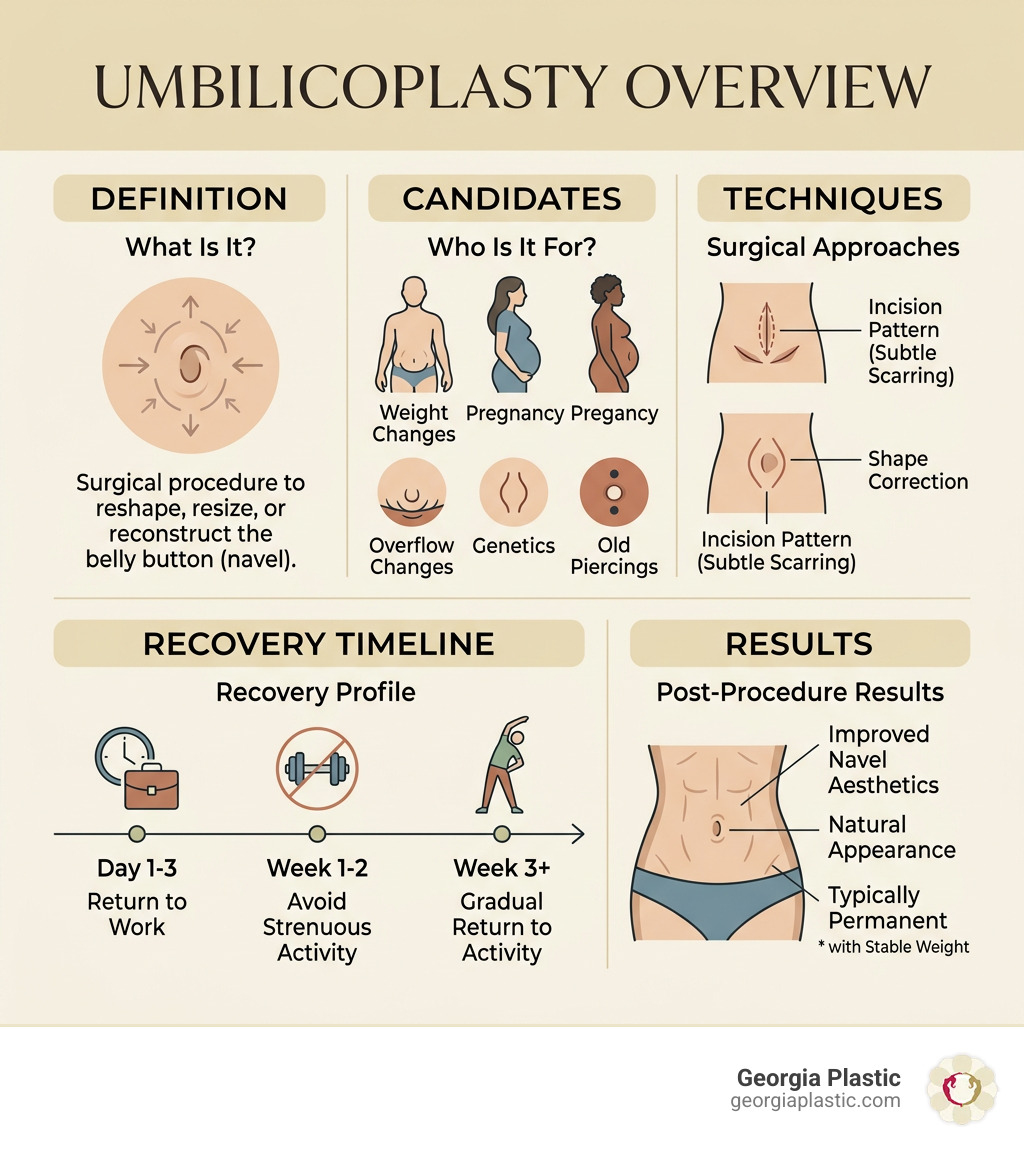
Umbilicoplasty is a surgical procedure that reshapes or repairs the belly button (navel) to improve its appearance. Here’s what you need to know at a glance:
| Question | Quick Answer |
|---|---|
| What is it? | Surgery to reshape, resize, or reconstruct the belly button |
| Who is it for? | Anyone unhappy with their navel’s shape due to pregnancy, weight changes, piercings, or genetics |
| How long does it take? | About 30 minutes to 1 hour |
| Recovery time? | Return to work in 1-3 days; avoid strenuous activity for a few weeks |
| Are results permanent? | Yes, if you maintain a stable weight |
| Can it be combined? | Yes — often paired with a tummy tuck or liposuction |
Your belly button is a small detail — but it sits right at the center of your abdomen. It’s visible in swimwear, activewear, and everyday clothing. And if you’re uncomfortable with how yours looks, that discomfort can quietly affect your confidence.
Many people don’t realize that belly button shape isn’t fixed. Pregnancy, significant weight loss, old piercings, or simply genetics can all change how your navel looks. As one surgical review put it, “the umbilicus is the central aesthetic subunit of the abdomen” — meaning it anchors how your entire midsection appears.
The good news? Umbilicoplasty is a straightforward, low-downtime procedure with high patient satisfaction rates.
I’m Dr. Stanley Okoro, a double board-certified plastic surgeon and founder of Georgia Plastic and Reconstructive Surgery, with extensive experience performing umbilicoplasty as both a standalone procedure and as part of comprehensive body contouring surgeries like tummy tucks and mommy makeovers. In this guide, I’ll walk you through everything you need to know — from surgical techniques to recovery — so you can make a confident, informed decision.
What is Umbilicoplasty and Why is it Performed?
At its core, umbilicoplasty is the plastic surgery of the navel. While it might seem like a modern “aesthetic whim,” it actually has deep roots in reconstructive medicine. Historically, these techniques were developed to treat umbilical hernias in infants. Today, however, it has evolved into a highly sought-after cosmetic procedure for adults who want to refine their midsection.
The navel is technically our very first scar—the remnant of where the umbilical cord connected us to our mothers. Because of how the cord is cut and heals, some of us end up with an “innie” and others with an “outie.” While neither is medically “wrong,” many of our patients prefer a small, vertically oriented “innie” with a slight superior hood (a small fold of skin at the top).
Common Reasons for Seeking Surgery
Why do patients come to us for this procedure? The reasons are as varied as the shapes of the navels themselves:
- Pregnancy Changes: During pregnancy, the abdominal wall stretches significantly. This can cause a once-deep navel to flatten, widen, or even pop out permanently. In fact, statistics show that women between 35 and 45 years of age opting for procedures like tummy tucks and liposuctions post-childbirth constitute nearly 25% of cosmetic practices.
- Weight Fluctuations: Gaining or losing a significant amount of weight can distort the skin around the belly button, making it look saggy or “sad” (downward-turning).
- Piercing Scars: We often see patients who had belly button piercings that migrated, rejected, or left behind unsightly stretched holes and keloid scarring.
- Umbilical Hernias: Sometimes, a small amount of fat or intestine pushes through a weak spot in the abdominal muscle, creating a bulge. We can often repair the hernia and reshape the navel in one go.
- Congenital Shape: Some people are simply born with a shape they dislike—perhaps it’s too large, too wide, or protrudes more than they’d like.
Transposition vs. Umbiliconeoplasty
It is important to understand the technical difference between the two main types of belly button surgery.
- Umbilicoplasty (Transposition): This is the most common method, often used during a tummy tuck. We keep your original belly button attached to its “stalk” (the connection to your abdominal wall), but we move the surrounding skin and create a new, prettier opening for it to sit in.
- Umbiliconeoplasty (De Novo Creation): This is the “creation of a new one.” If a patient has lost their belly button due to a previous surgery, a large hernia repair, or a congenital condition, we use local skin flaps to build a natural-looking navel from scratch.
Clinical literature, such as the scientific research on “scarless” techniques, highlights that the goal is always the same: a natural, recessed look that doesn’t scream “I had surgery.”
Surgical Techniques for a Perfect Umbilicus
Creating the “perfect” belly button is an art form. It’s not just about a hole in the skin; it’s about depth, shadow, and contour. At Georgia Plastic, we don’t believe in a one-size-fits-all approach. We customize the technique based on your specific anatomy.
The “Half-Moon” and “Four Flaps” Approaches
Surgeons have developed several ingenious ways to hide scars and create natural depth.
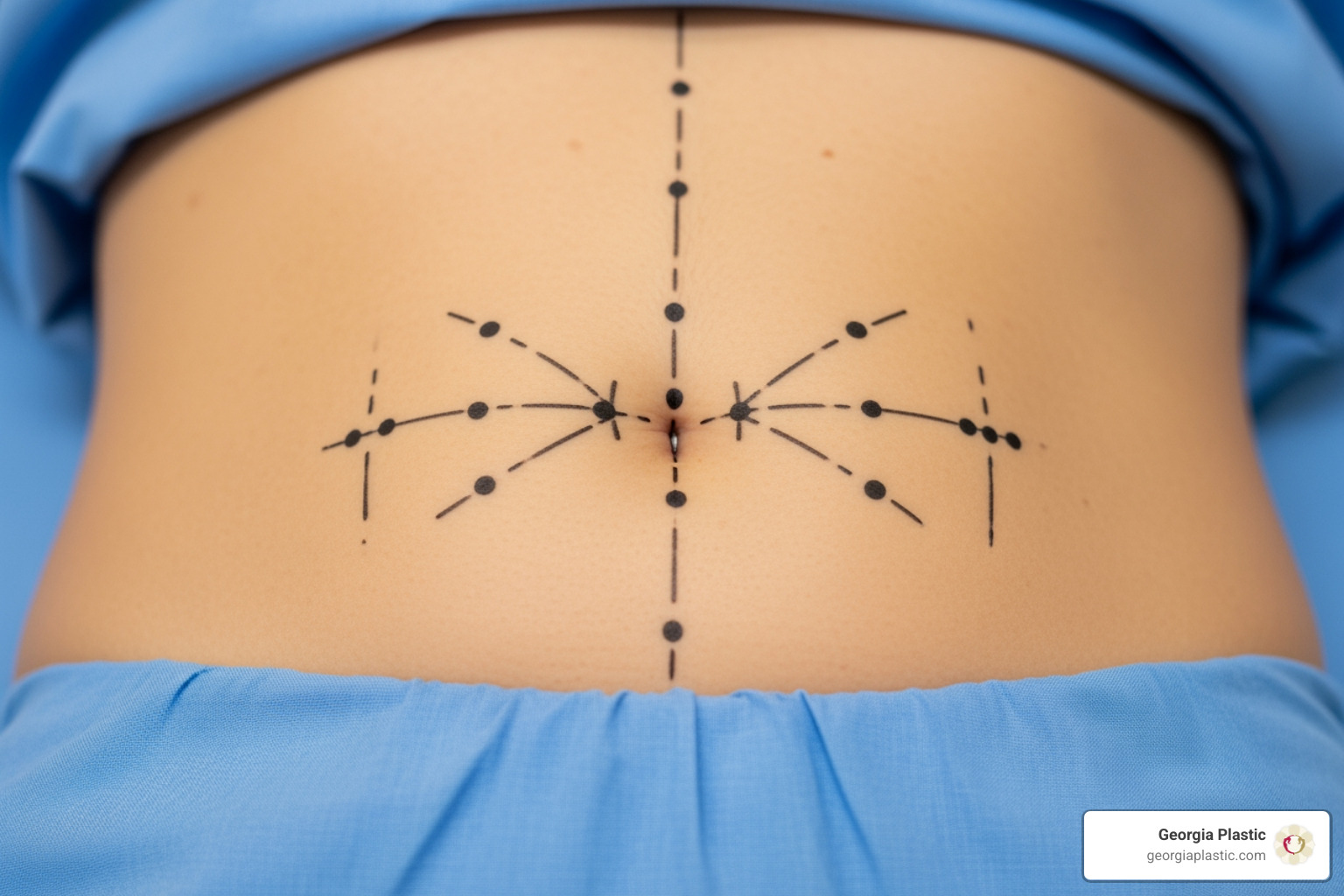
- The Half-Moon (Semi-lunate) Incision: This involves a curved incision, usually about 1.5 cm in diameter. By removing a small crescent of skin and fat, we can encourage the top edge to “hood” over the navel, which is a hallmark of a youthful, athletic abdomen.
- The Four Flaps Technique: For patients needing a completely new navel (neoumbilicoplasty), we sometimes use an X-shaped incision. This creates four small triangular flaps of skin that are tucked inward and anchored to the muscle layer, creating immediate, permanent depth.
- The Purse-String Suture: This technique uses a circular stitch to “cinch” the skin inward, much like closing a drawstring bag. It’s excellent for narrowing a wide navel.
Periumbilical Defatting
One of the most critical steps in a successful umbilicoplasty is what we call “defatting.” Research shows that about 80% of successful techniques involve trimming the subcutaneous fat immediately around the navel. Why? Because removing that thin layer of fat allows the skin to dip inward, creating a “sulcus” or a natural-looking depression. Without this, the belly button can look flat or “stuck on” rather than recessed.
Integration with Other Procedures
While many patients choose a standalone belly button surgery, it is most frequently performed as a vital component of a larger transformation.
- Abdominoplasty (Tummy Tuck): In a full tummy tuck, the belly button is actually “re-homed.” We release the skin around it, pull the skin down, and then bring the original navel through a new, precisely placed opening.
- Fleur-de-lis Tummy Tuck: For patients who have lost massive amounts of weight (often 100+ lbs), a vertical incision is required. In these cases, the umbilicoplasty is even more complex, often requiring a “two-dermal-flap” technique to ensure the navel looks natural amidst the vertical scarring. The scientific study on the two-dermal-flap transposition notes that this method provides a tension-free closure, which is the secret to those “invisible” scars.
According to a systematic review on creating the perfect umbilicus, the most aesthetically pleasing navels are small, vertically oriented, and have a “T-shape” or superior hooding. That is the gold standard we strive for in every case.
The Umbilicoplasty Recovery Process and Results
One of the best things about umbilicoplasty is that the recovery is generally very manageable. If you are having it done as a standalone procedure, you’ll be in and out of the surgery center in about an hour.
Recovery Timeline: What to Expect
| Feature | Standalone Umbilicoplasty | Combined with Tummy Tuck |
|---|---|---|
| Anesthesia | Often Local (numbing) | General Anesthesia |
| Surgery Time | 30 – 60 Minutes | 3 – 5 Hours |
| Hospital Stay | Outpatient (Go home same day) | Outpatient or Overnight |
| Return to Work | 1 – 3 Days | 2 – 3 Weeks |
| Exercise | 2 Weeks (Light) | 4 – 6 Weeks |
Pain Management and Activity
Most patients describe the feeling after a standalone procedure as a mild “tugging” or soreness, similar to a bruise. Over-the-counter pain relief is usually all that’s needed. We use dissolving sutures whenever possible, so you won’t have the anxiety of “getting stitches pulled.”
For the first 48 hours, we ask you to keep the area dry. After that, you can usually shower. You’ll want to avoid heavy lifting or intense core workouts for at least two weeks to ensure the internal anchoring sutures stay secure.
Long-Term Results
Are the results permanent? Yes! Once the tissue heals and the scar matures (which takes about 6 to 12 months for the final look), your new belly button shape is there to stay. However, life happens. Significant weight gain or a future pregnancy can stretch the skin again, potentially altering your results. We generally recommend waiting until you are finished having children before undergoing any abdominal contouring.
Safety, Risks, and Choosing Your Surgeon
As with any surgery, safety is our number one priority. While umbilicoplasty is a minor procedure, it still requires a sterile environment and a skilled hand.
Potential Risks
Complications are rare, but we believe in total transparency. Potential risks include:
- Infection: We provide antibiotic ointment and clear cleaning instructions to prevent this.
- Scarring: While we place incisions inside the navel to hide them, some patients may develop thickened scars. We manage this with silicone gels or, in rare cases, minor revisions.
- Stenosis: This is a fancy word for the opening becoming too narrow as it heals. Using “bolster” dressings during the first week helps keep the shape open and perfect.
- Asymmetry: No human body is perfectly symmetrical, but we use precise preoperative markings to ensure your navel is centered and balanced.
Choosing the Right Surgeon
The belly button is the “centerpiece” of your stomach. You wouldn’t want a novice painting the center of a masterpiece, and the same applies to your body. When searching for a surgeon, look for:
- Board Certification: Ensure they are certified by the American Board of Plastic Surgery.
- Experience: Ask to see “before and after” photos specifically of their belly button work.
- Hospital Privileges: Even if the surgery is in a private suite, a surgeon should have the credentials to perform the same procedure at a local hospital.
We recommend using this checklist for comparing cosmetic surgeons to help you vet your options. At Georgia Plastic, Dr. Okoro’s meticulous attention to detail ensures that the navel looks like a natural part of your body, not a surgical afterthought.
Frequently Asked Questions about Umbilicoplasty
Is umbilicoplasty the same as a tummy tuck?
No, but they are close cousins! A tummy tuck (abdominoplasty) addresses the whole abdominal area—removing excess skin, tightening the muscles, and often including liposuction. Umbilicoplasty is just the reshaping of the belly button. You can have a belly button surgery without a tummy tuck, but you almost always have a belly button surgery as part of a tummy tuck.
Can umbilicoplasty fix a piercing scar?
Absolutely. This is one of the most common reasons younger patients visit us. If you have a “hole” above your navel from an old piercing, or if the skin has thinned and sagged there, we can excise that scarred tissue and pull the healthy skin together to create a smooth, rejuvenated look.
How much does umbilicoplasty cost?
The price varies depending on whether it’s a standalone procedure or part of a larger surgery. In the UK, prices are noted to start around £2,200, while in the US, a standalone procedure typically ranges from $2,500 to $5,000. This usually includes the surgeon’s fee, the facility fee, and anesthesia. During your consultation, we provide a transparent, all-inclusive quote so there are no surprises.
Conclusion
Your belly button might be small, but its impact on your body confidence can be huge. Whether you’re looking to restore your pre-pregnancy body, fix a piercing mistake, or finally turn that “outie” into an “innie,” umbilicoplasty offers a safe, effective, and permanent solution.
At Georgia Plastic & Reconstructive Surgery, we pride ourselves on delivering natural-looking results that honor your unique anatomy. Dr. Okoro and our entire team are dedicated to personalized care, prioritizing your safety and your aesthetic goals above all else.
Ready to take the next step toward a midsection you love? Schedule a consultation for umbilicoplasty with us today in Atlanta. We look forward to helping you feel centered and confident again!


