
What Fat Transfer Breast Augmentation Really Is (And Whether It’s Right for You)
Fat transfer breast augmentation is a surgical procedure that uses your own body fat to naturally increase breast size and improve shape — no implants required.
Quick answers:
- What it is: Liposuction removes fat from areas like your abdomen or thighs, then purified fat is injected into your breasts
- Size increase: Typically one-half to one full cup size
- Recovery time: 2–4 days downtime, return to normal activity in 1–2 weeks
- Results: Permanent once fat cells settle, though 30–50% of transferred fat is naturally reabsorbed
- Best for: Women wanting a modest, natural-looking enhancement without implants
- Not ideal for: Women seeking more than one to two cup sizes, or those with very little donor fat
This option has grown in popularity because it solves two problems at once — it removes unwanted fat from one area of your body and uses it to enhance your breasts. The results look and feel natural because the tissue is natural.
But like any surgical procedure, it comes with real trade-offs worth understanding before you decide.
I’m Dr. Stanley Okoro, a double board-certified plastic surgeon and founder of Georgia Plastic and Reconstructive Surgery in Atlanta, where I specialize in advanced cosmetic procedures including fat transfer breast augmentation. My background in both reconstructive and aesthetic surgery gives me a precise, safety-first approach to delivering natural-looking results my patients feel confident in.
What is Fat Transfer Breast Augmentation?
At its core, fat transfer breast augmentation is exactly what it sounds like: moving fat from where you don’t want it to where you do. We often call this “autologous fat grafting,” which is just a fancy medical way of saying we are using your own (autologous) tissue. Unlike traditional augmentation that relies on silicone or saline shells, this method uses your body’s living cells to restore volume and improve symmetry.
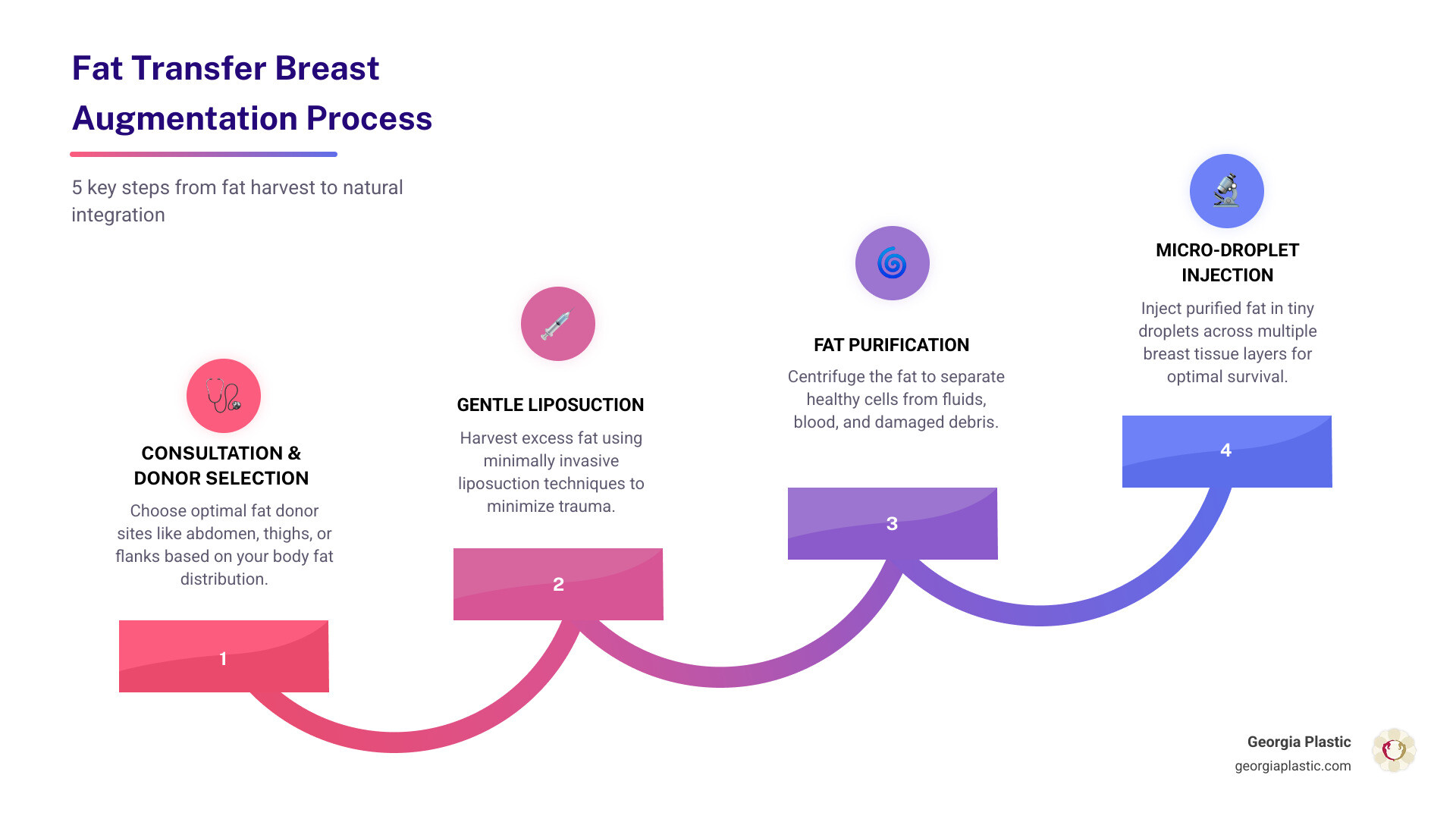
The process begins with liposuction harvesting. We identify “donor sites”—usually the abdomen, flanks (love handles), or thighs—and gently remove excess fat. This isn’t just about the breasts; it’s a body contouring bonus! Once the fat is out, it isn’t ready to go right back in. It contains fluids, blood, and damaged cells that wouldn’t survive the transfer.
To ensure the best results, we use a process called fat purification. This often involves centrifugation, where the harvested fat is spun at high speeds in a centrifuge to separate the pure, healthy fat cells from the unwanted liquids. This high-quality “liquid gold” is what we then use for volume restoration. According to scientific research on fat grafting, using purified fat is essential for the cells to establish a new blood supply and survive in their new home.
How the fat transfer breast augmentation procedure works
The actual surgery is a meticulous, multi-step process that usually takes between two to three hours. We perform this as an outpatient procedure, typically under general anesthesia or deep sedation to ensure you are completely comfortable.
- Donor Site Selection: During your consultation, we’ll look for areas with enough “pinchable” fat. Even slim patients often have enough fat in the thighs or lower back to make a difference.
- Gentle Liposuction: We use specialized, thin cannulas (suction tubes) to harvest the fat. It’s important to be gentle here; if the fat cell membranes are damaged during suction, they won’t survive the transfer.
- Purification: As mentioned, the fat is processed to remove impurities.
- Micro-droplet Injection: This is where the artistry happens. Instead of just “filling” the breast, we use a micro-droplet technique. We inject tiny droplets of fat into multiple planes of the breast tissue.
- Multi-plane Grafting: By placing the fat in different layers—under the skin, within the breast tissue, and near the chest muscle—we ensure each fat droplet is close to a blood supply.
- Tissue Integration: Over the next few weeks, your body works to create new blood vessels to “feed” the transferred fat.
The goal is a seamless integration where the fat becomes a permanent part of your breast tissue. It’s a delicate balance; we often “overfill” slightly because we know that, on average, about 30% to 50% of the transferred fat may die due to oxygen starvation before it can hook up to a blood supply.
Benefits of Fat Transfer vs. Traditional Implants
Why choose fat over implants? For many of our patients, the “no foreign material” aspect is the biggest selling point. You don’t have to worry about implant ruptures, capsular contracture (where the body creates a hard scar around the implant), or the rare risks associated with textured shells.
Here is a quick look at how the two methods stack up:
| Feature | Fat Transfer Breast Augmentation | Traditional Breast Implants |
|---|---|---|
| Material | Your own living fat cells | Silicone or Saline shells |
| Incision Size | Tiny (approx. 4mm), virtually scarless | Larger (usually 1-2 inches) |
| Feel | Completely natural | Can feel firm or “different” than tissue |
| Size Increase | Modest (0.5 to 1.5 cups) | Significant (1 to 5+ cups) |
| Body Contouring | Included (liposuction of donor areas) | None |
| Longevity | Permanent (once cells settle) | Usually replaced every 10–15 years |
| Recovery | 2–4 days for most | 1–2 weeks |
One of the greatest benefits of natural breast enhancement is the dual-benefit surgery. You aren’t just getting fuller breasts; you’re getting a slimmer waist or smoother thighs. It’s a comprehensive silhouette improvement. Furthermore, because we use tiny needles for the injections, it is considered a “scarless” technique compared to the traditional incisions required to insert a pre-formed implant.
Ideal candidates for fat transfer breast augmentation
While it sounds like the perfect solution, not everyone is a match for this procedure. At Georgia Plastic, we look for specific criteria to ensure you get the results you’re dreaming of.
- Donor Fat Availability: You need to have enough excess fat to harvest. If you are extremely lean or have a very low body fat percentage, there might not be enough “fuel” for the transfer. Interestingly, slim patients often have smaller, heartier fat cells that survive better, but you still need a certain volume to work with.
- Stable Weight: Your fat cells behave like fat cells elsewhere. If you lose significant weight after surgery, your breasts will shrink. If you gain weight, they will grow. We want you to be at a weight you can maintain.
- Non-smokers: This is non-negotiable. Smoking starves the tissues of oxygen, which is the number one killer of newly transferred fat cells. We ask patients to stop smoking at least six weeks before and after surgery.
- Modest Size Goals: If you want to go from an A-cup to a D-cup, fat transfer alone won’t get you there in one go. It’s best for those looking for a subtle, natural boost.
- Post-pregnancy Restoration: It’s a fantastic option for moms who feel their breasts have “deflated” after breastfeeding and want to restore that youthful volume without looking “done.”
If you’re unsure if you’re a candidate, it’s always best to find a board-certified plastic surgeon who can evaluate your tissue elasticity and donor sites in person.
Recovery and Results of Fat Transfer Breast Augmentation

One of the most common questions we get is, “How long will I be down?” Most patients find the recovery from fat transfer breast augmentation to be surprisingly manageable.
The Timeline:
- Days 1–3: You’ll feel some soreness, mostly at the liposuction donor sites. The breasts might feel tight or “full,” but usually aren’t very painful because we don’t have to cut into the chest muscle.
- Days 4–7: Most people return to desk jobs. You’ll wear a compression garment on your donor areas (like your stomach or thighs) and a supportive, non-underwire sports bra.
- Weeks 2–3: Swelling and bruising begin to subside. You can usually return to light walking.
- Months 3–6: This is the “settling” period. By the three-month mark, the fat that has survived is likely there to stay.
It is important to manage expectations regarding fat survival rates. On average, only about 30% to 60% of the transferred fat survives long-term. This is why we often inject a bit more than the desired final volume. If your body reabsorbs more than expected, some patients choose to have a second session to achieve their goal size. You can learn more about result longevity and what to expect during your follow-up appointments.
Maintaining your fat transfer breast augmentation results
Once the fat cells have established a blood supply, they are permanent. They are living tissue! However, they are still fat cells. To keep your results looking their best, we recommend:
- Weight Stability: Large fluctuations in weight will change the size of your breasts.
- Post-operative Compression: Wearing your compression garments as instructed is vital. It helps the skin at the liposuction site “snap back” and reduces swelling.
- No Pressure on Breasts: For the first two weeks, we ask you to sleep on your back. Putting direct pressure on the newly injected fat can “smother” the cells before they integrate.
- Healthy Lifestyle: Proper nutrition and hydration support the healing process and help those new cells thrive.
The benefits of fat transfer are lifelong, but they do not stop the natural aging process. Your breasts will still change over time due to gravity and skin elasticity, just like they would naturally.
Safety, Risks, and Mammograms
Safety is our top priority at Georgia Plastic. While fat transfer breast augmentation has a lower risk profile than implants for many patients, it is still surgery.
Potential risks include:
- Fat Necrosis: This happens when a “clump” of fat doesn’t get enough blood and dies, forming a small, firm lump.
- Oil Cysts: Similar to necrosis, these are small pockets of fluid that can form if the fat doesn’t integrate.
- Microcalcifications: As fat heals or dies, it can leave behind tiny calcium deposits.
A major concern for many women is: “Will this hide breast cancer?” According to research on fat transfer safety, the procedure does not increase your risk of breast cancer. However, the microcalcifications or cysts mentioned above can sometimes look like suspicious spots on a mammogram.
The solution is simple: Communication. Always tell your radiologist that you have had a fat transfer. Experienced radiologists can usually distinguish between benign fat-related changes and actual concerns. We often recommend a pre-operative mammogram for women over 40 (or those with a family history) to establish a “baseline” before surgery. You can read more fat grafting facts on our site to stay informed.
Frequently Asked Questions
How much does the procedure cost?
The cost of fat transfer breast augmentation varies based on several factors. Because it involves two surgeries in one (liposuction and breast injection), the price is often higher than a simple implant procedure.
Factors that influence the price include:
- The number of donor areas: Are we just doing the abdomen, or are we also doing the thighs and arms?
- Anesthesia and Facility fees: These are standard for any surgical center.
- Surgeon Expertise: You are paying for the skill and safety record of a board-certified specialist.
In general, you can expect the investment to start around $11,000 to $13,000, depending on the complexity of the liposuction required. We provide transparent pricing for fat transfer in Atlanta during your initial consultation.
Can I increase my size by two cups?
While some sources suggest a two-cup increase is possible, we like to stay realistic. Most patients achieve an increase of one-half to one full cup size per session. If you are looking for a “mega-volume” change, you might require multiple sessions spaced several months apart. There is research on mega-volume fat transfer that suggests using external tissue expanders (like the BRAVA system) before surgery can help create more “room” for the fat, potentially leading to larger gains.
Does it affect breast cancer detection?
As discussed, research on mammogram interference shows that while fat grafting can cause calcifications, they rarely prevent an accurate screening. Modern digital mammography, ultrasounds, and MRIs are incredibly sensitive. As long as you are consistent with your screenings and inform your medical team of your surgical history, your breast health monitoring should remain highly accurate.
Conclusion
Fat transfer breast augmentation offers a sophisticated, natural path to body confidence. By combining the benefits of liposuction with the softness and safety of your own tissue, we can create results that are uniquely yours.
At Georgia Plastic & Reconstructive Surgery, Dr. Okoro and our team are dedicated to providing personalized care that prioritizes your safety and your aesthetic goals. Whether you’re looking to restore volume lost to time or simply want to balance your silhouette, we are here to guide you through every step of the journey.
Ready to see if you’re a candidate? Schedule your fat transfer breast consultation with us in Atlanta today, and let’s discuss how we can help you achieve a natural, beautiful result.


