
Why More People Are Choosing Eye Bag Surgery
Eye bag surgery, also known as lower blepharoplasty, is a cosmetic procedure that removes or repositions excess fat, tightens muscles, and eliminates loose skin under the eyes to create a more refreshed, youthful appearance.
Quick Overview: What You Need to Know
- What it treats: Under-eye puffiness, sagging skin, fat deposits, and bags that make you look tired or aged
- Procedure time: 1-3 hours, typically outpatient
- Recovery: Most people return to work in 10-14 days
- Cost: Average $3,026-$3,900 (surgical fees only)
- Results: Long-lasting, often permanent improvement
- Techniques: Transconjunctival (no visible scar) or transcutaneous (under lash line)
As we age, the muscles around our eyes weaken and fat that normally supports the eye begins to bulge forward, creating those telltale puffy bags. For some people, genetics cause these bags to appear even in their 20s or 30s. While eye bags are harmless, they can make you look perpetually exhausted or older than you feel—even when you’re well-rested and healthy.
The good news? Modern surgical techniques can address these concerns with minimal scarring and natural-looking results. Lower blepharoplasty doesn’t just remove excess tissue—it can also reposition fat to smooth the transition between your lower eyelid and cheek, avoiding that hollowed-out appearance that sometimes results from older surgical methods.
Whether your eye bags stem from aging, genetics, or a combination of factors, understanding your options is the first step toward making an informed decision about treatment.
I’m Dr. Stanley Okoro, a double board-certified plastic surgeon with extensive experience performing eye bag surgery and facial rejuvenation procedures at Georgia Plastic and Reconstructive Surgery in Atlanta. Throughout my career, I’ve helped countless patients achieve natural-looking results that enhance their unique features while maintaining facial harmony.
Understanding Lower Blepharoplasty: What is Eye Bag Surgery?
When we talk about eye bag surgery, we are technically referring to a lower blepharoplasty. It is a procedure designed specifically to address the lower eyelid and the “junction” where the eye meets the cheek.
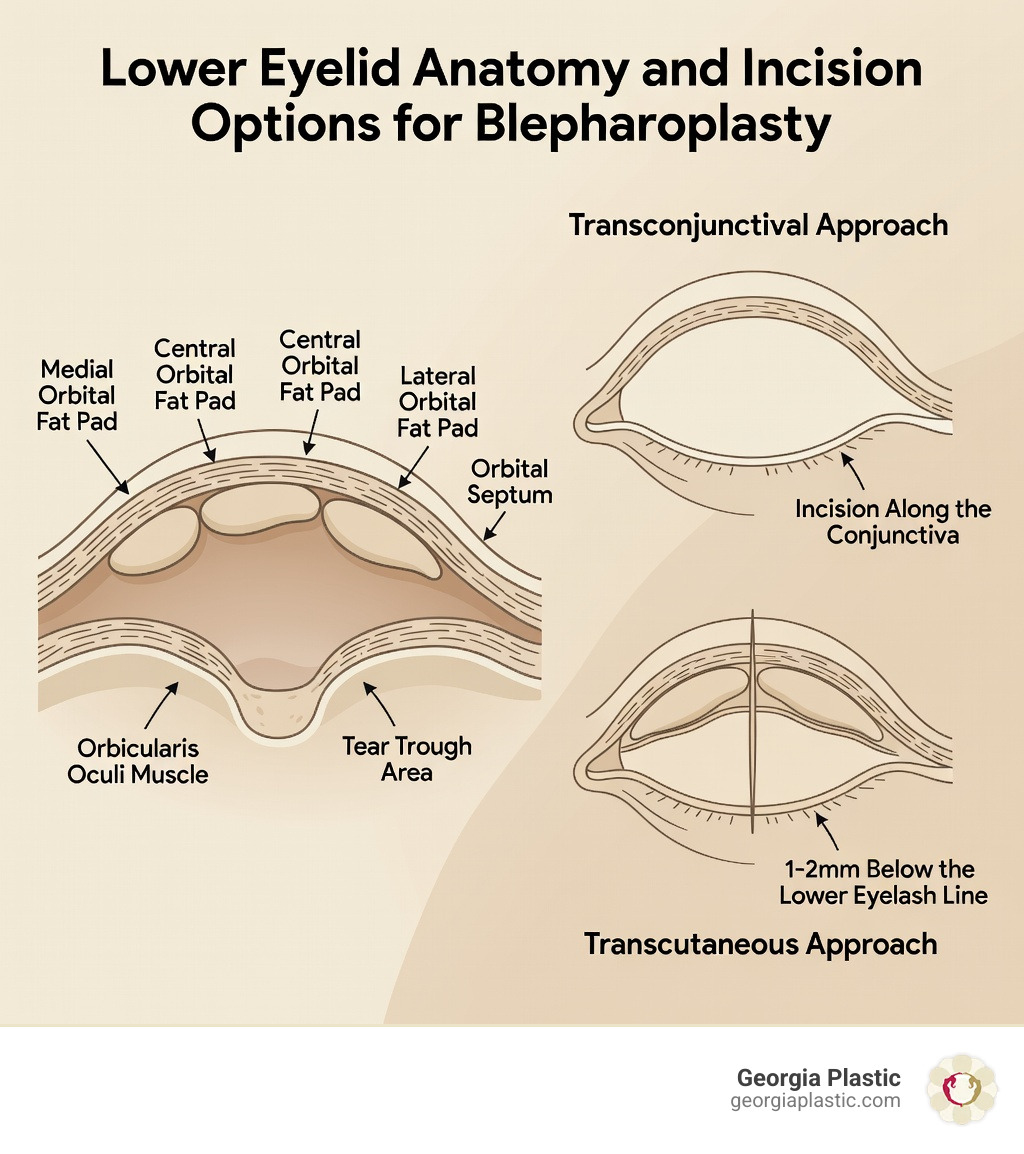
To understand how it works, we have to look at what is happening under the surface. Our eyes sit in a bed of protective fat called orbital fat. This fat is held in place by a thin membrane called the orbital septum. As the years go by (or thanks to our DNA), that membrane weakens. When it loses its strength, the fat starts to push forward, or “herniate.” This is what creates that puffy, bulging look we call eye bags.
In addition to fat herniation, many of us deal with muscle laxity. The orbicularis oculi muscle—the muscle that helps you squint—can begin to sag. Combined with thinning skin that loses its collagen and elastin, you end up with a “tired” look that no amount of expensive eye cream can truly fix.
According to Scientific research on blepharoplasty procedures, the primary goal of the surgery is to restore a smoother contour to the lower eyelid area. It’s almost always performed as an outpatient procedure, meaning you get to go home the same day. Depending on your comfort level and the complexity of the work, we may use local anesthesia with sedation (where you’re relaxed but technically awake) or general anesthesia.
The Difference Between Dark Circles and Eye Bags
One of the most frequent questions we hear during consultations is: “Will this surgery get rid of my dark circles?” The answer is: it depends on what is causing them.
It is vital to distinguish between structural “bags” and pigmentation “circles”:
- Eye Bags: These are actual protrusions of fat or sagging skin. They create a physical shadow.
- Dark Circles: These can be caused by hyperpigmentation (skin color), thinning skin that shows the blood vessels underneath, or “hollow” tear troughs.
- Malar Mounds (Festoons): These are often confused with eye bags but are actually located lower on the cheekbone and are usually related to fluid retention or sun damage.
If your “dark circles” are actually shadows caused by bulging fat, eye bag surgery will work wonders. However, if the darkness is purely skin pigment, we might suggest combining surgery with a chemical peel or laser treatment for the best result.
Surgical Techniques for Eye Bag Removal
There isn’t a “one-size-fits-all” approach to the eyes. Every face is unique, and our goal at Georgia Plastic is to ensure you still look like you—just a version of you that slept for ten hours and had a green smoothie.
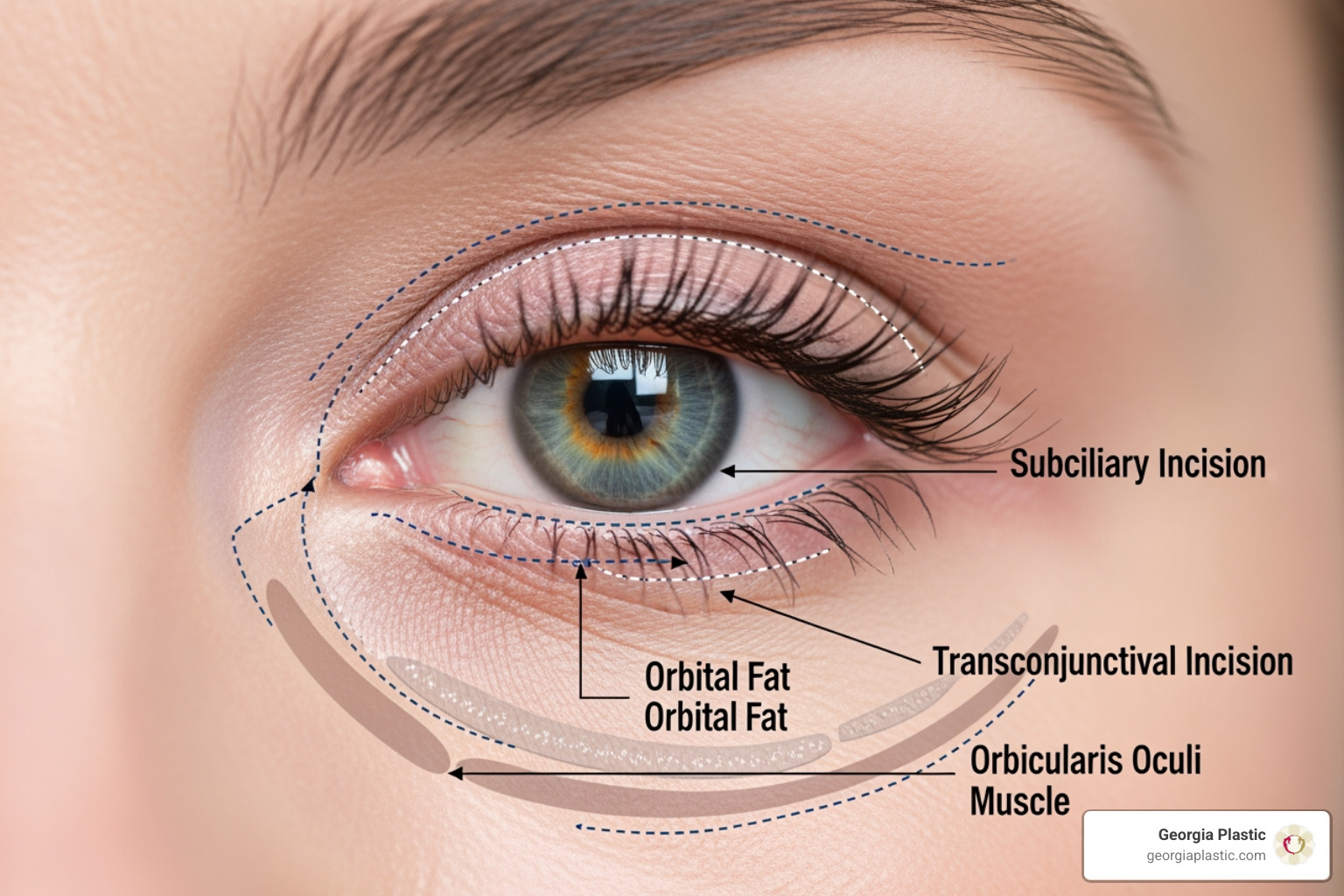
There are two primary ways we access the area: the transcutaneous approach and the transconjunctival approach. You can find more info about eyelid surgery techniques to see which might suit your specific anatomy.
Transconjunctival Eye Bag Surgery
This is often the “gold standard” for younger patients or those who have puffiness but still have relatively firm, elastic skin.
- The Technique: We make a tiny incision on the inside of the lower eyelid (the conjunctiva).
- The Benefit: There is absolutely no visible scarring.
- The Goal: We can easily remove or redistribute the fat pads through this internal access. Because we don’t cut the skin, the recovery is often a bit faster, and the natural shape of the eye is very well-preserved.
Transcutaneous Approach (The “Skin Pinch”)
For patients with significant skin laxity or “crepey” skin, we may use the transcutaneous approach. This involves an incision just below the lower eyelashes. Through this opening, we can remove excess skin, tighten the underlying muscle, and address the fat pads. While there is an external scar, it is placed in the natural shadow of the lash line, making it virtually imperceptible once healed.
Fat Repositioning and the Hamra Method
In the past, surgeons would simply “scoop out” all the fat. While this got rid of the bags, it often left patients looking hollow or “skeletal” a few years later.
Today, we prefer Fat Repositioning. Instead of throwing the fat away, we move it! We take that bulging fat and slide it down into the hollow “tear trough” area. This fills in the dip between the eye and the cheek, creating a smooth, seamless transition. This technique, sometimes associated with the Hamra Method, provides a much more natural and youthful contour. It’s like using your body’s own natural filler to fix the problem.
Preparing for Your Procedure and What to Expect
Preparation is the key to a smooth recovery and a great result. When you come in for your medical evaluation, we’ll look at everything from your vision and tear production to your overall health history.
Our Pre-Op Checklist:
- Smoking Cessation: You must stop smoking at least 4-6 weeks before and after surgery. Nicotine constricts blood vessels and can seriously mess with your healing.
- Medication Adjustments: You’ll need to stop taking blood thinners, aspirin, ibuprofen, and certain herbal supplements (like Vitamin E or Ginkgo) about two weeks before surgery, as these can increase bruising and bleeding.
- Arranging Post-Op Care: You cannot drive yourself home. You’ll need a friend or family member to pick you up and stay with you for the first 24 hours.
Am I a Candidate for Eye Bag Surgery?
Most of our patients are 30 or older, but we occasionally see younger patients who have inherited heavy bags from their parents. You might be a great candidate if:
- You are in good general health.
- You have realistic expectations (surgery makes you look better, not like a different person).
- You are bothered by persistent puffiness or sagging skin.
- Your bags are so heavy they are actually interfering with your vision or your ability to wear glasses comfortably.
You can read more info about who is a candidate for eyelid surgery to see if you check the boxes.
Step-by-Step: The Surgical Process
What actually happens once you’re in the OR?
- Marking: While you are awake, we carefully mark the areas of fat and skin to be addressed.
- Anesthesia: You’ll be administered anesthesia so you are comfortable and pain-free.
- The Incision: Based on our plan, we’ll use either the internal (transconjunctival) or external (transcutaneous) approach.
- Tissue Remodeling: We remove or reposition the fat and tighten the muscle if needed.
- Closing: We use very fine sutures. If we used the internal approach, we might use self-dissolving stitches that you’ll never even see.
- Duration: The whole thing usually takes between 1 and 2 hours.
The Recovery Journey: Timeline and Aftercare
Recovery isn’t just about waiting; it’s an active process! While you won’t be in significant pain (most patients describe it as “tightness” or “soreness”), you will definitely look like you’ve been in a minor scuffle for a few days.
The Recovery Timeline:
- Days 1-3: This is the peak of swelling and bruising. Keep your head elevated (sleep on two or three pillows) and use cold compresses for 10-15 minutes every hour you’re awake.
- Days 5-7: If you have external stitches, we’ll remove them at our office. You’ll likely start feeling much more like yourself.
- Days 10-14: Most of the “socially awkward” bruising has faded. This is when most people feel comfortable returning to work or going out to dinner.
- Weeks 2-6: Residual swelling continues to drop. You can usually resume light exercise after two weeks, but hold off on the heavy lifting or swimming for about a month.
For a deeper dive, check out more info about recovery tips and timeline.
Long-Term Results and Longevity
One of the best things about eye bag surgery is that the results are incredibly long-lasting. Once we remove or reposition those fat pads, they don’t typically “grow back.” While you will continue to age naturally, most patients find that they never need to repeat the lower eyelid procedure. You’ve essentially “reset the clock.”
Potential Risks and Complications
No surgery is without risk, and we believe in being 100% transparent. While rare, potential complications include:
- Dry Eyes: This is common during the first week and is managed with lubricating drops.
- Temporary Blurred Vision: Usually caused by the ointments we use to protect your eyes during surgery.
- Ectropion: A rare condition where the lower lid turns outward. This is why choosing an experienced surgeon is vital—proper technique prevents this.
- Asymmetry: No two eyes are identical, but we strive for the highest level of balance.
Costs, Risks, and Non-Surgical Alternatives
Let’s talk numbers. We know cost is a major factor in your decision. According to Statistics on blepharoplasty costs, the average surgeon’s fee is around $3,163.
However, it is important to remember that the “total” price usually includes:
- Surgeon’s fees
- Hospital or surgical facility costs
- Anesthesia fees
- Prescriptions for medication
- Medical tests
Because eye bag surgery is almost always considered cosmetic, insurance typically does not cover it. The exception is if the sagging is so severe it impairs your peripheral vision—in that case, your insurance may cover a portion of an upper blepharoplasty, but lower lid work is rarely covered.
Non-Surgical Options for Under-Eye Rejuvenation
If you aren’t quite ready for the operating room, there are other ways we can help refresh your look.
| Treatment | Best For | Longevity |
|---|---|---|
| Lower Blepharoplasty | Permanent fat removal & skin tightening | 10-15+ years |
| Dermal Fillers (HA) | Filling hollow tear troughs | 6-12 months |
| Laser Resurfacing | Tightening “crepey” skin & pigment | Varies (1-3 years) |
| Chemical Peels | Improving skin texture & dark circles | Varies |
| Microneedling | Boosting collagen for fine lines | Cumulative results |
Frequently Asked Questions about Eye Bag Removal
How long does eye bag surgery last?
For most patients, the results of a lower blepharoplasty last a lifetime. While your skin will continue to age and may lose some elasticity over the next 10 or 20 years, the fat pads we address do not typically return.
Is the procedure painful?
Surprisingly, no! Most patients are amazed at how little “pain” they feel. The primary sensation is one of tightness or “fullness” due to the swelling. We provide pain medication, but many patients find they only need over-the-counter Tylenol after the first day.
When can I return to work after surgery?
The “sweet spot” for most people is 10 to 14 days. By this point, any remaining bruising can usually be camouflaged with a little bit of concealer, and the swelling is minimal enough that coworkers likely won’t notice anything other than you looking “well-rested.”
Conclusion
Your eyes are the focal point of your face. They tell your story, but they shouldn’t tell the world that you’re tired when you’re actually feeling great. Eye bag surgery is one of the most rewarding procedures we perform because the change is subtle yet transformative.
At Georgia Plastic & Reconstructive Surgery, our philosophy is simple: we want you to look like the best version of yourself. Dr. Okoro and our entire team are dedicated to providing a safe, comfortable, and personalized experience that prioritizes your unique goals.
If you’re tired of looking tired, it might be time to take the next step. We invite you to schedule your consultation for eye bag surgery at our Atlanta office. Let’s work together to bring the spark back to your eyes!


