
Understanding Hymen Reconstruction Surgery
Hymenoplasty is a surgical procedure that restores or reconstructs the hymen, a thin membrane at the vaginal opening. Many women seek this procedure for cultural, religious, personal, or healing reasons after trauma.
Quick Facts About Hymenoplasty:
- What it is: Surgical repair of torn hymenal tissue using sutures or vaginal mucosal flaps
- Duration: 30–90 minutes as an outpatient procedure
- Anesthesia: Local anesthesia with or without light sedation
- Recovery: 6–8 weeks for complete healing; return to work in 1–2 days
- Success rate: Approximately 93.4% with minimal complications
- Common reasons: Cultural or religious expectations, trauma recovery, personal choice
- Important note: Only about half of women bleed during first intercourse naturally, and hymenoplasty does not guarantee bleeding
Hymen reconstruction has become increasingly requested worldwide, particularly among women ages 19–35. The procedure addresses both physical restoration and emotional well-being for patients navigating complex cultural expectations or seeking healing after sexual trauma.
Despite common misconceptions, the hymen can tear through non-sexual activities like exercise, tampon use, or horseback riding. The presence or absence of an intact hymen does not medically indicate virginity, as hymens vary greatly in appearance and elasticity. Medical professionals now recognize that visible breaks or irregularities are completely normal even in sexually inactive individuals.
As Dr. Stanley Okoro, a double board-certified plastic surgeon at Georgia Plastic and Reconstructive Surgery in Atlanta, I have experience in delicate aesthetic procedures that require both surgical precision and sensitivity to each patient’s unique needs. My approach to hymenoplasty emphasizes patient safety, confidentiality, and natural-looking results tailored to individual circumstances.
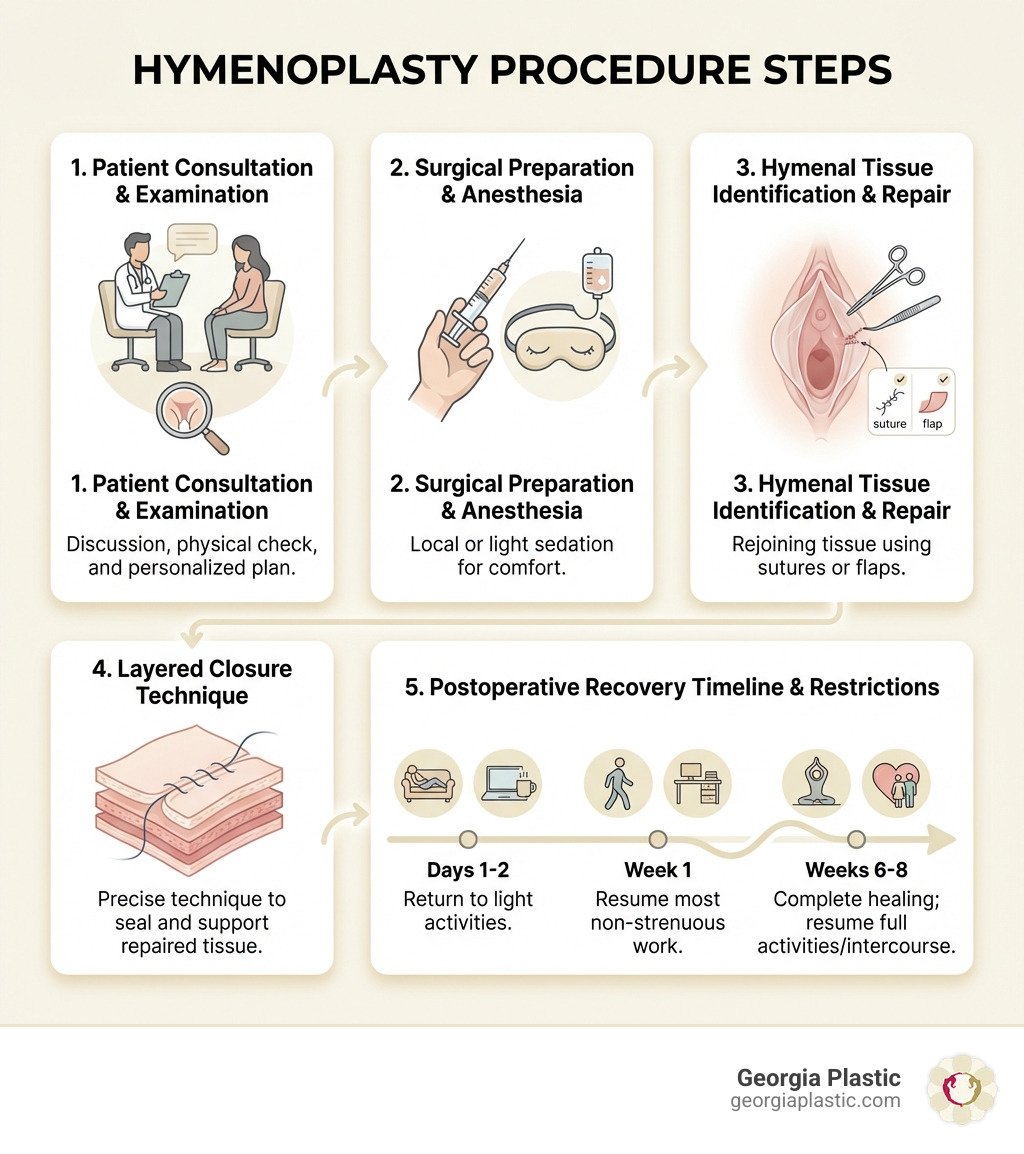
What is Hymenoplasty and How Does it Work?
At its core, hymenoplasty is a restorative surgical procedure designed to repair the hymen. To understand how the surgery works, we first have to look at the anatomy. The hymen is a thin, crescent-shaped layer of tissue located about 1 to 1.5 centimeters inside the vaginal opening. It is a remnant of fetal development, and contrary to popular belief, it is not a solid seal that “pops.” Instead, it is a stretchy, flexible ring of tissue.
When we perform a hymenoplasty, we are essentially reuniting the torn edges of this membrane. If there is enough remaining tissue (what we call hymenal vestiges), we can carefully suture them back together using incredibly fine, dissolvable stitches. In cases where the original tissue is too sparse, we use advanced techniques involving the surrounding vaginal lining to create a new membrane that mimics the appearance and function of a natural hymen.
The goal of the surgery is to restore the vaginal introitus to a “pre-sexual” state. For many of our patients, this isn’t just about physical tissue; it’s about “revirginization”—a term used to describe the restoration of the perceived state of virginity. However, we always emphasize that while we can reconstruct the tissue, the concept of virginity itself is a social and cultural construct rather than a medical one. We encourage everyone to read this scientific research on hymen myths and sexual history to better understand the biological reality of this tissue.
Permanent vs. Temporary Hymenoplasty Techniques
Depending on your specific goals and timeline, there are two primary ways we approach this surgery. In our experience, and supported by global statistics, about 83.3% of patients opt for a permanent solution, while 16.7% choose a temporary “quick fix.”
- Permanent Hymenoplasty: This is the most common choice for women who want a long-term result. We use a “reapproximation” technique or a “vaginal mucosal flap” technique. In the flap technique, we raise small sections of the vaginal wall and overlap them in a crisscross fashion to create a robust new barrier. We use a trilayered suturing method to ensure the new hymen is strong enough for daily activities but will still tear and potentially bleed during future intercourse.
- Temporary Hymenoplasty: Often called “hymen repair,” this is a simpler procedure typically performed 5 to 7 days before a wedding. We use fine, rapid-absorbing sutures to pull the remaining edges of the hymen together. It is designed to be a short-term solution for those who need immediate results for cultural ceremonies.
Both methods utilize dissolvable stitches, meaning you won’t have to return to our office to have them removed. You can find research on surgical techniques and outcomes that highlights the high success rates of these modern methods.
Candidates and Preoperative Preparation
Who is a good candidate for this procedure? At Georgia Plastic, we see women from all walks of life. Statistics show the predominant age group is between 19 and 35, though we have seen patients ranging from 14 to 49 years old.
The preparation process starts with a private, compassionate consultation. We will perform a physical examination to assess the remaining hymenal tissue and discuss your medical history. It is vital that you are in good overall health. We also prioritize your psychological readiness. Many women seek this procedure under significant stress or due to past trauma, and we want to ensure you feel empowered and safe in your decision.
If you are a smoker, we will ask you to stop at least two to four weeks before and after the surgery. Smoking significantly impairs blood flow and can lead to complications with tissue healing. We also require informed consent, where we explain all the potential outcomes and risks so you can make the best decision for your body.
Common Reasons for Seeking Hymen Reconstruction
The decision to undergo hymenoplasty is deeply personal and often influenced by a variety of factors. While the media often focuses on “revirginization” for marriage, the reality is much more nuanced.
- Cultural and Religious Traditions: For many, an intact hymen is a symbol of purity and family honor. In some communities, the absence of bleeding on the wedding night can lead to severe social consequences or even danger for the woman.
- Trauma Recovery: A significant portion of our patients (roughly 36.7% in recent years) are seeking the procedure following a sexual assault, incest, or child abuse. For these survivors, the surgery is a symbolic way to reclaim their bodies and erase physical evidence of a traumatic event.
- Healing from Injury: The hymen can tear due to non-sexual reasons, such as vigorous gymnastics, horseback riding, or even the use of tampons. Women who have experienced this may feel “cheated” out of their natural state and wish to restore it before marriage.
- Personal Choice: Some women simply want to experience the “first time” feeling again with a new partner as a symbolic gift.
| Motivation Category | Primary Drivers | Desired Outcome |
|---|---|---|
| Cultural/Religious | Family honor, marriage requirements | Bleeding on wedding night, social acceptance |
| Restorative/Trauma | Sexual assault, incest, child abuse | Emotional healing, reclaiming bodily autonomy |
| Accidental Injury | Sports, tampon use, pelvic exams | Restoring “natural” pre-injury state |
| Aesthetic/Personal | Relationship milestone, self-confidence | Enhanced intimacy, personal satisfaction |
Myths and Facts About the Hymen and Virginity
There is perhaps no other part of the human body surrounded by as much misinformation as the hymen. To provide the best care, we must dispel these myths.
Myth: A woman must bleed the first time she has sex if she is a virgin. Fact: This is false. Only about half of women experience bleeding during their first vaginal intercourse. Many hymens are very elastic and simply stretch, while others may have been previously thinned or torn by non-sexual activities.
Myth: You can tell if a woman is a virgin by looking at her hymen. Fact: Even for trained medical professionals, it is often impossible to determine sexual history based on a physical exam. Natural variations in hymen shape (annular, crescentic, fimbriated) and the fact that the tissue can heal spontaneously make “virginity testing” scientifically invalid. We recommend reviewing this pediatric research on hymen variations for a deeper medical perspective.
Myth: Using a tampon will always break your hymen. Fact: While tampons can cause minor tears in some women, the hymen is generally flexible enough to accommodate them without significant damage.
The Procedure: Anesthesia, Duration, and Setting
We understand that the idea of any surgery in such a sensitive area can be nerve-wracking. That is why we have refined our process to be as comfortable and discreet as possible.
The procedure is typically performed in our state-of-the-art, accredited outpatient surgical facility here in Atlanta. This provides a sterile, private environment that is much more comfortable than a large hospital setting.
What to expect during the procedure:
- Anesthesia: Most patients receive local anesthesia combined with IV sedation (twilight sleep). This ensures you are completely comfortable and relaxed during the surgery. All anesthesia at Georgia Plastic is administered or supervised by a board-certified anesthesiologist.
- Duration: The surgery itself is relatively quick, usually taking between 30 and 90 minutes. If you are combining it with other procedures, it may take a bit longer.
- The Process: We carefully clean the area and use a “lithotomy” position (similar to a gynecological exam). We then identify the hymenal remnants and use precision instruments to perform the reconstruction. We use very fine, absorbable sutures that the body will naturally break down over time.
Combining Hymenoplasty with Other Procedures
It is quite common for patients to request additional procedures at the same time as their hymenoplasty. In fact, research shows that about 21.4% of patients undergo a vaginoplasty concurrently.
Commonly combined procedures include:
- Vaginoplasty: This tightens the vaginal canal, which can be beneficial for women who have experienced childbirth or aging-related laxity.
- Labiaplasty: This reshapes or reduces the size of the labia minora for better comfort or aesthetic appearance.
- Perineoplasty: This repairs the area between the vagina and the anus, often damaged during childbirth.
Combining these surgeries allows for a single recovery period and can provide a more comprehensive “rejuvenation” of the intimate area. You can find more info about our surgical services on our dedicated page.
Recovery Timeline and Postoperative Care
Recovery from hymenoplasty requires patience and strict adherence to our protocols to ensure the best results. While you can return to light activities very quickly, the internal tissues need time to gain strength.

The Recovery Timeline:
- Days 1–2: You may experience some mild discomfort, swelling, and slight spotting. Most patients can return to work or school within 48 hours, provided their job doesn’t involve heavy lifting.
- Weeks 1–2: The initial soreness will fade. You should continue to practice excellent hygiene, using warm water (sitz baths) to keep the area clean.
- Weeks 3–6: The dissolvable sutures will begin to disappear. During this time, you must avoid any strenuous exercise, heavy lifting, or activities like cycling or horseback riding.
- Weeks 6–8: This is the critical window for complete healing. You must strictly avoid inserting anything into the vagina—no tampons and no sexual intercourse—until we give you the final “clear” at your follow-up appointment.
Postoperative Success Tips:
- Wear loose-fitting cotton underwear to allow the area to breathe.
- Avoid soaking in hot tubs or swimming pools for at least four weeks to prevent infection.
- Use a gentle, unscented soap for external cleaning only.
Potential Risks and Complications
While hymenoplasty is highly successful (93.4% success rate in large studies), no surgery is without risk. We believe in total transparency with our patients.
Potential complications can include:
- Infection: Very rare (0.02%), but we provide antibiotics as a precaution.
- Minor Bleeding or Hematoma: Small amounts of spotting are normal, but excessive bleeding (0.05%) requires immediate attention.
- Hymeneal Thinning: In about 3.9% of cases, the reconstructed tissue may become thin over time, which might affect the likelihood of bleeding during future intercourse.
- Scarring: While we place incisions internally to hide them, everyone’s body heals differently.
We schedule follow-up appointments at one month and six months post-procedure to monitor your healing and ensure you are happy with the results.
Legal, Ethical, and Financial Considerations
The global landscape of hymenoplasty is complex. In some countries, like the UK, the procedure has been banned or classified as a form of female genital mutilation (FGM) by organizations like the WHO. However, in the United States, it remains a legal, elective cosmetic and reconstructive procedure.
At Georgia Plastic, we view this through the lens of patient autonomy. We believe every woman has the right to make decisions about her own body, especially when those decisions are tied to her safety, emotional healing, or cultural identity. We maintain the strictest levels of patient confidentiality. Our office is a safe space, and your records are protected by federal privacy laws.
Financial Facts:
- Cost: The price of the procedure varies based on the technique used and whether it is combined with other surgeries. We provide a detailed quote during your consultation.
- Insurance: Because this is considered an elective cosmetic or reconstructive procedure, it is almost never covered by medical insurance.
- Financing: We offer various financing options to help make the procedure accessible for those who need it.
Frequently Asked Questions about Hymen Restoration
Will anyone be able to tell I had surgery?
The short answer is no. When performed by an expert like Dr. Okoro, the results are incredibly natural. The incisions are placed internally, and we use “like for like” tissue. Even a gynecologist performing a routine exam would have a difficult time identifying that a repair had been made once you are fully healed. To your partner, the appearance and feel will be indistinguishable from a natural hymen.
Does the procedure guarantee bleeding during intercourse?
We cannot offer a 100% guarantee of bleeding, just as nature doesn’t guarantee it for every virgin. However, our techniques are designed to maximize the chances of “spotting” by creating a vascularized membrane that will tear. Clinical studies show high satisfaction rates, but individual physiological variations in tissue thickness and blood supply do play a role.
How soon before a wedding should I have the surgery?
We strongly recommend scheduling your surgery at least 6 to 8 weeks before your wedding or intended date of intercourse. This allows the sutures to dissolve completely and the tissue to heal and soften, ensuring the most natural experience. While urgent cases can sometimes be handled in a 2-week window using rapid-absorbing stitches, the 6-week window is the gold standard for safety and results.
Conclusion
At Georgia Plastic & Reconstructive Surgery, we understand that seeking hymenoplasty is a significant decision that carries weight far beyond the surgical suite. Whether you are seeking to honor cultural traditions, reclaim your body after trauma, or simply make a personal choice for your future, we are here to support you with compassion and expertise.
Led by the double board-certified Dr. Okoro, our team in Atlanta, GA, is dedicated to providing personalized care that delivers natural-looking results while prioritizing your safety and privacy above all else. We don’t just see a procedure; we see a woman looking for a fresh start, and we are honored to be part of that journey.
If you have more questions or feel ready to take the next step, we invite you to schedule a consultation for hymenoplasty with us today. Let us help you find the peace of mind and confidence you deserve.


