
Understanding Breast Changes After Motherhood
Breast lift after pregnancy is a surgical procedure (mastopexy) that helps restore the shape and position of breasts after childbearing and nursing. Here’s what you need to know:
Key Facts:
- Best timing: Wait 6-12 months after stopping breastfeeding
- What it does: Removes excess skin, tightens tissue, and repositions nipples
- Recovery time: 1-2 weeks for initial healing, 6-12 weeks for full results
- Longevity: Results typically last 10-15 years
- Future breastfeeding: Usually possible, but not guaranteed
- Safety: Safe to get pregnant after surgery, though pregnancy may affect results
Pregnancy and breastfeeding often leave lasting changes to your body. Many women describe their post-baby breasts as “deflated” or simply not the same as before.
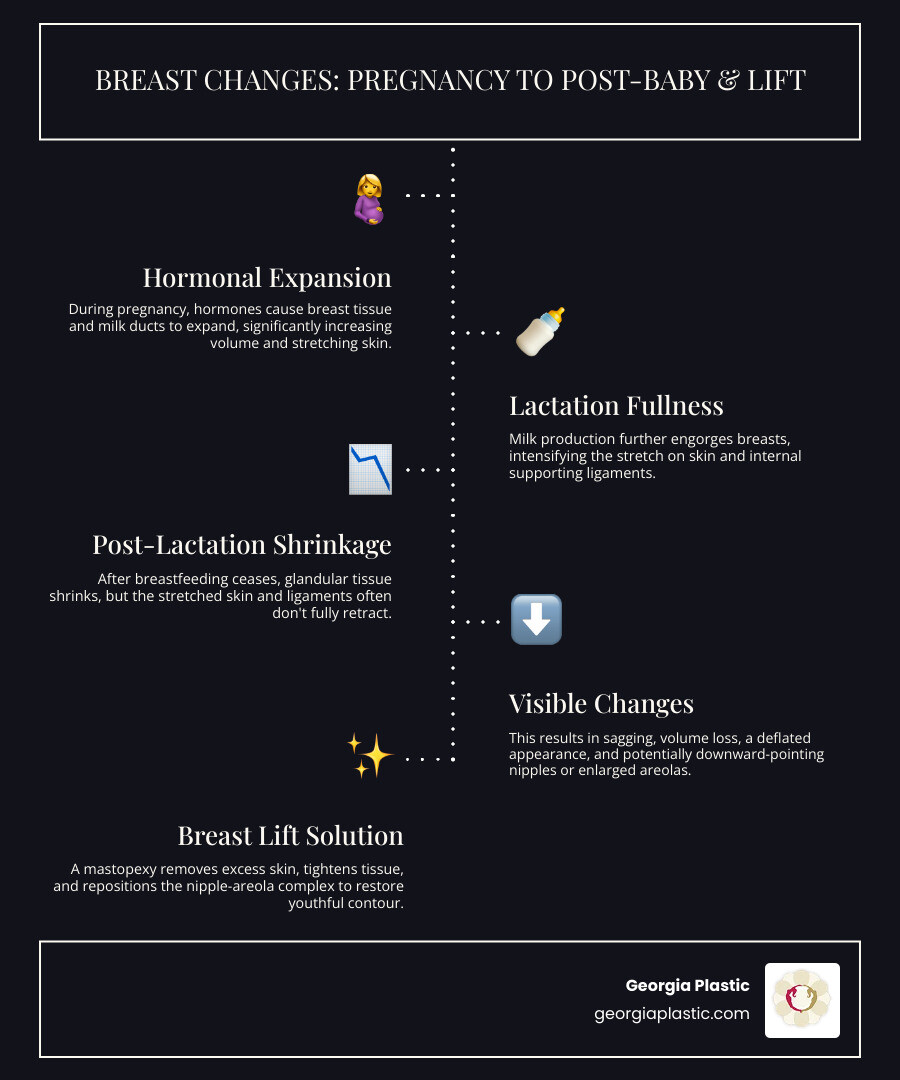
This happens because pregnancy hormones cause your breasts to grow, stretching the skin and supporting ligaments. After you stop breastfeeding, the breast tissue shrinks, but the stretched skin doesn’t always bounce back. The result is often sagging, drooping breasts that have lost their youthful shape and firmness.
Since 2000, breast lift surgeries have increased by 70 percent—double the rate of breast implants. In 2020 alone, more than 87,000 women chose breast lift surgery to address these post-pregnancy changes.
A breast lift (mastopexy) can help restore your pre-baby contour by removing excess skin and reshaping your breast tissue. It’s not about changing who you are—it’s about feeling like yourself again.
As Dr. Stanley Okoro, a double board-certified plastic surgeon specializing in mommy makeovers and breast lift after pregnancy procedures, I’ve helped hundreds of mothers in Atlanta regain their confidence. My approach focuses on delivering natural-looking results that complement your body while prioritizing safety and satisfaction.
Why Breasts Change After Pregnancy and Breastfeeding
Motherhood brings profound physical changes, especially to the breasts, which can alter their appearance long-term.
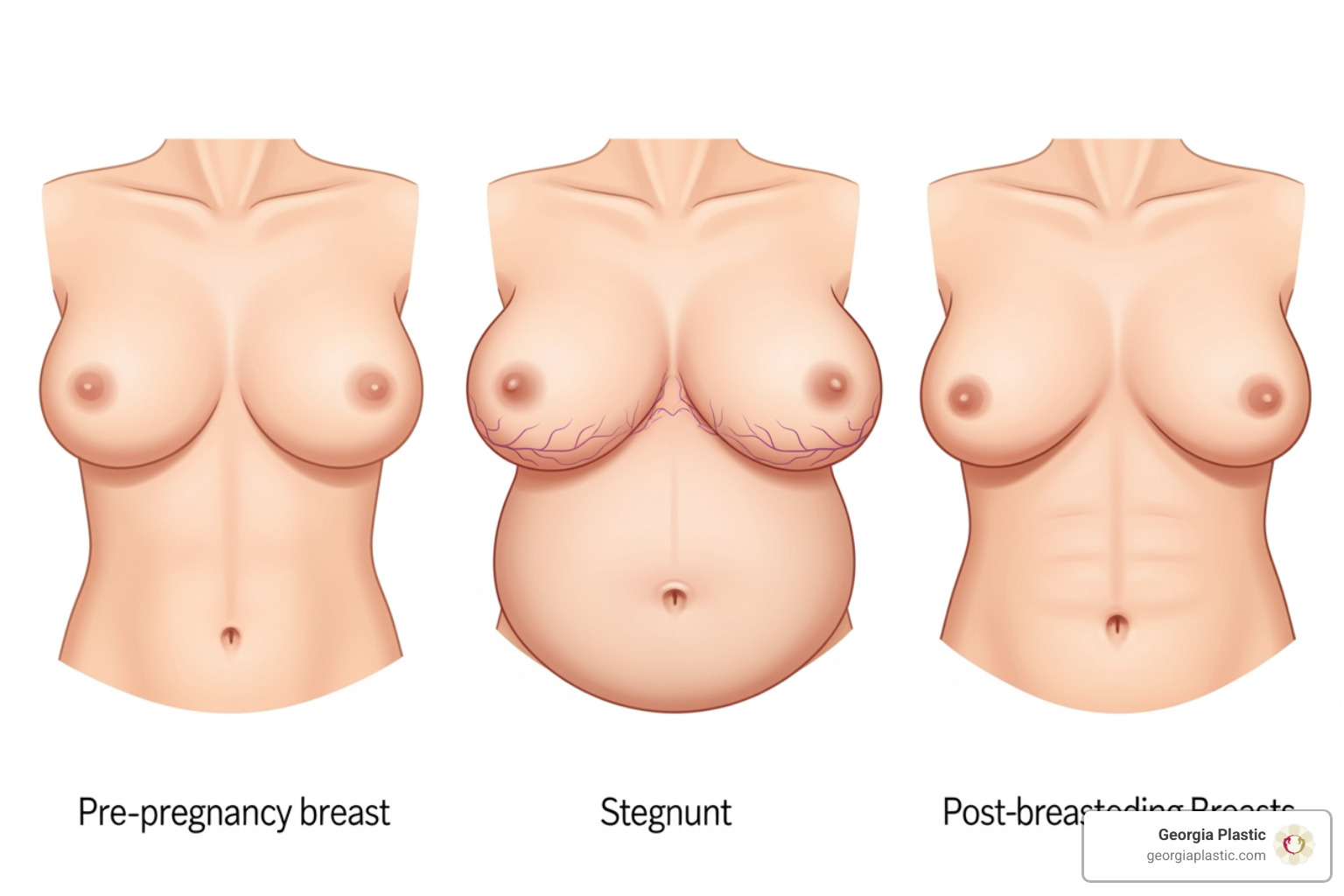
Starting early in pregnancy, hormonal surges cause your breasts to grow, often by a cup size or more, to prepare for milk production. This expansion stretches the skin and supporting ligaments.
After you stop breastfeeding, the milk-producing glandular tissue shrinks. However, the stretched skin and ligaments often don’t contract to match this reduced volume. This leads to several common changes:
- Sagging and Drooping: The stretched skin and ligaments can no longer adequately support the breast tissue, causing them to hang lower on your chest.
- Volume Loss: As glandular tissue shrinks, breasts can appear “deflated,” empty, or less full, particularly in the upper pole.
- Nipple and Areola Enlargement: The areolas (the pigmented skin around the nipples) often become larger during pregnancy and may not shrink back to their original size. Nipples may also point downward due to the overall sagging.
- Changes in Skin Elasticity: The skin on your breasts may lose its youthful elasticity, contributing to a less firm appearance.
These changes are normal. However, for many women, they can impact self-confidence. Understanding why they happen is the first step in deciding if a breast lift after pregnancy is right for you. You can read more about these natural changes at Breast changes during pregnancy.
What a Postpartum Breast Lift Can Achieve
A breast lift after pregnancy (mastopexy) is a cosmetic procedure that counteracts the effects of pregnancy and breastfeeding. Its goal is to restore a more youthful, perkier breast contour.
At its core, a breast lift addresses the two main issues caused by pregnancy: excess stretched skin and displaced breast tissue. Our surgeons achieve this by:
- Removing excess skin: This is crucial for tightening the breast envelope and eliminating laxity.
- Tightening surrounding tissue: The underlying breast tissue is reshaped and lifted to create a firmer, more supported breast mound.
- Repositioning the nipple and areola: For a youthful appearance, the nipple and areola are moved to a higher, more central position on the breast. If the areolas have enlarged, we can also reduce their size to be more proportionate.
It’s important to understand what a breast lift doesn’t do on its own. It primarily focuses on lifting and reshaping, not significantly changing breast size. If you desire more fullness, we can combine your breast lift with breast augmentation using implants. Conversely, if you feel your breasts are too large, a breast reduction can be performed with the lift to achieve a smaller, lighter, and more lifted profile.
The Benefits of a Breast Lift After Pregnancy
The benefits of a breast lift after pregnancy go beyond the physical, often helping our patients reclaim a sense of self and confidence.
- Restored youthful contour: We can bring your breasts back to a higher, more youthful position on your chest.
- Improved breast shape and projection: The procedure reshapes the breast tissue, creating better projection and a rounder, firmer appearance.
- Symmetrical appearance: If one breast sags more than the other, a breast lift can help create a more balanced and symmetrical look.
- Increased self-confidence: Feeling good about your body can have a profound impact on your overall well-being and confidence in all aspects of your life.
- Clothes fitting better: Say goodbye to bras that don’t quite fit or clothes that don’t drape properly. Many women find their wardrobe options expand significantly after a breast lift.
- Correcting downward-pointing nipples: We can reposition your nipples to face forward, aligning with a more youthful breast profile.
Common Breast Lift Techniques Explained
The specific technique we use for your breast lift after pregnancy will depend on the degree of sagging you have and your desired outcome. During your consultation, we’ll discuss the best approach for you.
| Technique | Degree of Sagging | Incision Pattern | Typical Scarring |
|---|---|---|---|
| Anchor Lift (Full Mastopexy) | Extensive | Around the areola, vertically down to the breast crease, and horizontally along the breast crease | “Anchor” or “T” shape |
| Lollipop/Vertical Lift | Moderate | Around the areola and vertically down to the breast crease | “Lollipop” or “I” shape |
| Donut/Periareolar Lift | Mild | Around the perimeter of the areola only | Circular scar around the areola |
- Anchor lift (extensive sagging): Ideal for women with significant sagging and excess skin, this technique provides the most dramatic lift and reshaping.
- Lollipop/Vertical lift (moderate sagging): For moderate sagging, this technique offers a significant lift with less scarring than an anchor lift.
- Donut/Periareolar lift (mild sagging): Suitable for minimal sagging or an enlarged areola, this technique has the least invasive scarring, confined to the areola.
Choosing the right technique is a collaborative process. Your surgeon will assess your anatomy and goals to recommend the best approach for your breast lift after pregnancy.
Planning Your Breast Lift After Pregnancy: Timing and Key Considerations
Timing is crucial for optimal, long-lasting results from a breast lift after pregnancy. Your body should be fully recovered and stabilized from pregnancy and breastfeeding before surgery.
Generally, we recommend waiting:
- After childbirth: Your body needs time to heal from delivery, and your hormones need to stabilize.
- After breastfeeding: It’s crucial to wait until you have completely stopped breastfeeding. The consensus among surgeons is to wait at least 3-6 months, and ideally 6-12 months, after your last breastfeeding session. This allows your milk production to cease, your breast tissues to soften, and your breasts to settle into their non-lactating size and shape. Operating on actively lactating breasts can lead to complications and unpredictable results.
- Stable body weight: Significant weight fluctuations can impact your breast shape and the longevity of your breast lift results. We recommend being at or near your ideal, stable body weight before surgery.
- Completing your family: This is perhaps the most important consideration. While a breast lift is generally safe if you plan to have more children, subsequent pregnancies can undo the results of your surgery. If you are certain you are done having children, your results are more likely to last.
As plasticsurgery.org notes, it’s best to have this surgery after you are finished breastfeeding and no longer plan to become pregnant. Waiting up to six months after lactation stops allows the breast tissue to settle. You can read more at Better breasts after pregnancy and breastfeeding.
Can I Breastfeed After a Breast Lift?
This is a very common and understandable concern for women considering a breast lift after pregnancy who might still want to have more children. The good news is that for many women, breastfeeding after a breast lift is still possible.
However, it’s not a guarantee, and several factors play a role:
- Impact on milk ducts: During a breast lift, we reshape breast tissue and reposition the nipple. Depending on the extent of the lift and the incision technique used, there’s a slight risk that some milk ducts could be disrupted.
- Nerve sensation: Changes in nipple sensation can sometimes occur after breast surgery, which might affect the let-down reflex crucial for breastfeeding.
- Surgical technique matters: Techniques that involve minimal disruption to the breast tissue and ducts, such as a periareolar lift, may have a lower impact on breastfeeding. More extensive lifts, like an anchor lift, carry a slightly higher risk. Incisions around the areola, where many ducts converge, are more likely to cause reductions in milk production.
- Possibility vs. guarantee: While many women can successfully breastfeed after a breast lift, we can’t guarantee a full milk supply or problem-free breastfeeding. The CDC notes that while most mothers can produce some milk after breast surgery, a full supply isn’t guaranteed as procedures can affect nerves and ducts. You can learn more at Breast Surgery and Breastfeeding.
If future breastfeeding is a priority for you, discuss this in detail during your consultation. We will choose a technique that prioritizes preserving your milk ducts and nerve sensation as much as possible.
What if I Get Pregnant After My Breast Lift?
It’s safe to become pregnant after a breast lift after pregnancy procedure, but it’s important to understand how a future pregnancy might affect your results.
- Safety of future pregnancy: Rest assured, getting pregnant after a breast lift poses no risk to you or your baby.
- Hormonal effects on results: Just like your first pregnancy, a subsequent pregnancy will bring hormonal fluctuations that can cause your breasts to enlarge again. This expansion can re-stretch the skin and ligaments that were tightened during your breast lift.
- Potential for re-stretching: The sad truth is that a future pregnancy and breastfeeding can potentially undo some or all of the improvements made during your breast lift, leading to renewed sagging or volume loss.
- Longevity of results: While breast lift results can last 10-15 years on average, a subsequent pregnancy is one of the most significant factors that can shorten this duration.
- Possibility of a future revision: If you do become pregnant again after your breast lift and experience significant changes, a revision surgery may be an option to restore your desired breast contour. This is why we often recommend waiting until you are certain your family is complete before undergoing a breast lift.
We believe in managing expectations transparently. While we strive for long-lasting results, we also want you to be fully informed about factors that can influence them.
Your Surgical Journey: From Consultation to Recovery
A breast lift after pregnancy journey involves several steps. Our team at Georgia Plastic & Reconstructive Surgery will guide you through each phase with care.

- The initial consultation: We’ll discuss your medical history and aesthetic goals, and perform a physical exam to assess your breasts. This helps us determine if a breast lift is right for you, outline a surgical plan, and review before-and-after photos to help you visualize potential outcomes.
- Preparation: We’ll provide detailed pre-surgery instructions, including guidelines on medications, smoking cessation, and arranging for help during your initial recovery.
- Anesthesia: Most breast lifts are performed under general anesthesia, meaning you’ll be completely asleep during the procedure.
- The procedure steps: Once you’re comfortable, we’ll make precise incisions based on the agreed-upon technique (anchor, lollipop, or donut). Through these incisions, we remove excess skin, reshape the underlying breast tissue, and reposition your nipple-areola complex to a higher, more youthful position. The incisions are then carefully closed with sutures. The procedure typically takes about two hours.
- Immediate post-op: You’ll wake up with your breasts bandaged and in a surgical support bra. Swelling, bruising, and discomfort are normal and managed with pain medication. Most patients go home the same day, though temporary drainage tubes may be used for a few days.
- The first week: This is a crucial healing period. You’ll need to rest and follow all post-operative instructions. We’ll schedule a follow-up to check your progress.
- Long-term healing: Swelling and bruising typically subside within two weeks, while numbness may last about six weeks. Your final results will settle over several months as your breasts assume their new shape and scars soften and fade over 1-2 years.
Tips for a Faster Recovery for Moms
A smooth recovery from your breast lift after pregnancy is vital for optimal results. Here are our top tips for busy moms:
- Arranging childcare: This is paramount. Arrange for a trusted family member or friend to care for your children for at least the first week, and ideally longer, especially if you have young children. You won’t be able to lift them.
- Meal prepping: Prepare and freeze healthy, easy-to-reheat meals before your surgery. This will eliminate cooking stress during recovery.
- Creating a recovery nest: Set up a comfortable, easily accessible recovery area with everything you need within reach: water, snacks, books, remote controls, and medications.
- Following surgeon’s instructions: We cannot stress this enough! Adhering to all post-operative instructions regarding wound care, medication, and activity restrictions is key to a safe and effective recovery.
- Wearing the support bra: You’ll be instructed to wear a special surgical support bra continuously for several weeks. This bra provides essential support, minimizes swelling, and helps your breasts heal in their new position.
- Pain management: Take your prescribed pain medication as directed. Don’t try to tough it out; staying ahead of the pain will make you more comfortable and allow for better rest.
- Avoiding heavy lifting: For at least 4-6 weeks, you must avoid lifting anything heavier than a gallon of milk, reaching overhead, or engaging in strenuous activities that could strain your chest muscles.
Most women can return to light activities and non-strenuous work within 1-2 weeks, but full recovery can take up to six weeks. Planning ahead makes all the difference!
Choosing the Right Surgeon for Your Post-Pregnancy Breast Lift
The success and safety of your breast lift after pregnancy depend on your surgeon’s expertise. This is not a decision to take lightly.
Here’s what to look for when choosing your surgeon:
- Board certification: Always choose a surgeon who is board-certified by the American Board of Plastic Surgery. This signifies that they have met rigorous standards for training, experience, and ethical practice.
- Experience with “mommy makeovers”: Look for a surgeon with experience in breast lifts, especially for post-pregnancy patients. This indicates a deep understanding of the unique challenges and goals associated with restoring a mother’s body.
- Viewing before-and-after photos: A surgeon’s gallery of patient photos is a powerful indicator of their skill and aesthetic style. Look for results that resonate with your own goals.
- Patient testimonials: Reading reviews and testimonials from previous patients can give you insight into the surgeon’s patient care, communication style, and overall patient satisfaction.
- Surgeon’s aesthetic style: Every surgeon has a unique artistic eye. During your consultation, ensure their aesthetic philosophy aligns with your vision for natural-looking results.
- Accredited facility: Ensure the surgery will be performed in an accredited surgical facility that meets the highest safety standards.
We encourage you to do your research. You can begin your search at Find a board-certified plastic surgeon. At Georgia Plastic & Reconstructive Surgery, our board-certified surgeon, Dr. Stanley Okoro, specializes in body contouring for mothers, prioritizing safety and natural outcomes.
Frequently Asked Questions about Post-Baby Breast Lifts
We understand you likely have many questions about a breast lift after pregnancy. Here are some of the most common ones we hear:
How long do breast lift results last?
Breast lift results typically last 10 to 15 years, but this varies. The procedure turns back the clock, but it cannot stop the natural aging process.
Several factors can affect the longevity of your results:
- Aging: As you age, your skin naturally loses elasticity, and gravity continues its relentless pull, which can cause some degree of sagging over time.
- Gravity: It’s an unavoidable force! Over decades, gravity will continue to exert its influence on your breasts.
- Weight fluctuations: Significant gains or losses in weight after your surgery can stretch your skin and tissues, potentially compromising your results. Maintaining a stable weight is one of the best ways to preserve your lift.
- Future pregnancies: As discussed, subsequent pregnancies and breastfeeding can cause your breasts to enlarge and stretch again, potentially undoing the effects of your breast lift.
While results are long-lasting, they aren’t immune to these processes. Some patients consider a revision lift years later to refresh their appearance.
What are the risks of a breast lift?
Like any surgery, a breast lift after pregnancy has potential risks, which we will discuss during your consultation.
Common risks include:
- Scarring: Incisions are necessary for a breast lift, and while we strive for the finest, most discreet scars, they are permanent. They typically soften and fade over 1-2 years and are usually hidden by bras and bathing suits.
- Sensation changes: You might experience temporary or, less commonly, permanent changes in nipple or breast sensation, including increased sensitivity, decreased sensitivity, or numbness. Erotic sensation is usually unaffected.
- Asymmetry: While we aim for symmetry, slight differences in breast shape, size, or nipple position can occur.
- Infection: Although rare, infection is a possibility with any surgery. We prescribe antibiotics to minimize this risk.
- Bleeding: Post-operative bleeding or hematoma (a collection of blood under the skin) can occur.
- Trouble breastfeeding: As previously discussed, there’s a slight risk of affecting milk ducts, which could impact future breastfeeding capabilities.
- Anesthesia risks: Adverse reactions to anesthesia are rare but possible.
We will provide comprehensive information on all risks. You can find more details at Risks of a breast lift.
Will a breast lift make my breasts smaller or can I add volume?
This is a common point of confusion. It’s important to clarify:
- Reshaping vs. resizing: A breast lift’s primary goal is to reshape and lift your existing breast tissue, removing excess skin to create a firmer, more youthful contour. It does not inherently make your breasts smaller or larger in terms of volume.
- The illusion of smaller size: Sometimes, by removing saggy skin and lifting the breasts, they may appear slightly smaller or more compact, simply because the tissue is now higher and more organized.
- Combining with breast augmentation: If you’ve experienced significant volume loss after pregnancy and breastfeeding and desire fuller, larger breasts, we can combine your breast lift with breast augmentation using implants. This is a very popular option for what’s often called a “mommy makeover.”
- Combining with fat transfer: Another option for adding subtle volume is fat transfer, where fat is harvested from another area of your body (like the abdomen or thighs) via liposuction and then injected into your breasts. This offers a more natural feel and avoids implants.
During your consultation, we’ll discuss your goals. If you want more volume, we can explore combining your lift with augmentation or fat transfer.
Reclaim Your Confidence After Motherhood
The journey of motherhood is transformative in countless ways, and it’s perfectly natural to want to feel confident and comfortable in your own skin afterward. A breast lift after pregnancy offers a powerful solution for women seeking to restore the youthful contour and firmness of their breasts, helping them feel more like their pre-baby selves.
We’ve seen how this procedure can boost self-esteem, improve body image, and even improve daily comfort. It’s about empowering you to make a choice that aligns with how you feel inside.
We believe in the importance of realistic expectations and personalized care. At Georgia Plastic & Reconstructive Surgery, our team, led by board-certified Dr. Okoro, is dedicated to helping mothers restore their pre-baby confidence with personalized care, delivering natural-looking results while prioritizing patient safety. We’re here to answer all your questions and guide you through every step of this empowering journey.
If you’re ready to explore how a breast lift can help you regain your confidence and address the changes brought on by pregnancy and breastfeeding, we invite you to learn more about your options and the potential costs involved. Learn more about the cost of a breast lift in Atlanta. Let us help you feel like your best self again!


