
Why Earlobe Repair Is More Common Than You Think
Earlobe repair is a minor cosmetic surgery that fixes torn, stretched, or misshapen earlobes — and it’s one of the most frequently performed procedures by plastic surgeons.
Here’s a quick overview of what it involves:
| What you want to know | The short answer |
|---|---|
| What is it? | A procedure (lobuloplasty) that restores damaged earlobes |
| Who needs it? | People with torn, stretched, gauged, or drooping earlobes |
| Where is it done? | In-office, under local anesthesia |
| How long does it take? | Less than one hour |
| Recovery time? | Minimal — most return to normal activities right away |
| Can you re-pierce after? | Yes, typically after 3-6 months |
| Is it covered by insurance? | Usually not — it’s considered cosmetic |
Earlobes are made entirely of soft tissue — fat and skin — with no cartilage to give them structure. That makes them surprisingly easy to damage. Heavy earrings slowly stretch the piercing hole. An earring caught on clothing can cause a sudden tear. Years of wearing jewelry, combined with natural collagen loss from aging, can leave earlobes looking elongated, deflated, or uneven.
The frustrating part? There’s almost no way to hide a damaged earlobe. Long hair helps — but only so much.
The good news is that earlobe repair is a well-established, quick, and low-risk procedure that can restore your earlobes to a natural shape — and let you wear earrings again with confidence.
I’m Dr. Stanley Okoro, a double board-certified plastic surgeon and founder of Georgia Plastic and Reconstructive Surgery, with extensive experience performing earlobe repair as part of a comprehensive range of facial cosmetic procedures. In the sections below, I’ll walk you through everything you need to know — from causes and candidacy to procedure types, recovery, and costs.
Understanding Earlobe Repair Surgery
At its core, earlobe repair, medically known as lobuloplasty, is an artful restoration of the ear’s most delicate feature. Unlike the upper three-quarters of your ear, which is supported by sturdy cartilage, the earlobe is composed solely of skin and fat. This lack of structural support is exactly why it is so prone to stretching and tearing. When gravity, heavy jewelry, or sudden trauma take their toll, the tissue doesn’t just “bounce back”—it requires surgical intervention to find its way home.
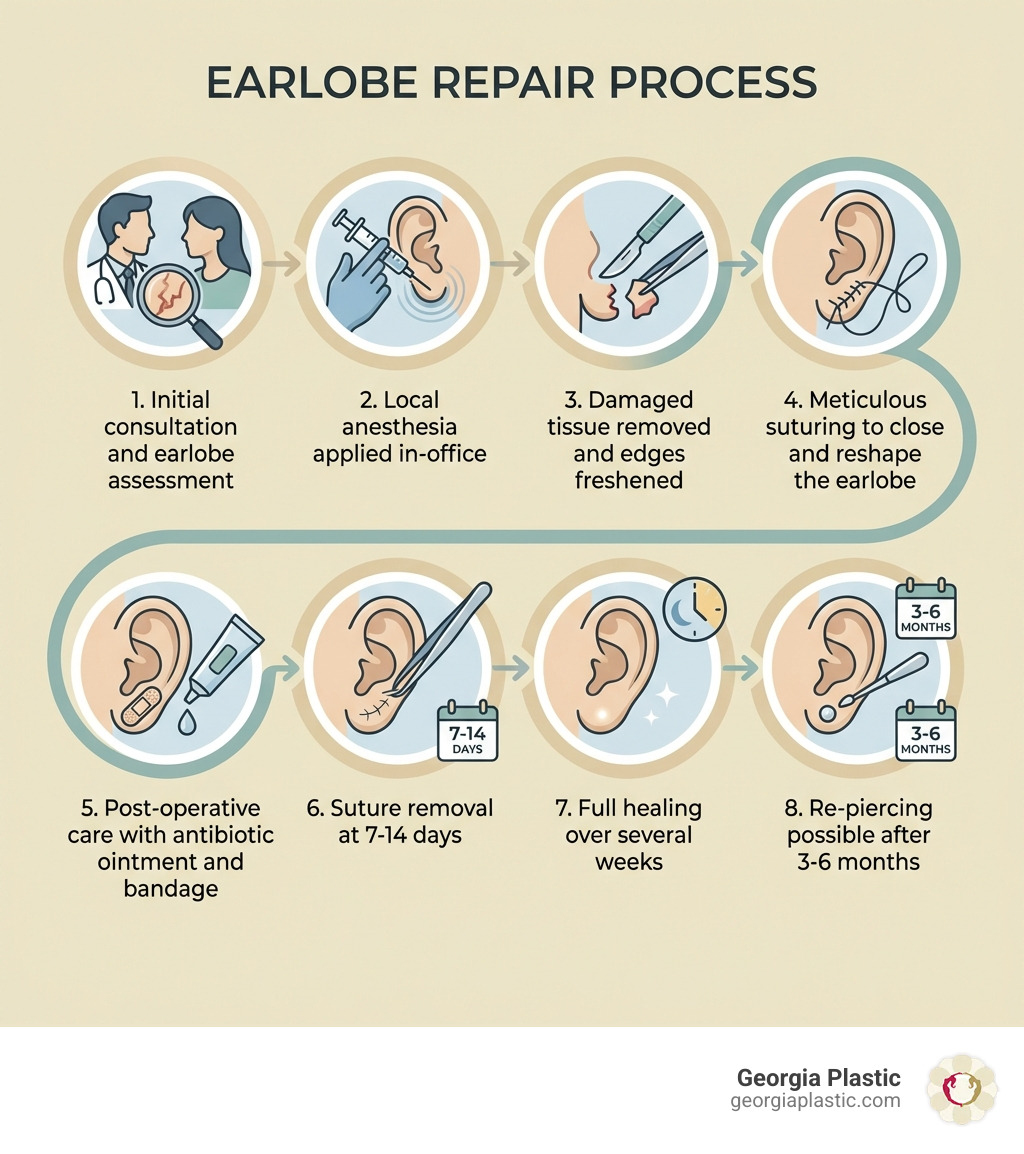
The procedure is widely considered a simple solution to torn and stretched earlobes. We perform this as an in-office procedure, meaning you don’t have to worry about the logistics of a hospital stay or the grogginess of general anesthesia. We use a local anesthetic to completely numb the area, ensuring you remain comfortable and awake throughout the process.
Most patients find the experience surprisingly relaxed. Since the surgery typically takes less than an hour, many of our patients schedule their repair during a long lunch break. It’s a “small” procedure in terms of time, but the impact on your self-image and your ability to wear your favorite jewelry again is massive. If you’ve been wondering why your earrings don’t sit right anymore, there are several reasons to consider earlobe repair surgery that go beyond just aesthetics, including restoring the structural integrity of the lobe itself.
Common Causes and Candidates for Treatment
Who exactly is a candidate for earlobe repair? The answer is more diverse than you might think. While many people assume it’s only for “accidents,” much of the damage we see is the result of long-term wear and tear.
The Heavy Jewelry Culprit
Consistently wearing heavy “chandelier” or hoop earrings is the most common cause of elongated piercing holes. Over time, the weight of the metal pulls down on the thin skin, creating a “slit” rather than a hole. Eventually, this slit can travel all the way to the bottom of the lobe, resulting in a complete split.
Accidental Trauma
Life happens. We often see patients whose earrings were snagged by a hairbrush, caught on a sweater, or—most commonly—tugged on by a curious toddler or a playful pet. These sudden forces can instantly rip through the delicate tissue.
The “Gauge” Trend
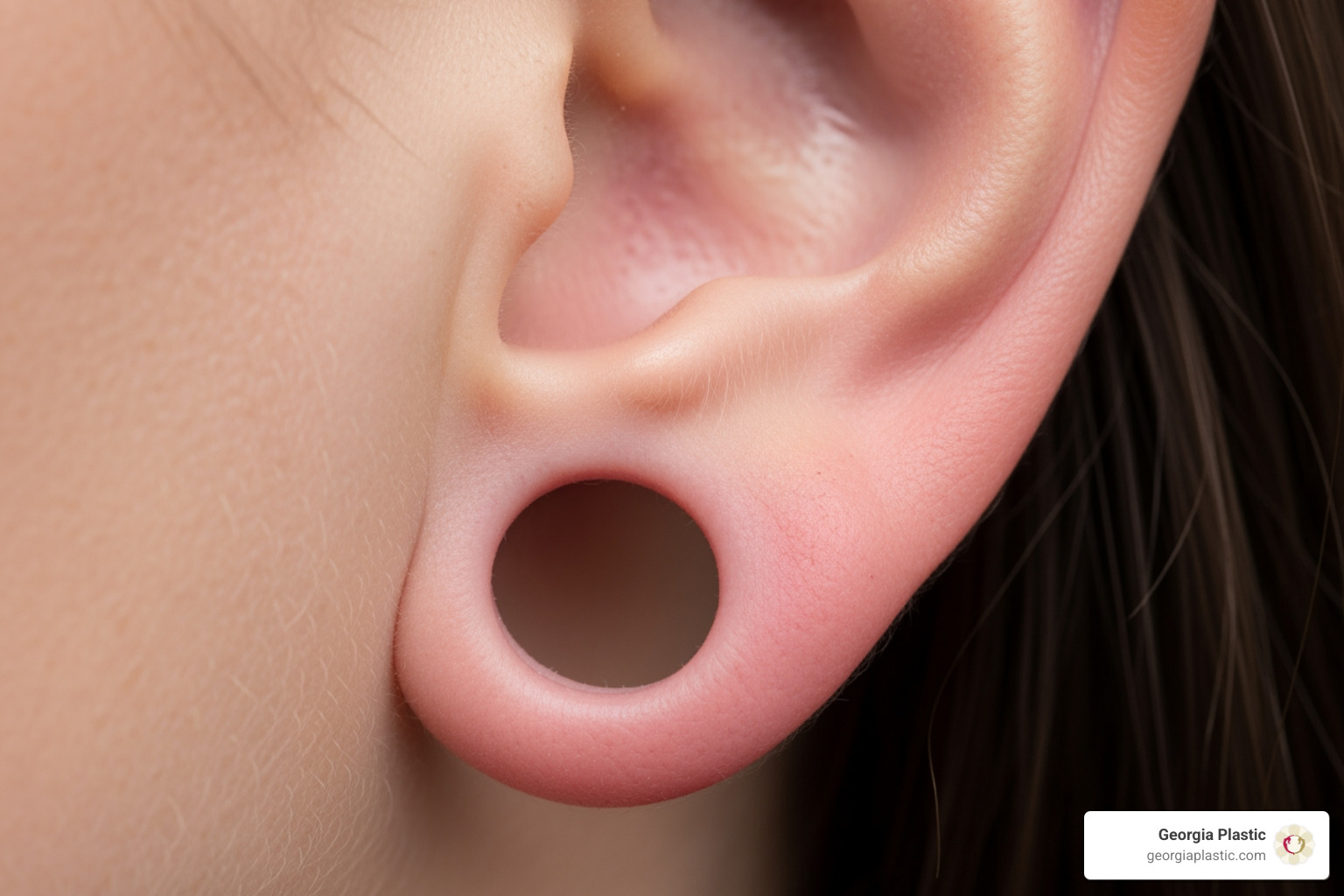
Ear gauging (using plugs or spacers to expand the piercing) has been a popular trend for years. While some small gauges may shrink slightly on their own after the jewelry is removed, larger stretches rarely return to a normal shape without help. We specialize in reconstructing these large openings to create a natural-looking, solid earlobe once again.
Aging and Gravity
Just like the rest of our face, our ears age. As we lose collagen and elastin, the earlobes can become thin, wrinkled, and “deflated.” In some cases, a previous facelift can result in what we call a “pixie ear,” where the lobe appears pulled or attached directly to the cheek. Scientific research on ear plastic surgery shows that these issues are not just about vanity; they are about restoring the natural proportions of the face.
If you are in good general health, a non-smoker (or willing to pause for healing), and have realistic expectations about scarring, you are likely an excellent candidate. You can check if you are an earlobe repair candidate by evaluating how much the current shape of your ear bothers you or interferes with your lifestyle.
Types of Earlobe Repair Procedures
No two ears are damaged in exactly the same way, which is why we offer several specialized techniques to address your specific needs.
- Split Earlobe Repair: This is for the classic “torn” ear. We freshen the edges of the tear by removing a tiny amount of the healed skin (epithelium) that has grown over the wound. This allows the two sides to “knit” back together during healing.
- Elongated Piercing Correction: For holes that haven’t split but are too large to hold a stud earring, we excise the stretched tissue and close the area to create a fresh, stable foundation.
Gauge/Plug Reconstruction: This is a more complex version of the repair. Because there is often a significant amount of missing or stretched-out tissue, we use advanced flap techniques to rearrange the remaining skin and recreate a rounded, natural lobe.
Earlobe Reduction: Some patients are born with naturally large earlobes, or find that their lobes have grown significantly with age. We can surgically “trim” the lobe to a more proportionate size while hiding the scars in the natural contours of the ear.
- Keloid Removal: Keloids are thick, raised scars that can form after a piercing. These require a specialized approach, often combining surgical excision with steroid injections to prevent the scar from returning.
Comparing Surgical Techniques
When we perform a earlobe repair, we choose the suturing method that will provide the strongest result and the least visible scar.
| Technique | How it Works | Best For |
|---|---|---|
| Linear Repair | A straight-line closure of the wound. | Simple, fresh tears or small reductions. |
| Z-Plasty | A “Z” shaped incision that redistributes tension. | Preventing “notching” at the bottom of the lobe and gauge repairs. |
| Layered Closure | Suturing both the front, middle, and back of the lobe. | Ensuring maximum strength and preventing the hole from re-opening. |
To see the difference these techniques make, you can view our gallery of earlobe repair results and see how we prioritize a seamless, natural finish.
The Surgical Process and Recovery Timeline
We want our patients to feel completely prepared for their day of surgery. Here is exactly what you can expect when you visit us for your earlobe repair.
Step 1: Numbing and Preparation
Once you are comfortable in our procedure room, we apply a local numbing agent (lidocaine). You might feel a tiny pinch, but within minutes, your ear will be completely numb. You’ll be awake and able to chat with us or listen to music during the process.
Step 2: The “Freshening”
If your tear happened months or years ago, the skin has already healed over the edges. We must gently remove this thin layer of healed skin to expose “fresh” tissue. This is the only way the two sides of the lobe will bond back together permanently.
Step 3: Meticulous Suturing
This is where the artistry happens. Using very fine, hair-thin sutures, we carefully align the edges. We often use a “key suture” at the very bottom of the lobe to ensure the curve is perfectly rounded and symmetrical with your other ear.
The Recovery Timeline
Recovery is remarkably straightforward. Most patients report a “throbbing” sensation for a few hours after the numbing wears off, which is easily managed with over-the-counter pain relief.
- Days 1–3: You will keep the area clean and apply a thin layer of antibiotic ointment. You can usually wash your hair after 24 hours, provided you are gentle.
- Days 7–10: You’ll return to our office for suture removal (unless we used dissolvable stitches). By this point, the initial “knit” of the skin is complete.
- Weeks 2–6: The scar will look slightly pink but will begin to fade. You should avoid putting any pressure on the ears or sleeping directly on them if possible.
- Month 3+: The tissue has gained enough strength for us to discuss re-piercing.
For those living in or traveling to the area, we provide a detailed guide on earlobe repair in Atlanta to help you plan your visit and aftercare.
Benefits, Risks, and Choosing a Surgeon
The primary benefit of earlobe repair is the restoration of your confidence. No more hiding your ears behind your hair or feeling self-conscious about asymmetrical lobes. Beyond aesthetics, the surgery provides a stable base for future jewelry wear.
Understanding the Risks
While this is a low-risk procedure, no surgery is without potential complications. These can include:
- Scarring: While we aim for “imperceptible” scars, everyone heals differently.
- Asymmetry: Small differences between the two ears are possible, though we measure meticulously to prevent this.
- Notching: If not performed correctly, a small “V” shaped indentation can form at the bottom of the lobe. (This is why choosing an expert is vital!)
- Infection: Rare, but prevented with proper aftercare and antibiotic ointment.
Why Board Certification Matters
Because earlobe repair is often labeled as “simple,” many under-qualified practitioners offer it. However, the earlobe is a three-dimensional structure. It requires an eye for symmetry and a deep understanding of tissue tension. Choosing a board-certified plastic surgeon ensures that your procedure is performed with the highest standards of patient safety and surgical finesse. You can find the latest information on earlobe repair safety standards to understand why medical credentials are non-negotiable.
Frequently Asked Questions about Earlobe Repair
How much does earlobe repair cost?
The cost of earlobe repair varies based on the complexity of the damage. A simple split on one ear is less expensive than a complex reconstruction of two gauged ears. Generally, prices can range from $400 to $1,500 per ear. Because this is almost always considered a cosmetic procedure, it is rarely covered by insurance. However, if the tear was caused by a traumatic injury (like a dog bite or a car accident), it’s worth checking with your provider. We provide clear, out-of-pocket estimates during your consultation so there are no surprises.
Is earlobe repair painful?
In a word: No. The local anesthesia ensures you feel nothing during the actual surgery. Afterward, most patients describe the feeling as a mild soreness or “tightness” rather than sharp pain. We sometimes offer nitrous oxide (laughing gas) for patients who are particularly anxious about needles or the surgical environment, allowing you to remain relaxed throughout the process.
When can I re-pierce my ears after earlobe repair?
This is the question we hear most! We generally recommend waiting 3 to 6 months before re-piercing. The scar tissue needs time to gain its full strength. When you do re-pierce, we advise doing so at least 3mm away from the original scar line. This prevents the new hole from “sliding” back into the old one. We also suggest starting with small, lightweight gold or silver studs rather than heavy hoops.
Conclusion
Your ears play a subtle but vital role in your overall facial harmony. Whether your damage came from years of heavy fashion choices, an accidental tug, or the natural progression of time, you don’t have to live with a torn or stretched lobe. Earlobe repair is a quick, effective, and life-changing way to restore your natural look.
At Georgia Plastic & Reconstructive Surgery, Dr. Okoro and our entire team are dedicated to providing personalized care that prioritizes your safety and delivers natural-looking results. We understand that even “minor” procedures are a big deal to you, and we treat every ear with the artistic precision it deserves.
Are you ready to wear those stunning earrings again? Schedule your earlobe repair in Atlanta consultation today and let us help you put the finishing touch back on your appearance.


