
What You Need to Know About Calf Implants Before Taking the Next Step
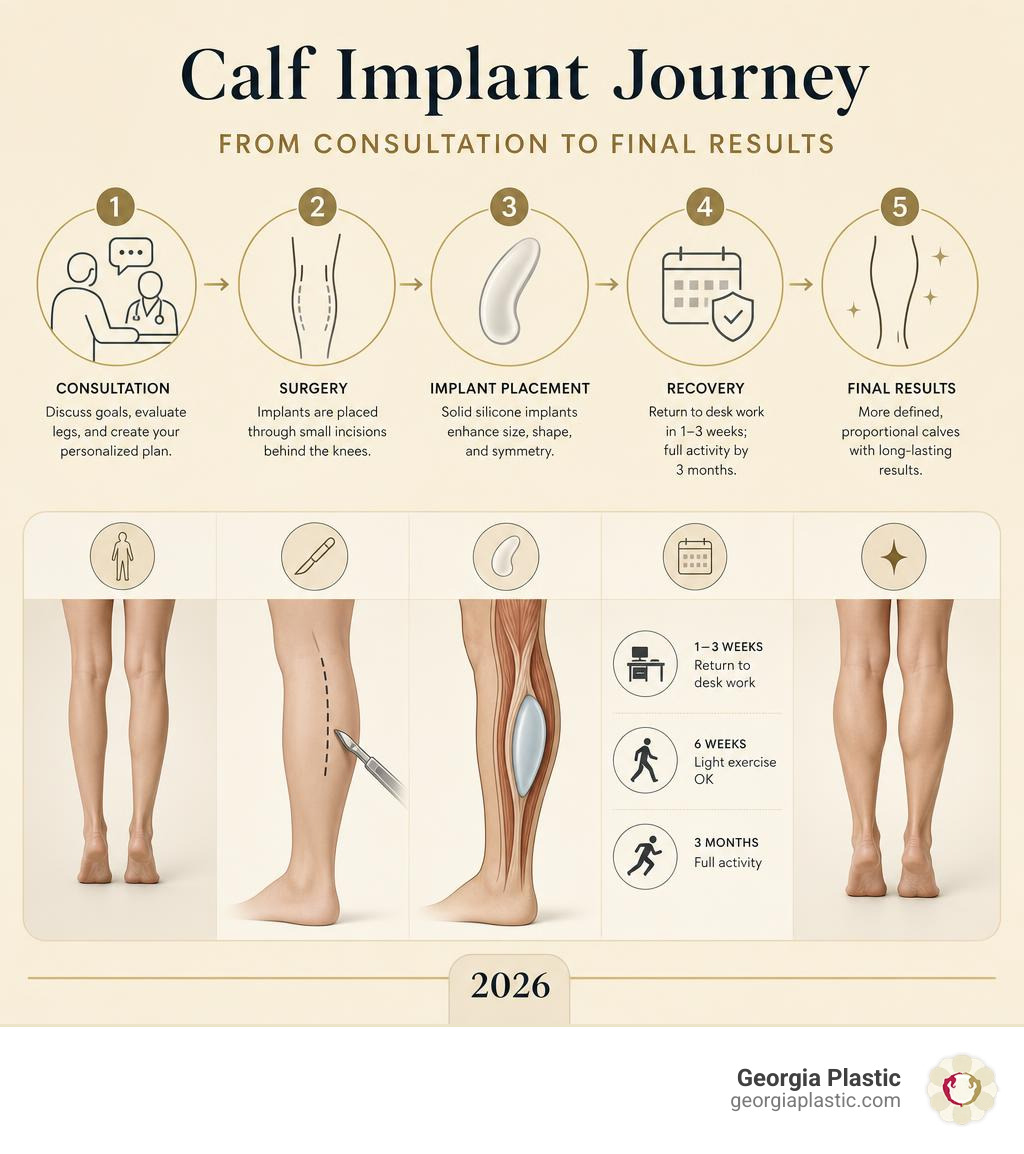
A calf implant is a medical-grade silicone device surgically placed in the lower leg to increase size, improve shape, and create more defined, proportional contours. If you are exploring this procedure, here is a quick overview:
Calf Implant at a Glance
| Topic | Key Facts |
|---|---|
| What it is | Solid silicone implant placed in the calf to add volume and definition |
| Who it helps | People with small, underdeveloped, or asymmetrical calves — cosmetic or reconstructive |
| Surgery time | 1–2 hours, outpatient |
| Recovery | Return to desk work in 1–3 weeks; full activity by 3 months |
| Average cost | $5,026 (varies by surgeon, location, and implant type) |
| Satisfaction rate | 95.4% |
| Results | Long-lasting; solid silicone implants do not rupture or leak |
No amount of training works for everyone. Some people are simply born with calves that resist growth — no matter how many sets they add to leg day. Others deal with asymmetry from an injury, a congenital condition like clubfoot, or muscle loss from illness. For these patients, calf augmentation offers a reliable, predictable path to legs that look and feel proportional.
This guide walks you through everything: how the surgery works, who qualifies, what recovery looks like, what it costs, and what results you can realistically expect.
I’m Dr. Stanley Okoro, a double board-certified plastic surgeon and founder of Georgia Plastic and Reconstructive Surgery, with extensive experience performing body contouring procedures including calf implant surgery. My approach combines surgical precision with individualized planning so every patient gets results that look natural and last.
Calf implant further reading:
What Is a Calf Implant?
A calf implant is a shaped medical-grade silicone device used to enhance the lower leg. The goal is not to make the leg look artificial or overbuilt. The goal is to improve proportion, definition, and balance.
Calf implant surgery is also called:
- Calf augmentation
- Calf enlargement
- Calf enhancement
- Lower-leg contouring
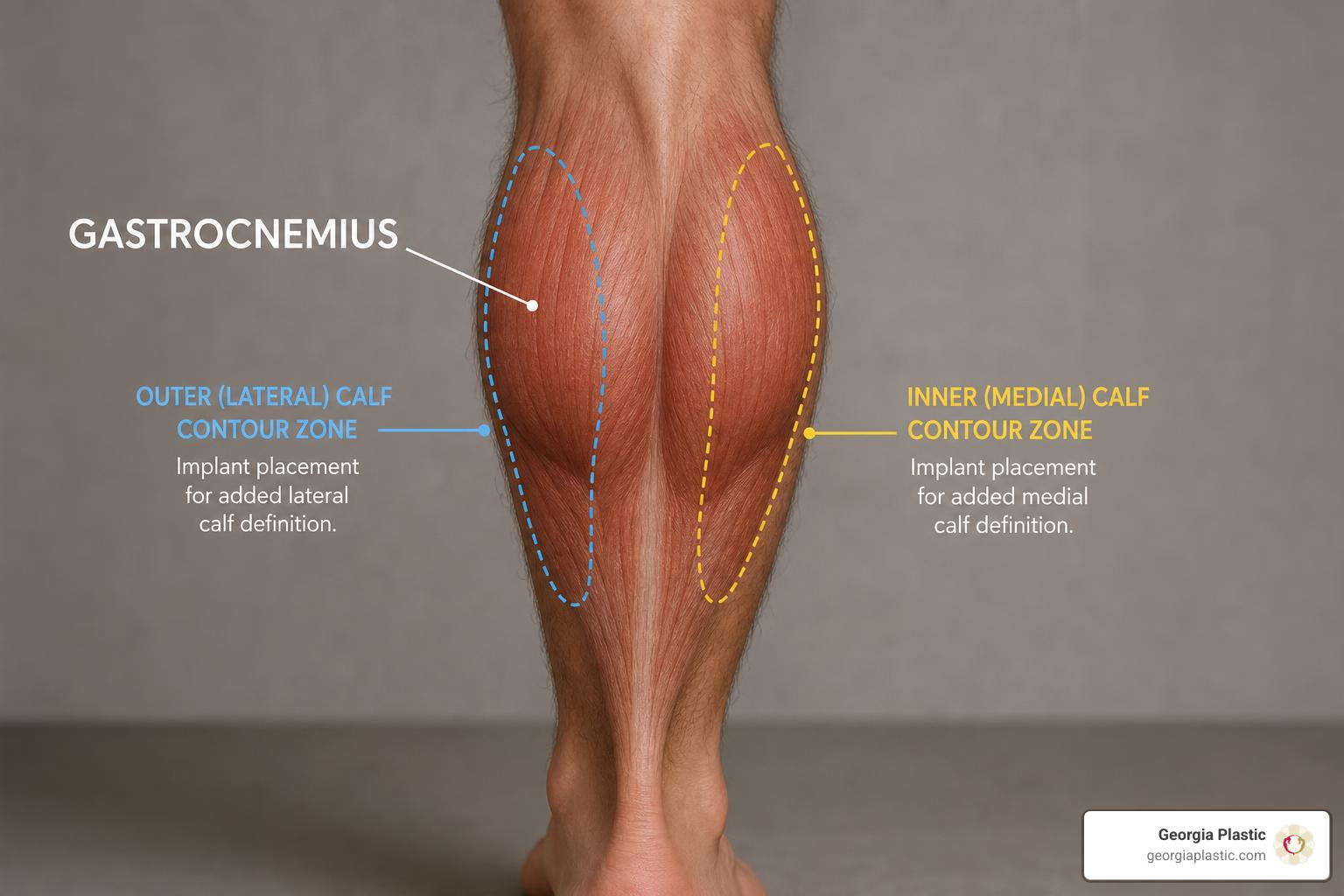
The implant is positioned to complement the natural gastrocnemius muscle, which is the visible calf muscle that gives the lower leg its rounded, athletic shape. Depending on your anatomy and goals, an implant can add fullness to the inner calf, outer calf, or both.
Calf implants are used for both cosmetic and reconstructive reasons. Some patients want more definition after years of training with limited growth. Others want to correct asymmetry caused by trauma, illness, muscle atrophy, or congenital conditions.
One reason calf augmentation remains appealing is predictability. Fat transfer, fillers, and exercise can help certain patients, but a solid implant provides a defined shape and volume that is planned before surgery.
Calf augmentation has also been associated with a high satisfaction rate, with research reporting a 95.4% satisfaction rate for calf augmentation using implants or fat transfer. For a general third-party overview, you can also review this calf implant overview, and for our practice-specific information, visit more info about calf implants.
What Calf Implants Can Improve
Calf implants can improve lower-leg contour in several ways. They are especially useful when the issue is structural, meaning the calf muscle shape or volume is naturally limited.
| Goal | How a Calf Implant May Help |
|---|---|
| Small calves | Adds predictable volume and shape |
| Inner calf deficiency | Improves medial calf fullness |
| Outer calf flatness | Enhances lateral contour when appropriate |
| Calf asymmetry | Helps balance one leg with the other |
| Athletic definition | Creates a more muscular-looking outline |
| Reconstructive correction | Restores contour after injury, illness, or congenital muscle loss |
| Clothing fit | Helps pants, shorts, boots, and swimwear look more balanced |
| Proportional legs | Balances calves with thighs and overall body frame |
A calf implant can be placed on one leg or both legs. Some patients need only medial calf enhancement, while others benefit from both medial and lateral augmentation. The best plan depends on your anatomy, soft-tissue thickness, muscle shape, and goals.
And yes, we still encourage leg day. The implant adds shape, but strong legs are never out of style.
Solid Silicone Calf Implant Materials and Designs
Most modern calf implants are made from solid silicone elastomer. This material is firm yet flexible, and it is designed to mimic the feel and shape of muscle. Unlike liquid-filled implants, solid silicone calf implants do not leak.
There are two broad implant categories patients often ask about:
| Implant Type | Advantages | Considerations |
|---|---|---|
| Solid silicone | Durable, flexible, can be shaped or custom-carved, no leakage risk | Edges may be felt if oversized or poorly positioned |
| Silicone gel | Softer feel in some designs, available in certain shapes | Potential for shell damage, leakage, or capsular contracture, though these issues are uncommon |
In our view, solid silicone is usually preferred for calf augmentation because it is stable, long-lasting, and well-suited for the lower leg. Solid implants can come in anatomical or symmetrical shapes. Anatomical, or teardrop-like, implants can create a more natural calf contour because they are designed to follow the shape of the gastrocnemius muscle.
Some patients need custom implants, especially in reconstructive cases where one leg has significant atrophy or an unusual contour. Custom carving or advanced planning may be considered when standard sizes will not provide the most natural result.
How to Choose the Right Calf Implant Size and Shape
Choosing the right calf implant is not like choosing a shoe size. Bigger is not automatically better. In fact, an implant that is too large can create visible edges, pressure, discomfort, or an unnatural look.
During consultation, we evaluate:
- Lower-leg measurements
- Calf circumference
- Existing gastrocnemius shape
- Medial and lateral calf fullness
- Skin and soft-tissue thickness
- Differences between the right and left legs
- Desired level of enhancement
- Whether one or two implants per leg are needed
- Whether the goal is cosmetic, reconstructive, or both
Some patients only need an implant along the inner calf. Others need medial and lateral implants to create better balance. Patients with congenital asymmetry or muscle atrophy may need a more customized approach.
The best results usually come from proportional sizing. The implant should blend with your natural anatomy, not announce itself like a neon sign that says, “I had calf surgery.”
How Calf Implant Surgery Is Performed
Calf implant surgery is usually an outpatient procedure. In many cases, it takes about 1 to 2 hours, depending on whether one or both legs are treated and whether the case is cosmetic or reconstructive.
The general steps include:
- Preoperative markings while standing
- Anesthesia
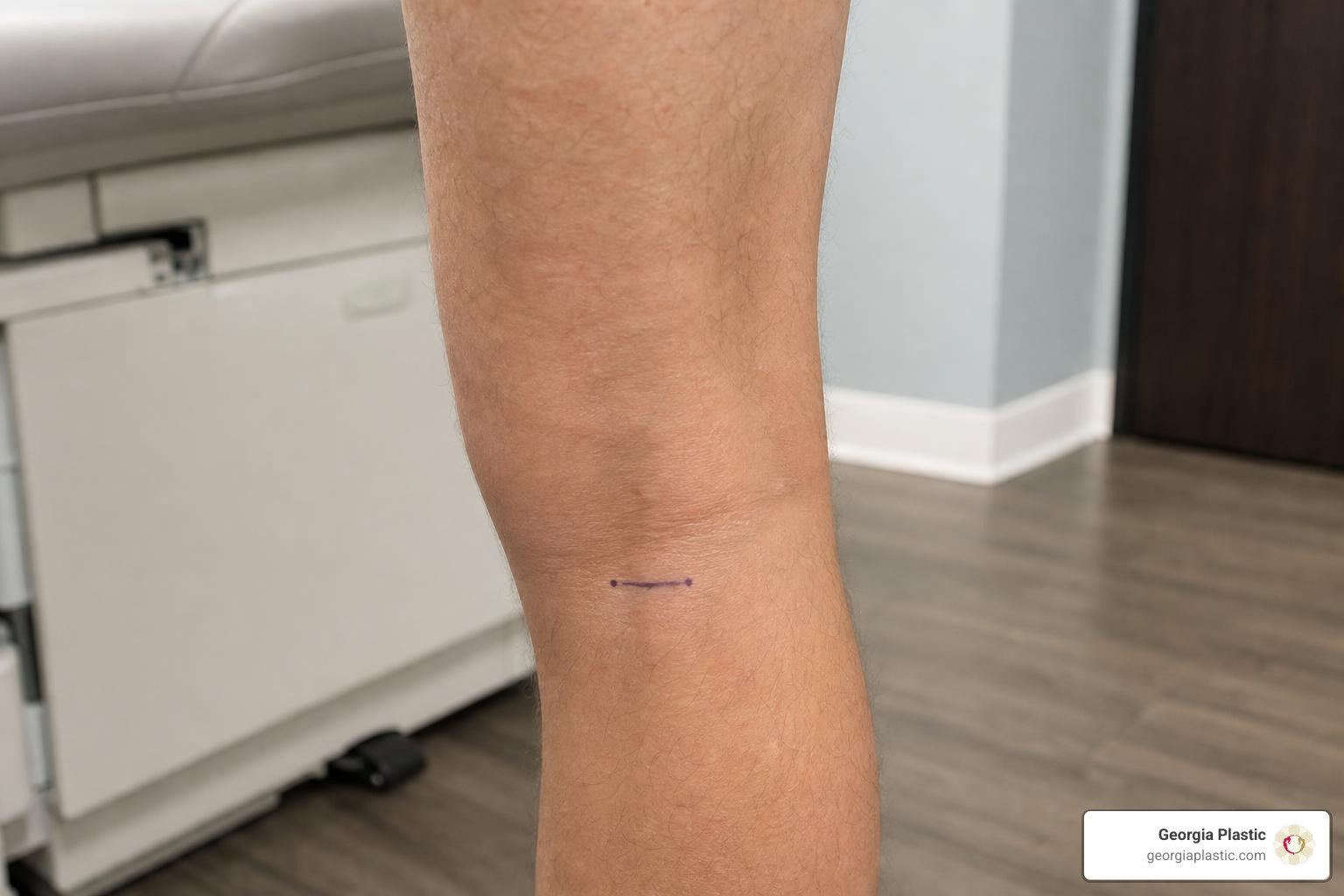
- Small incision behind the knee
- Careful pocket creation
- Implant insertion and positioning
- Closure of the incision
- Compression dressing or garment
- Recovery monitoring before going home
Surgical planning is critical. The calf contains important nerves and blood vessels, and the implant pocket must be created with precision. A well-designed pocket helps reduce the risk of shifting, rotation, visible edges, and asymmetry.
You can learn more about our approach to lower-leg enhancement here: more info about Atlanta calf augmentation.
Incision Placement Behind the Knee
The incision is typically placed in the natural crease behind the knee, called the popliteal crease. This location helps hide the scar in a natural fold.
Typical incision length varies by implant size and technique, but it is often around 3 to 7 cm. The surgeon carefully dissects through the tissue to create access to the implant pocket while protecting surrounding structures.
After the implant is placed, the incision is closed in layers. Scar care may include:
- Keeping the incision clean and dry as directed
- Avoiding tension on the incision
- Wearing compression as recommended
- Avoiding sun exposure on healing scars
- Using scar treatments only when cleared by your surgeon
Most scars fade over time, but scar quality varies from person to person.
Subfascial vs Submuscular Placement
Calf implants are usually placed in one of two locations: subfascial or submuscular.
| Placement | Where It Goes | Advantages | Considerations |
|---|---|---|---|
| Subfascial | Beneath the fascia covering the gastrocnemius muscle | Less invasive, often shorter recovery, common technique, good support | Implant edges may be more noticeable in very thin patients if sizing or pocket design is not ideal |
| Submuscular | Beneath or within deeper muscle plane | More soft-tissue coverage, potentially more natural camouflage | More discomfort, longer recovery, technically more involved |
Subfascial placement is commonly used because it provides good implant support while avoiding unnecessary trauma to the calf muscle. Submuscular placement may be considered when additional coverage is needed or when anatomy suggests it may produce a better contour.
The right choice depends on the patient. We consider tissue thickness, desired result, implant size, activity level, and safety. The pocket must be precise either way. A poorly shaped pocket can allow migration, rotation, or visible implant borders.
A key safety point: the calf is a tight anatomical space. Oversizing the implant can increase pressure, which may raise the risk of nerve irritation, pain, or circulation concerns. This is one reason experienced surgical planning matters.
Anesthesia Options and Surgical Setting
Calf implant surgery is typically performed under general anesthesia or deep sedation. In select cases, local anesthesia with sedation may be appropriate, but most patients are more comfortable and safer with a deeper anesthesia plan.
The procedure should be performed in a sterile, accredited surgical setting with appropriate monitoring. Anesthesia planning may include:
- Review of your medical history
- Medication and supplement review
- Fasting instructions
- Monitoring during surgery
- Recovery observation before discharge
Because calf augmentation is an outpatient surgery, most patients go home the same day with a responsible adult.
Who Is a Good Candidate and How Should You Prepare?
Good candidates for calf implants are healthy, realistic, and bothered by calf shape or asymmetry that cannot be corrected with exercise alone.
Calf augmentation can help:
- Men and women with naturally small calves
- Bodybuilders or athletes with stubborn calf underdevelopment
- Patients with one calf smaller than the other
- People with muscle atrophy after injury or illness
- Patients with congenital conditions such as clubfoot, polio-related changes, or spina bifida-related asymmetry
- Patients seeking more masculine or balanced lower-leg proportions as part of gender-affirming goals
Calf implant surgery is highly specialized. One important industry insight is that many plastic surgeons perform very few calf augmentation cases in their careers. Some sources note that many surgeons have not performed even five total calf augmentation cases, while experienced calf augmentation surgeons may perform around 20 cases per year. This does not mean the procedure is unsafe, but it does mean surgeon experience matters.
Cosmetic and Reconstructive Candidate Criteria
You may be a good candidate if you:
- Are in good overall health
- Have a stable weight
- Do not smoke, or can stop before and after surgery
- Have realistic expectations
- Understand the risks and recovery process
- Want improved proportion rather than extreme size
- Have reached a plateau with exercise
- Have calf asymmetry from genetics, injury, illness, or congenital conditions
- Are emotionally prepared for surgery and recovery
You may need to delay or avoid surgery if you have uncontrolled medical conditions, active infection, poor circulation, high surgical risk, or unrealistic expectations.
We also discuss psychological readiness. Cosmetic surgery should support your confidence, not chase perfection. If the goal is “make my calves match my body better,” that is very different from “make my legs look like a different person’s legs.”
Preoperative Planning Before a Calf Implant Procedure
Preparation helps reduce risk and makes recovery smoother. Before surgery, your plan may include:
- Full medical history review
- Physical exam
- Blood work or medical testing
- Medication adjustments
- Stopping nicotine before and after surgery
- Avoiding certain supplements or blood-thinning medications
- Preoperative photos
- Calf measurements
- Implant sizing discussion
- Review of before-and-after photos
- Anesthesia evaluation
- Recovery planning
Pre-surgery checklist:
- Ask who will perform the procedure and where it will be done
- Confirm the surgical facility is properly accredited
- Review implant size, shape, and placement plan
- Ask whether one or both calves will be treated
- Ask whether medial-only or medial-lateral implants are recommended
- Stop smoking as instructed
- Complete blood work and medical clearance if needed
- Pick up prescriptions before surgery
- Arrange a ride home
- Ask someone to stay with you the first night
- Prepare loose clothing and easy meals
- Set up a recovery area where you can elevate your legs
- Move trip hazards out of walkways
- Keep compression garments ready if instructed
Recovery, Risks, and Long-Term Results
Recovery from calf implant surgery requires patience. The calves are involved in almost every step you take, so soreness and tightness are expected early on.
Common early recovery symptoms include:
- Swelling
- Bruising
- Tightness
- Discomfort while walking
- Mild incision soreness
- Temporary changes in skin sensation
Your aftercare plan may include prescription pain medication, antibiotics, compression garments, leg elevation, icing when appropriate, and follow-up visits.
Walking is usually encouraged in short, careful amounts because it supports circulation and helps reduce blood clot risk. But this is not the time to test your new calves on a treadmill. The gym will wait. It has waited for all of us at some point.
Recovery Timeline After Calf Implant Surgery
Every patient heals differently, but a typical recovery timeline looks like this:
| Time After Surgery | What to Expect |
|---|---|
| First 48 hours | Rest, elevate legs, limited walking, soreness and tightness |
| Days 3 to 7 | Short assisted walks, possible crutches, swelling and bruising continue |
| Weeks 1 to 3 | Many desk-work patients return, depending on comfort and job duties |
| Weeks 3 to 6 | Compression may continue; light activity may increase if cleared |
| Weeks 6 to 12 | Gradual return to more exercise; avoid calf loading until cleared |
| Months 3 to 6 | Swelling continues to settle; final contour becomes clearer |
Many patients can return to desk work in 1 to 3 weeks. More physically demanding jobs may require longer downtime. Running, jumping, heavy lower-body lifting, and calf exercises are usually restricted for at least 6 weeks and sometimes up to 12 weeks.
Compression garments or stockings may be recommended for several weeks to help manage swelling and support healing.
Risks, Complications, and Side Effects
All surgery has risks. Calf implants are generally safe when performed by an experienced plastic surgeon, but patients should understand possible complications before moving forward.
Potential risks include:
- Infection
- Bleeding
- Hematoma
- Seroma
- Poor scarring
- Delayed wound healing
- Implant shifting
- Implant rotation
- Asymmetry
- Visible or palpable implant edges
- Changes in skin sensation
- Nerve irritation or injury
- Muscle injury
- Capsular contracture
- Pain or tightness
- Compartment syndrome
- Need for revision surgery
The tibial nerve is one of the important nerves in the calf region, so careful dissection and proper implant sizing are essential. Compartment syndrome is rare but serious. It occurs when pressure inside a closed tissue space becomes too high and can affect blood flow or nerve function. Severe pain, increasing tightness, numbness, or color changes should be reported immediately.
Capsular contracture, where scar tissue tightens around an implant, is more commonly discussed with breast implants but can occur with calf implants as well. Reported rates are low, but it remains a known risk.
Risk reduction starts with proper patient selection, careful implant sizing, precise pocket creation, and strict aftercare.
What Results Can Patients Realistically Expect?
You will see added volume immediately, but early swelling can make the calves look larger or tighter than the final result. As swelling improves, the shape becomes more natural.
Realistic results include:
- Fuller lower legs
- Better calf definition
- Improved symmetry
- More proportional leg shape
- Better balance between calves and thighs
- Improved fit in shorts, pants, boots, or swimwear
- Long-lasting enhancement
Solid silicone calf implants are designed to be long-lasting and do not have a routine replacement schedule. They can be removed or replaced if needed, such as in cases of shifting, dissatisfaction with size, infection, or trauma.
Calf implants do not stop natural aging, weight fluctuation, or changes in muscle tone. Maintaining stable weight and staying active after full healing can help preserve your results.
Calf Implant Cost and Insurance
The average cost of calf implants is reported at $5,026, but that number may not include all expenses. Total cost varies based on the surgeon, facility, anesthesia, implant type, complexity, and geographic location.
For deeper cost information, see:
How Much Do Calf Implants Cost in 2026?
As of 2026, calf implant pricing may include:
- Surgeon’s fee
- Anesthesia fee
- Operating room or facility fee
- Implant cost
- Custom implant planning, if needed
- Medical tests
- Compression garments
- Prescriptions
- Follow-up visits
- Revision complexity, if applicable
Cost may also change depending on whether surgery is:
- Unilateral or bilateral
- Medial-only or medial-lateral
- Standard implant or custom implant
- Cosmetic or reconstructive
- Primary or revision surgery
The most accurate estimate comes from an in-person consultation after your anatomy, goals, and surgical plan are reviewed.
Are Calf Implants Covered by Insurance?
Most cosmetic calf implant procedures are not covered by insurance.
Insurance may consider coverage when calf augmentation is reconstructive, such as when it addresses:
- Congenital deformity
- Traumatic injury
- Disease-related muscle loss
- Functional impairment
- Significant asymmetry with medical documentation
Coverage is never guaranteed. Patients may need:
- Medical records
- Photos
- Specialist documentation
- Referral from a physician
- Prior authorization
- Insurer review
If your goal is purely cosmetic enhancement, you should expect to pay out of pocket. If your case is reconstructive, our team can help you understand what documentation may be needed.
What Affects Your Calf Implant Treatment Plan?
No two calf augmentation plans are exactly alike. Your surgical plan depends on your body, your goals, and what can be done safely.
Key planning factors to discuss during consultation:
- Your current calf size and shape
- Whether one or both legs need treatment
- Degree of asymmetry
- Skin and soft-tissue thickness
- Existing muscle development
- Medial versus lateral calf deficiency
- Implant size and shape
- Solid silicone versus other implant options
- Subfascial versus submuscular placement
- Scar location
- Recovery timeline
- Work and exercise schedule
- Medical conditions
- Smoking or nicotine use
- Cosmetic versus reconstructive goals
- Long-term expectations
A thoughtful plan creates a result that looks like it belongs to you. That is always the goal.
Conclusion
Calf augmentation can be a powerful option for patients who want more balanced, defined, and proportional lower legs. A calf implant can improve naturally small calves, correct asymmetry, support reconstructive goals, and create long-lasting contour when exercise alone is not enough.
The best outcomes come from safety-first planning, careful sizing, precise implant placement, and realistic expectations. This is a specialized procedure, so choosing a board-certified plastic surgeon with body contouring experience matters.
At Georgia Plastic & Reconstructive Surgery in Atlanta, we focus on personalized care, natural-looking results, and patient safety at every step. If you are ready to explore whether calf implants are right for you, we invite you to take the next step.


