
Why RF for Stretch Marks Is One of the Most Effective Solutions Available Today
RF for stretch marks is a clinically proven, minimally invasive treatment that uses radiofrequency energy — delivered through tiny needles or surface applicators — to stimulate collagen and elastin deep in the skin, visibly reducing the length, width, and color of stretch marks over a series of sessions.
Quick answer: How does RF treat stretch marks?
| What it does | What to expect |
|---|---|
| Heats the deep dermis to trigger collagen rebuilding | Visible improvement after the first session |
| Stimulates elastin and new tissue formation | 3-6 sessions spaced 4 weeks apart |
| Reduces stretch mark length, width, and color | Minimal downtime (24-48 hours) |
| Safe for all skin types, including darker tones | Results continue improving for months |
Stretch marks are more than a cosmetic nuisance. They form when the skin stretches faster than its support structure can handle, tearing the collagen and elastin fibers in the dermis. The result is a scar — flat, discolored, and stubborn. Topical creams rarely reach deep enough to make a real difference. Lasers can work, but carry higher risks for darker skin tones.
That is where RF comes in.
Clinical studies show that RF treatment can reduce striae length by over 1 cm on average, with 87.5% of patients reporting visible improvement — and no adverse events recorded. For older, white stretch marks that were once considered nearly untreatable, RF has changed the conversation entirely.
I’m Dr. Stanley Okoro, a double board-certified plastic surgeon and founder of Georgia Plastic and Reconstructive Surgery, where I help patients achieve natural-looking results using advanced technologies including RF for stretch marks. My experience across surgical and non-surgical body treatments gives me a unique perspective on matching the right approach to each patient’s skin type, stretch mark stage, and goals.
Understanding the Science of RF for Stretch Marks
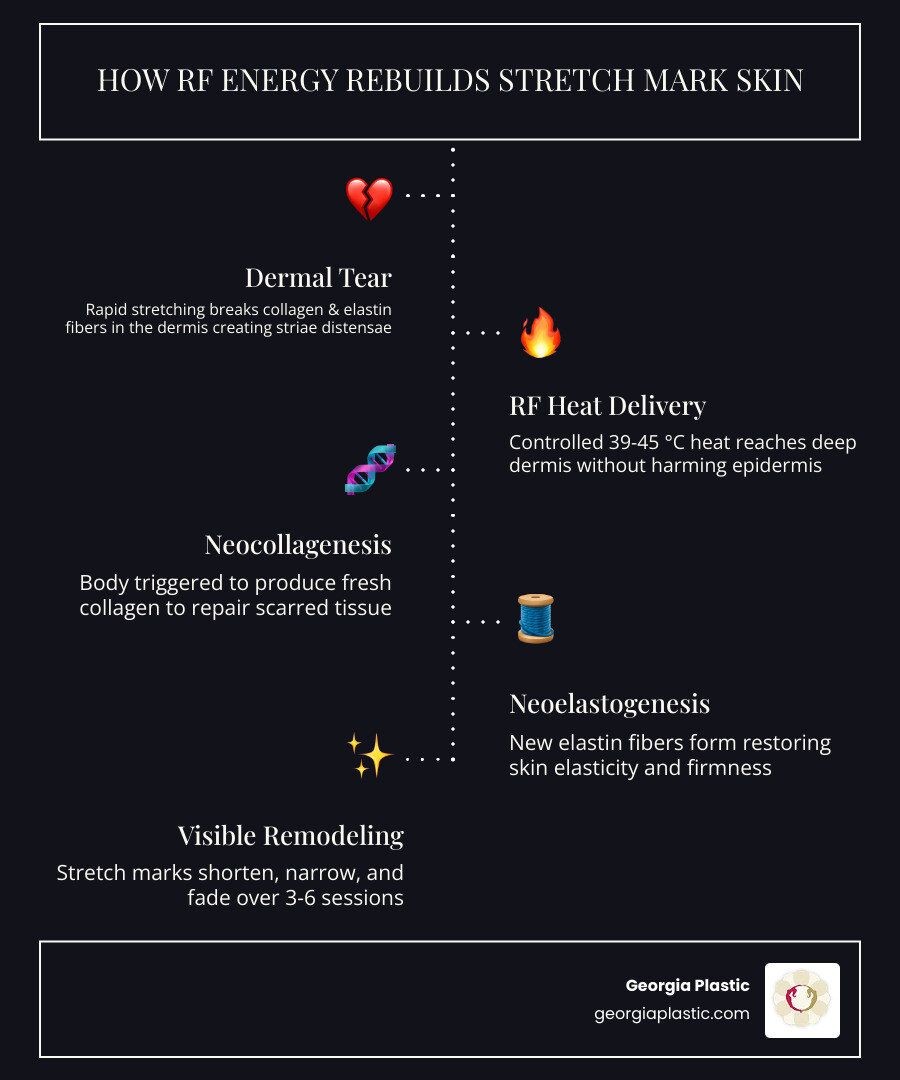
To understand why RF for stretch marks is such a game-changer, we first need to look at what is happening beneath the surface. Stretch marks, or striae distensae, are essentially atrophic dermal scars. When your body undergoes rapid growth—whether from puberty, pregnancy, or weight changes—the dermis (the middle layer of your skin) tears. This disruption breaks the “scaffolding” of your skin: collagen and elastin.
Radiofrequency (RF) energy works by delivering controlled heat into these deeper layers without damaging the surface of the skin. When the dermis is heated to a therapeutic temperature (usually between 39°C and 45°C), it triggers a biological response known as neocollagenesis and neoelastogenesis. In simpler terms, we are “tricking” your body into thinking it has a new injury, prompting it to produce fresh, high-quality collagen and elastin to repair the old, scarred tissue.
This process leads to thermal remodeling, where the skin becomes thicker, tighter, and more organized. If you are new to energy-based aesthetics, our Beginner’s Guide to RF Skin Treatment is a great place to start. For those looking for broader skin tightening benefits alongside stretch mark reduction, Quantum RF Skin Tightening offers powerful results.
How RF Microneedling Targets Striae

RF microneedling takes the power of radiofrequency and combines it with the mechanical benefits of microneedling. During the procedure, ultra-fine needles create thousands of micro-channels in the skin. As these needles reach a specific, pre-set depth, they release a burst of RF energy.
This “dual-action” approach is incredibly effective for stretch marks because:
- Direct Delivery: The needles bypass the outer layer of skin, delivering heat exactly where the stretch mark “tear” exists.
- Insulated vs. Non-Insulated Tips: Depending on your skin tone, we can use insulated needles that protect the surface from heat, significantly reducing the risk of hyperpigmentation.
- Hyaluronic Acid Stimulation: Advanced RF devices have been shown to stimulate not just collagen and elastin, but also hyaluronic acid, which helps hydrate and plump the scarred area from the inside out.
One of the most popular technologies we use for this is Morpheus8, which is famous for its ability to remodel both skin and underlying fat for a smoother, tighter appearance.
Non-Invasive RF and Pulsed Magnetic Fields
Not every patient requires needles to see results. Some of the most exciting research in May 2026 involves the combination of multipolar RF and Pulsed Electromagnetic Fields (PEMF). This technology provides homogeneous heating, meaning the heat is spread evenly across the treatment area without the need for needles.
PEMF works by stimulating the synthesis of new fibers through fibroblast activation and improving blood flow to the scarred tissue. This is a fantastic option for patients who want a completely comfortable, “hot stone massage” feel with no downtime. This technology is often utilized in treatments like ThermiSmooth Body, which is excellent for refining skin texture.
Clinical Evidence: Does RF Really Work?
We don’t just rely on “before and after” photos; we look at the hard data. Clinical evidence strongly supports the use of RF for stretch marks.
According to a two-center pilot study on RF and PEMF, researchers found:
- 87.5% of subjects noticed visible improvement in their stretch marks.
- The mean reduction in the length of striae was 1.031 cm.
- The mean reduction in width was 0.160 cm.
- 100% of participants found the treatment comfortable.
Furthermore, a clinical evaluation of fractional RF using 3D digital analysis showed an average 19.1% reduction in striae volume after just a few sessions. This study also noted significant improvements in redness (14.3% reduction) and pigmentation (11.2% reduction).
Recent research on nanofractional RF and beta-glucan has even shown that combining RF with specific topical formulations can enhance the healing of mature, white stretch marks by increasing collagen density and skin thickness.
Success Rates for Different Skin Types
One of the biggest concerns for our patients in Atlanta is whether these treatments are safe for deeper skin tones. Historically, lasers were risky for Fitzpatrick IV-VI skin types because they could cause permanent dark spots (hyperpigmentation).
However, RF for stretch marks is generally safe for all skin tones. Because RF is “color-blind” (it targets water in the tissue, not pigment), it doesn’t carry the same risks as traditional light-based lasers. By using specific protocols—such as non-insulated needles for certain cases or adjusting the pulse duration—we can safely treat diverse skin types with minimal risk. You can learn more about our approach on our Microneedling Treatments page.
Comparing RF for Stretch Marks to Other Treatments
When you’re looking to get rid of your “stripes,” you have options. But how does RF stack up?
| Feature | RF Microneedling | CO2 Laser | Topical Creams |
|---|---|---|---|
| Primary Goal | Deep dermal remodeling | Surface resurfacing | Hydration |
| Downtime | 1-2 days | 7-10 days | None |
| Skin Tone Safety | High (All types) | Moderate (Risk for dark skin) | High |
| Effectiveness | High (Proven results) | High (For surface texture) | Very Low |
| Pain Level | Low (with numbing) | Moderate to High | None |
While Fractionated CO2 Laser Resurfacing is excellent for surface wrinkles, RF often wins for stretch marks because it penetrates deeper into the dermis where the actual tear is located.
RF for Stretch Marks vs. Topical Products
Let’s be honest: we’ve all spent money on “miracle” stretch mark creams. The problem is the epidermal barrier. Your skin is designed to keep things out. Most creams simply sit on the surface, providing hydration but never reaching the damaged collagen fibers.
RF for stretch marks bypasses this barrier. By creating micro-channels and using heat, we improve blood flow and trigger actual tissue regeneration. While creams are great for Scar Management post-procedure, they are rarely enough on their own to “fix” a stretch mark.
Why RF is Superior for Older White Stretch Marks
Older stretch marks (striae alba) are notoriously difficult to treat because they are “stable” scars. They have lost their blood supply and turned white or silvery.
RF is uniquely effective here because it increases skin compactness and improves the “mismatch” in texture between the stretch mark and the surrounding skin. By stimulating melanocytes (pigment-producing cells) through deep remodeling, some studies have shown that RF can even help white stretch marks regain some of their natural color, making them blend in. For very severe cases, we might discuss Scar Revision or surgical options, but RF remains the gold standard for non-surgical improvement.
What to Expect During Your RF Treatment Journey

We want your journey to be as smooth as the skin we’re aiming for! Here is the typical “play-by-play” for an RF session:
- Preparation: We apply a high-strength topical numbing cream to the area for about 45–60 minutes. This ensures the procedure is “annoying” at worst, rather than painful.
- The Procedure: The actual RF session takes about 30–45 minutes depending on the size of the area (abdomen, thighs, or breasts). You might feel a warm, prickly sensation.
- Immediate Aftermath: The skin will be red and slightly swollen—similar to a mild sunburn. This usually resolves within 24 to 48 hours.
- Recovery: You can return to daily activities almost immediately. We just ask that you avoid direct sun exposure and harsh chemicals for a few days. Treatments like ThermiSmooth are even gentler, often having zero downtime at all.
Recommended Session Protocols
Consistency is key. You won’t see 100% of the results after one session because collagen takes time to grow.
- Initial Series: We usually recommend 3 to 4 treatments.
- Intervals: Sessions are spaced 4 to 6 weeks apart to allow the skin to heal and build new tissue.
- Results Timeline: You’ll notice texture improvements within a few weeks, but the “wow” results typically appear 3 to 6 months after your final session as collagen maturation completes.
For patients looking for more dramatic body contouring, we often combine RF treatments with BodyTite for a comprehensive “shrink-wrap” effect on the skin.
Treating Red vs. White RF for Stretch Marks
The “age” of your stretch marks matters:
- Red Stretch Marks (Striae Rubra): These are new and still inflamed. RF works quickly here by reducing vascularization and stopping the scarring process early.
- White Stretch Marks (Striae Alba): These are older and atrophic. RF focuses on “filling in” the depression by thickening the dermis and improving pigment matching.
You can see examples of how we handle different types of skin marks in our Gallery Scar Revision.
Frequently Asked Questions about RF for Stretch Marks
Is RF microneedling safe for dark skin tones?
Yes! This is one of the primary reasons we recommend RF for stretch marks at Georgia Plastic. Because the energy is delivered deep into the dermis and doesn’t target melanin, the risk of Post-Inflammatory Hyperpigmentation (PIH) is significantly lower than with traditional lasers. We use controlled heating and specific needle tips to ensure safety for all Fitzpatrick skin types.
How long do the results of RF stretch mark treatment last?
The collagen and elastin we build is yours to keep! The remodeling is essentially permanent. However, your skin will continue to age naturally. To maintain your results, we recommend a stable weight, good hydration, and occasionally a single maintenance session once a year.
Does the procedure hurt?
With our medical-grade numbing cream, most patients rate the pain as a 3 out of 10. It feels like a series of small, hot pinpricks. Afterward, you might feel a bit of “tightness” or edema (swelling), but this fades quickly.
Conclusion
At Georgia Plastic & Reconstructive Surgery, we understand that stretch marks can impact your confidence, whether they appeared after a joyful pregnancy or a hard-won weight loss journey. Under the leadership of Dr. Okoro, our team is dedicated to providing personalized care that prioritizes your safety and delivers natural-looking results.
RF for stretch marks is no longer a “maybe” — it is a scientifically backed solution that can truly transform the texture and appearance of your skin. If you’re ready to say goodbye to your stripes and hello to smoother skin, we are here to help.
Schedule your consultation for RF for stretch marks at Georgia Plastic today and let’s create a customized plan that works for you.


