
What Breast Fat Grafting Before and After Results Really Look Like
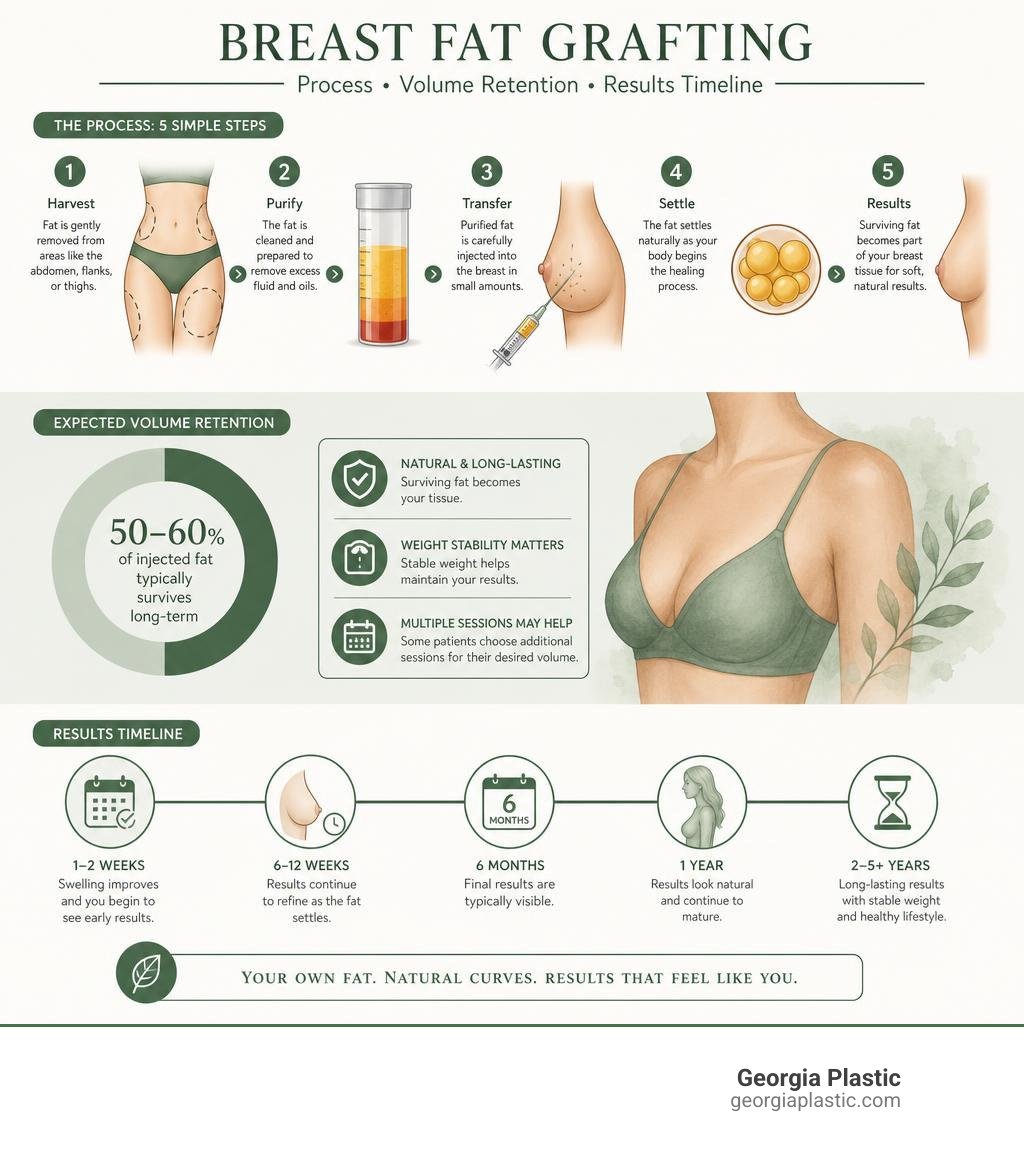
Breast fat grafting before and after photos tell a clear story: modest, natural-looking volume gains that move and feel like real breast tissue — because they are.
Here’s a quick snapshot of what most patients can expect:
| What You Want to Know | The Short Answer |
|---|---|
| How much size increase? | About 3/4 to 1 cup size per session |
| How long do results last? | 2-5+ years with stable weight |
| How much fat survives? | 50-60% of injected fat long-term |
| How much fat is typically used? | Around 200-250 cc per breast |
| When do final results show? | Around 6 months post-procedure |
| Is it safe? | Yes, using your own fat — no foreign material |
This isn’t a procedure for dramatic size changes. It’s for women who want real curves from real tissue — with no implants, no foreign materials, and results that age naturally with your body.
I’m Dr. Stanley Okoro, a double board-certified plastic surgeon and founder of Georgia Plastic and Reconstructive Surgery in Atlanta, where breast fat grafting before and after transformations are among the most rewarding outcomes I deliver for my patients. In the sections below, I’ll walk you through everything — from what the procedure actually involves to what real results look like at one year, two years, and beyond.
Understanding Breast Fat Grafting vs. Traditional Implants
When deciding how to enhance your bustline, the first fork in the road is usually choosing between autologous fat (your own natural tissue) and traditional breast implants (typically silicone or saline). Both options are fantastic, but they serve very different goals, lifestyles, and aesthetic desires.
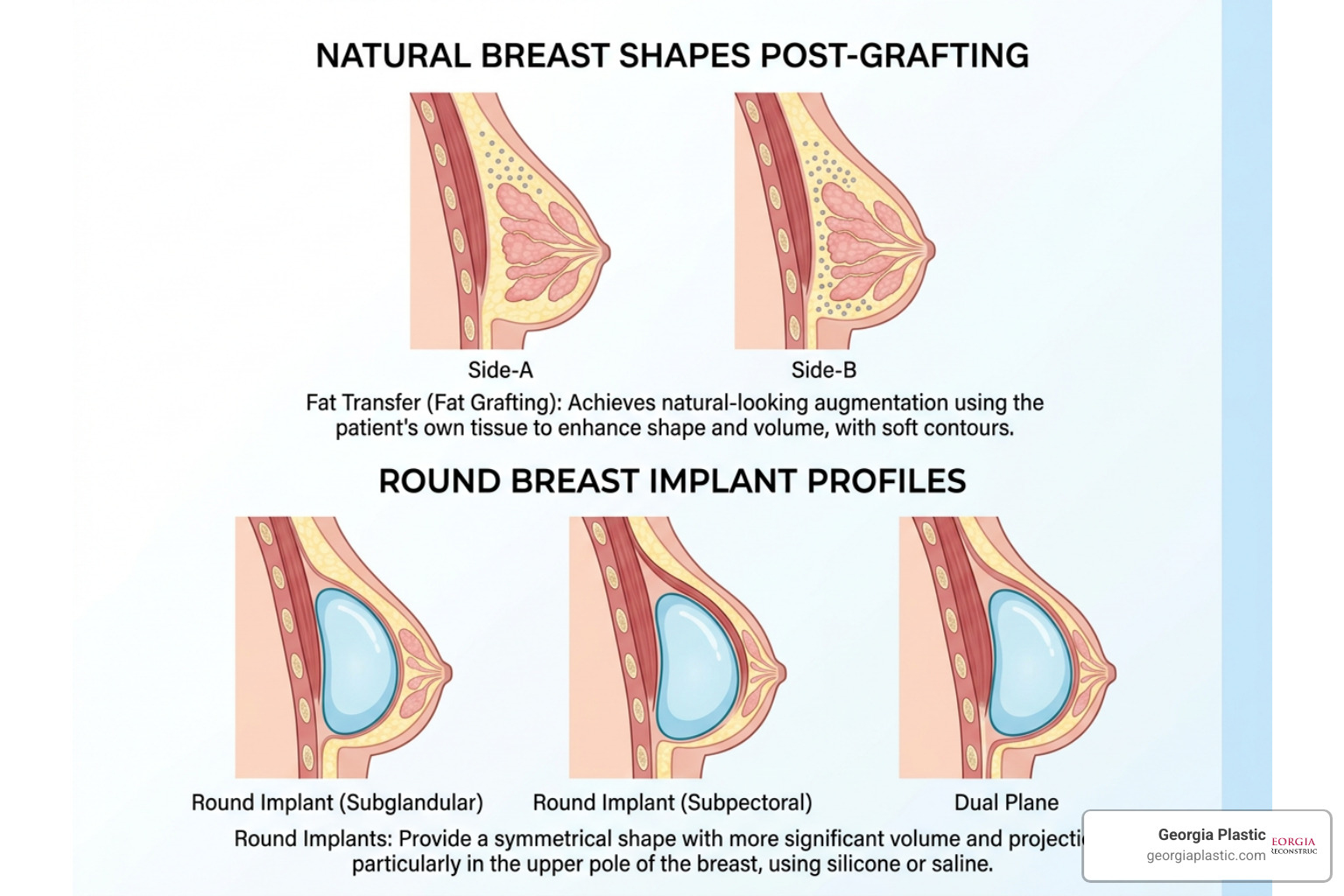
Traditional breast implants are the go-to choice if you are looking for a dramatic increase in size (two, three, or more cup sizes) or want that classic, highly structured upper-pole fullness. Implants provide a predictable shape and volume because, well, what we put in is exactly what stays there. However, implants are foreign objects. They require incisions that leave small scars, carry a small risk of capsular contracture (where scar tissue tightens around the implant), and may eventually need to be replaced or revised down the road.
On the other hand, breast fat grafting—often called natural breast augmentation—uses your body’s own excess fat to gently restore volume, improve symmetry, and soften the contours of your breasts. Because we use autologous fat, there is absolutely zero risk of your body rejecting the tissue or developing capsular contracture. Plus, you get the double benefit of body contouring: we harvest the fat using liposuction from areas where you might have a little extra to spare (like your abdomen, flanks, or thighs) and transfer it to where you want it most.
To help you visualize the differences, we have broken down the two procedures side-by-side:
| Feature | Breast Fat Grafting (Autologous Fat) | Traditional Breast Implants |
|---|---|---|
| Material Used | Your own purified fat cells | Silicone gel or Saline-filled shells |
| Volume Increase | Modest (typically 3/4 to 1 cup size per session) | Dramatic (1 to 3+ cup sizes in one surgery) |
| Look and Feel | Completely natural; moves and soft-feels like real breast tissue | Highly structured; can feel firmer or more rounded |
| Incision & Scars | Tiny pinprick punctures (under 1/4 inch) | Small surgical incisions (typically 1 to 2 inches) |
| Dual Benefit | Yes! Slims down donor areas via liposuction | No; only affects the breasts |
| Foreign Objects | None | Yes |
| Longevity | Permanent once fat cells establish blood supply | May require replacement or revision in 10-15 years |
If you are trying to weigh these options for your own body, you can Learn more about breast augmentation options to see which path aligns best with your cosmetic goals.
For those concerned about safety, you can rest easy. Extensive medical literature, including Scientific research on autologous fat transfer safety, demonstrates that fat grafting to the breast is a highly safe, effective, and oncologically sound procedure that does not increase your risk of breast cancer.
Breast Fat Grafting Before After: Real Patient Results and Expectations
When browsing through a breast fat grafting before after gallery, it is important to look at the images with an educated eye. The most striking transformations show a beautiful restoration of natural fullness, improved cleavage, and a softer, more youthful slope.
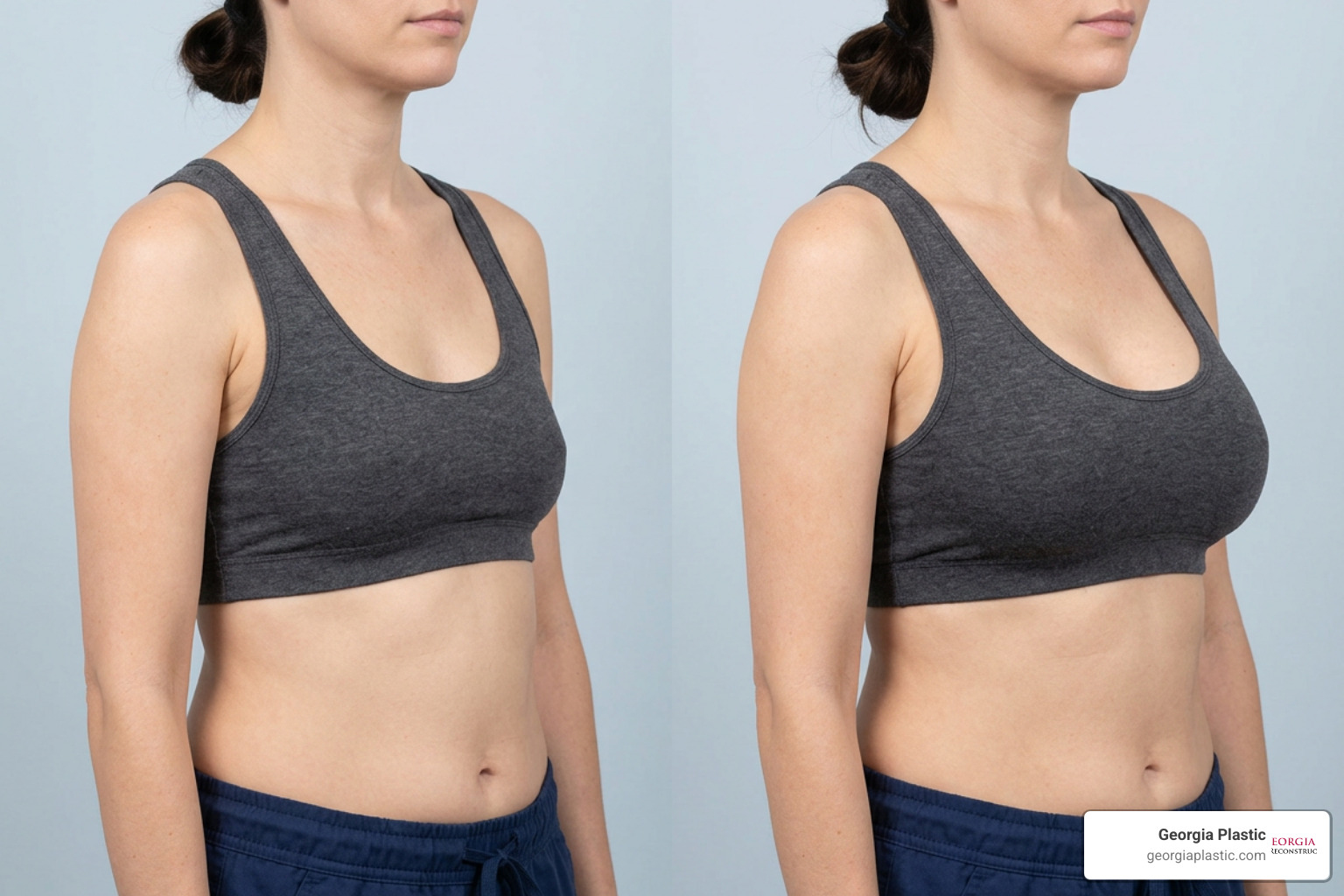
To set realistic expectations, let’s talk numbers. In a typical procedure, we inject approximately 200 to 250 cc of purified fat per breast. However, you won’t keep 100% of that volume. It is a biological reality that only about 50-60% of the transferred fat survives long-term. The remaining 40-50% is naturally and safely reabsorbed by your body within the first few months.
Because of this natural reabsorption, we slightly overfill the breasts during surgery. This means that immediately after your procedure, your breasts will look significantly larger and feel quite firm due to a combination of the extra fat and normal surgical swelling.
Here is what the timeline of your results will look like:
- Weeks 1 to 4: Swelling is at its peak. Your breasts will look beautifully full, but keep in mind that some of this is temporary fluid.
- Months 2 to 3: The swelling subsides, and your body naturally processes the fat cells that did not establish a blood supply. Your breasts may seem to “shrink” slightly during this phase—don’t panic! This is a completely normal part of the healing cycle.
- Month 6: Your results have officially stabilized. The fat cells that remain at this point have successfully integrated into your breast tissue, developed a permanent blood supply, and are there to stay.
Most patients achieve a very satisfying 3/4 to 1 cup size increase. If you are looking for a more dramatic result, the procedure can safely be repeated in a second session once the initial graft has fully healed. To see what these natural transitions look like on real women, you can View our gallery of fat grafting breast results.
The long-term durability of this procedure is well-documented. A landmark Scientific study on long-term fat graft survival confirms that the volume and shape achieved through autologous fat transfer remain stable and beautifully integrated even at multi-year follow-ups, provided the patient’s weight remains stable.
Step-by-Step: How the Procedure is Performed
How do we take fat from one part of your body and seamlessly weave it into your breasts? It is a delicate, three-step surgical art form that requires meticulous technique to ensure the highest possible fat survival rate.
Step 1: Liposuction Harvesting
The process begins with gentle liposuction. We typically target areas with stubborn, diet-resistant fat, such as the abdomen, love handles (flanks), outer thighs, or inner knees. Using specialized, low-pressure power-assisted liposuction cannulas, we gently harvest the fat. We use a gentle touch because we want to keep the harvested fat cells and their valuable stem cells completely intact and undamaged.
Step 2: Processing and Purification
Once harvested, the “raw” fat cannot simply be reinjected. It contains fluids, oil, and broken cells that must be removed. We place the harvested tissue into a specialized centrifuge or filtration system. This rapid spinning process separates the pure, highly viable living fat cells and regenerative stem cells from the unwanted fluids.
Step 3: Micro-Injection Technique
Now, the magic happens. Using tiny, blunt-tipped micro-cannulas (which require incisions so small they don’t even need stitches), we carefully inject the purified fat into the breast tissue.
We don’t just inject the fat in one large pocket. If we did, the cells in the center wouldn’t get a blood supply and would die, leading to hard lumps or fat reabsorption. Instead, we inject the fat in hundreds of tiny, microscopic droplets throughout different layers of the breast tissue. This “micro-droplet” technique ensures that every single transferred fat cell is surrounded by healthy, blood-rich tissue, giving it the absolute best chance to survive and thrive.
If you are ready to slim down your midsection and boost your bustline at the same time, you can Discover how we put your fat to good use.
Recovery Timeline and Long-Term Results
One of the greatest benefits of a natural breast augmentation is the relatively smooth and gentle recovery compared to traditional implant surgery. Because we do not cut through breast muscles or place large foreign objects behind the tissue, breast discomfort is typically very mild.
However, you are recovering from two distinct procedures: liposuction (the donor site) and fat grafting (the recipient site).
The Recovery Timeline
- Days 1 to 3: You will feel some soreness, which most patients describe as feeling like they did a very intense chest and core workout. Mild swelling and bruising will begin to peak.
- Week 1: Most patients are off all prescription pain medications and are ready to return to light desk work. You will wear a supportive, non-wired compression garment on your liposuction areas to minimize swelling and help your skin snap back into place.
- Weeks 2 to 4: Bruising on both your breasts and donor sites will mostly resolve. You can gradually increase your daily physical activity, though heavy lifting and high-impact cardio should still be avoided.
- Month 2: The majority of the donor site swelling will have diminished, allowing you to see your newly contoured waistline or thighs. Your breasts will begin to feel softer and settle into their final shape.
To ensure you get the absolute best long-term results from your breast fat grafting before after journey, we recommend following these recovery best practices:
- Protect the Grafts: Avoid putting direct pressure on your breasts for the first 2 to 3 weeks. This means absolutely no sleeping on your stomach, no tight sports bras, and no underwire bras. We want those newly transferred fat cells to rest undisturbed while they build their new blood supply!
- Wear Loose Clothing: Opt for loose, comfortable shirts and soft, wire-free bralettes that do not compress your breast tissue.
- Do Not Smoke: Nicotine severely constricts blood vessels, which can starve the newly transferred fat cells of oxygen and dramatically lower your fat survival rate.
- Maintain a Stable Weight: Transferred fat cells behave exactly like the fat cells in the rest of your body. If you lose a significant amount of weight, the fat cells in your breasts will shrink. If you gain weight, they will expand. Keeping your weight stable is key to preserving your beautiful symmetry.
For a deeper dive into what to expect as the months and years roll by, you can Read about how long fat transfer breast augmentation lasts.
Frequently Asked Questions About Breast Fat Grafting
Making the decision to undergo any cosmetic procedure comes with plenty of questions. We believe that an educated patient is a happy, confident patient. Below, we have answered some of the most common questions our Atlanta patients ask during their clinical consultations.
Who is a good candidate for breast fat grafting before after results?
To get those gorgeous, natural breast fat grafting before after results, you need to meet a few key criteria. First and foremost, you must have enough harvestable donor fat. If you are extremely lean or have a very low body mass index (BMI), you may not have the 100 to 200 cc of excess fat required for a successful transfer.
Additionally, ideal candidates should be at a stable, healthy weight, be non-smokers (or willing to quit well before and after surgery), and have realistic expectations about achieving a modest, natural volume increase rather than a dramatic size jump. To find out if this procedure is right for your unique body type, you can Check if you are a good candidate for fat transfer.
How long do breast fat grafting before after outcomes last?
Once the transferred fat cells successfully survive the initial six-month healing and integration phase, they are considered permanent. They are now a living, breathing part of your breast tissue.
However, because they are real fat cells, they will respond to your body’s natural changes. If you lose weight, they will shrink; if you gain weight, they will grow. They will also age naturally alongside you, meaning that natural skin laxity and gravity over the decades will still affect your breast shape.
Can fat transfer be combined with a breast lift?
Absolutely! In fact, combining these two procedures is incredibly common and highly effective. While a breast lift is excellent for raising sagging tissue and repositioning the nipple to a more youthful height, it does not add volume to the upper portion of the breast.
By combining a lift with fat grafting, we can restore that beautiful, youthful fullness to the upper slope of your breast without needing an implant. This combination is also a wonderful way to correct tuberous breasts, improve natural asymmetry, or even smooth out minor skin rippling from a previous breast implant surgery. To learn more about how we can lift and reshape your bustline, Explore our complete guide to breast lifts.
Conclusion
At Georgia Plastic & Reconstructive Surgery, we believe that plastic surgery should never look “done”—it should simply look like you, only refreshed, contoured, and beautifully proportioned. Led by our double board-certified plastic surgeon, Dr. Stanley Okoro, our practice is dedicated to providing highly personalized care that prioritizes your safety and delivers natural-looking results that you will love for years to come.
If you are ready to say goodbye to synthetic implants and hello to natural, soft, and beautifully contoured curves using your body’s own tissue, we are here to guide you every step of the way.
Don’t wait to feel completely confident in your own skin. Schedule your natural breast augmentation fat transfer consultation in Atlanta with us today, and let’s discuss how we can help you achieve your dream silhouette!


