
In 2024, 20.5 million non-surgical procedures were performed worldwide, compared with about 15.8 million surgical procedures in 2023, and that gap says a lot about where aesthetics has moved. Non surgical skin treatments aren't a side category anymore, they're a core part of mainstream care, especially for patients who want visible improvement without committing to an operation Madison Plastic Surgery statistics on non-surgical cosmetic procedures worldwide.

The shift is easy to understand in the exam room. People want less downtime, less disruption, and a path that lets them address early aging before they're ready for surgery. That preference has changed what patients ask for and what practices need to offer, because the modern conversation is no longer “surgery or nothing,” it's “what gives me the right result for my degree of change?”
Table of Contents
- The Rise of Non Surgical Skin Treatments
- Understanding the Major Treatment Categories
- Comparing Downtime, Cost, and Durability
- When Non Surgical Options Stop Working
- Choosing the Right Provider and Practice
- Your Consultation and Treatment Roadmap
The Rise of Non Surgical Skin Treatments
The scale of adoption is the first thing worth understanding. One review reported roughly 10.6 million non-invasive procedures globally in 2014 and more than 20.5 million in 2024, which means annual volume nearly doubled over a decade Botonics global minimally invasive procedures data. That kind of expansion does not happen unless patients keep finding these treatments useful in real life, not just appealing in theory.
The other reason is practical. Non surgical skin treatments fit modern schedules and modern risk tolerance. A patient can often come in for a focused session, return to work sooner than after an operation, and still address wrinkles, texture, laxity, or volume changes. That makes these treatments especially appealing for people in the early or middle stages of facial aging, when the goal is measurable improvement rather than major structural change.
The category has also become more technically credible. Analysts at the American Society for Dermatologic Surgery reported that neuromodulator injections reached 9,480,949 procedures, a 9% year-over-year increase, while fillers, resurfacing, laser skin treatments, and lip augmentation rounded out the leading non-surgical procedures Madison Plastic Surgery statistics on non-surgical cosmetic procedures worldwide. In plain language, injectables and skin-resurfacing technologies now anchor a large share of mainstream aesthetic care.
Practical rule: if a treatment category keeps growing for years, it usually means it is solving a real patient problem, not just selling an idea.
For patients, that matters more than trend language. A therapy earns a place in a consultation when it can reliably improve appearance with a tolerable recovery profile and a predictable safety margin. That is why many practices now use non-invasive care first for the right candidate, then move to surgery when the tissue problem has outgrown what energy devices or injectables can fix.
For readers comparing options inside a specialty practice, the non-surgical side of care is often organized alongside surgical planning, which is why this overview of non-surgical care is a useful internal reference point when you are deciding how far to push non-invasive treatment before considering a lift or revision.
The story is not that surgery is disappearing. Non surgical skin treatments have become the default starting point for many people, especially when the issue is early collagen loss, mild laxity, texture irregularity, or volume depletion rather than major descent. The important question is how long that approach remains efficient, because repeated maintenance can eventually cost more, take more time, and deliver less change than a surgical option would.
Understanding the Major Treatment Categories
A good consultation starts with mechanism, because different devices solve different problems. If you don't know what a treatment does to the skin, it's easy to chase a brand name instead of a result. The useful framework is to divide non surgical skin treatments by how they change tissue, not by how they're marketed.
Injectables and resurfacing based treatments
Injectables split into two broad groups, neuromodulators and fillers. Neuromodulators soften expression-related lines by reducing muscle activity, while fillers restore or replace volume where the face has deflated. Fillers tend to help with midface hollowing, lip shape, and contour support, while neuromodulators work best on dynamic wrinkles that form from repeated movement. For a patient who's lost volume and also has line formation, those two often complement each other instead of competing.
Laser resurfacing works differently. It uses controlled light energy to target damaged skin and encourage renewal, so it's better suited to texture, sun damage, and fine-line refinement than to true sagging. A resurfacing approach can improve surface quality, but it doesn't replace a lifted facial framework when gravity has already won. In practice, that means laser can polish, but it can't rebuild.
For readers who want a deeper procedural overview of filler-based care, the injectables resource is a practical place to compare common uses before a consultation.
If the problem is movement, neuromodulators help. If the problem is missing support, fillers help. If the problem is damaged surface quality, resurfacing helps.
Energy based tightening and regenerative treatments
Radiofrequency and ultrasound-based tightening rely on controlled dermal heating. The point is to warm deeper layers enough to denature and reorganize collagen, then trigger remodeling that can produce new collagen and elastin while leaving the epidermis intact review on non-surgical skin tightening mechanism. That's why these treatments are often used for mild laxity, jawline softening, or neck aging when surgery feels like too much.
Microneedling uses a different biology. It creates controlled micro-injury with needle lengths around 0.5 to 1.5 mm, which initiates wound healing, collagen production, and neovascularization microneedling review. It's a practical choice for acne scarring, rough texture, and mild laxity, especially when a patient wants improvement without the downtime associated with more aggressive resurfacing.
Chemical peels work by exfoliating the outer skin layers, and they're useful when dullness, uneven tone, or mild surface damage is the issue. Body-contouring devices are a separate category, but the logic is similar, they're used when a patient wants refinement rather than excision.
A useful patient resource for a laser-forward setting aimed at specific skin goals is this guide for Swiss pharmacy teams, which helps illustrate how resurfacing conversations are often framed around recovery and texture rather than dramatic lifting.
The key takeaway is that each category addresses a different layer of the problem. Injectables replace or relax. Lasers resurface. RF and ultrasound tighten. Microneedling remodels. Peels exfoliate. When a provider mixes them well, the result is usually better than relying on one device to do everything.
Comparing Downtime, Cost, and Durability
The decision that patients need help with isn't “what sounds good.” It's what they can live with repeatedly. A treatment can be effective and still be the wrong choice if the recovery, price, and maintenance schedule don't fit the rest of life.
| Treatment Type | Typical Downtime | Cost Range | Result Duration |
|---|---|---|---|
| Neuromodulators | Usually brief | Varies by area and dose | Temporary, maintenance needed |
| Fillers | Short, with possible swelling or bruising | Varies by product and area | Temporary, maintenance needed |
| Laser resurfacing | Ranges from minimal to more involved depending on depth | Varies by device and treatment area | Longer than simple topical care, but not permanent |
| Radiofrequency tightening | Usually low downtime | Varies by session and area | Gradual and maintenance-based |
| Microneedling | Short, with redness common | Varies by depth and area | Builds over time, often needs a series |
| Chemical peels | Usually brief for lighter peels | Varies by peel depth | Temporary, often repeated |
| Body-contouring devices | Usually low downtime | Varies by area and device | Often maintenance-oriented |
The table matters because durability is where the hidden cost lives. A treatment that looks affordable per visit can become expensive if it needs frequent repetition to keep pace with aging. That's especially true for treatments that improve modestly, then require ongoing maintenance to hold the line.
Maintenance burden is also emotional burden. Patients don't just pay once, they pay in appointments, planning, recovery windows, and the stress of deciding whether a next session is worth it. If a treatment only gives subtle change, the key question becomes whether those subtle gains are enough to justify the next round.
Practical takeaway: the right treatment isn't always the one with the lowest upfront price, it's the one whose maintenance plan still makes sense a year later.
For patients specifically asking how long injected volume tends to hold, the lip filler duration guide can help frame the kind of maintenance discussion that should happen before treatment, not after.
Costs also vary because expertise matters. Device selection, treatment area, and provider skill all influence what a plan ultimately feels like to a patient. A careful consultation should explain not just the first appointment, but the expected follow-up cadence and what happens if results plateau. That's the level of transparency patients deserve before they commit to a multi-session plan.
When Non Surgical Options Stop Working
The biggest mistake I see is treating non surgical skin treatments as if they're interchangeable with a lift. They're not. They're best for early intervention, texture refinement, mild laxity, and maintenance, but they reach a point where incremental improvement stops matching the effort required.
A useful warning sign is structural descent. If the brows, cheeks, jawline, or neck have dropped in a way that changes facial architecture, injectables and energy-based devices can only camouflage part of the problem. They can soften and support, but they can't reposition tissue that has descended.
The decision rule I use in practice
If a patient is asking for better skin quality, more even texture, or a modest lift in firmness, non-surgical care may still be appropriate. If the request is really about skin that feels loose enough to fold, hang, or sit low on the face and neck, the conversation should shift toward surgery. That's not failure, it's matching the tool to the anatomy.
The other limit is diminishing returns. A patient who keeps layering treatment on top of treatment, hoping for a step-change that never comes, is often paying for maintenance while expecting transformation. That's where the financial and emotional cost starts to outweigh the visible benefit.

Cleveland Clinic's overview of the non-surgical facelift space frames these treatments as temporary, low-downtime options rather than replacements for surgical lifting Cleveland Clinic non-surgical facelift overview. That's the right mental model. Use them to delay, refine, or maintain, but don't force them to do structural work that belongs in an operating room.
A candid consultation should answer three questions. Is the problem texture, volume, or descent? Can the expected change be seen clearly enough to justify the cost? And if the answer is no, is the patient better served by a surgical plan now rather than another series of temporary fixes?
Those questions protect patients from over-treatment. They also keep non-surgical care honest, which is exactly how it should be used.
Choosing the Right Provider and Practice
The device matters, but the operator matters more. A strong result depends on anatomy, skin type, treatment depth, and judgment, and those are provider decisions long before they're machine decisions. That's why patients should ask who is performing the treatment, what their experience is with the specific modality, and how they handle complications if something doesn't go as expected.
Integrated practices have a clear advantage here because they can evaluate both non-surgical and surgical paths in the same setting. Georgia Plastic & Reconstructive Surgery, for example, pairs board-certified plastic surgery care with on-site medspa services through AmaChi MedSpa, so a patient discussing skin tightening or injectables can also get a surgical opinion when the anatomy calls for it. That matters when the borderline cases are exactly the ones that need the most honest guidance.
Questions worth asking in consultation
- Who performs the treatment? Ask whether the provider has direct experience with the exact device and treatment area you need.
- What does this plan treat best? A good clinician should explain whether your concern is volume loss, laxity, texture, or a combination.
- What happens if I want more change later? The answer should include maintenance, escalation, and when surgery becomes the better option.
- What does follow-up look like? A practice should be able to describe recovery guidance, touch-up timing, and what to expect if swelling or bruising lasts longer than planned.
For patients evaluating skill standards in adjacent aesthetic services, this laser hair removal nurse guide is a useful reminder that procedure safety and results depend heavily on training, not just equipment.
A red flag is any consultation that sells a single device as the answer to every aging concern. Another is a practice that never mentions surgical alternatives even when the tissue problem is clearly beyond the reach of non-invasive care. If a provider can't tell you where the ceiling is, they probably won't help you avoid paying for it.
Georgia Plastic & Reconstructive Surgery is one of the places where non-surgical and surgical pathways can be discussed in the same visit, which helps patients compare maintenance care against a more durable correction instead of guessing in the dark. That kind of structure is useful because it turns a cosmetic decision into a medical one.
Your Consultation and Treatment Roadmap
The cleanest way to approach non surgical skin treatments is to think in phases, not impulses. Start with the problem you want to solve, then match it to a modality that fits your anatomy, schedule, and tolerance for repeat visits. If you're trying to treat mild laxity, texture changes, or early volume loss, that plan may be straightforward. If you're trying to correct a more advanced structural issue, the roadmap should include surgery as a real option, not a last resort.
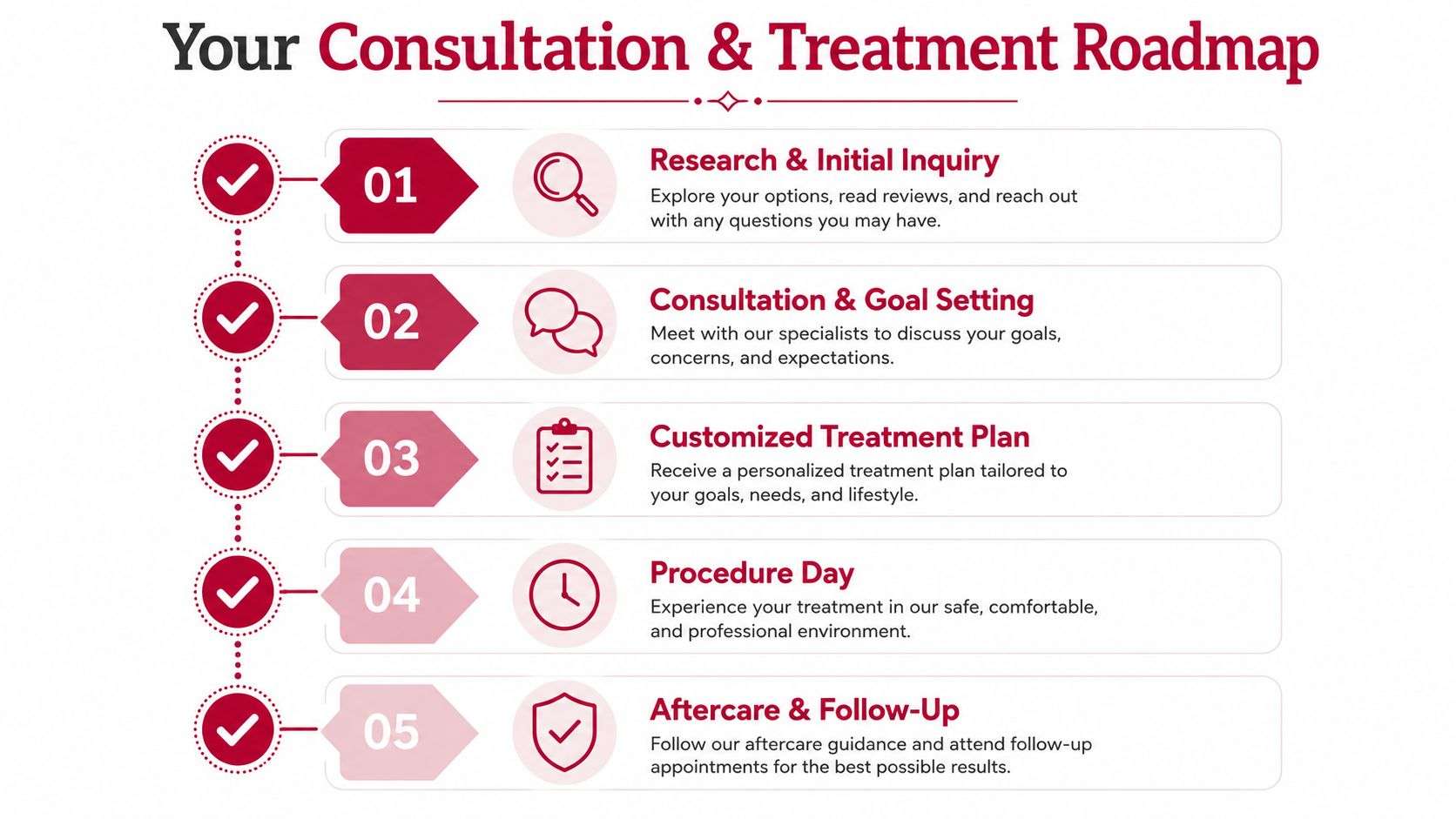
A consultation should begin with clear goals and a frank discussion of trade-offs. Bring photos if you have them, be specific about what bothers you, and ask how the plan changes if you want more dramatic improvement later. The best plans are the ones that respect both biology and budget.
What a good plan should include
- Research and initial questions. Know whether you want tightening, smoothing, contour support, or volume restoration.
- Goal setting. Decide what kind of change would feel worth it to you, not just what sounds impressive.
- Customized sequencing. Some patients need one treatment, others need a combination, especially when skin quality and support both need attention.
- Procedure day preparation. Ask what to avoid beforehand, how long the appointment takes, and what normal recovery looks like.
- Aftercare and follow-up. Understand when results should show up, when to return, and what signs mean you should call the office.
Microneedling and energy-based tightening usually improve over time rather than immediately, which means patience matters. Injectables can look faster, but they still need maintenance. That's why the smartest plan is the one that fits your real life over several months, not the one that sounds most dramatic in the moment.
If you're weighing whether to keep stacking treatments or move to a more durable solution, schedule a consultation with Georgia Plastic & Reconstructive Surgery. Their team can review non-surgical skin treatments alongside surgical alternatives, so you can make a plan that fits your goals, your downtime, and the level of change your skin needs.


