Understanding Your Path to a Youthful Neck
Neck lift recovery is a critical phase that determines the success of your surgical results and your overall satisfaction with the procedure. The journey typically unfolds over several weeks, with most patients feeling well enough to return to work after two weeks, though full healing generally takes around 4-6 weeks. Here’s what you need to know:
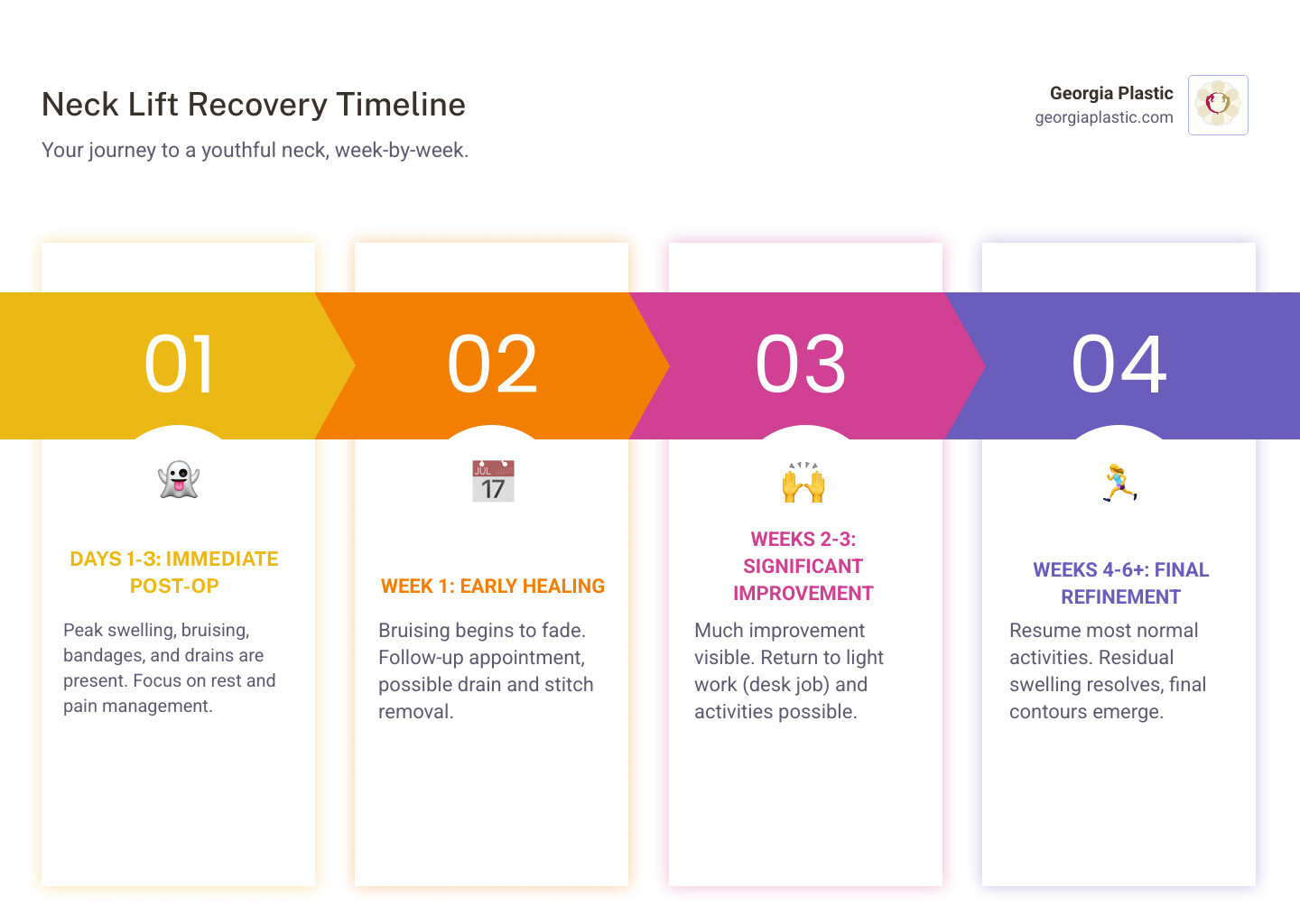
Key Recovery Milestones:
- Days 1-3: Peak swelling and bruising, bandages in place, drains possibly present
- Week 1: Bruising begins to fade, follow-up appointment, possible drain/stitch removal
- Weeks 2-3: Significant improvement visible, return to light work possible
- Weeks 4-6: Resumption of normal activities, continued refinement of results
- Months 3-6: Residual swelling resolves, final contours emerge
Understanding this timeline helps you prepare mentally and physically for what lies ahead. While the first few days involve managing discomfort, tightness, and visible bruising, the recovery process becomes progressively easier. Most people notice that pain, swelling, and bruising resolve within two weeks, and the new contours of the neck start to become visible.
One crucial detail often surprises patients: do not apply ice to your neck after surgery. This can compromise blood flow and result in skin death—a serious complication that’s entirely preventable with proper aftercare.
Your recovery experience will be unique, influenced by factors like the extent of your surgery, your overall health, whether you combined procedures, and how closely you follow post-operative instructions. Some patients feel comfortable working from home after just one week, while others need the full two weeks before resuming professional activities.
As Dr. Stanley Okoro, a double board-certified plastic surgeon specializing in facial rejuvenation, I’ve guided countless patients through neck lift recovery with a focus on safety, realistic expectations, and exceptional outcomes. My approach combines surgical precision with comprehensive aftercare support to ensure your journey is as smooth as possible.
Your Detailed Neck Lift Recovery Timeline
Starting on a neck lift recovery journey means understanding that healing is a process, not an event. It unfolds in distinct phases, each with its own set of expectations and care requirements. Our goal is to equip you with the knowledge to steer each stage confidently, from the immediate aftermath of surgery to the emergence of your beautiful, refined results.
The First 24-48 Hours: Immediate Post-Op Care
The first couple of days are often the most intense phase of neck lift recovery. Immediately after your procedure, a soft compression bandage will be gently placed around your face and neck. This is essential for minimizing swelling and bruising, and it helps to support the newly sculpted contours of your neck. In some cases, a thin drainage tube might also be present to collect any excess fluid or blood, further aiding in reducing swelling. Our team will provide you with specific instructions on how to care for the surgical site and manage these drains, if applicable.
You can expect to feel a sensation of tightness, fullness, and possibly some discomfort in your neck and jawline. Many patients describe this as pressure rather than sharp pain. We will prescribe pain medication to help manage this, typically for the first 3-5 days. It’s crucial to take these medications exactly as directed.
A cornerstone of early neck lift recovery is keeping your head liftd above your heart at all times, even when sleeping. This significantly helps in minimizing swelling. We recommend sleeping with your head liftd on 2-3 pillows, or at a 30- to 45-degree angle. Maintaining a neutral neck position, avoiding excessive twisting or bending, is also vital to prevent strain on the healing tissues.
Rest is paramount during this initial period. While you should avoid strenuous activity, gentle ambulation – light walking for 10 minutes every two hours – is encouraged to promote circulation and prevent complications like blood clots. You’ll need a trusted friend or family member to act as a support system during these first 24 hours, assisting with daily tasks and ensuring your well-being. They can also help monitor for any unexpected changes. For more detailed insights into what to expect, the American Society of Plastic Surgeons offers valuable information on Neck Lift Recovery: What to Expect.
The First Week (Days 3-7): Managing Discomfort and Early Healing
As you move beyond the initial 48 hours, the peak of swelling and bruising usually occurs during days 1-3, but you’ll start to notice subtle improvements. The bruising, while still visible, should begin to fade over these next few days, often transitioning from purplish to greenish-yellow. Your neck will still feel tight and possibly firm, a normal part of the healing process as tissues start to adhere in their new positions.
Around 5-7 days after your surgery, you will have your first post-operative visit with our team. This is an important milestone in your neck lift recovery. During this appointment, we will assess your healing progress, remove any drains if they were placed, and typically remove your stitches. We’ll also provide further guidance on wound care, which usually involves cleaning incisions gently with a Q-tip and water twice daily for the first 24-36 hours after your dressing is removed. You can usually shower or bathe the day after your operation, but be gentle around the incision sites.
During this week, limited mobility is still recommended. Continue to prioritize rest, but keep up with your light walking to maintain circulation. If you experience tightness when swallowing, sticking to a soft food diet for the first few days can be helpful. Patience is key as your body diligently works to heal itself.
Weeks 2-4: Returning to Normalcy

By the second and third week of your neck lift recovery, you’ll likely feel a significant shift. The most noticeable bruising should have largely faded, and a good portion of the initial swelling will have subsided. Most of our patients feel considerably more presentable and comfortable enough to resume light social activities.
Many individuals with desk jobs find they are well enough to return to work after two weeks, and some can even work from home after the first week. However, if your job involves physical exertion, we recommend a longer period of rest. During this time, you can also typically resume applying makeup, though it’s crucial to avoid applying it directly to any healing incision sites.
Light activities can be gradually reintroduced into your routine. This might include longer walks or gentle lower-body exercises. However, continue avoiding heavy lifting (anything over 10 pounds), strenuous exercise, or any activity that significantly raises your blood pressure or strains your neck. Your neck may still feel somewhat firm or “wooden” to the touch, and some numbness or altered sensation is common as nerves regenerate. These sensations will gradually improve over the coming months. For more information on how a neck lift contributes to a refreshed look, explore our insights on facial rejuvenation.
Month 1 to 6: Seeing Your Final Results Emerge
This phase of neck lift recovery is where the magic truly unfolds, as your initial improvements give way to the refined, long-lasting results you anticipated. While significant changes are visible within the first month, residual swelling can linger for up to three months, and sometimes even longer. As this swelling fully subsides, the final contours of your neck and jawline will become increasingly apparent.
The tightness and numbness you experienced earlier will also gradually resolve during this period. While some sensations might persist for several months, most patients report a return to normal feeling. Our team monitors your progress closely during follow-up appointments, providing reassurance and guidance.
Scar maturation is also a key aspect of this stage. Initially, your incision lines will be pink and firm, especially for the first six weeks. Over the next 6-12 months, they will continue to fade, soften, and flatten, becoming much less noticeable. We’ll discuss scar management techniques to optimize this process.
By the end of six months, you should be enjoying the full benefits of your neck lift. The results are designed to be long-lasting, providing a more youthful and defined profile for years to come. To maintain these results, consistent sun protection is vital. We recommend applying an SPF 30+ sunscreen to exposed skin daily, especially avoiding direct sun exposure between 10 AM and 3 PM for at least six weeks post-surgery.
Essential Aftercare for a Smooth Neck Lift Recovery
A successful neck lift recovery isn’t just about the surgeon’s skill; it’s a partnership that heavily relies on your diligent aftercare. Following our specific instructions is paramount for minimizing complications, ensuring proper healing, and achieving the best possible aesthetic outcome. Think of it as protecting your investment in yourself!
Wound Care, Drains, and Compression Garments
Proper care of your surgical sites is non-negotiable. We’ll provide detailed instructions on incision cleaning, which typically involves gentle cleansing with a Q-tip and water. Avoid applying any ointments or creams unless specifically instructed by our team. If you have drains, we’ll guide you on how to manage them, including how to empty them and monitor fluid output. They are usually removed within a few days.
A crucial component of neck lift recovery is the compression garment, often a chin strap. This garment plays a vital role in reducing swelling, providing support to the healing tissues, and helping your skin redrape smoothly over your new contours. We typically recommend wearing this continuously for the first week, and then nightly for the subsequent three weeks. Adherence to this schedule is critical for optimal results.
When it comes to clothing, simplicity is your friend. We advise wearing loose-fitting, button-up shirts or tops with wide neck openings. This prevents you from having to pull clothing over your head, which can tug on your incisions and cause discomfort or even compromise your results.
Managing Swelling and Tightness (The Right Way)
Swelling (edema) is a normal and expected part of neck lift recovery. Our primary strategy for managing it is consistent head elevation. By keeping your head above your heart, you allow gravity to assist in fluid drainage, significantly reducing swelling. As mentioned earlier, sleeping with your head liftd on 2-3 pillows, or at a 30- to 45-degree angle, is essential for several weeks.
Now, for a crucial warning that we cannot stress enough: DO NOT APPLY ICE DIRECTLY TO YOUR NECK AFTER SURGERY. While ice is often recommended for general swelling, the delicate tissues of the neck, particularly after a neck lift, are highly susceptible to compromised blood flow. Applying ice can constrict blood vessels, reduce circulation, and potentially lead to serious complications like skin death (necrosis). Instead, if you wish to apply cold, use cool compresses gently on your cheeks, not directly on your neck incisions, for 20 minutes each hour during the first 12-24 hours.
The sensation of tightness, fullness, and even some numbness is also a normal part of neck lift recovery. This occurs as the skin and underlying muscles (like the platysma) have been tightened and repositioned. You might experience a “pulling” feeling, especially when turning your head or opening your mouth wide. This tightness can sometimes affect swallowing, making soft foods more comfortable initially. These sensations will gradually subside as your body heals and adapts to its new contours, typically improving over two to three months.
Activity and Exercise Restrictions
During neck lift recovery, protecting your healing tissues from strain is paramount. We provide a clear set of guidelines to ensure you don’t inadvertently jeopardize your results:
- No heavy lifting: For at least the first two weeks, and ideally up to 4-6 weeks, avoid lifting, pushing, or pulling anything over 10 pounds. This includes groceries, laundry baskets, or small children.
- No strenuous exercise: Any activity that significantly raises your blood pressure or causes you to strain should be avoided for the first 3-6 weeks. This means no jogging, running, cycling, swimming, or high-impact workouts.
- No bending over: Avoid movements where your head is lower than your heart, as this can increase blood pressure in the surgical area and exacerbate swelling or bleeding.
- No excessive neck twisting or abrupt movements: Keep your head in a neutral, straight position as much as possible to prevent strain on the healing muscles and incisions.
While these restrictions might sound daunting, light walking is encouraged from day one to promote circulation. As your neck lift recovery progresses, we’ll guide you through a gradual return to exercise. Gentle lower-body exercises might be cleared around week two, followed by upper-body and core work (avoiding neck flexion) at three to four weeks. Most patients can resume their full workout routines by 4-6 weeks, but always await our clearance. For those interested in understanding how these restrictions compare to other facial procedures, you can find more information about facelift surgery.
Diet, Hydration, and Scar Management
What you put into your body significantly impacts your neck lift recovery. Proper nutrition and hydration are not just good for general health; they are critical for optimal healing.
Hydration: Aim to drink at least eight glasses of water daily. For the first few days, we recommend consuming at least 8 ounces of non-carbonated, non-alcoholic, caffeine-free fluids every two hours. Staying well-hydrated helps your body flush out toxins and reduce swelling.
Diet: Focus on a nutrient-rich diet packed with lean proteins, fresh fruits, and vegetables. These provide the essential building blocks for tissue repair. Specific nutrients like Vitamin C and Omega-3 fatty acids are particularly beneficial for wound healing and reducing inflammation. A low-sodium diet is also advisable to prevent fluid retention and minimize swelling. If you experience tightness when swallowing, starting with a soft, bland, and nutritious diet for the first 24-48 hours can be helpful. Also, be mindful of constipation, which can be a side effect of pain medication; increasing fluids and fiber, and having a stool softener on hand, can alleviate this. For a comprehensive overview of the procedure and recovery, the Cleveland Clinic offers detailed information on Neck Lift (Platysmaplasty): Surgery, Recovery & What to Expect.
Scar Management: While we carefully place incisions in discreet locations (under the chin and around the ears) to minimize visibility, some scarring is inevitable. During neck lift recovery, scars will initially be firm and pink for about six weeks. Over the next 6-12 months, they will gradually fade, flatten, and blend with your skin tone. To optimize scar healing, we often recommend silicone gel or sheets once the incisions are fully closed and healed. Strict sun protection is also crucial for scars; direct sunlight can cause them to darken and become more noticeable. Apply an SPF 30+ sunscreen to your scars every day, and avoid prolonged sun exposure for at least six weeks post-surgery.
Neck Lift vs. Other Procedures: How Recovery Compares
Understanding the nuances of neck lift recovery in comparison to other cosmetic procedures can help set realistic expectations and inform your decision-making process. While many facial rejuvenation surgeries share common recovery elements, there are distinct differences.
Neck Lift vs. Facelift Recovery
A neck lift (platysmaplasty) and a facelift (rhytidectomy) are often performed together, but their primary focus areas and, consequently, their recovery experiences have some differences.
| Feature | Neck Lift Recovery | Facelift Recovery | Combined Procedure Recovery |
|---|---|---|---|
| Primary Area | Platysma muscle, under-chin, jawline, and upper neck. | Cheeks, temples, midface, and often the SMAS (Superficial Musculoaponeurotic System). | Comprehensive lower face and neck rejuvenation. |
| Incision Locations | Small incision under the chin; around the ears and possibly into the hairline. | Arcing around the ears, extending into the hairline and/or temples. | Combination of both, often around ears, hairline, and under chin. |
| Areas of Swelling | Primarily under the chin, along the jawline, and upper neck. | More widespread swelling in the midface, cheeks, and around the ears. | More extensive swelling across the entire lower face and neck. |
| Numbness Patterns | Common in the neck and under the chin. | More common in the midface, cheeks, and around the ears. | Broader areas of numbness, often including midface, ears, and neck. |
| Sensation of Tightness | Often described as a “pulling” feeling in the neck, sometimes affecting swallowing. | More generalized tightness in the midface, cheeks, and around the ears. | Significant tightness throughout the lower face and neck. |
| Recovery Timeline | Similar: light activity 1-2 days, desk work 7-15 days, exercise 4-6 weeks. | Similar: light activity 1-2 days, desk work 10-14 days, exercise 4-6 weeks. | May be slightly extended due to the increased scope of surgery. |
While the timelines for initial healing (light walking, returning to desk work, resuming exercise) are broadly similar for both procedures, the specific areas of discomfort and sensation can differ. A neck lift might leave you feeling tightness with swallowing, while a facelift might bring more temporary numbness in the cheeks or around the ears. When combined, the recovery period might be slightly extended due to the more extensive surgical work, but the foundational principles of aftercare remain the same: head elevation, cold compresses, meticulous incision hygiene, and strict avoidance of nicotine. For more on the transformative effects of a facelift, visit What Does a Facelift Do and How Can It Transform?.
Surgical vs. Non-Surgical Neck Rejuvenation Recovery
When considering options for a more youthful neck, it’s important to understand the differences in recovery between surgical and non-surgical approaches.
Surgical Neck Lift: A surgical neck lift offers the most dramatic and long-lasting results by physically removing excess skin and fat, and tightening underlying muscles. This is a true “one-and-done” solution for many, with results that can last for years. However, this comes with a more significant neck lift recovery period, involving downtime, swelling, bruising, and activity restrictions as outlined in this guide. While the initial recovery requires dedication, the enduring change is often well worth the effort for those seeking comprehensive rejuvenation.
Non-Surgical Alternatives: For individuals with mild to moderate signs of aging, or those not ready for surgery, several non-surgical options exist:
- Botox (Botulinum Toxin Injections): Can relax neck bands (platysmal bands) for a smoother appearance. Recovery is minimal, usually just minor redness or bruising at injection sites, lasting hours to a few days. Results are temporary, lasting 3-4 months.
- Dermal Fillers: Can be used to improve jawline definition or fill in certain neck lines. Recovery is typically minor swelling or bruising, resolving within a few days. Results last 6-18 months.
- Ultherapy: Uses ultrasound energy to lift and tighten skin by stimulating collagen production. There’s usually no downtime, with mild redness or swelling for a few hours. Results appear gradually over 2-3 months and can last up to a year or more.
- Deoxycholic Acid Injections (e.g., Kybella): Targets and destroys fat cells under the chin. Swelling and numbness can be significant for 1-2 weeks, and multiple sessions are often needed.
- Fractionated Laser Treatments: Improve skin texture and tone. Downtime varies from a few days to a week, depending on the laser intensity.
The key difference in recovery is the trade-off between invasiveness, downtime, and longevity of results. Non-surgical options generally have minimal to no downtime, allowing for an immediate return to daily activities. However, their results are temporary, require repeat treatments, and are less dramatic than a surgical neck lift. A surgical neck lift, while requiring a dedicated neck lift recovery period, provides a more profound and enduring change. To explore non-surgical lifting solutions like Ultherapy, you can read more here: Ultherapy Your Non-Surgical Lifting Solution.
Frequently Asked Questions about Neck Lift Recovery
We understand you likely have many questions about neck lift recovery. Here, we address some of the most common concerns to provide clarity and peace of mind.
How painful is a neck lift recovery?
Most patients describe neck lift recovery as uncomfortable rather than severely painful. The primary sensations are tightness, fullness, and a feeling of pulling in the neck muscles, especially as the tissues heal and settle into their new positions. Swelling and bruising are most intense during the first 48-72 hours, then steadily improve over one to two weeks.
We will provide prescription pain medication to manage discomfort during the initial 3-5 days. After this, over-the-counter pain relievers are usually sufficient. The feeling of tightness is normal and will gradually subside over several weeks to months as your body adapts. Keeping your head liftd, using cool compresses (on cheeks, not neck), and avoiding strenuous activity are excellent ways to minimize discomfort.
When can I drive and return to work?
The timing for resuming driving and returning to work during neck lift recovery depends on several factors, including your individual healing rate and the nature of your activities.
Driving: You should not drive while taking prescription pain medication, as it can impair your judgment and reaction time. Additionally, you need to be able to turn your head comfortably and without pain to safely operate a vehicle. For most patients, this means refraining from driving for at least the first week, often 1-2 weeks, after surgery. Always consult with us before getting back behind the wheel.
Returning to Work: For those with desk jobs or roles that don’t require physical exertion, working from home may be possible after the first week. However, most people feel well enough to return to the office after two weeks. If your job involves heavy lifting, strenuous activity, or significant head/neck movement, you may need to take off 3-4 weeks, or even longer, to ensure a safe and complete neck lift recovery.
What are the signs of a complication I should watch for?
While complications are rare, it’s crucial to be aware of the signs that warrant immediate attention during your neck lift recovery. Your safety is our top priority, and knowing when to contact us can make all the difference.
Contact your surgeon immediately if you experience any of the following:
- Signs of Infection: This includes a fever over 101ºF, chills, excessive pain that is not managed by your prescribed medication, pus or any unusual discharge from the incision sites, or bright redness that is hot to the touch at the surgical area.
- Hematoma: A sudden, significant, and often painful swelling that appears rapidly on one side of the neck could indicate a hematoma (a collection of blood under the skin). This requires prompt medical evaluation.
- Excessive Bleeding: While some minor oozing is normal, profuse or uncontrolled bleeding is a serious concern.
- Persistent Nausea/Vomiting: If you experience severe, continuous nausea and vomiting, especially if it leads to dehydration.
- Neurological Changes: Continued dizziness, incoherent behavior, or hallucinations are serious and require immediate attention.
- Sudden, Sharp Pain: Any sudden onset of sharp, intense pain that was not previously present or is not responsive to medication.
- Deep Vein Thrombosis (DVT) Symptoms: Swelling or tenderness in your legs or calves, which could indicate a blood clot.
Call 911 immediately for:
- Loss of consciousness
- Shortness of breath or difficulty breathing
- Acute chest pain
We will provide you with specific contact information and instructions for emergencies. Never hesitate to reach out if you have any concerns during your neck lift recovery.
Achieve Your Rejuvenation Goals
A successful neck lift recovery is a partnership between your surgeon’s skill and your diligent aftercare. By following these guidelines, you can steer your healing journey smoothly and enjoy a more youthful, defined neck contour for years to come. The team at Georgia Plastic & Reconstructive Surgery is committed to providing personalized care throughout your entire experience. Learn more about your facial rejuvenation options.