You've probably seen the pattern: a smooth abdomen, a sharply defined waist, or a cleaner jawline in a carefully posed photo, followed by the question, “Could my result look like that?” Then you find out the image was taken at an undisclosed point in recovery, under controlled lighting, with no explanation of the patient's starting anatomy or surgical plan.
That missing context matters. Liposuction before and after photos show a change in contour, not the entire surgical experience. The most useful gallery doesn't display a smaller silhouette. It explains candidacy, treatment areas, technique, healing time, skin quality, and the limitations that shaped the final result.
Table of Contents
- Walking Through Real Liposuction Before and After Cases
- What Before and After Really Means in Liposuction
- Who Makes a Good Candidate for Visible Results
- How Technique Choice Shapes the After Photo
- Abdomen and Flank Cases and What the Healing Timeline Looks Like
- Thighs Arms and Chin Cases With Smaller Area Changes
- When the After Photo Is Not as Smooth as Expected
- How to Evaluate Your Own Liposuction Before and After
Walking Through Real Liposuction Before and After Cases
Maria, 38, came to consultation after seeing a friend's six-week post-op photograph. Her friend's waist looked dramatically smaller, and Maria assumed the image showed the finished result. During the consultation, she learned that the photo still showed swelling, the compression garment had influenced the outline, and the contour would continue settling for months.
That misunderstanding is common. A photograph taken during early healing can look both encouraging and misleading. It may show a meaningful reduction in volume while still concealing firmness, residual swelling, bruising, numbness, or small areas of unevenness.

What each case should disclose
A useful case walk-through should include nine to twelve carefully selected examples spanning the abdomen, flanks, thighs, arms, and submental area. Each photo pair should be accompanied by a caption block that identifies:
- Starting body context: The patient's starting BMI range and relevant anatomy.
- Technique: Whether the surgeon used suction-assisted liposuction, power-assisted liposuction, laser-assisted treatment, radiofrequency-assisted treatment, or awake tumescent liposuction.
- Treatment scope: The number of areas treated, including whether the case involved a combined procedure.
- Healing interval: The time between the before and after images, rather than a vague label such as “after surgery.”
The cases should be organized by body region because the visible result differs substantially between an abdomen, an inner thigh, an upper arm, and a neck. Abdominal contouring is judged largely by the waist transition and front profile. Chin treatment is judged by the jawline-to-neck angle. Arm treatment often depends more on skin drape and triceps definition than on a dramatic change in overall size.
Practical rule: A before-and-after pair is most informative when it teaches you what decision produced the visible change.
Standardized lighting, posture, camera distance, and photographic angles matter. Garment-free images should be used wherever the patient has consented, because compression can temporarily smooth the surface and obscure the untreated boundaries. A reputable before-and-after photo gallery should help you compare like with like, not make you guess which variables changed between photographs.
What Before and After Really Means in Liposuction
A good liposuction result isn't defined by the number on a scale. Liposuction is a contouring procedure. Its purpose is to reduce selected fat pockets and improve proportion, such as creating a flatter lower abdomen, a smoother waist transition, a less prominent bra-line bulge, or a clearer angle between the jaw and neck.
The visible result is better understood as a contour delta, the difference between two comparable silhouettes. That delta may be subtle from the front and more apparent from the side. It may show as a smoother curve rather than a smaller measurement. A large prospective outcome study of 360 liposuction and body-contouring patients found substantial patient-reported benefit after liposuction alone, including improved self-esteem reported by 85.8%, improved quality of life reported by 69.6%, and overall satisfaction of 88.8% (prospective liposuction and body-contouring outcomes).
What the camera captures
Photography is strong at showing:
- Silhouette: The outward projection of the abdomen, hips, thighs, arms, or neck.
- Proportion: How the treated area relates to adjacent untreated areas.
- Surface shadows: Changes in the way light moves across a contour.
- Symmetry: Differences between the right and left sides when the angles are matched.
Photography can't show tissue quality, internal scarring, muscle tone beneath the fat layer, sensation, or the patient's actual weight. It also can't tell you whether the skin will continue retracting or whether firmness at an early follow-up is temporary.
Marketing galleries may exaggerate the contour delta through angled lighting, a sucked-in posture, selective clothing, or a compression garment. Judge a case only when the before and after images use the same posture, lighting, camera angle, and stated recovery point.
Who Makes a Good Candidate for Visible Results
The most dramatic photo changes usually begin with localized fat and reasonably elastic skin, not a higher amount of removable fat. During consultation, the surgeon evaluates whether the skin can retract after the underlying fat is reduced. Skin with good recoil can settle over the new contour. Skin with marked laxity, extensive stretch marks, or poor tone may remain loose or develop more visible folds after fat removal.
Fat distribution also affects the photograph. A patient with a few concentrated pockets often produces a crisper before-and-after transition than someone with diffuse adiposity across the entire trunk. Removing fat from one zone can also make an untreated adjacent zone appear more prominent, so the surgical plan must account for the full silhouette rather than one isolated pocket.
A stable weight history is useful because ongoing weight change makes it difficult to judge what surgery accomplished. Muscle tone matters, too. Liposuction can uncover an existing abdominal or triceps contour, but it won't create muscle beneath the treated layer.
Candidacy factors that shape the after photo
| Factor | Favorable for visible result | Reduces visible result |
|---|---|---|
| Skin quality | Firm skin with useful elastic recoil | Laxity, stretch marks, or thin, poorly retracting skin |
| Fat pattern | Localized pockets with clear boundaries | Diffuse fullness across several untreated zones |
| Weight status | Stable weight and realistic contour goals | Ongoing weight fluctuation or expectations of major weight loss |
| Muscle foundation | Existing tone beneath the fat layer | Limited underlying definition |
| Medical readiness | Good general health and ability to follow recovery instructions | Conditions, medications, or habits that increase healing risk |
| Surgical history | Minimal distortion of the treatment plane | Prior operations or scarring that alter tissue mobility |
| Nicotine use | No current smoking or nicotine exposure | Continued nicotine use, which can impair healing |
| Lymphatic health | Normal fluid movement and manageable swelling | Lymphatic conditions that can prolong edema or change contour |
BMI can be one screening reference, but it shouldn't replace an examination. A surgeon also needs to assess the skin envelope, fat texture, asymmetry, prior pregnancies or weight changes, and whether a lift or abdominal repair would address the actual problem more effectively than liposuction alone.
How Technique Choice Shapes the After Photo
Technique affects more than the equipment used in the operating room. It can influence how the surgeon accesses dense fat, how carefully the transition zones are blended, how the skin responds, and how the treated area appears during healing.
Modern tumescent liposuction has its historical foundation in the technique introduced by dermatologist Jeffrey A. Klein in 1987. A later patient survey of tumescent liposuction reported that about 85% of patients were mostly or completely satisfied, while about 40% described positive effects on social life, about 91% on body feeling, and 57% on attractiveness (survey of tumescent liposuction outcomes). Those findings help explain why patient-reported improvement shouldn't be reduced to the width of a waist in a photograph.
Reading the visible signature
| Technique | Visible change in after photo | Best for | Healing signature |
|---|---|---|---|
| Traditional suction-assisted liposuction | Broad volume reduction and smoother curves | Larger abdominal, flank, or thigh fat pockets | Swelling and firmness can temporarily blur the contour |
| Power-assisted liposuction | Efficient removal with controlled contour refinement | Areas requiring repeated, consistent cannula movement | Bruising and edema follow the treated field |
| Laser-assisted liposuction | Fat reduction with a possible skin-quality contribution | Selected areas with mild laxity and appropriate skin response | Surface refinement may develop gradually as swelling settles |
| Radiofrequency-assisted treatment | Fat reduction paired with tissue coagulation and tightening intent | Mild laxity where skin drape is part of the concern | Firmness can persist while the skin and deeper tissues settle |
| Awake tumescent liposuction | More limited-volume contouring with active positioning feedback | Focused pockets and patients suited to local anesthesia | Smaller treatment scope doesn't eliminate swelling or uneven early texture |
Device choice shouldn't be treated as a guarantee of superior photographs. A 2026 systematic review of liposuction-assisted technologies found no substantial evidence that technology-assisted liposuction is superior to traditional liposuction or that endolaser clearly improves skin tightening (systematic review of liposuction-assisted technologies). Candidate selection, surgeon judgment, cannula control, blending, and follow-up care often matter more than the label on the device.
Abdomen and Flank Cases and What the Healing Timeline Looks Like
Consider two abdominal cases with a similar starting profile. In the first, the patient has a concentrated lower-abdominal pocket and good skin recoil. The after image shows a flatter front profile and a cleaner transition into the pubic area. In the second, the patient has loose skin and abdominal wall laxity after pregnancy. Liposuction may improve the fat layer, but a mini tummy tuck or another form of skin excision may be needed to produce a tighter lower abdomen.
Incisions are commonly placed near the umbilicus, within the pubic hairline, or in flank creases. Their visibility depends on healing and placement, but the cannula pattern across the treatment field often has a greater effect on the smoothness of the contour. Broad, controlled passes and careful blending help prevent a visible ledge between treated and untreated areas.

Why early photographs mislead
Compression garments support the early contour while swelling resolves. Abdominal and flank patients are often instructed to wear them full-time for four to six weeks, followed by part-time use for another two to four weeks, according to the surgical plan. The garment can make an early photograph look smoother than the uncovered tissue will appear at that moment.
The usual visual progression is uneven rather than linear:
- First week: Swelling, bruising, drainage, and compression dominate the image.
- Weeks two to three: Bruising improves, but firmness and residual edema remain.
- Weeks four to six: The first clearer silhouette change becomes easier to assess.
- Months three to six: Swelling continues to resolve and the final contour becomes more reliable.
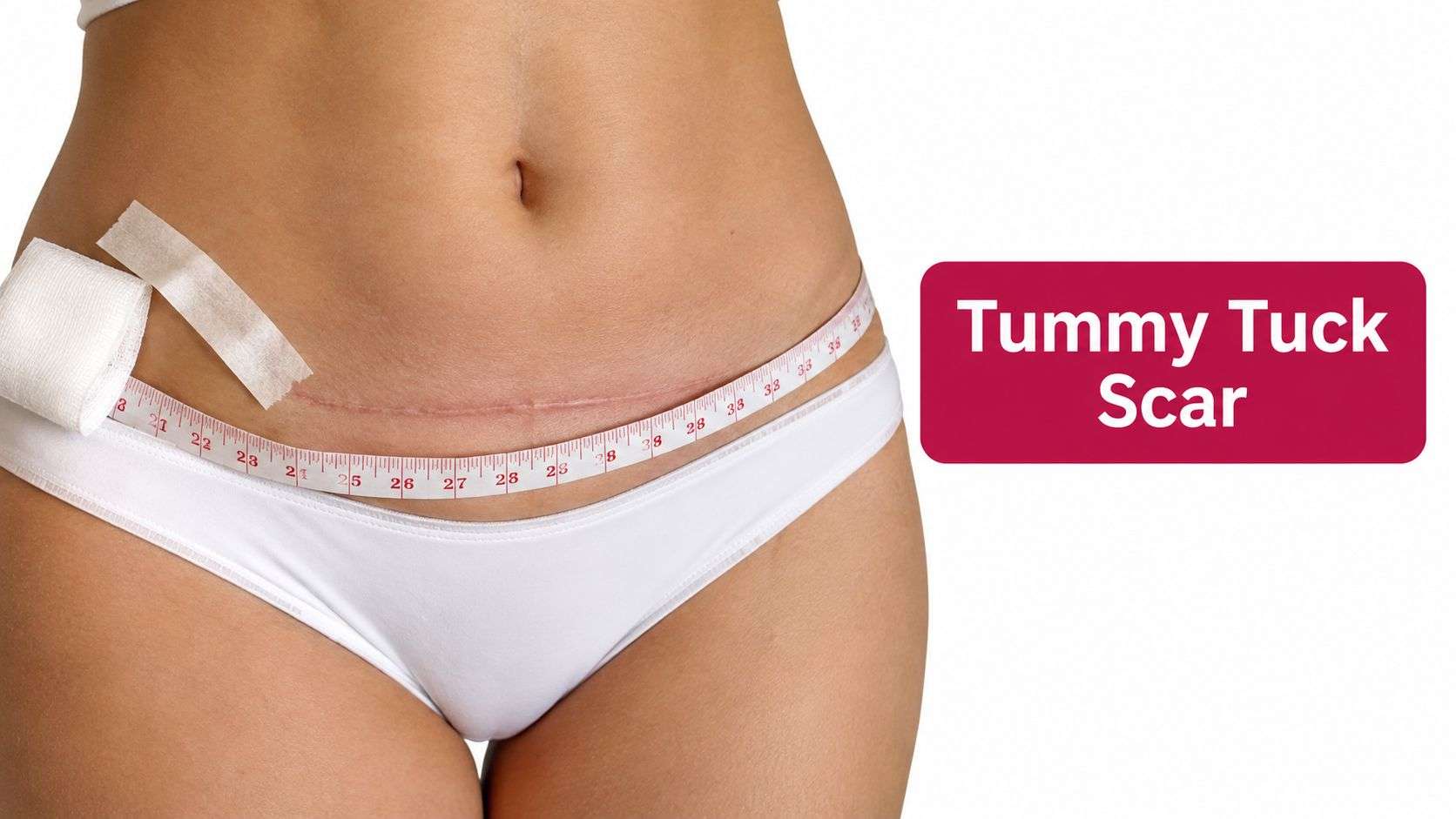
A combined case involving skin excision, such as a mini tummy tuck, may show a tighter abdominal wall and more defined lower abdomen, but it also carries a longer low abdominal scar and a different recovery course. A study measuring photographs across 301 cases found statistically significant reductions in abdominal, thigh, knee, and arm width, with no evidence of fat reaccumulation among the 46 patients followed for at least one year (photographic measurement study of liposuction contour change). That supports judging the result after swelling resolves, not from the first post-operative image.
Thighs Arms and Chin Cases With Smaller Area Changes
Smaller treatment zones tell a different visual story. An inner-thigh case may show a cleaner medial line and less contact between the thighs, but the result depends heavily on whether the skin can contract. If the skin is loose, removing fat can reveal laxity rather than create the firm, narrow appearance a patient expected.
Outer-thigh treatment often produces a more obvious silhouette change because lateral projection affects the body from both the front and back. The important comparison is usually the hip-to-thigh transition, not the amount of fat removed. A well-balanced result avoids creating a hollow beneath the hip or an abrupt boundary between treated and untreated tissue.

Arms and chin require a different standard
Arm liposuction usually aims for a modest circumference change and improved triceps contour rather than a dramatic reduction in overall size. The after photograph is most useful when it shows whether the skin drapes smoothly, whether the back of the arm looks lighter, and whether the transition into the shoulder and elbow remains natural.
Chin and neck treatment can create a particularly noticeable structural improvement because a small amount of fullness can obscure the jawline. The relevant image may show a clearer jawline-to-neck angle, less submental shadow, and better facial proportion. These areas often become socially presentable sooner than the abdomen or thighs, but final settling still takes time, commonly two to three months for the contour to mature.
The right comparison depends on the zone:
- Inner thigh: Skin recoil and medial smoothness.
- Outer thigh: Hip-to-thigh continuity.
- Upper arm: Triceps definition and skin drape.
- Chin and neck: Jawline clarity and neck angle.
When the After Photo Is Not as Smooth as Expected
A polished after photo doesn't prove that healing was easy. Liposuction can expose or create contour irregularity when fat removal is uneven, the cannula works too close to the skin, the skin has poor recoil, or pre-existing asymmetry becomes more apparent after swelling disappears.
Temporary firmness, lumpiness, numbness, bruising, and swelling can persist during recovery. New dents, persistent waviness, worsening asymmetry, fluid accumulation, fever, severe pain, calf swelling, shortness of breath, burns after energy-assisted treatment, or prolonged nerve symptoms require prompt contact with the surgical team.
What the complication data actually highlights
A 2024 systematic review reported an overall complication rate of 2.62%, with contour deformity at 2.35%. Other reported categories included hyperpigmentation at 1.49%, seroma at 0.65%, hematoma at 0.27%, infection at 0.02%, and venous thromboembolism at 0.017% (systematic review of liposuction complications).
The practical lesson is important. Patients often focus on bruising or swelling, but contour deformity was the most prominent category in that review. That doesn't mean irregularity is inevitable, nor does it mean revision is routinely required. It means a responsible consultation should address dents, waviness, asymmetry, skin quality, and the possibility that the final result may need observation before any corrective decision.
A credible gallery should disclose whether images are retouched, when the after photo was taken, which areas were treated, and whether another procedure was performed at the same time. If a result appears perfectly symmetrical from every angle, ask how the images were standardized and whether the patient's natural asymmetry is visible.
Patients with a persistent concern may eventually discuss revision liposuction, but the timing depends on healing, examination findings, stable weight, and the surgeon's assessment.
How to Evaluate Your Own Liposuction Before and After
Start with documentation, not judgment. Record your surgery date, weight, medications, activity level, and the areas treated. Take front, side, and back photographs in consistent lighting and posture, and use the same distance from the camera each time. The practice's photographic instructions can help you create comparisons that show actual contour change rather than changes in pose.
Questions to settle before surgery
Ask the surgeon to identify the primary problem:
- Fat volume: Is the goal removal of a localized pocket?
- Skin laxity: Does the skin need tightening or excision?
- Muscle separation: Is abdominal wall repair part of the plan?
- Combined contour: Would treating adjacent areas create a more balanced silhouette?
Liposuction alone won't correct significant skin laxity or abdominal wall separation. Reviewing a case with a similar starting body shape, skin quality, treatment area, and procedure type is more useful than choosing the most dramatic photograph in a gallery.
Also confirm the planned technique, anesthesia, treatment zones, incision locations, compression instructions, activity restrictions, and follow-up schedule. If your broader goal includes nutrition, activity, and sustainable body composition rather than a single fat pocket, you may also find a resource on how to transform your physique useful alongside surgical counseling.
Checkpoints after the procedure
On surgery day, verify the markings, consent documents, procedure plan, and identity of the operating team. During early recovery, contact the surgical team promptly about heavy bleeding, severe or escalating pain, fever, calf swelling, or shortness of breath.
At later visits, the focus shifts to swelling, firmness, sensation, contour, scar healing, and the safe progression of activity. Don't judge the final result until the settling period recommended by your surgeon has passed, often several months. Weight gain or loss can alter the comparison, and no gallery can predict your exact healing pattern, scar behavior, or degree of improvement.
Georgia Plastic & Reconstructive Surgery offers consultations, liposuction options including Smartlipo and awake liposuction, recovery guidance, and patient education for people evaluating body-contouring goals. Visit Georgia Plastic & Reconstructive Surgery to review the practice's resources and request a consultation focused on your anatomy, treatment plan, and realistic before-and-after expectations.