
Understanding Chin and Jaw Implants: Your Path to Facial Balance
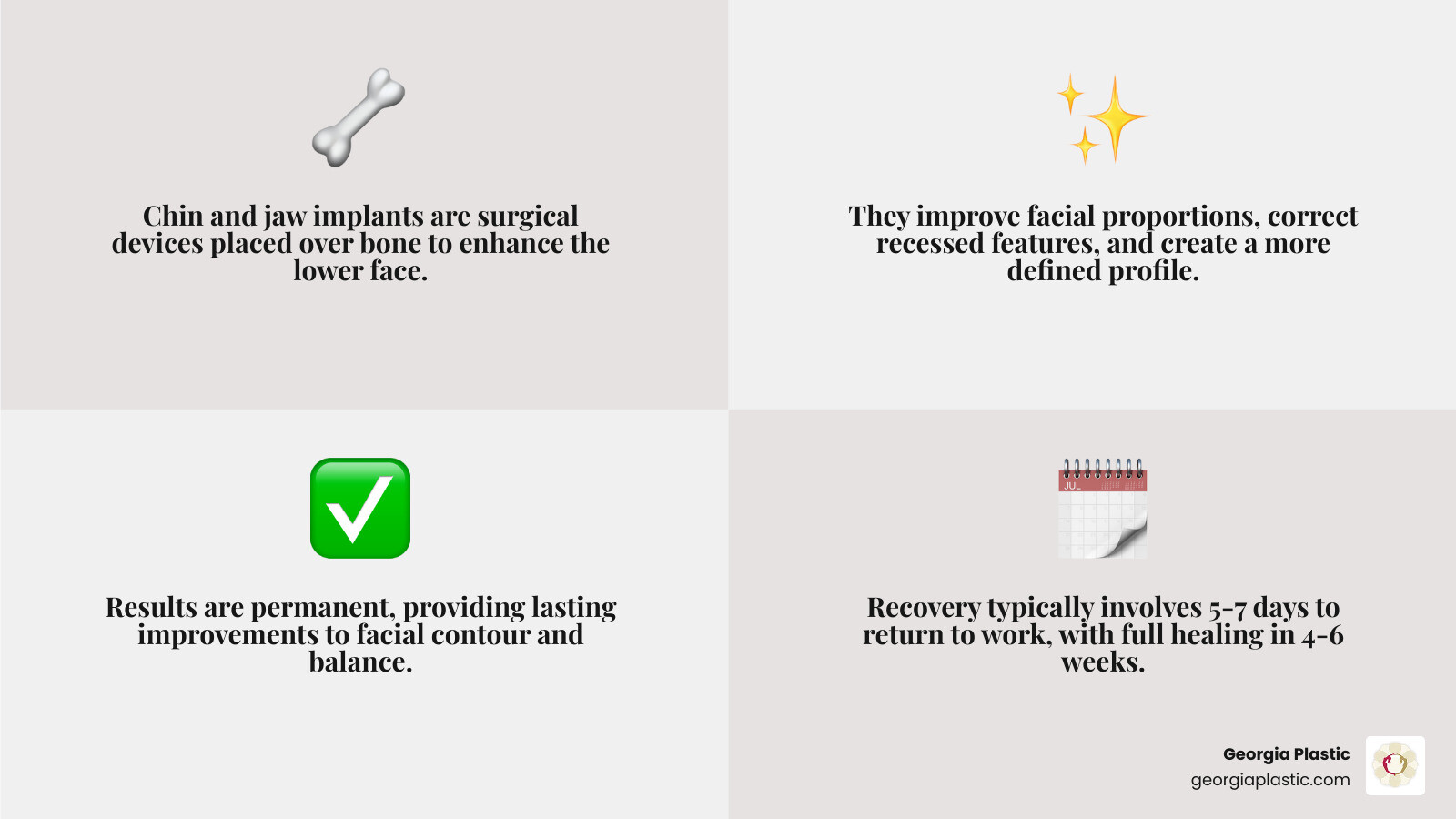
Chin and jaw implant surgery is a cosmetic procedure that improves the lower face by placing solid, biocompatible materials over the chin bone or along the jawline. These implants improve facial proportions, correct recessed or weak features, and create a more defined profile.
Quick Overview:
- What they are: Surgical implants (usually silicone) placed over the chin or jaw bones
- Purpose: Improve facial balance, strengthen weak chins, widen narrow jawlines
- Procedure time: 1-2 hours for chin implants, about 2 hours for jaw implants
- Recovery: 5-7 days to return to work, 4-6 weeks for full healing
- Results: Permanent improvements to facial contour and profile
- Risks: Low infection risk (1%), potential numbness, implant shifting
- Cost: Varies based on complexity and surgeon experience
Many people don’t realize how much their chin and jaw shape affect their overall appearance. A small or recessed chin can make your nose look larger than it is. A weak jawline can blur the definition between your face and neck.
Facial implants offer a permanent solution to these concerns. Unlike temporary fillers that dissolve over time, chin and jaw implants become part of your facial structure. They’re made from materials that feel natural and blend with your existing bone.
As Dr. Stanley Okoro, a double board-certified plastic surgeon specializing in facial procedures, I’ve helped countless patients achieve balanced, natural-looking results through chin and jaw implant surgery at Georgia Plastic and Reconstructive Surgery. My approach combines surgical precision with an understanding of facial aesthetics to improve each patient’s unique features while maintaining harmony across the entire face.
Are You a Candidate for Chin or Jaw Augmentation?
Deciding to undergo any cosmetic procedure is a significant step, and determining if you’re a suitable candidate for chin and jaw implant surgery is paramount. We always begin with a thorough evaluation to ensure the procedure aligns with your goals and health status.
The primary benefits patients seek from chin or jaw augmentation include improved self-confidence and a more harmonious facial balance. A stronger profile can dramatically improve your overall appearance. For instance, chin implants can increase the size and projection of a chin that is not in proportion with the forehead and mid-face, or one that seems to disappear into the neck. Similarly, jaw implants increase the width of the lower third of your face, defining a weak jawline that might otherwise blend into the neck.
You might be an excellent candidate if you:
- Are bothered by a recessed or “weak” chin.
- Feel your jawline lacks definition or appears too narrow.
- Desire better facial symmetry and overall balance.
- Have reached full skeletal maturity, which typically occurs in late adolescence. This ensures your facial bones have stopped growing, providing stable results.
- Are in good overall physical health and do not have any medical conditions that could impair healing.
- Are a non-smoker. Smoking can significantly impede the healing process and increase the risk of complications.
- Hold realistic expectations for the outcome of the surgery. While we strive for transformative results, understanding the limitations and potential changes is crucial.
As the American Society of Plastic Surgeons highlights, a good candidate for chin surgery is someone who is physically healthy, does not smoke, and has a positive outlook with specific goals for improving facial contours. You can learn more about who is a good candidate for chin surgery on their website.
For those considering jaw angle implants, candidates should also have completed any orthodontic or orthognathic work and not be planning further treatments of that nature. This ensures the implant placement will complement your stable dental and jaw structure. Both men and women are potential candidates, though men often seek a stronger, more chiseled jawline, while women might desire a more subtle improvement to improve facial balance.
The Chin and Jaw Implant Procedure: What to Expect
Once we’ve determined you’re a good candidate, our next step is a detailed consultation and surgical planning session. This is where we discuss your aesthetic goals, evaluate your unique facial anatomy, and decide on the best approach for your chin and jaw implant surgery. We may use digital imaging systems to help you visualize potential results and ensure we’re aligned on the desired outcome.
Chin and jaw implant surgery is typically an outpatient procedure, meaning you can return home the same day. It can be performed under various types of anesthesia, including general anesthesia, IV sedation, or local anesthesia with sedation, depending on the complexity of your procedure and your comfort level.
Types of Chin and Jaw Implants
The type of implant we choose is crucial for achieving natural-looking and lasting results. The most common material for facial implants is silicone, a flexible, biocompatible substance that has been safely used for decades. These silicone implants are small, solid devices molded to fit around your existing bone structure. They come in a wide variety of shapes, sizes, and styles, allowing us to select or even sculpt an implant that perfectly matches your anatomy and aesthetic goals.
While silicone implants are popular, another material, Medpor (porous polyethylene), is also used, particularly for jaw angle implants. Unlike silicone, Medpor implants are porous, allowing tissue to grow into them, and they are typically screwed into the bone. This makes them more integrated with your natural bone structure but also more complex to insert and remove compared to silicone implants, which are simply placed into a pocket.
Our goal is always to select or create a custom-fit implant that improves your features harmoniously. We often sculpt implants to match your individual anatomy and correct any pre-operative asymmetries, ensuring a truly personalized result.
The Surgical Process Step-by-Step
The surgical process for chin and jaw implants is precise and carefully executed:
- Anesthesia: As discussed during your consultation, the appropriate anesthesia is administered to ensure your comfort throughout the procedure.
- Incisions:
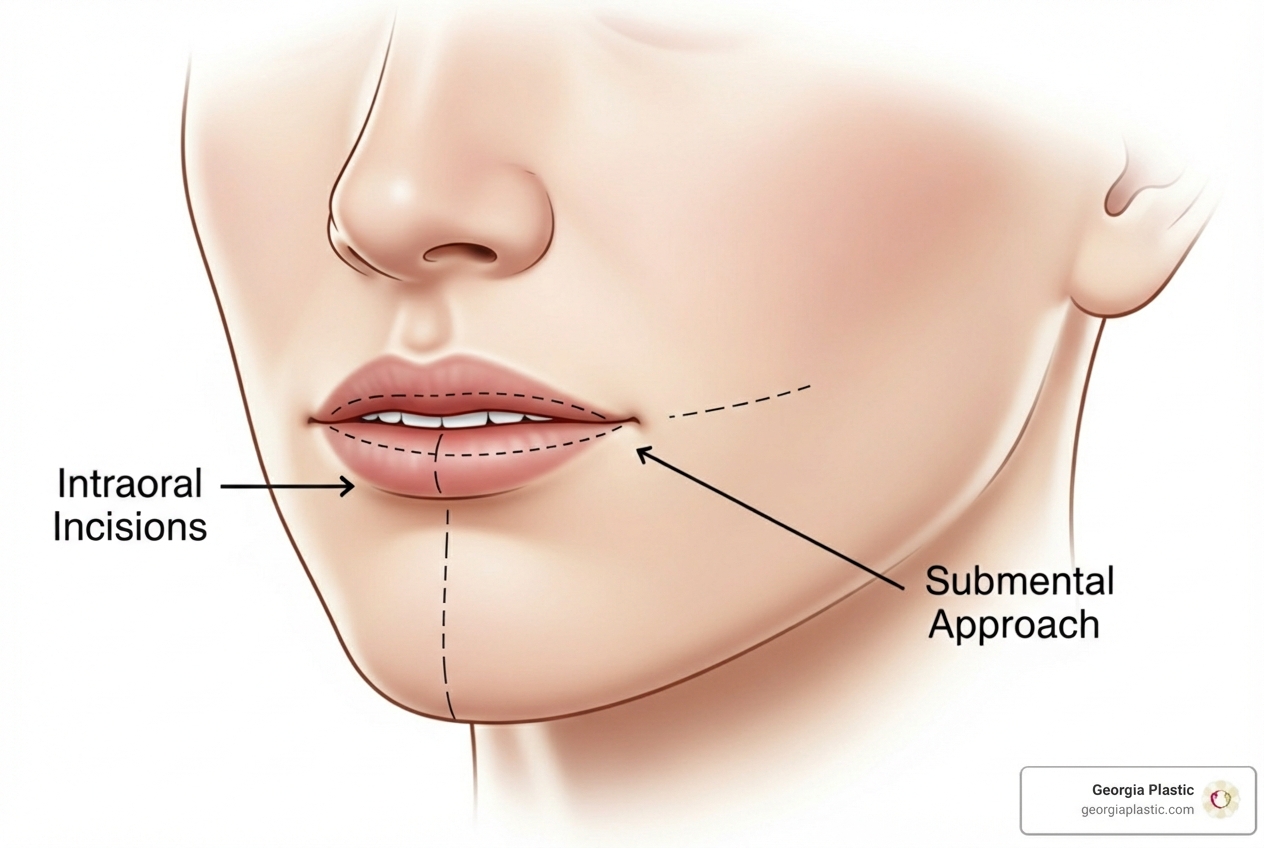
- Chin Implants: For chin implants, a small incision is typically made either underneath the chin in a natural crease (submental approach) or inside the mouth, along the lower lip (intraoral approach). The submental incision results in a nearly invisible scar, while the intraoral approach leaves no visible external scar.
- Jaw Implants: Jaw implants are usually inserted through incisions made inside the mouth, in the area where the cheek meets the gum line. This completely hides any resulting scars.
- Creating a Pocket: Through the incision, we carefully create a precise pocket directly over the chin bone or along the jawbone. For chin implants, this pocket is often created over the bone, underneath the muscles, to ensure maximum stability.
- Implant Placement: The chosen implant is then carefully inserted into this pocket. We ensure it is perfectly positioned and molded to fit your bone structure. In some cases, for chin implants, the jawbone might be gently shaved to ensure a better fit.
- Implant Fixation:
- Chin Implants: The chin implant is secured in place, often with surgical sutures, to prevent shifting.
- Jaw Implants: Jaw implants, especially Medpor types, are typically attached to the bone with tiny titanium screws for robust fixation. Silicone jaw implants are placed into a pocket and become encapsulated.
- Closure: The incisions are then closed with dissolvable stitches or surgical glue.
The duration of these procedures varies. Chin implant surgery alone typically takes less than 1 hour to perform. Jaw implant surgery usually takes about two hours.
Combining Procedures for Total Facial Harmony
Sometimes, achieving your ideal facial harmony involves more than just a single procedure. We often recommend combining chin and jaw implants with other cosmetic surgeries to improve overall balance and achieve more comprehensive results.
- Rhinoplasty (Nose Surgery): It might seem surprising, but a small or recessed chin can make your nose appear larger than it actually is. Combining a chin implant with rhinoplasty can create a much more balanced and attractive profile, as strengthening the chin helps to harmonize the facial features. This approach can be truly transformative for overall facial aesthetics.
- Neck Liposuction: For patients concerned about a “double chin” or excess fat around the neck and jawline, neck liposuction can be performed simultaneously. This removes unwanted fat, further defining the jawline and enhancing the results of your chin or jaw implants. We can often perform neck liposuction through the same incision used for a chin implant, minimizing additional scarring.
- Facelift: If you’re also experiencing signs of aging such as sagging skin in the lower face and neck, a facelift can be combined with chin and jaw implants to provide a more youthful and defined contour. The implants provide structural improvement, while the facelift addresses skin laxity.
- Fat Grafting: In some cases, fat grafting (transferring fat from another part of your body) can be used in conjunction with implants to add subtle volume and smooth contours, further refining your results.
By strategically combining procedures, we can address multiple concerns at once, leading to a more cohesive and aesthetically pleasing outcome, often with a single recovery period.
Recovery, Results, and Potential Risks
Undergoing chin and jaw implant surgery is an exciting journey towards a more confident you. Understanding the recovery process, what to expect from your results, and the potential risks involved is a crucial part of this journey.
Immediately after your procedure, you’ll likely experience some swelling, bruising, and mild discomfort in the treated area. Don’t worry, this is completely normal! We’ll provide you with pain medication to manage any discomfort, which typically subsides within 3-5 days.

Post-operative care is key to a smooth recovery. For the first 1-2 weeks, we recommend sleeping face-up with your head liftd, using a reclining chair or multiple pillows. This helps to decrease swelling and protect the surgical site. A compression dressing or chin strap may be applied and worn for the first week to support the implants and minimize swelling.
Your diet will also require some adjustments. For the first few days, a soft food or liquid diet is usually recommended, especially if incisions were made inside the mouth. If you have intraoral incisions, maintaining good oral hygiene is essential. We’ll advise you to rinse your mouth with salt water or an antibacterial mouthwash before and after meals to keep the area clean and prevent infection.
The Recovery Timeline
While individual recovery times can vary, here’s a general timeline for what you can expect:
- First Week (Days 1-7): This is your primary downtime. Swelling and bruising will be most noticeable. Pain medication will help manage discomfort. Most patients feel comfortable returning to desk work or non-strenuous activities within 5-7 days. You’ll need to wear your chin strap as instructed.
- Two Weeks Post-Op: Significant swelling and bruising should start to resolve. You can typically resume light exercise. Some numbness in the chin and lower lip is common and may persist for several weeks.
- Four to Six Weeks Post-Op: Most of the swelling should have subsided, and you can gradually return to strenuous activities, including heavy lifting and high-intensity workouts. Recovery from chin augmentation usually takes about four to six weeks for the initial healing phase.
- One to Three Months: While you’ll see initial improvements quickly, it can take up to 1-3 months for all residual swelling to fully resolve and for your final results to become evident. Some altered skin sensation or numbness might take up to a year to fully resolve, but this is usually a gradual process.
Long-Term Results and Durability
One of the most appealing aspects of chin and jaw implants is their permanence. These implants are designed to be a long-lasting, if not permanent, solution for enhancing your facial structure. Made from strong, durable medical-grade materials, they are intended to remain in place for many years.
Once the initial healing is complete, your improved chin and jawline will feel natural, much like your own bone. While the implants themselves are durable and won’t change, your surrounding facial tissues will continue to age naturally. However, the structural improvement provided by the implants will endure, maintaining your improved profile. In rare cases, trauma could damage an implant, potentially necessitating replacement.
Understanding the Risks
While chin and jaw implant surgery is generally safe, as with any surgical procedure, there are potential risks and complications. We prioritize patient safety and take every precaution to minimize these:
- Infection: The risk of infection from facial implants is quite low, generally around 1%. We prescribe antibiotics before and after surgery to further reduce this risk.
- Nerve Injury/Numbness: Temporary numbness in the chin or lower lip is common after chin implant surgery due to nerve manipulation. In rare cases, nerve injury can lead to prolonged or permanent numbness.
- Implant Shifting: Although implants are secured, there’s a slight risk they could shift out of optimal position, requiring a corrective procedure.
- Asymmetry: While we strive for perfect symmetry, natural facial asymmetries exist. In some cases, minor asymmetry might persist or occur post-surgery.
- Scarring: As mentioned, incisions are strategically placed to be minimally visible. However, as with any incision, there is a potential for poor scarring, though this is uncommon.
- Other Risks: Less common risks include hematoma (internal bleeding), allergic reactions to materials or medications, and anesthesia complications.
We will discuss all potential risks and complications thoroughly during your consultation, ensuring you are fully informed and comfortable with your decision. For more general information on chin surgery, you can also consult the American Society of Plastic Surgeons.
Costs and Alternatives to Surgical Implants
When considering chin and jaw implant surgery, understanding the financial investment and exploring alternative options is an important part of your decision-making process.
What is the Cost of Chin and Jaw Implant Surgery?
The cost of chin and jaw implant surgery can vary significantly based on several factors:
- Surgeon’s Fee: This is often the largest component and reflects the surgeon’s experience, reputation, and geographic location. Highly specialized and board-certified plastic surgeons typically have higher fees.
- Anesthesia Costs: The type of anesthesia used (general, IV sedation, local with sedation) and the duration of the procedure will influence these costs.
- Facility Fees: These cover the use of the accredited surgical facility where your procedure will take place.
- Implant Type and Material: While often included in the surgeon’s fee, the specific type and material of the implant (e.g., silicone vs. Medpor, standard vs. custom) can impact the overall cost.
- Procedure Complexity: Whether you’re getting a chin implant, jaw implants, or a combination of both, and if additional procedures are performed simultaneously, will affect the total cost.
- Geographic Location: Costs can differ significantly depending on the city or region where the surgery is performed.
Chin implant surgery is generally less expensive than more extensive jaw surgery, which often involves more intricate planning and a longer surgical time. Since these are cosmetic procedures, they are typically not covered by health insurance. We encourage you to schedule a personalized consultation to receive an accurate estimate custom to your specific needs and goals. Many clinics also offer financing options to help make the procedure more accessible.
Non-Surgical and Alternative Options
While chin and jaw implants offer permanent and dramatic results, not everyone is ready for surgery or requires such an extensive change. Fortunately, there are several non-surgical and alternative options to consider for enhancing your chin and jawline:
- Dermal Fillers: Injectable dermal fillers, such as those made with hyaluronic acid (e.g., Juvéderm Voluma), can temporarily add volume and projection to the chin and define the jawline. These are less invasive, require little to no downtime, and offer immediate results. However, they are temporary, typically lasting 12-24 months, and require repeat treatments to maintain the effect. You can explore more about nonsurgical chin and jawline augmentation using fillers.
- Fat Grafting (Autologous Fat Transfer): This procedure involves harvesting fat from another area of your body (like the abdomen or thighs) via liposuction, processing it, and then injecting it into the chin or jawline. Fat grafting offers a more natural solution as it uses your own tissue. The results can be semi-permanent, as a portion of the transferred fat cells will survive indefinitely, but not all of them, so some volume may be lost. It’s more invasive than fillers but less so than implants.
- Sliding Genioplasty (Osseous Genioplasty): This is a surgical alternative to a chin implant that involves repositioning your own chin bone. During this procedure, the chin bone is cut, advanced forward (or moved in other directions), and then secured with small plates and screws. This is a permanent solution and can address significant chin recession or asymmetry, but it is a more complex procedure than simply placing an implant.
| Feature | Chin/Jaw Implants | Dermal Fillers | Fat Grafting | Sliding Genioplasty |
|---|---|---|---|---|
| Permanence | Permanent | Temporary (12-24 months) | Semi-permanent (some fat reabsorbs) | Permanent |
| Invasiveness | Surgical (moderate) | Non-surgical (minimal) | Minimally invasive surgical (moderate) | Surgical (more invasive than implants) |
| Cost | Moderate to High | Low (per treatment) | Moderate | High |
| Results | Significant, long-lasting structural change | Subtle to moderate volume improvement | Natural feel, moderate volume improvement | Significant structural change, bone repositioning |
Each of these options has its own set of advantages and considerations regarding permanence, invasiveness, cost, and the extent of results. We will discuss all suitable alternatives during your consultation, helping you choose the best path to achieve your desired aesthetic outcome.
Conclusion: Sculpting Your Ideal Look
Achieving a balanced and harmonious facial profile can significantly improve your self-confidence and overall appearance. Chin and jaw implant surgery offers a powerful and permanent solution for those seeking to refine their lower facial contours, address a recessed chin, or define a weak jawline. It’s a journey that combines art and science to sculpt your ideal look.
At Georgia Plastic, our commitment is to provide personalized care that delivers natural-looking results while prioritizing your safety and well-being. Choosing a board-certified plastic surgeon, like Dr. Stanley Okoro, who has experience in facial cosmetic surgery, is crucial. Our expertise ensures meticulous attention to detail, from the initial consultation and custom implant selection to the precise surgical execution and comprehensive post-operative care.
If you’re ready to explore how chin and jaw implant surgery can transform your profile and bring your facial features into beautiful harmony, we invite you to schedule a consultation with us. Let’s work together to sculpt the confident, balanced look you’ve always envisioned.
For more information about our facial rejuvenation services, please visit our website.


