
A Torn Earlobe Is More Common — and More Fixable — Than You Think
If you want to how to repair earlobe tear damage quickly, here is the short answer:
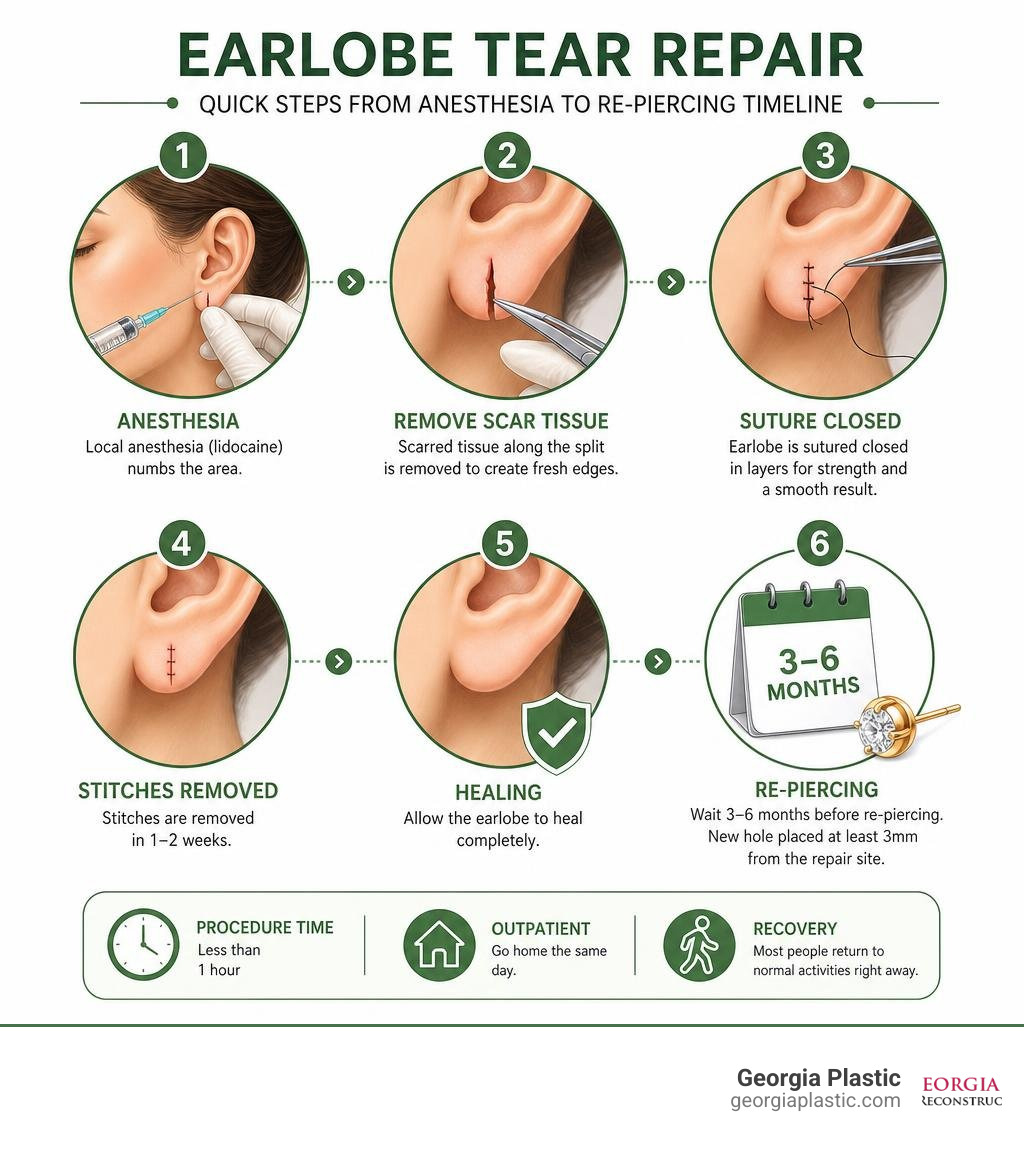
How to Repair an Earlobe Tear (Quick Overview)
- See a board-certified plastic surgeon for a consultation and evaluation
- Receive local anesthesia (lidocaine) to numb the area — no general anesthesia needed
- Surgeon removes scarred tissue along the split to create fresh edges
- Earlobe is sutured closed in layers for strength and a smooth result
- Stitches are removed in 1-2 weeks at a follow-up visit
- Wait 3-6 months before re-piercing, with the new hole placed at least 3mm from the repair site
That is the core process. The procedure is outpatient, takes less than one hour, and most people go straight back to their normal day.
Now, here is the fuller picture.
You reach for a favorite pair of earrings, and something feels wrong. The hole has stretched into a slit. Or an earring got caught on a sweater, a toddler gave it a tug, and now there is a visible split running through the lobe. It happens more often than most people realize — and it can quietly chip away at your confidence every time you look in the mirror.
The good news? A torn or stretched earlobe is one of the most straightforward cosmetic issues a plastic surgeon can fix. The procedure is called a lobuloplasty, and it is among the most frequently performed minor surgeries in plastic surgery practices today.
I’m Dr. Stanley Okoro, a double board-certified plastic surgeon and founder of Georgia Plastic and Reconstructive Surgery in Atlanta. I have performed numerous earlobe repairs and understand exactly what patients need to know about how to repair earlobe tear injuries safely and with lasting results — and I will walk you through all of it below.
Simple how to repair earlobe tear glossary:
Understanding Earlobe Damage: Causes and Classifications
To understand how we fix a torn earlobe, it helps to look at the unique anatomy of the ear itself. While the upper two-thirds of your ear are supported by a firm, flexible frame of cartilage, the lower third—the earlobe—is made entirely of skin, fat, and connective tissue.
Because the earlobe lacks cartilage, it has very little internal structural support. Over time, gravity, aging, and external forces can easily stretch this soft tissue. As we age, our skin naturally loses collagen and elasticity, making the earlobe even more vulnerable to tearing or elongation under tension.
Common Causes of Torn and Stretched Earlobes
Most earlobe damage falls into two categories: gradual stretching or sudden trauma. Here are the most common culprits we see in our Atlanta practice:
- Heavy Jewelry: Wearing large, heavy, or dangling earrings can pull down on the piercing hole. Over the years, this creates a slow “cheese-cutter effect,” where the earring post gradually slices downward through the soft tissue until the hole becomes an elongated slit or splits completely.
- Accidental Tugs: A hoop earring gets caught in a hairbrush, snagged on a knitted sweater, or pulled forcefully by a curious toddler or an overexcited pet. This causes a sudden, painful, and immediate split.
- The “Gauge” Trend: Stretching the earlobes intentionally with gauges or plugs alters the tissue permanently. Once the skin is stretched beyond a certain point, it loses the ability to shrink back naturally.
- Aging and Gravity: Even without heavy jewelry, the natural aging process can cause earlobes to lose volume, sag, and appear elongated.
Understanding these factors is the first step toward finding a solution. If you are experiencing these issues, there are many Reasons to Consider Earlobe Repair Surgery to restore both the strength and appearance of your lobes.
Classifying Your Earlobe Tear
When you visit us for a consultation, we evaluate the severity of your tear using a standard medical classification system. This helps us customize our surgical approach to your specific anatomy.
- Type I (Partial Tear / Elongated Perforation): The piercing hole has stretched into an elongated vertical slit, but the bottom rim of the earlobe remains completely intact. The cleft length is less than the remaining healthy tissue below it.
- Type IIA (Deep Partial Tear): The piercing hole is severely stretched, and the cleft end extends very close to the bottom margin of the earlobe, leaving only a tiny bridge of skin intact.
- Type IIB (Bifid Lobe / Complete Split): The earlobe is completely split into two distinct halves (bifid), creating a dramatic V-shaped gap.
- Type III (Complex Deformities): This includes multiple splits, torn tissue from gauges, severe scarring, or tissue loss from previous trauma or infected piercings.
| Classification | Description | Visual Appearance | Typical Repair Approach |
|---|---|---|---|
| Type I | Mild to moderate vertical stretching | Elongated slot; bottom rim intact | Excision of the inner lining and simple linear closure |
| Type IIA | Deep stretching near the bottom margin | Thin bridge of skin remaining | Delicate tract excision and layered reinforcement |
| Type IIB | Complete split (Bifid lobe) | Two separate hanging flaps of skin | Re-alignment, Z-plasty, or layered closure |
| Type III | Complex tears, gauges, or tissue loss | Missing tissue, severe scarring, or multiple slits | Flap rearrangement, reconstructive lobuloplasty |
How to Repair Earlobe Tear Injuries with Lobuloplasty
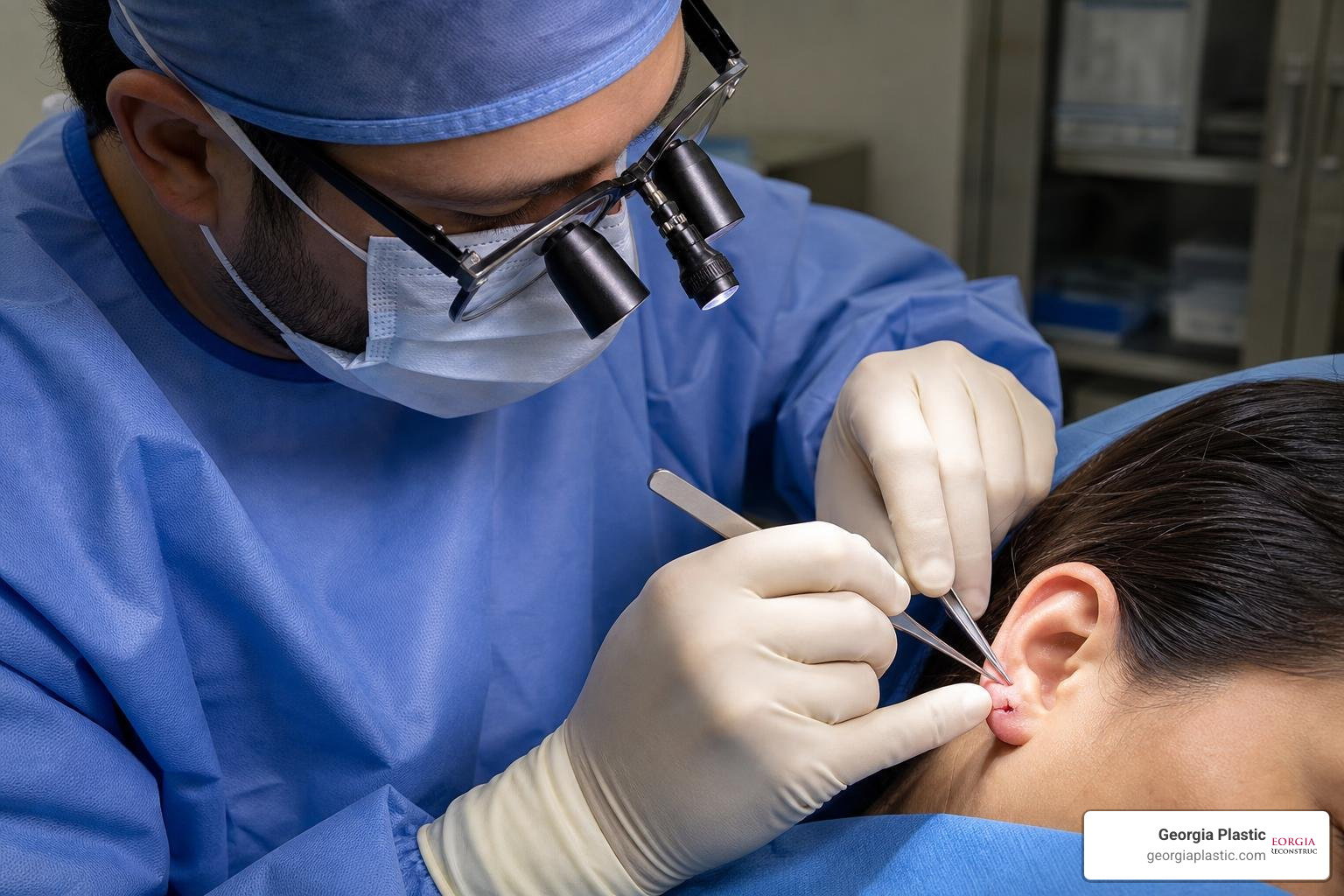
If you have a split or stretched earlobe, the body cannot naturally knit the edges back together on its own. This is because the skin inside the split has already healed and “skinned over,” creating a permanent barrier. To fix it, we must perform a minor surgical procedure called a lobuloplasty.
A lobuloplasty is a highly precise outpatient procedure. It is performed right in our office under local anesthesia. You remain fully awake, comfortable, and able to walk out of the clinic immediately after we finish.
Surgical Techniques for Earlobe Reconstruction
Depending on the nature of your tear, we utilize different surgical techniques to ensure a strong, natural-looking, and symmetrical result:
- Linear Repair: For simple partial tears, we gently excise the healed skin lining the inside of the stretched hole. This creates fresh, raw edges that we then align perfectly and suture together in a straight line.
- Z-Plasty: For complete splits (Type IIB), a simple straight-line repair can sometimes contract as it heals, causing a tiny notch at the bottom rim of the earlobe. To prevent this “notching,” we often use a Z-plasty technique. This involves creating small triangular flaps of skin that interlock. This redistributes tissue tension, preserves a smooth, rounded bottom border, and minimizes the visibility of the scar.
- Layered Closure: To ensure the earlobe can withstand future wear, we perform a multi-layered closure. We use deep, absorbable sutures to bind the internal fatty tissue together, followed by incredibly fine sutures to close the outer skin.
For a deeper dive into these methods, explore The Complete Guide to Earlobe Repair.
Innovative Tools for Precise Tissue Excision
To achieve the most symmetrical margins with minimal tissue handling, plastic surgeons use a variety of refined tools. Traditionally, a scalpel is used to meticulously carve away the scarred inner tract of the split. In some cases, radiofrequency units are employed to excise the tissue while simultaneously sealing tiny blood vessels, which reduces bleeding and swelling.
Additionally, modern clinical research has introduced highly precise methods for partial tears. For instance, an Innovative technique for partial earlobe tear repair using a customized elliptical biopsy punch – JCAS allows surgeons to modify a standard circular biopsy punch into an elliptical shape. By stamping and rotating this customized tool over a Type I defect, we can excise the entire stretched tract in a single, clean motion. This ensures perfectly symmetrical margins on both sides of the earlobe, reduces operating time, and minimizes trauma to the surrounding tissue for a cleaner heal.
What to Expect: Preparation, Procedure, and Recovery Timeline
Knowing what to expect can take the anxiety out of any medical procedure. Earlobe repair is incredibly straightforward, utilizing modern 2026 clinical standards for safety and comfort.
Preparing for Your Lobuloplasty
Preparation is minimal, but crucial for ensuring a smooth procedure and recovery. During your initial consultation, we will review your medical history and evaluate your earlobes to confirm you are a good candidate. To prepare:
- Avoid blood-thinning medications, such as aspirin, ibuprofen, and certain herbal supplements, for at least one week prior to surgery to minimize bruising.
- Refrain from smoking or using nicotine products, as nicotine restricts blood vessels and can delay your body’s natural healing process.
- Keep your ears clean and free of any active infections or cysts.
If you are wondering if this procedure is right for your specific situation, you can read more about what makes someone an Earlobe Repair: Otoplasty Good Candidate.
Step-by-Step: How to Repair Earlobe Tear Defects in the Office
Once you are ready, the actual procedure takes less than an hour:
- Marking: We carefully measure and mark the surgical lines on your earlobe to ensure perfect symmetry with your other ear.
- Numbing: We administer a local lidocaine block. You will feel a brief, mild pinch, but within seconds, your entire earlobe will be completely numb. You will remain awake and comfortable, feeling only light pressure during the procedure.
- Freshening the Edges: We gently remove the old scar tissue lining the tear to reveal healthy, vascular tissue.
- Suturing: Using magnifying loupes, we meticulously align the skin edges and place the sutures. We pay special attention to the “key suture” at the very bottom rim of the lobe to guarantee a smooth, rounded contour.
If you are feeling nervous about the process, reading How to Fix a Split Earlobe Without Losing Your Mind can offer some comforting perspective.
Your Recovery and Re-Piercing Timeline
The recovery from a lobuloplasty is remarkably quick. Most patients experience only mild tightness or soreness that is easily managed with over-the-counter pain relievers.
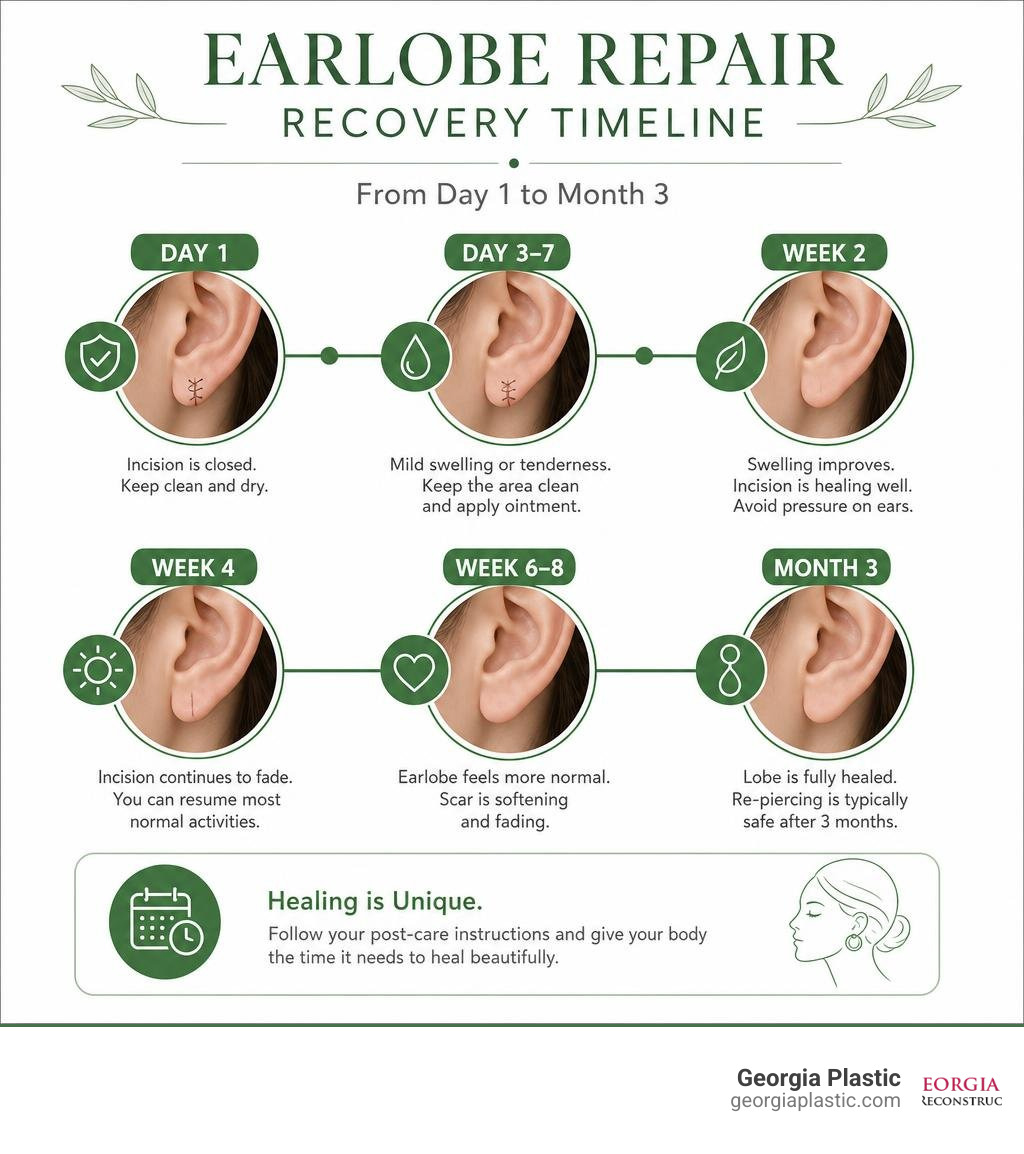
To ensure your earlobe heals beautifully, follow these simple post-operative aftercare steps:
- Keep the area clean and dry for the first 24 hours.
- Apply a thin layer of prescribed or over-the-counter antibiotic ointment to the incision line 2 to 3 times a day to keep it moist and prevent infection.
- Avoid sleeping directly on your stomach or sides; try to keep your head elevated on a couple of pillows for the first few nights.
- Refrain from strenuous exercise or swimming for at least one week to protect the delicate stitches.
- Do not wear any earrings, clip-ons, or headphones that press directly against the healing lobe.
Your stitches will be removed in our office about 1 to 2 weeks after the procedure. Over the next few weeks, the incision line will heal, leaving a fine, faint line.
When can you re-pierce? You must wait a minimum of 3 to 6 months before re-piercing your ear. This gives the scar tissue enough time to mature and regain its strength. When you do get them re-pierced, make sure the professional piercer places the new hole at least 3 millimeters away from the original scar line. Because scar tissue is naturally weaker than normal skin, piercing directly through the scar dramatically increases the risk of a repeat tear.
Benefits, Risks, and Non-Surgical Alternatives
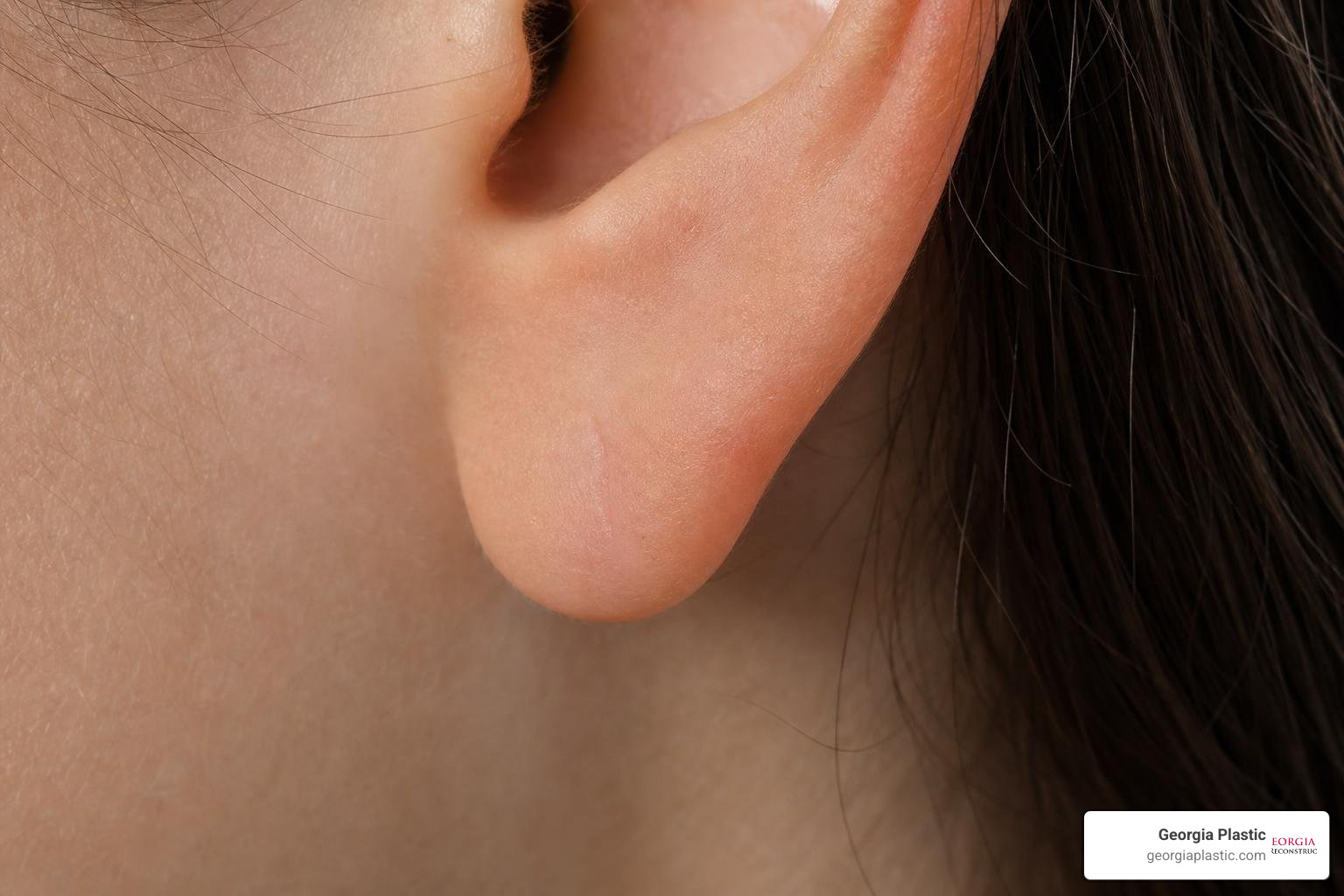
Choosing to repair a torn earlobe offers a massive boost to your self-image. It restores aesthetic harmony to your face, allowing you to wear your hair up with confidence and, eventually, return to wearing beautiful jewelry.
The Pros and Cons of Surgical Repair
Like any surgical procedure, it is important to weigh the benefits against the potential risks:
- The Pros:
- Permanent, long-lasting results.
- Performed under local anesthesia with virtually no downtime.
- Restores a natural, symmetrical, and rounded earlobe shape.
- Leaves a barely visible, pencil-fine scar line that fades over time.
- The Cons and Risks:
- Small risk of localized infection, swelling, or mild bruising.
- Potential for minor asymmetry, though choosing an experienced surgeon minimizes this.
- Risk of keloid formation (raised, thick scars), particularly in individuals who are genetically prone to keloids.
To see real-life examples of how we restore earlobes to their natural beauty, browse our Gallery: Earlobe Repair.
Can You Learn How to Repair Earlobe Tear Damage Without Surgery?
A common question we hear is whether a torn or stretched earlobe can be fixed without going under the scalpel.
For patients with stretched gauges, there is a slight chance of natural recovery. If you have only stretched your ears to a small size (typically under 8mm to 10mm, or a “00 gauge”), removing the plugs may allow the tissue to shrink naturally over several months to a year. However, if the lobes have been stretched beyond this “point of no return,” or if the tissue has become thin and fibrous, surgery is the only effective way to restore a normal shape.
For patients with sagging, drooping, or deflated earlobes due to aging, non-surgical injectables can be an excellent alternative. We can use dermal fillers, such as hyaluronic acid or collagen-stimulating injectables like Sculptra Aesthetic, to plump up the lobe. This restores lost volume, smooths out wrinkles, and provides better support for lightweight earrings.
However, non-surgical methods cannot fix a partial tear, a complete split, or severely stretched gauge holes. For those issues, a surgical lobuloplasty remains the gold standard.
Cost, Insurance, and Choosing the Right Surgeon
When planning your earlobe repair, it is helpful to understand the financial aspects and the importance of selecting the right medical professional.
How Much Does Earlobe Repair Cost?
Because earlobe repair is considered a cosmetic procedure, it is rarely covered by health insurance. The only common exception is if the tear was caused by an acute, traumatic injury (such as a dog bite or a sudden accident) that requires immediate reconstructive care in an emergency setting.
The cost of earlobe repair typically ranges from $400 to $1,500 per earlobe, depending on the complexity of the tear. Fixing a simple partial tear is generally less expensive than reconstructing a large, stretched gauge hole or repairing a complex, scarred Type III deformity. During your consultation, we provide a transparent, customized quote that covers the surgical fee, local anesthesia, and all post-operative follow-up visits.
Selecting a Qualified Board-Certified Surgeon
While earlobe repair is a minor in-office procedure, it still requires a high level of surgical artistry and technical skill to achieve a natural, symmetrical result. The earlobe is highly visible, and poor suturing can easily lead to notched borders, puckered skin, or thick, unsightly scars.
When choosing a doctor, always look for a board-certified plastic surgeon. Board certification ensures the surgeon has undergone rigorous training, adheres to the highest safety protocols, and operates in a sterile, accredited medical environment. A skilled surgeon understands tissue tension, facial symmetry, and delicate suturing techniques, giving you the safest experience and the most beautiful, natural-looking outcome possible.
Frequently Asked Questions about Earlobe Repair
We want our patients to feel fully informed. Here are quick answers to some of the most common questions we receive:
Is earlobe repair surgery painful?
Not at all. Before we begin, we administer a local anesthetic to completely numb the earlobe. You might feel a brief pinch during the injection, but you will feel absolutely no pain during the actual procedure. Afterward, you may experience mild soreness or a tight sensation, which is easily managed with over-the-counter pain relievers like acetaminophen or ibuprofen.
When can I wear heavy earrings again after repair?
We strongly advise against wearing heavy, dangling, or large hoop earrings ever again after a repair. Because the repaired tissue is supported by scar tissue, it will always be slightly weaker than a completely natural earlobe. If you wear heavy jewelry, you risk stretching or tearing the lobe all over again. Stick to lightweight studs and save statement pieces for very brief, special occasions.
Will there be a visible scar after the procedure?
Any time the skin is cut, a scar will form. However, because we use incredibly fine sutures and meticulous plastic surgery techniques, the resulting scar is typically a pencil-fine, faint white line. Over several months, this line matures, softens, and fades, becoming barely noticeable to the naked eye.
Conclusion
A torn or stretched earlobe does not have to be a permanent source of self-consciousness. Whether your tear was caused by years of heavy jewelry, an accidental tug, or gauges, a quick, in-office lobuloplasty can restore your ear’s natural contour and give you your confidence back.
At Georgia Plastic & Reconstructive Surgery, Dr. Stanley Okoro and our dedicated team prioritize your safety, comfort, and aesthetic goals. We provide personalized care that delivers natural-looking results, ensuring your ears are strong, symmetrical, and ready to shine once again.
Ready to take the next step? Schedule a consultation for earlobe repair in Atlanta with us today, and let’s get your sparkle back!


