
When a Torn or Stretched Earlobe Sends You Searching for Help
If you’re looking for earlobe repair near me, here’s what you need to know right away:
Quick Answer: How to Find Earlobe Repair Near You
- Search for a board-certified plastic surgeon or dermatologist in your area who specializes in facial or cosmetic procedures
- Look for before-and-after photos of earlobe repair cases specifically
- Confirm the procedure is done in-office under local anesthesia — no hospital stay needed
- Expect to pay $400–$1,500 out of pocket (most insurance won’t cover it)
- Plan for same-day return to normal activities with stitches out in about a week
Over time, an ear piercing hole can quietly go from a tiny dot to a long slit — or worse, a full tear. It happens gradually, from years of wearing heavy earrings, or suddenly, from an accidental snag. For people who stretched their earlobes with gauges and later changed their minds, the damage can feel even after harder to reverse.
The good news? Earlobe repair is one of the most straightforward cosmetic procedures available. It’s done in a doctor’s office, takes under an hour, and most people walk out and go right back to their day.
Earlobes may seem like a minor detail, but when they’re torn or misshapen, it’s hard not to notice — and hard to ignore.
I’m Dr. Stanley Okoro, a double board-certified plastic surgeon and founder of Georgia Plastic and Reconstructive Surgery in Atlanta, where earlobe repair is among the most commonly requested cosmetic procedures I perform. With years of experience restoring natural earlobe contour for patients across the region, I’ll walk you through everything you need to know to find the right earlobe repair near me and feel confident moving forward.
What Earlobe Repair Is and Whether You’re a Good Candidate
At its core, earlobe repair (often called lobuloplasty) is a reconstructive procedure designed to restore the natural shape and integrity of the earlobe. Unlike other parts of the ear, the lobe is composed entirely of skin and fat; it lacks the structural support of bone or cartilage. This makes it soft and aesthetically pleasing, but also incredibly vulnerable to stretching and tearing.
Whether you are dealing with a complete split from a traumatic snag or simply frustrated that your earrings “droop” due to elongated holes, this procedure offers a permanent fix. For more detailed insights, you can explore The Complete Guide to Earlobe Repair.
What problems earlobe repair can fix
We see a wide variety of earlobe issues at our practice. The procedure is highly versatile and can address:
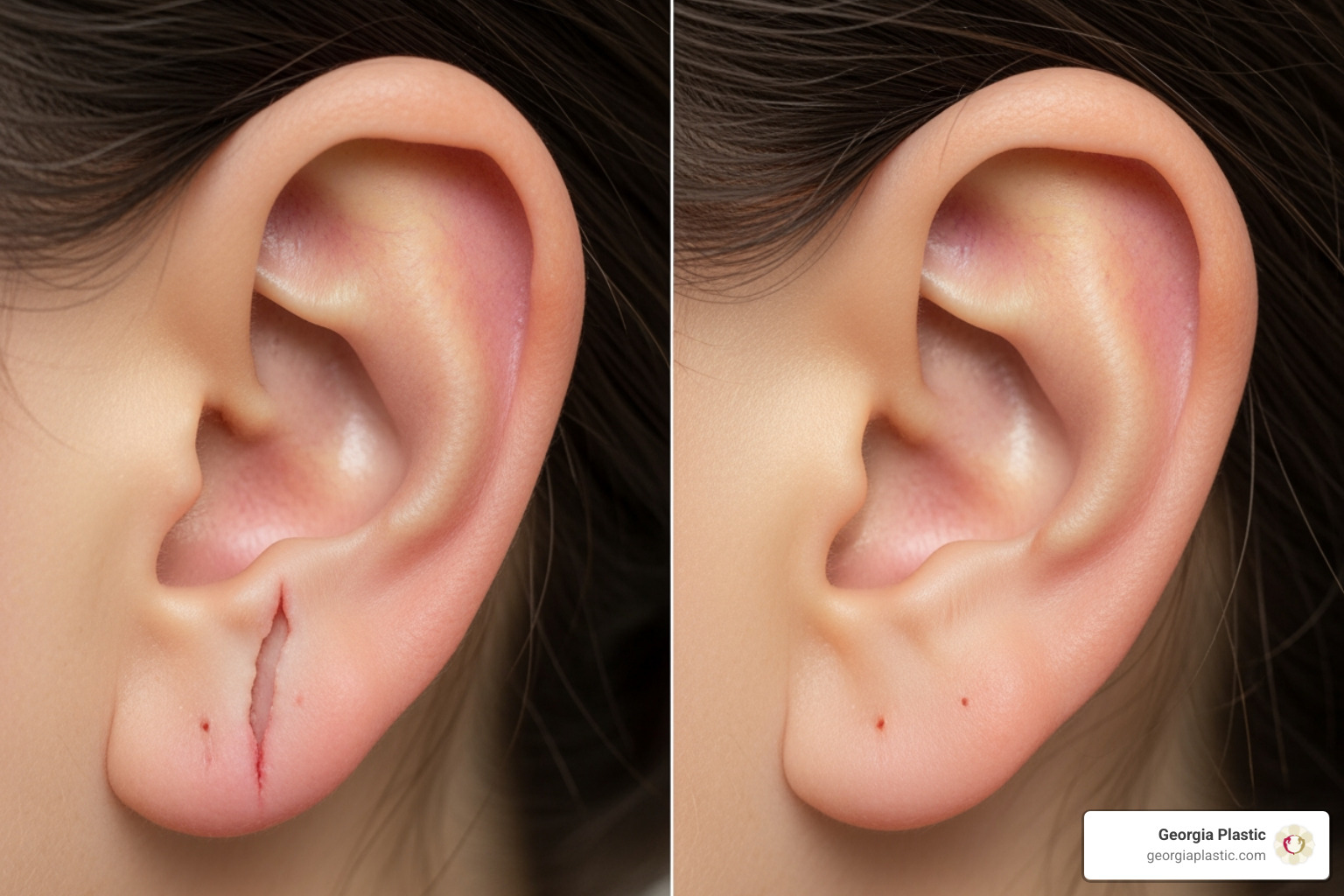
- Split Piercings: When a piercing hole becomes a vertical slit that reaches the bottom of the lobe.
- Partial Tears: Elongated holes that haven’t quite broken through but make it impossible to wear studs.
- Gauge Reversal: Closing the large, circular holes left behind by “gauging” or “plugging” earlobes.
- Asymmetry: Correcting lobes that are naturally different sizes or have been altered differently by jewelry.
- Oversized Lobes: Reducing the physical size of the lobe (earlobe reduction) for a more youthful look.
- Keloid Scars: Removing thick, lumpy scar tissue that often forms after a piercing becomes infected or irritated.
Who is a good candidate for earlobe repair near me
Most people who are unhappy with the appearance of their ears are excellent candidates. Ideal candidates are generally:
- Healthy Adults: People in good overall health with no active infections in the ear area.
- Non-Smokers: Or those willing to pause smoking, as nicotine can significantly impair blood flow and wound healing.
- Realistic Expecters: Understanding that while we strive for “invisible” scars, a fine line will exist where the skin was joined.
- Trauma or Aging Cases: Whether the damage happened yesterday or resulted from decades of heavy hoops.
If you’re wondering if you fit the bill, check out this More info about candidate criteria to see how we evaluate patients.
Common causes of torn, stretched, or damaged earlobes
Why do earlobes fail us? It usually comes down to one of these common culprits:
- The “Heavy Earring” Effect: Years of wearing statement pieces can slowly cheese-wire through the soft tissue.
- Accidental Pulls: A toddler grabbing an earring, a brush getting caught, or a sweater snagging can cause an instant, painful split.
- Gauges: Intentional stretching creates a permanent hole that the body cannot close on its own once it reaches a certain size.
- Aging Skin: As we lose collagen and elasticity (especially by May 2026!), our skin becomes thinner and more prone to stretching under gravity.
- Metal Irritation: Chronic inflammation from nickel allergies can weaken the tissue around a piercing.
Learn more about the reasons to consider earlobe repair surgery to see which category your situation falls into.
How Earlobe Repair Is Performed and What It Feels Like
The most common reaction we get from patients after the procedure is, “That’s it? I should have done this years ago!” Because the earlobe is so accessible, we can perform the entire surgery right in our office. There is no need for a hospital visit or general anesthesia.
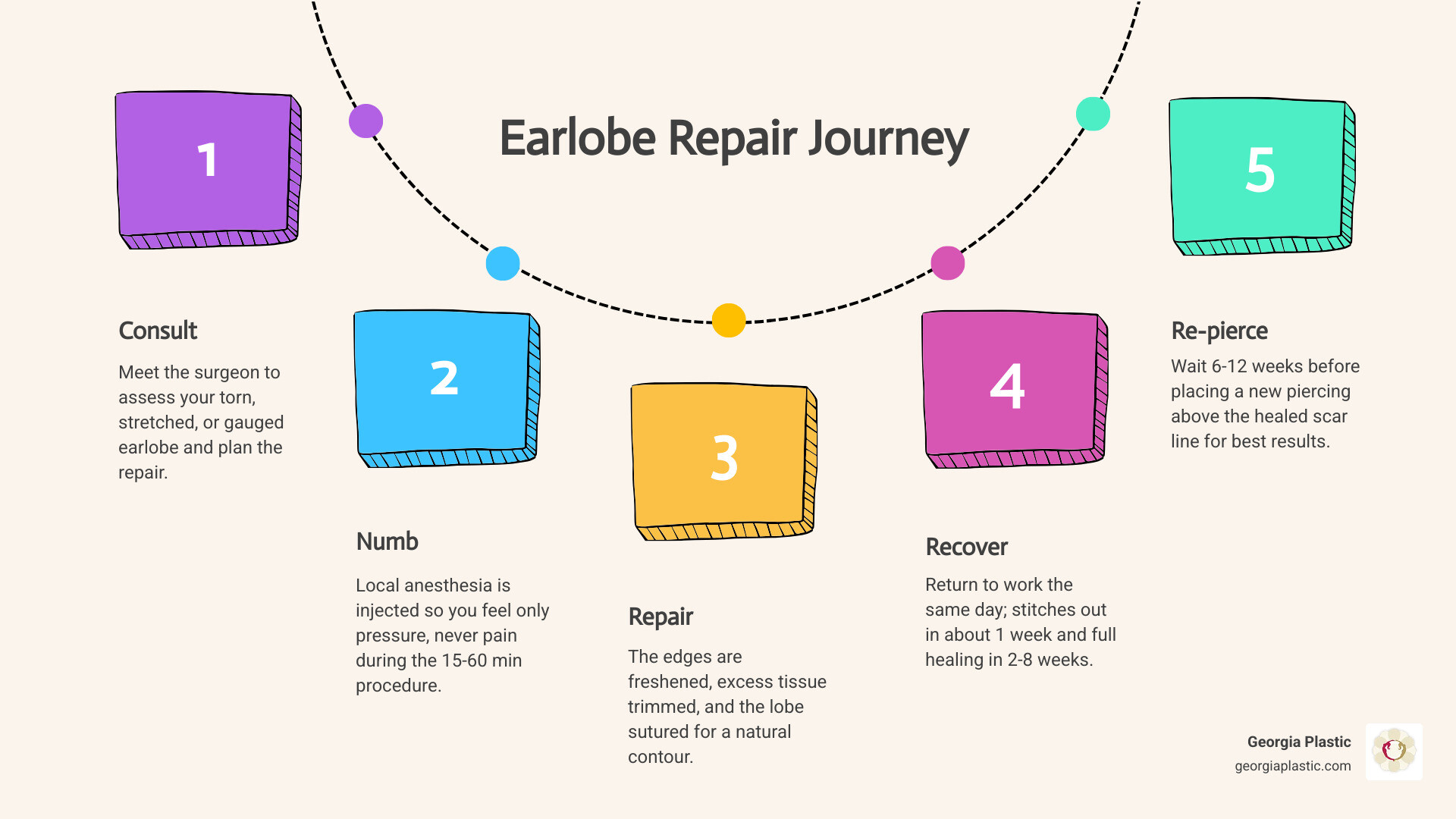
Step by step: what happens during earlobe repair near me
When you arrive for your appointment, here is the roadmap:
- Consultation & Marking: We examine the tear and mark the precise lines for the incision to ensure the resulting curve is perfectly natural.
- Numbing: We use a very fine needle to inject a local anesthetic. You’ll feel a quick pinch, and then the area becomes completely numb.
- Edge Freshening: To get the skin to grow back together, we must remove the old, healed skin inside the tear. We “freshen” the edges so they can bond.
- Tissue Trimming: If the lobe is stretched (like from a gauge), we remove the excess “loop” of skin.
- Fine Suturing: We use tiny, hair-thin stitches to meticulously join the skin. In some cases, we use a “flap” technique to prevent a notched look at the bottom of the lobe.
- Same-Day Discharge: We apply a bit of antibiotic ointment and a small bandage, and you’re free to drive yourself home.

What type of anesthesia is used and is it painful?
We almost exclusively use local anesthesia. This is the same type of numbing you get at the dentist. You remain fully awake and can even chat with us during the procedure. While you might feel some tugging or pressure, you should not feel any sharp pain. As noted by the Mayo Clinic, local anesthesia is ideal for minor surgeries because it carries fewer risks than general anesthesia and allows for a faster return to normal activities.
For patients who are particularly anxious about needles or the “sounds” of surgery, we sometimes offer light sedation or nitrous oxide (laughing gas) to help you relax. Post-procedure discomfort is usually very mild and easily managed with over-the-counter Tylenol or Advil.
How long the procedure usually takes
Speed depends on the complexity, but here are the general benchmarks:
- Simple Tear (One Lobe): 15 to 20 minutes.
- Both Lobes: 30 to 45 minutes.
- Gauge Repair: 45 to 60 minutes (this requires more complex “puzzle-piece” reconstruction to restore a round shape).
Recovery, Aftercare, and Re-Piercing Timeline
Recovery is remarkably easy. Unlike major surgeries, there are no heavy “mummy” bandages or weeks of bed rest. However, your ears are delicate during the first few days, and following our instructions is the best way to ensure a faint, flat scar. For a broader look at ear-related treatments, visit our page on Ear Surgery.
Typical recovery time after earlobe repair
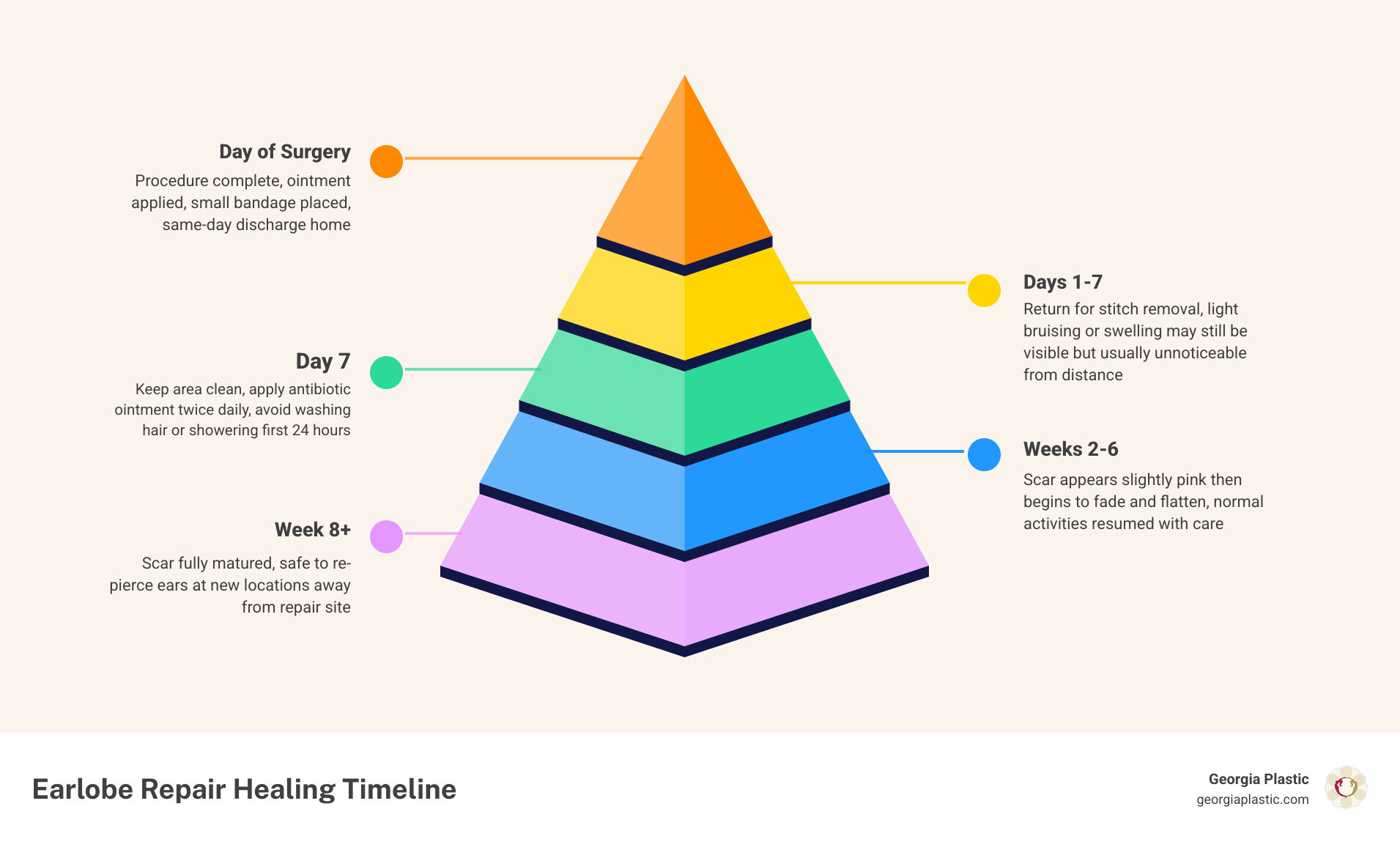
Most patients return to work the very next day. You might have some slight bruising or swelling for 48 to 72 hours, but it’s rarely enough to notice from a distance.
- Days 1–7: Stitches remain in place. You’ll keep the area clean and apply ointment.
- Day 7: You return to the office to have the stitches removed (unless we used absorbable ones).
- Weeks 2–6: The scar will look slightly pink but will begin to fade and flatten.
Aftercare instructions that help you heal well
To get the best result, we recommend these simple steps:
- Keep it Dry: Avoid showering or washing your hair for the first 24 hours.
- Ointment is Your Friend: Apply a thin layer of antibiotic ointment twice a day to keep the wound moist (this prevents scabbing, which leads to better scars).
- Sleep on Your Back: Try to avoid putting direct pressure on the ears for about a week.
- No Heavy Lifting: Avoid strenuous exercise for 2–3 days to keep your blood pressure down and prevent swelling.
- Hands Off: Don’t pick at any crusting; let the stitches do their work.
When can you re-pierce your ears?
This is the question everyone asks! You can wear earrings again, but patience is key.
- The Wait: We typically recommend waiting 6 to 8 weeks at a minimum. Some complex gauge repairs may require 12 weeks.
- The Location: Never re-pierce exactly in the scar line. The scar tissue is never quite as strong as original skin. We recommend placing the new hole at least 3mm away from the old scar.
- The Jewelry: Start with small, light studs (ideally 14k gold or surgical steel) and avoid heavy hoops for at least six months.
Earlobe Repair Cost, Insurance, and Risks
Let’s talk numbers. Because earlobe repair is almost always considered a “cosmetic” procedure, insurance companies generally won’t foot the bill.
How much does earlobe repair cost?
In May 2026, the national average for earlobe repair ranges from $400 to $1,500.
- Simple Split: Usually on the lower end ($450–$900).
- Gauge Repair: Usually on the higher end due to the complexity of the reconstruction.
- Included: This price typically covers the consultation, the procedure, the local anesthesia, and your follow-up stitch-removal visit.
| Procedure Type | Complexity | Estimated Cost (Per Lobe) |
|---|---|---|
| Simple Tear | Low | $450 – $750 |
| Stretched Hole | Medium | $600 – $900 |
| Gauge Repair | High | $900 – $1,500 |
Is earlobe repair covered by insurance?
In 99% of cases, no. Insurance views this as an elective cosmetic fix. The only rare exceptions might involve a traumatic injury that happened during a documented accident, but even then, it’s an uphill battle. We offer various financing options, such as CareCredit, to make the out-of-pocket cost more manageable.
Risks, side effects, and potential complications
While very safe, no surgery is without risk. Potential issues include:
- Scarring: Everyone gets a scar, but in some cases, it can become thick (hypertrophic) or notched.
- Infection: Rare, but possible if aftercare isn’t followed.
- Asymmetry: While we aim for perfection, ears are sisters, not twins.
- Recurrence: If you go right back to wearing heavy earrings, the lobe can tear again.
How to Choose the Right Provider for Earlobe Repair Near Me
When searching for earlobe repair near me, don’t just go to the cheapest place. Your ears are a prominent facial feature! You want someone with a “surgical eye” for symmetry and contour.
What to look for in a local earlobe repair specialist
- Board Certification: Look for a surgeon certified by the American Board of Plastic Surgery. This certification ensures that the surgeon has completed the necessary training and adheres to strict safety and ethical standards.
- Before-and-After Gallery: A specialist should have plenty of photos showing their work. You can view our Gallery Earlobe Repair for examples.
- Office Environment: The facility should be clean, professional, and equipped for minor surgery.
- Personalized Plan: A good doctor won’t rush you; they will explain exactly how they plan to reshape your specific lobe.
Questions to ask at your consultation for earlobe repair near me
- How many of these procedures do you perform each month?
- Will you be using a “straight line” closure or a “Z-plasty” to prevent notching?
- Are there any hidden fees beyond the quoted price?
- What is your policy if the earlobe doesn’t heal symmetrically?
Can earlobe repair be combined with other cosmetic procedures?
Absolutely. Many of our patients choose to fix their earlobes while undergoing other facial rejuvenation. Common combinations include:
- Facelift or Neck Lift: As we tighten the face, we can “refresh” the ears to match.
- Otoplasty: If you are also unhappy with how much your ears “stick out,” we can address both. See more at Atlanta Otoplasty.
- Fillers: Sometimes, we use dermal fillers to “plump up” thin, aged lobes without surgery.
Frequently Asked Questions About Earlobe Repair Near Me
Will I have to miss work after earlobe repair?
No! Most people have the procedure on a Friday and are back to work on Monday, or even the same afternoon if they have a desk job. There are no large bandages; just a small amount of ointment and a tiny band-aid.
Will my earlobe look normal again?
Yes. Our goal is a natural, rounded curve. While a very fine line (the scar) will be present, it usually fades so well that it is barely noticeable to the naked eye.
Can stretched gauge holes always be repaired?
In almost every case, yes. Even if the tissue is very thin, we can often rearrange the remaining skin to create a smaller, natural-looking lobe. It is a more advanced reconstruction, but it is highly successful. For those in the local area, you can find more specific details on Earlobe Repair in Atlanta.
Conclusion
A split or stretched earlobe doesn’t have to be a permanent part of your look. Whether it was an accident, a heavy earring habit, or a style choice from your younger years that no longer fits your life in May 2026, the fix is fast, safe, and effective.
At Georgia Plastic & Reconstructive Surgery, we pride ourselves on providing the kind of meticulous, personalized care that turns a stressful “search for earlobe repair near me” into a smooth, confidence-boosting experience. If you’re ready to wear your favorite earrings again or simply want to restore the natural look of your ears, we are here to help.
Ready to take the next step? Schedule your consultation for Earlobe Repair in Atlanta today and let’s get your ears back to looking their best!


