
What You Should Know Before Getting Butt Implants
Butt implants are silicone prosthetics surgically placed into the gluteal region to add permanent volume, projection, and shape to the buttocks.
Quick answer — here’s what butt implants involve:
| Factor | Details |
|---|---|
| What they are | Solid silicone implants placed inside or below the gluteus muscle |
| Best for | Low body fat, flat or square buttocks, limited fat for BBL |
| Results | Immediate and permanent |
| Recovery | 2-3 weeks before desk work, 6-8 weeks for full activity |
| Average cost | $7,992 (range: $3,500–$22,000) |
| Key risk | 21.6% overall complication rate, 17.8% revision rate |
| vs. BBL | More dramatic projection; BBL feels more natural but requires adequate body fat |
Whether your buttocks are naturally flat, have lost volume after weight loss, or simply don’t match your proportions, butt implants offer a surgical path to a fuller, rounder shape — without needing donor fat.
But this procedure carries real trade-offs. The complication rate is higher than many other cosmetic surgeries, recovery is demanding, and choosing the right surgeon matters enormously.
This guide walks you through everything — how the procedure works, who it’s right for, what recovery looks like, and how it compares to a Brazilian Butt Lift (BBL).
I’m Dr. Stanley Okoro, a double board-certified plastic surgeon and founder of Georgia Plastic and Reconstructive Surgery, with extensive experience performing butt implants and gluteal augmentation procedures for patients across Atlanta and beyond. My approach focuses on surgical precision and natural-looking results tailored to each patient’s unique anatomy.
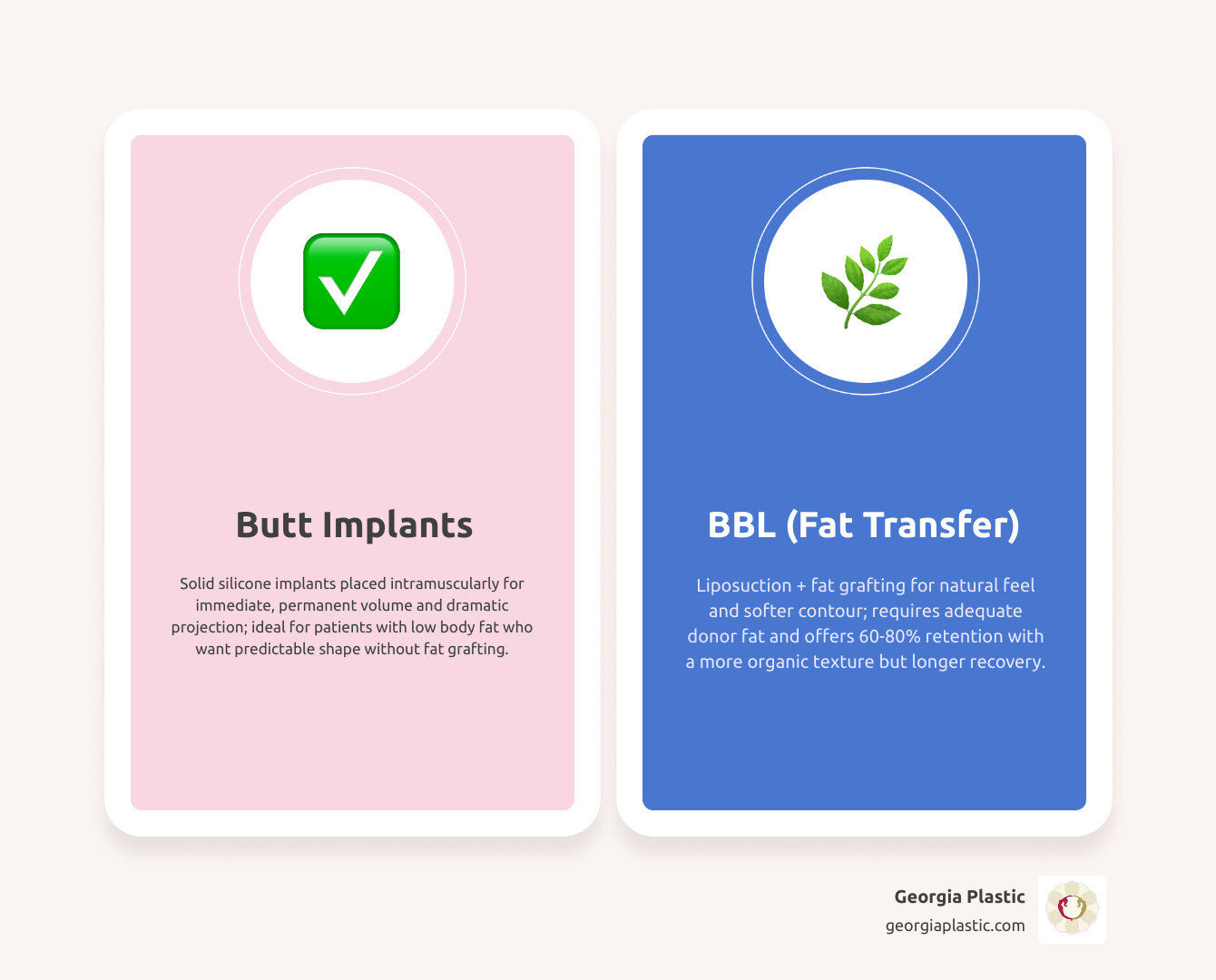
Basic butt implants vocab:
What Are Butt Implants and How Do They Compare to BBL?
At the simplest level, butt implants add volume with a prosthetic implant, while a BBL adds volume with your own fat. Both can improve shape and projection, but they work very differently.
Nationally, BBL remains far more common. Research cited above shows about 29,466 BBL procedures are performed annually versus roughly 1,245 butt implant procedures, meaning BBL accounts for about 96% of buttock augmentation cases. That does not mean implants are obsolete. It means implants are a more specialized option, often best for a narrower group of patients.
| Feature | Butt Implants | BBL |
|---|---|---|
| Volume source | Solid silicone implant | Your own transferred fat |
| Best for | Patients with little body fat | Patients with enough donor fat |
| Results timeline | Immediate volume | Swelling first, then final result over months |
| Longevity | Long-lasting, semi-permanent | Long-lasting, but some fat loss is expected |
| Feel | Can feel natural when well placed | Usually feels most natural |
| Shape change | More predictable projection | Softer, more subtle contouring |
| Body contouring bonus | Not by itself | Yes, through liposuction |
| Recovery issue | Sitting discomfort and implant healing | Protecting fat survival |
What butt implants are and how they work
Butt implants are usually made from solid or semi-solid silicone elastomer designed specifically for the gluteal area. Unlike breast implants, they are not liquid-filled. They are firmer, tougher, and built to tolerate daily pressure and movement better.
During surgery, we create a pocket and place the implant inside or in relation to the gluteal muscle to increase fullness and projection. Because the implant itself supplies the volume, the size change is visible right away.
If you want a medical overview, What to Know About Butt Implants offers a general third-party summary. You can also learn more on our Buttock Implants page.
Butt implants vs Brazilian Butt Lift
A BBL uses liposuction to remove fat from areas like the abdomen, flanks, or thighs, then purifies and reinjects that fat into the buttocks. This can create a very natural look and feel, but it depends on having enough donor fat and accepting that some transferred fat will not survive. Most patients retain about 60% to 80% of transferred fat after healing.
That leads to the biggest practical differences:
- Butt implants are often better for patients with low BMI or minimal fat stores.
- BBL is often better for patients who want softer enhancement plus body contouring from liposuction.
- Implants offer more predictable projection.
- BBL can feel more natural because it uses your own tissue.
For another medical overview, see Butt Implants: Surgery, Recovery, Scars & vs. BBL. We also break down the differences here: Implants vs Fat Transfer for Buttock Augmentation.
Types of Butt Implants, Materials, and Ideal Candidates
Not all gluteal implants are one-size-fits-all. Shape, width, projection, and firmness all matter. In real patient examples from the research, implant sizes ranged from 276cc to 460cc. The right size depends on anatomy, skin quality, tissue thickness, and your overall proportions.
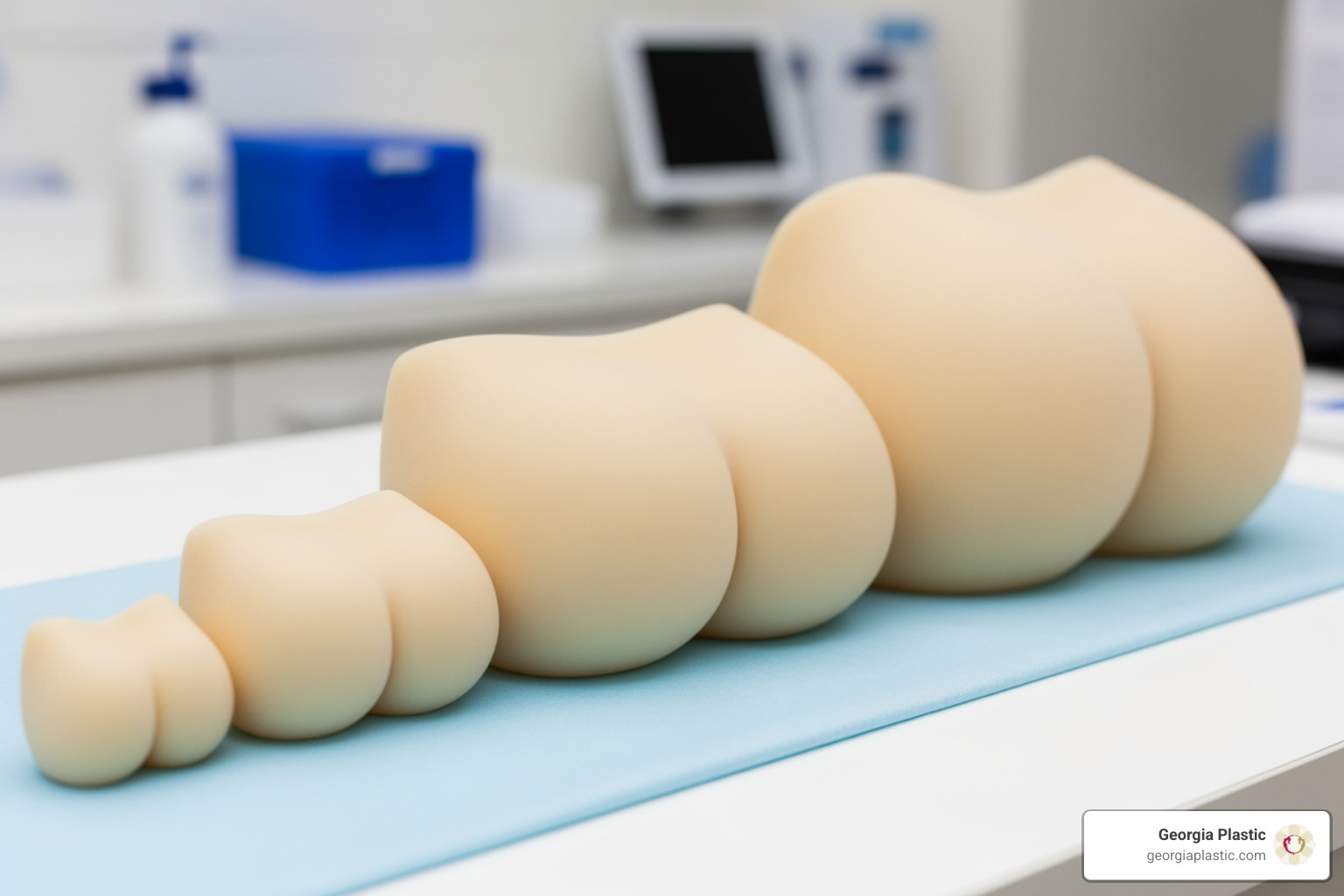
Materials and styles used in butt implants
Most modern butt implants are made of solid silicone or semi-solid silicone elastomer. Silicone dominates the market, with research above noting about 65% market share because of its durability and safety record.
Common features include:
- Round or oval shapes
- Smooth outer surface
- Different projection profiles
- Firm construction to mimic support and withstand pressure
These implants are different from breast implants. They are denser and less compressible, because the buttocks have to handle sitting, walking, stairs, workouts, and all the glamorous things life throws at them.
Who is a good candidate for butt implant surgery?
The best candidates are usually people who want more shape but do not have enough extra fat for a BBL.
In general, ideal candidates include people who:
- Have flat, square, or under-projected buttocks
- Have low BMI or an athletic build with minimal fat stores
- Want more dramatic or predictable projection
- Have buttock asymmetry
- Are at a stable weight
- Do not smoke
- Are in good general health
- Do not have medical issues that strongly impair healing
- Have realistic expectations about scars, recovery, and risks
Butt implants can be especially useful for lean patients. We discuss that in more detail here: Buttock Implants for Patients with Little Body Fat.
Patients who are not ideal candidates may include:
- Smokers unwilling to stop before and after surgery
- People with uncontrolled diabetes or other healing problems
- Patients seeking correction mainly for loose, sagging skin rather than volume loss
- Anyone expecting a completely risk-free procedure
When a combined approach may make sense
Sometimes the best answer is not implants alone or fat transfer alone, but both.
A hybrid plan may include:
- Butt implants for core projection
- Fat transfer to soften edges and improve transitions
- Waist liposuction to enhance the overall silhouette
This can work well in patients who want reliable volume but also want a smoother, more natural contour. We explore this option further in Want Bigger Backside Without Fat Transfer? Try Buttock Implants.
How the Procedure Works: Incisions, Placement, and Surgical Steps
Butt implant surgery usually takes about 2 to 3 hours, depending on complexity and whether we combine it with liposuction or fat grafting.
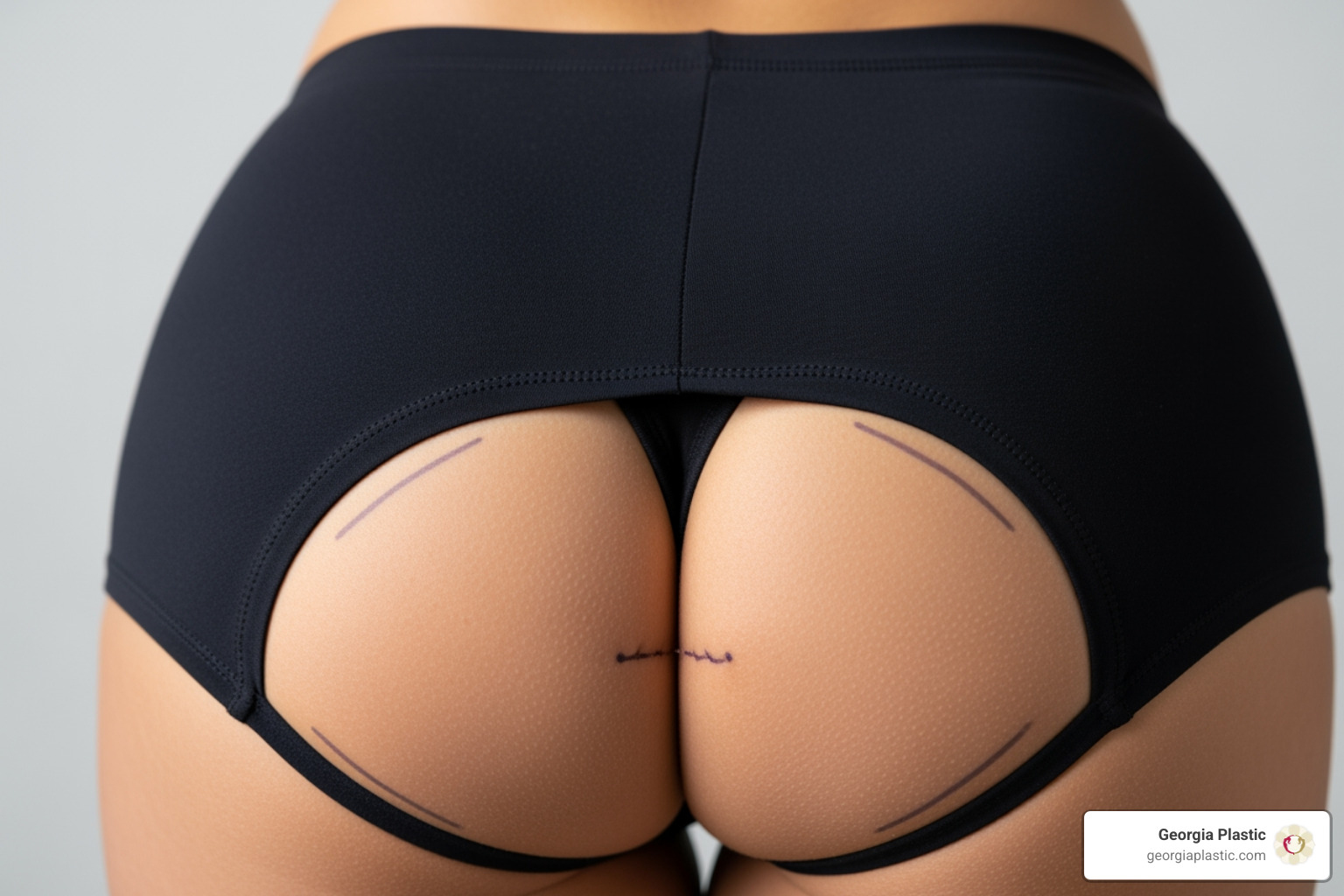
Incision placement and implant positioning
Incisions are typically placed where scars can be concealed as much as possible, often in or near the intergluteal crease, sacral area, or another naturally hidden fold.
Placement options may include:
- Intramuscular: within the gluteus muscle
- Subfascial: above the muscle but under the fascia
- Submuscular or deeper placement in selected cases
Each plane has trade-offs. Intramuscular placement is commonly favored because it can provide good coverage and reduce implant visibility. Some literature notes that deeper placement may create a more natural contour in some patients but can come with greater technical challenges and higher concern around nearby structures such as the sciatic nerve. That is one reason surgeon experience matters so much.
Step-by-step overview of butt implant surgery
A typical butt implant procedure includes:
Consultation and planning
We evaluate your anatomy, skin quality, body proportions, and goals. We choose implant size and shape carefully rather than chasing a number for bragging rights at brunch.Surgical markings
Before surgery, we mark landmarks, implant position, and symmetry points.Anesthesia
Most butt implant surgery is performed under general anesthesia.Incision and pocket creation
We make the planned incision and carefully create a pocket for each implant.Implant placement
The implants are inserted and positioned to achieve balanced shape and projection.Symmetry check
We assess both sides closely. Tiny differences matter a lot in a paired structure.Closure
We close the incision in layers. Drains may be used in some cases to reduce fluid buildup.Dressings and compression
Compression garments and dressings are applied, and you are monitored in recovery before going home.
If you want to see examples of surgical outcomes, visit our Gallery Buttock Implants.
Butt implants for men and body-specific planning
Men can also be strong candidates for gluteal implants, but the planning is different. Male buttock augmentation usually aims for a firmer, more athletic, less rounded contour than many female cases.
When we plan surgery for men, we consider:
- Pelvic shape
- Existing gluteal muscle mass
- Desired athletic definition
- Clothing fit and body balance
Learn more in Gluteal Implants for Men: The Hard Facts and view examples in our Gallery Male Buttocks Implant.
Risks, Safety, Recovery, and Long-Term Results
This is the part where we skip the sugarcoating. Butt implant surgery can produce excellent results, but it has a meaningful complication profile.
Safety considerations and complication risks
Research referenced above reports an overall complication rate of 21.6% for buttock implants and a revision rate of 17.8%. That is higher than BBL’s reported overall complication rate of 9.9%, although the complication types differ.
Possible risks include:
- Infection
- Seroma, or fluid collection
- Bleeding
- Wound separation
- Implant malposition or rotation
- Capsular contracture
- Asymmetry
- Numbness or sensory changes
- Nerve injury
- Scarring
- Blood clots
- Need for revision or implant removal
Some implant-specific complications are localized rather than systemic, but they are still significant. If infection occurs, prompt treatment is critical, and implant removal may be necessary in serious cases.
Good safety habits matter:
- Choose a board-certified plastic surgeon
- Confirm the surgical facility is accredited
- Stop smoking well before surgery
- Follow recovery instructions exactly
Recovery timeline and post-op care
Recovery is not instant, and the first few weeks require patience. Most patients can walk the same day, which helps circulation and lowers clot risk, but direct pressure on the buttocks must be limited.
Common milestones include:
- First 48 hours: rest, short walks, soreness, swelling, careful wound care
- 48 hours and beyond: many patients can shower if cleared
- First 2 weeks: no direct sitting unless specifically instructed, or only with modified positioning
- About 2 to 3 weeks: many desk-job patients return to work with a pillow or pressure-relief strategy
- 4 to 6 weeks: gradual return to more activity
- Around 6 weeks: back to the gym for light exercise if approved
- Around 8 weeks: lower-body and glute-focused training may resume with surgeon approval
- About 3 months: most swelling has settled and the implants feel more familiar
Helpful recovery rules usually include:
- Sleep on your stomach or side early on
- Wear compression garments as directed
- Take short walks right away
- Avoid smoking and vaping
- Keep follow-up appointments
- Call us for fever, severe swelling, drainage, chest pain, shortness of breath, or worsening pain
A common patient question is whether sitting feels strange. Early on, yes, it can. Many patients describe it as awkward more than painful after the initial healing period. By about six weeks, comfort improves, and by three months many people adjust so well they stop noticing the implants in daily life.
How long butt implants last and what affects longevity
Buttock implants are generally considered semi-permanent, long-lasting devices. They are not usually replaced on a routine schedule the way people sometimes discuss breast implants.
Many patients keep them for 10 to 15 years or longer, and some never need revision. Longevity depends on:
- Implant quality
- Surgical technique
- Placement plane
- Your anatomy and tissue support
- Weight changes
- Aging and gravity
- Trauma or complications
Reasons for revision can include:
- Implant shift
- Hardening or capsular contracture
- Infection
- Desire for a different size
- Asymmetry over time
Cost of Butt Implants and How to Choose Between Implants and BBL
The average cost of butt implant surgery is about $7,992, but published ranges vary widely from roughly $3,500 to $22,000. That big spread is not random. It reflects surgeon experience, geography, facility type, and whether other procedures are added.
What affects butt implant pricing
Your quote may include:
- Surgeon fee
- Anesthesia fee
- Operating room or facility fee
- Implant cost
- Pre-op testing
- Post-op garments
- Prescriptions
- Follow-up care
- Combined procedures such as liposuction or fat grafting
In Atlanta, pricing will also reflect local market conditions and the surgeon’s experience with gluteal augmentation. The cheapest option is rarely the best value when revision surgery is expensive and recovery is no joke.
Butt implants vs BBL for safety, results, and recovery
This choice depends on anatomy, goals, and tolerance for trade-offs.
Butt implants may be better if you:
- Have very little body fat
- Want stronger projection
- Want more predictable volume retention
BBL may be better if you:
- Have enough donor fat
- Prefer a softer, more natural feel
- Like the added contouring benefit of liposuction
Safety is more nuanced. BBL has historically carried concern for fat embolism, though improved technique has reduced reported mortality risk from about 1 in 3,000 to around 1 in 14,900. Butt implants do not carry that same embolism risk, but they do have higher overall local complication and revision rates in the data above.
Recovery also differs:
- Implants: earlier sitting modifications, incision healing, implant settling
- BBL: more prolonged protection of transferred fat and longer sitting restrictions in many cases
For a direct comparison, see Brazilian Butt Lift vs Buttock Implants.
Frequently Asked Questions About Butt Implants
Do butt implants feel natural and are they uncomfortable?
They can feel natural when properly selected and placed, especially in patients with enough soft tissue coverage. That said, they do not feel exactly like untreated tissue. In the first several weeks, sitting often feels unusual. Most patients say it becomes much more comfortable after about six weeks, and many adapt fully by three months.
How much time off work will I need after butt implants?
Plan on at least two weeks off if your job requires sitting. Some desk-job patients return around 2 to 3 weeks using careful positioning or a pillow. If your work is physical, involves lifting, or requires a lot of movement, you may need longer.
Will butt implants leave scars?
Yes. Any surgical incision leaves a scar. The goal is to place scars where they are less visible, often within a natural crease. Scars usually look firmer and more noticeable early on, then soften and fade over time. Full scar maturation can take many months.
Good scar care includes:
- Keeping the incision clean
- Avoiding tension on the wound
- Following all dressing instructions
- Protecting healing skin as directed by your surgeon
Conclusion: Is Butt Implant Surgery Right for You?
Butt implants can be an excellent option for the right patient, especially if you want lasting projection but do not have enough body fat for a BBL. They can also be a smart solution for lean or athletic patients, for asymmetry, or when a more dramatic shape change is the goal.
But this is not a casual procedure. It requires careful planning, a real commitment to recovery, and an experienced surgeon who prioritizes safety as much as aesthetics.
At Georgia Plastic & Reconstructive Surgery, we believe the best results come from matching the procedure to the patient, not the other way around. We focus on personalized planning, natural-looking balance, and safety-first care at every step.
If you are exploring your options, start here:
If you are ready to discuss your anatomy, goals, and whether implants, fat transfer, or a combined approach makes the most sense, a consultation is the best next step.


