
What Is the Earlobe Repair Recovery Time?
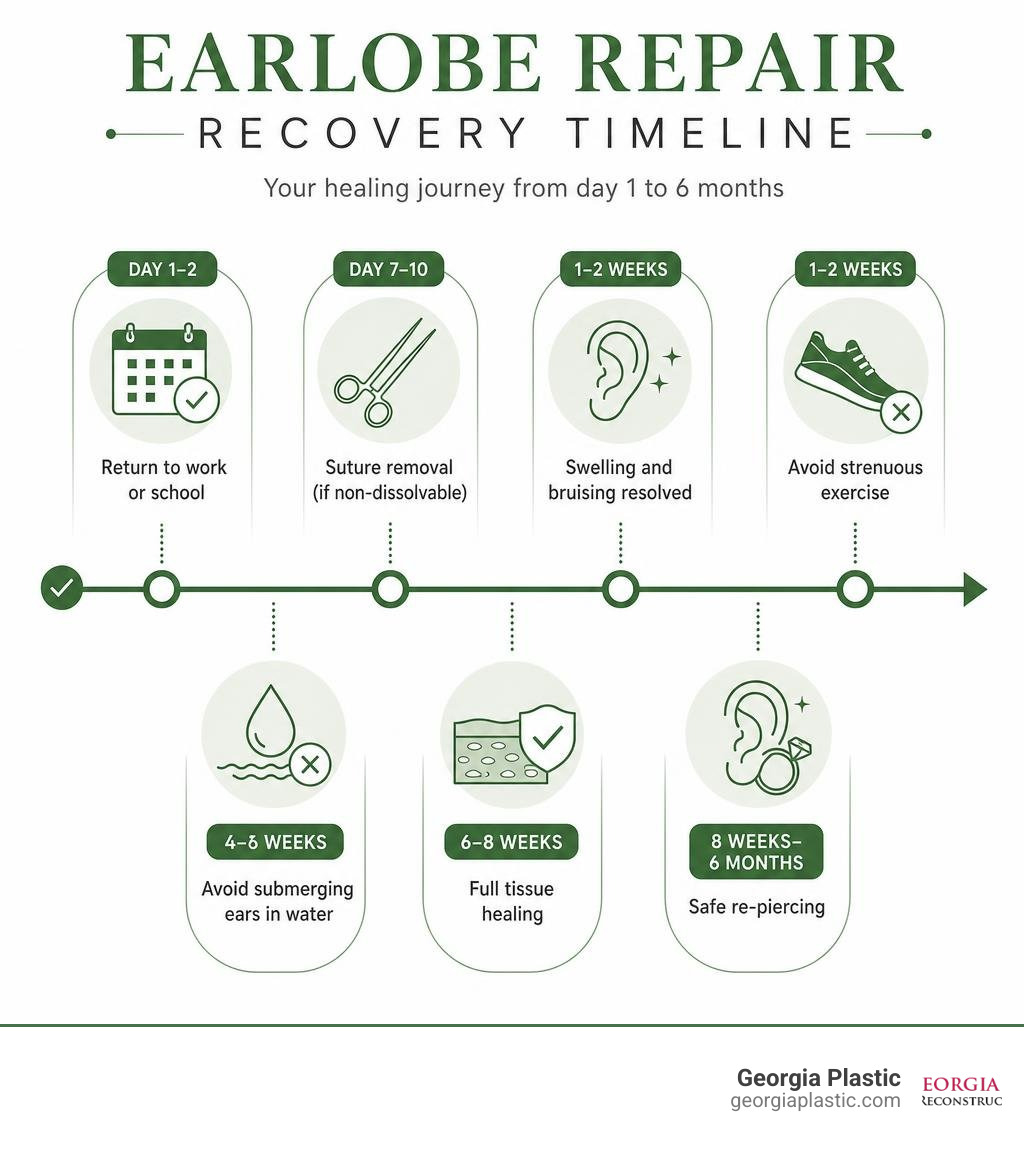
Earlobe repair recovery time is typically short, with most patients back to their daily routine within 1–2 days. Here is a quick overview of the key milestones:
| Recovery Milestone | Typical Timeframe |
|---|---|
| Return to work or school | 1–2 days |
| Suture removal (if non-dissolvable) | 7–10 days |
| Swelling and bruising resolved | 1–2 weeks |
| Avoid strenuous exercise | 1–2 weeks |
| Avoid submerging ears in water | 4–6 weeks |
| Full tissue healing | 6–8 weeks |
| Safe re-piercing | 8 weeks to 6 months |
Your earlobes go through a lot. Heavy earrings, gauges, accidental snags — over time, these can stretch or tear the tissue in ways that don’t fix themselves. If you’ve been living with a split or stretched earlobe, you may be surprised to learn that the fix is simpler — and the recovery faster — than you’d expect.
Earlobe repair (also called lobuloplasty) is one of the most commonly performed procedures by plastic surgeons. It’s done in-office, under local anesthesia, and usually takes less than an hour. Most people walk out the same day and head back to their normal life almost immediately.
But knowing exactly what to expect — day by day, week by week — makes the process much smoother.
This guide walks you through every stage of recovery, from the first 24 hours to the moment you’re cleared to re-pierce.
I’m Dr. Stanley Okoro, a double board-certified plastic surgeon and founder of Georgia Plastic and Reconstructive Surgery, with extensive experience performing earlobe repair procedures and guiding patients through a smooth earlobe repair recovery time. I’ll walk you through everything you need to know so you can heal confidently and get back to wearing the earrings you love.
Basic earlobe repair recovery time vocab:
What to Expect: Your Earlobe Repair Recovery Time
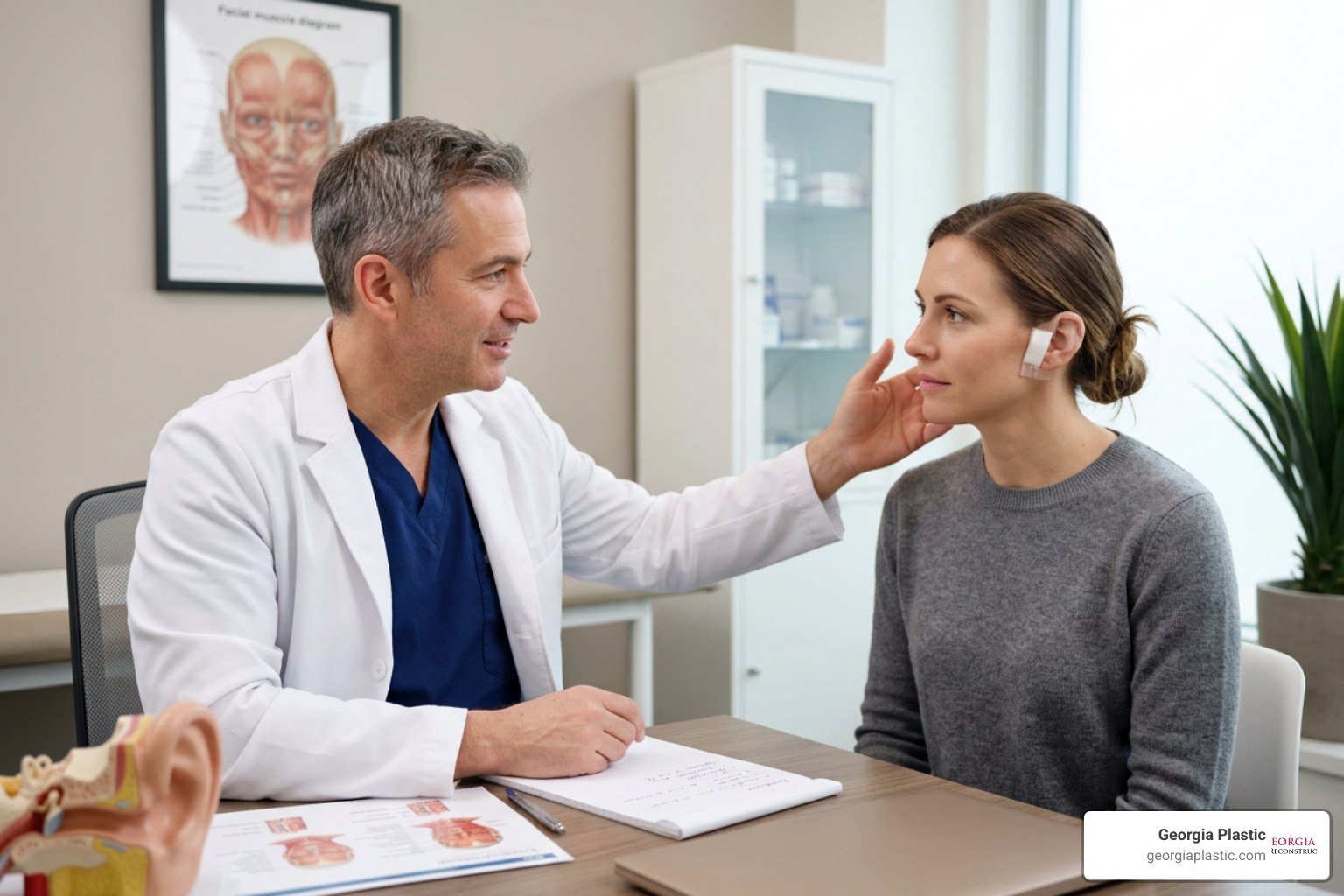
When patients visit us at Georgia Plastic & Reconstructive Surgery, one of their first questions is almost always: “How long will it take to look normal again?”
The beautiful thing about the earlobe is its highly vascularized nature. Because the earlobe is packed with tiny blood vessels and contains no cartilage (only skin and fat), it has an incredible capacity to heal. This rich blood supply means that your earlobe repair recovery time is remarkably swift compared to other cosmetic or reconstructive surgeries.
However, “healed on the outside” is not the same as “fully strong on the inside.” While your skin will close and look completely normal within a week or two, the deep internal tissue takes several months to regain its original structural integrity. Understanding this distinction is the key to preventing a recurrent tear.
There are several Reasons to Consider Earlobe Repair Surgery, ranging from a complete traumatic split to a slowly stretched-out piercing hole. To help you plan your schedule, we have broken down the typical recovery milestones based on the severity of the initial damage:
| Damage Severity | Surgical Requirement | Return to Work | Stitch Removal | Full Internal Healing |
|---|---|---|---|---|
| Simple Split / Tear | Straightforward excision & closure | 1 Day | 7 Days | 6–8 Weeks |
| Stretched Piercing | Removal of internal skin tunnel & closure | 1–2 Days | 7 Days | 8–12 Weeks |
| Gauged Earlobe | Complex tissue rearrangement (Z-plasty) | 1–2 Days | 7–10 Days | 12–16 Weeks |
| Keloid Scar Removal | Excision + localized healing therapy | 1–2 Days | 7–10 Days | 12–24 Weeks |
As you can see, even if you are recovering from large-gauge dilations that require a more complex, puzzle-like tissue rearrangement, your downtime from work or school remains incredibly minimal.
Factors That Influence Your Earlobe Repair Recovery Time
While the timelines above represent the average experience, everyone’s body marches to the beat of its own drum. Several individual factors can nudge your recovery timeline in one direction or another:
- The Extent of the Damage: A simple, clean split from a single snag heals faster than an earlobe that has been stretched out to two inches by heavy gauges. Gauged ears often require us to trim away excess skin and rotate healthy tissue flaps to recreate a natural, rounded lobe contour. More tissue manipulation naturally requires a slightly longer cellular healing process.
- The Chosen Surgical Technique: Simple linear closures heal quickly but can sometimes leave a tiny “notch” at the bottom of the lobe. To prevent this, we often utilize advanced techniques like a Z-plasty or inverted V-plasty. These methods redistribute tension and camouflage the scar in the natural creases of your ear, though they may take a few extra days to settle.
- Individual Health and Lifestyle: Your body needs resources to rebuild tissue. Factors like your nutritional status, hydration levels, and overall immune health play a major role. For instance, smoking severely restricts blood flow by constricting tiny blood vessels, which can drastically delay your healing.
- Wound Care Compliance: How well you follow your post-operative instructions is the single biggest factor under your control. Keeping the site clean, moist, and protected from physical trauma ensures that the delicate new skin cells can lay down a strong foundation without interruption.
For a deeper dive into how cellular health and systemic factors dictate how quickly our bodies mend, you can read this Scientific research on wound healing factors.
Step-by-Step Earlobe Healing: The First 7 Days
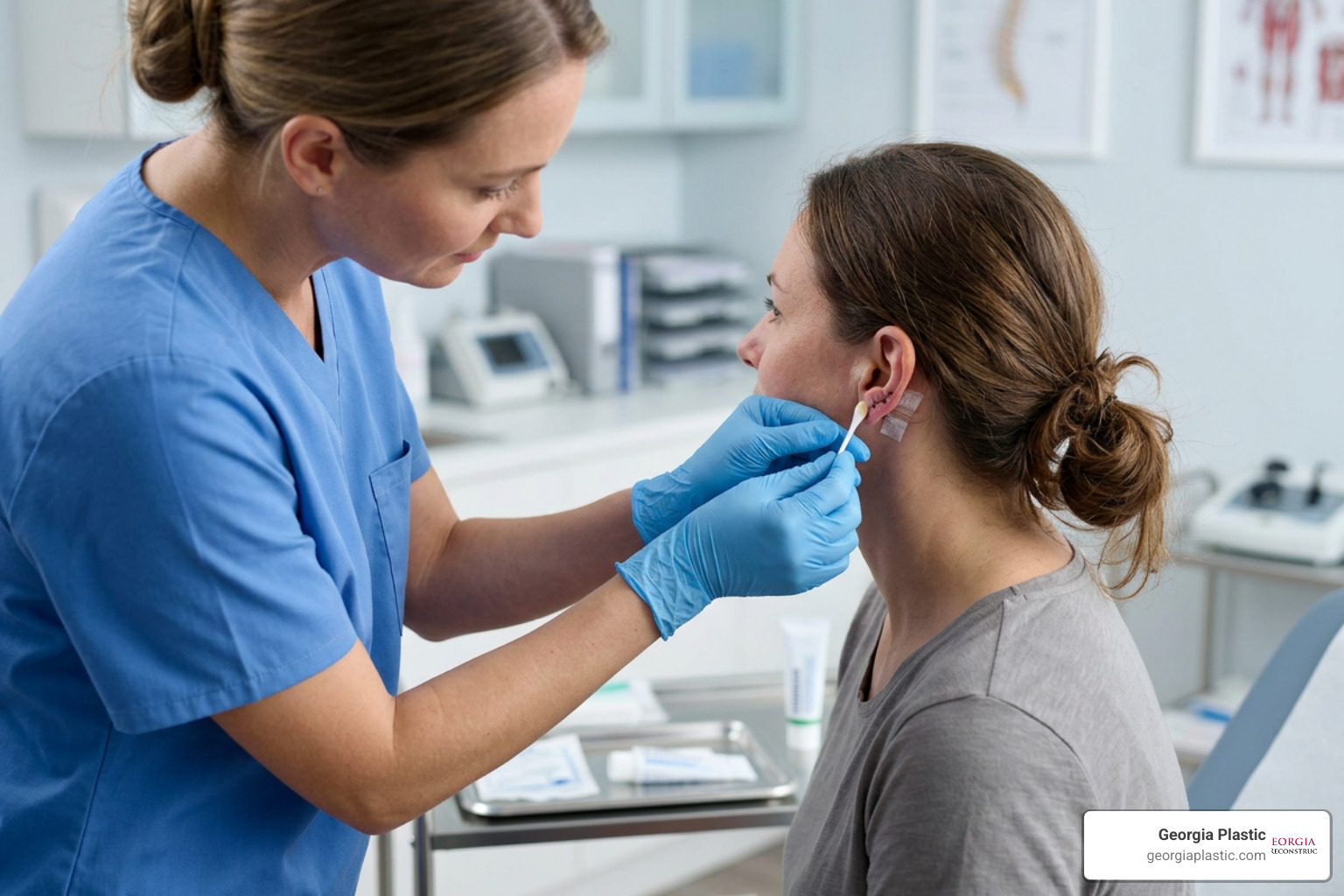
The first week of your earlobe repair recovery time is when the most active healing occurs. During this phase, your body initiates an inflammatory response to clear out any debris and begins building a temporary matrix of collagen to seal the incision.
Whether you are recovering from a simple tear or a complex reconstruction, we outline the exact steps you need to take in The Complete Guide to Earlobe Repair to keep your healing on the fast track. Let’s break down what those first seven days look like on a practical, day-by-day basis.
Immediate Post-Op Care (Days 1–3)
When you leave our Atlanta office, the local anesthesia will still be keeping your ears completely numb. As it wears off over the next few hours, you will not feel sharp pain, but rather a mild, warm throbbing or a sensation of tightness. This is completely normal and is easily managed with over-the-counter pain relievers like Tylenol or ibuprofen.
Here is your checklist for the first 72 hours:
- Keep It Dry (First 24 Hours): Avoid showering or washing your hair for the first 24 hours to give the fresh incision line time to seal. If you must wash your body, take a shallow bath or use a handheld showerhead, keeping your head completely dry.
- Cleanse Gently (Starting Day 2): After the first 24 hours, you can gently clean the area. Use a mild, fragrance-free soap and warm water. Do not scrub or let the direct, high-pressure shower spray hit your ears. Instead, cup water in your hand and gently splash the area, then pat it dry with a clean paper towel.
- Apply Ointment: Keep a thin layer of plain Vaseline or an over-the-counter antibiotic ointment (like Bacitracin) on the incision line at all times. Think of this as a protective shield. A moist wound environment prevents hard scabs from forming, which actually reduces scarring and speeds up the migration of new skin cells.
- Watch Your Sleeping Position: This is perhaps the hardest part for side-sleepers! For the first few nights, you must sleep on your back with your head elevated on two or three pillows. This elevation uses gravity to drain fluid away from your head, minimizing morning swelling. If you absolutely must sleep on your side, consider using a travel neck pillow (the donut-shaped kind) and placing your ear directly in the center hole so it doesn’t touch the fabric.
Early Healing and Suture Removal (Days 4–7)
By day four, any initial throbbing should have completely subsided. You might begin to experience a new sensation: itching. Itching is a classic sign that your nerves are waking up and your skin is actively knitting back together. Resist the urge to scratch! Continue applying your ointment to keep the skin hydrated and soothe the itch.
During this mid-week stretch, you will notice the incision line looking cleaner. Any initial redness or mild bruising will start fading from a deep purple to a light yellow or green.
Depending on the specific surgical plan we designed for you, you will either have dissolvable stitches or traditional, non-dissolvable sutures:
- Dissolvable Sutures: These are highly convenient and will gradually soften and wash away on their own over 10 to 14 days, meaning you won’t need to have them physically pulled out.
- Non-Dissolvable Sutures: If we used ultra-fine nylon sutures to achieve the absolute sharpest, flattest scar possible, you will return to our office around day 7 for a quick, completely painless suture removal.
Once those stitches are out or dissolved, you are well on your way to getting your normal routine back. To understand the cosmetic transformation that occurs during this week, you can read our detailed guide on How to Repair an Earlobe Tear and Get Your Sparkle Back.
Activity Restrictions and Precautions During Recovery
Because you will feel great within 48 hours, it is incredibly tempting to jump right back into your normal, high-energy routine. However, your healing earlobes are still delicate. Accidental trauma, excessive tension, or exposure to bacteria can quickly derail your progress.
To ensure you remain an Earlobe Repair Otoplasty Good Candidate throughout your entire healing journey, we ask that you adhere to the following simple precautions:
- Exercise Restrictions: You can resume light walking the very next day. However, avoid strenuous cardiovascular workouts, heavy lifting, or any activity that causes intense facial flushing for the first 1 to 2 weeks. Increased blood pressure can cause the delicate, newly forming capillaries in your earlobe to rupture, leading to localized bleeding or late-stage swelling.
- Avoid Contact Sports: For at least 3 to 4 weeks, stay away from sports where a ball, a hand, or a helmet could brush against or snag your ear. This includes basketball, soccer, wrestling, and even high-intensity yoga where your head is pressed against a mat.
- Water Exposure Warnings: You may shower and wash your hair normally after the first 24 hours, but you must strictly avoid submerging your head in water. This means no swimming pools, hot tubs, lakes, or oceans for 4 to 6 weeks. Standing water is a breeding ground for bacteria, and soaking a fresh surgical scar can soften the tissue too much, causing the wound edges to pull apart.
- Sun Protection is Essential: Fresh scars are highly sensitive to ultraviolet (UV) radiation. If your healing earlobe is exposed to direct sunlight during the first six months, it can trigger hyperpigmentation, turning the scar a permanent dark brown or deep purple color. Whenever you go outside, wear a wide-brimmed hat, or apply a mineral-based SPF 30+ sunscreen directly to the healed incision line once the skin has fully closed (usually around week two).
- Be Mindful of Clothing and Hairbrushes: This is a sneaky one! When pulling tight t-shirts, sweaters, or hoodies over your head, do so slowly and carefully. It is incredibly easy to snag a healing earlobe on a tight collar. Similarly, when brushing your hair, keep a free hand over your ear as a shield to prevent the brush bristles from catching the healing tissue.
Safe Re-Piercing After Earlobe Repair
For many of our patients, the ultimate goal of earlobe repair is not just to have a smooth, normal-looking ear — it is to finally wear beautiful earrings again!
However, rushing this step is the number one cause of re-injury. If you pierce too early, or in the wrong spot, the delicate scar tissue will simply split open again under the weight of even the lightest jewelry.
Before scheduling your piercing appointment, we highly recommend browsing our Gallery: Earlobe Repair to see the beautifully healed, natural results of patients who patiently followed our timeline.
When Can You Safely Re-Pierce Your Ears?
The golden rule of re-piercing after an earlobe repair is patience.
While the skin on the outside looks completely healed within a couple of weeks, the internal remodeling of collagen fibers continues for months. Scar tissue never quite reaches 100% of the strength of original, undamaged skin; at best, it tops out at about 80% strength after a full year.
Because of this, we recommend the following timeline:
- Minimum Wait Time: You must wait a bare minimum of 8 to 12 weeks before re-piercing.
- Ideal Wait Time: For the absolute safest results, especially if you had a complex gauged ear reconstruction or a severe traumatic tear, waiting 3 to 6 months is highly recommended. This extra time allows the scar tissue to mature, flatten, and soften, making the re-piercing process much more comfortable and stable.
When you are finally ready to re-pierce, keep these crucial guidelines in mind:
- The 3mm Rule: Never pierce directly through the surgical scar. Scar tissue is structurally weaker than the surrounding healthy skin and lacks the elasticity to hold a piercing post. Your new piercing must be placed at least 3 millimeters (about 0.12 inches) away from the scar line — either slightly above it or to the side.
- Go to a Professional: Avoid the mall piercing guns at all costs. Piercing guns use blunt force to ram a stud through the tissue, which can easily shatter or tear your delicate, repaired earlobe. Instead, visit a professional piercer who uses a sterile, single-use hollow needle. Needles create a clean, precise channel with minimal trauma to the surrounding tissue.
- Start Light: For the first six months after your new piercing, wear only lightweight, hypoallergenic studs made of high-quality gold, silver, or implant-grade titanium. Avoid heavy, dangling, or chandelier-style earrings entirely. Give your ears a full year of total healing before introducing any jewelry that exerts downward pull.
Minimizing Risks and Optimizing Your Earlobe Repair Recovery Time
While earlobe repair is incredibly safe, no surgical procedure is completely without risk. By taking proactive steps, you can drastically minimize the chances of complications like infection, prolonged swelling, or thick scarring.
- Infection Prevention: Wash your hands thoroughly with soap and water before touching your ears for any reason. Keep your phone screen sanitized with alcohol wipes, as you press it against your ear multiple times a day. If you have long hair, try keeping it tied back in a ponytail or bun for the first week to prevent hair oils and styling products from irritating the incision.
- Scar Management: Once your stitches are removed and the skin is fully closed (around day 10 to 14), you can transition from petroleum ointment to medical-grade silicone scar gel. Applying a thin layer of silicone gel twice daily is clinically proven to keep the tissue hydrated and encourage collagen fibers to lay down in a flat, orderly fashion.
- Keloid Prevention: If you have a personal or family history of keloids (thick, raised, overgrown scars), let us know during your consultation. We can use specialized suturing techniques, recommend pressure earrings, or perform localized steroid injections during your recovery to keep keloid formation at bay.
For clinical insights into how medical-grade treatments help minimize post-surgical scarring, you can read this Scientific research on scar management.
Frequently Asked Questions about Earlobe Repair
Is earlobe repair surgery painful?
Not at all! The entire procedure is performed under local anesthesia, which completely numbs the earlobe. You will feel a quick pinch from the initial numbing injection, but after that, you will feel absolutely nothing during the surgery itself.
After the anesthesia wears off, most patients describe the sensation as a mild, warm throb, similar to a minor sunburn. This discomfort is easily managed with over-the-counter pain relievers like Tylenol or ibuprofen and typically disappears entirely within 24 to 48 hours.
Can both earlobes be repaired at the same time?
Yes, absolutely! In fact, we highly recommend repairing both ears during a single visit if both are damaged.
Performing a bilateral repair allows us to achieve the absolute best possible symmetry between your left and right earlobes. Plus, it means you only have to go through one recovery period, one week of sleeping on your back, and one timeline before you can get both ears re-pierced.
Will there be a visible scar after my earlobe heals?
Because a surgical incision is required to freshen the edges of the tear and close them back together, a scar is an inevitable part of the healing process. However, because the earlobe heals so well, this scar is typically incredibly faint, thin, and hard to see.
By using precise suturing techniques and hiding the incision line in the natural creases of your ear, the scar will gradually fade from a faint pink line to a tiny, nearly invisible white line over several months. Following proper aftercare, using silicone scar gel, and practicing strict sun protection will ensure your scar heals beautifully.
Conclusion
A torn, split, or stretched earlobe can make you feel self-conscious and keep you from wearing the jewelry that expresses your personal style. Fortunately, you do not have to live with it. Earlobe repair is a quick, highly effective, and virtually painless outpatient procedure that can restore a natural, harmonious contour to your ears with almost zero downtime.
At Georgia Plastic & Reconstructive Surgery, we understand that even the smallest cosmetic concerns can have a major impact on your confidence. Led by board-certified plastic surgeon Dr. Stanley Okoro, our team is dedicated to providing personalized care that delivers natural-looking results while keeping your safety and comfort as our absolute highest priorities.
If you are ready to restore your earlobes and get your sparkle back, we invite you to take the first step. Schedule a personalized consultation for Earlobe Repair in Atlanta with us today, and let us help you bounce back beautifully!


