
Why Nasolabial Folds Are One of the Most Challenging Signs of Aging to Treat
A facelift for nasolabial folds is one of the most effective long-term solutions for the deep smile lines that run from the sides of your nose to the corners of your mouth. Here’s a quick overview of your main options:
| Treatment | How It Works | How Long It Lasts |
|---|---|---|
| Dermal fillers | Adds volume to soften folds | 6-18 months |
| Thread lift | Lifts tissue with dissolvable threads | 1-2 years |
| Mini facelift | Repositions superficial tissue in lower face | 5-7 years |
| Deep plane facelift | Releases ligaments and lifts deep tissue layers | 10-15 years |
The deeper and more established your folds are, the more likely you’ll need a surgical approach for a result that actually lasts.
Nasolabial folds are completely normal. Every face has them. But as you age, fat deflates, ligaments loosen, and the soft tissue of your midface descends – making those lines look deeper and casting sharper shadows across your face. That shift in light and shadow is what makes a face look tired or older than it feels.
Non-surgical options like fillers can help, but they don’t fix the underlying structural changes. That’s why many patients eventually explore surgery.
I’m Dr. Stanley Okoro, a double board-certified plastic surgeon and founder of Georgia Plastic and Reconstructive Surgery, with extensive experience performing advanced facial procedures – including facelift for nasolabial folds – using techniques focused on natural, long-lasting results. In this guide, I’ll walk you through exactly how modern facelift techniques target the root causes of smile lines, so you can make an informed decision.
Understanding the Anatomy of Nasolabial Folds
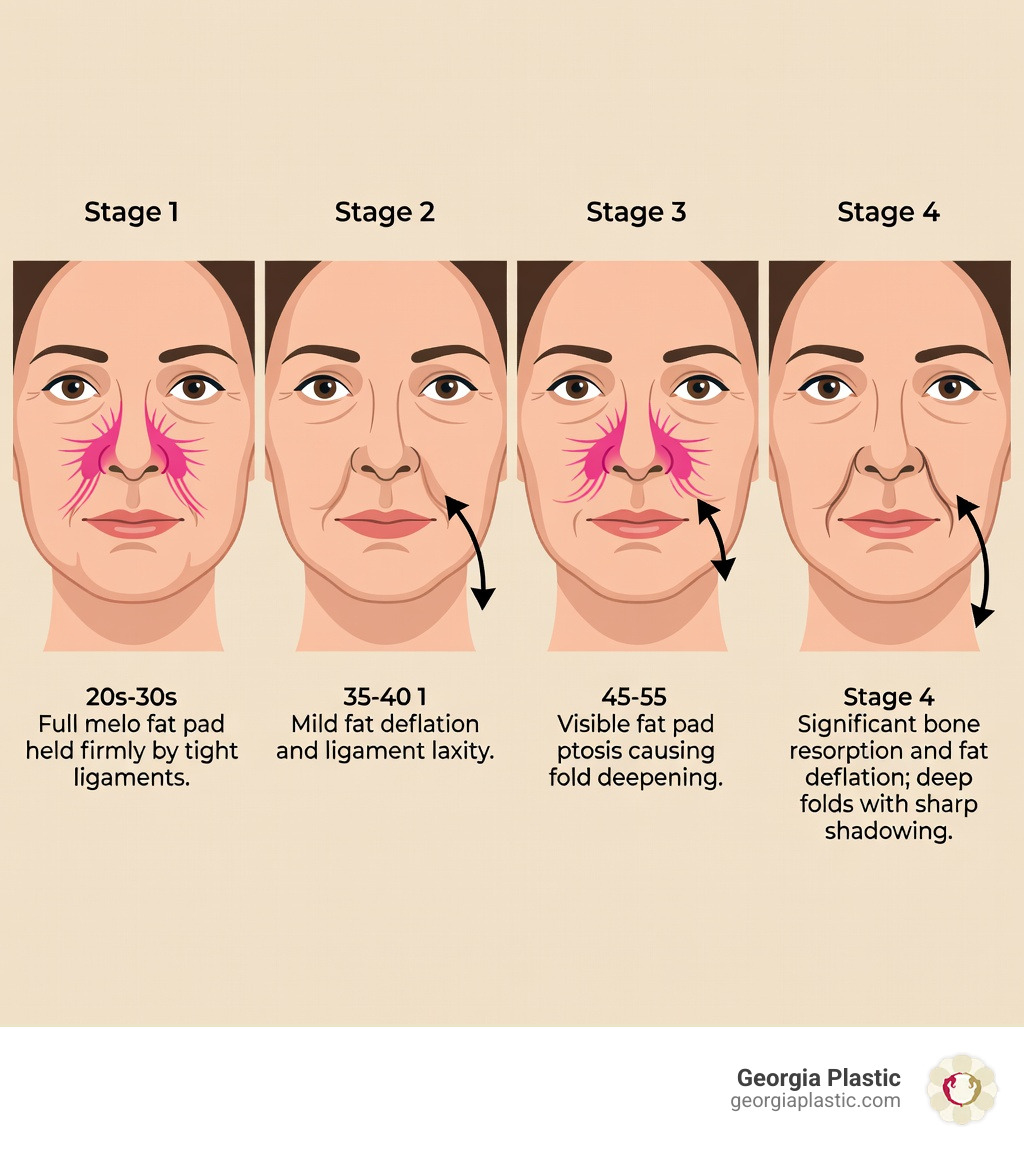
To understand why a facelift for nasolabial folds is necessary, we first have to look at what is happening beneath the skin. The nasolabial fold (often more accurately called the melolabial fold) is the boundary between the cheek and the upper lip. It isn’t just a “wrinkle” in the skin; it is a complex intersection of fat, muscle, and connective tissue.
The primary player here is the melo fat pad (MFP), often traditionally called the malar fat pad. This is a triangular thickened area of subcutaneous fat that sits over your cheekbones. In a youthful face, this fat pad is held high by strong “anchors” called the retinacula cutis. These are tiny fibers that act like a honeycomb, connecting your skin to the deeper structures of your face.
As we age, several things happen simultaneously:
- Midface Descent: Those honeycomb fibers (retinacula cutis) stretch out. Gravity takes over, and the MFP begins to slide downward and inward toward the nose and mouth.
- Soft Tissue Thinning: Research shows that perioral soft tissue thickness can decrease by up to 40% due to fat deflation and muscle atrophy. This makes the underlying “crease” where muscles attach to the skin much more visible.
- Maxillary Resorption: Even our bones aren’t immune. The maxilla (upper jaw bone) actually recedes slightly with age, losing the structural “shelf” that once supported the cheek tissues.
- Ligament Laxity: Facial ligaments act like pillars. When they loosen, the midface sags, causing the MFP to bunch up against the fixed nasolabial crease, creating a heavy “overhang.”
For a deeper dive into how these structures change, you can read more about the Anatomy of the aging face or explore our general info about facelift procedures.
The Limitations of a Traditional Facelift for Nasolabial Folds
Many patients are frustrated when they undergo a standard facelift only to see their smile lines return just a few months later. This happens because traditional techniques often rely on skin tension and lateral (sideways) pulling.
Think of your face like a heavy curtain. If the curtain is sagging in the middle, pulling the edges to the side doesn’t fix the middle—it just creates weird diagonal tension lines. In plastic surgery, this is known as the “pulled” or “windswept” look.
Scientific mechanical testing of the melo fat pad has revealed exactly why these traditional lifts fail. An isolated MFP is incredibly stretchy; it can extend a mean of two times more than an MFP that is still attached to the skin. When a surgeon pulls the skin laterally, the tension is mostly absorbed by the skin itself, not the heavy fat pad underneath.
Once the skin naturally relaxes (which it always does in the weeks following surgery), the heavy MFP simply slides back down to its old position. Furthermore, the stiffness of the skin-MFP composite is nearly double that of an isolated fat pad, meaning you need a technique that moves the entire unit, not just the surface layer. This is why we focus on moving the deeper facial glide planes and ligaments rather than just stretching the skin.

Advanced Surgical Techniques for Lasting Correction
Because we understand the biomechanical limitations of old-school surgery, we utilize advanced techniques designed specifically to tackle the midface.
The Deep Plane Facelift for Nasolabial Folds
The deep plane facelift for nasolabial folds is widely considered the gold standard for midface rejuvenation. Unlike a traditional SMAS lift, which merely tightens the muscle layer, a deep plane lift goes underneath the SMAS (Superficial Musculo-Aponeurotic System).
By entering this deeper space, we can safely release the four key retaining ligaments—specifically the zygomatic and maxillary ligaments—that keep the midface “stuck” in a saggy position. Once these anchors are released, we can lift the entire composite of skin and fat vertically.
This offers several benefits:
- Tension-Free Closure: Because the lift happens deep down, there is no tension on the skin incisions. This prevents scarring and that “operated-on” look.
- Vertical Lift: Aging is a downward process; the fix must be an upward one.
- Natural Results: We aren’t changing who you are; we are simply putting your anatomy back where it was ten or fifteen years ago.
For those interested in the technical details, you can read our article Beyond the surface: exploring the deep plane facelift.
Melo Fat Pad Plication and Volume Restoration
Sometimes, lifting isn’t enough. If you have significant volume loss, a lift might just make you look like a “tighter” version of a hollow face. This is where MFP plication and volume restoration come in.
Plication involves folding or suturing the melo fat pad back into a higher, more youthful position on the cheekbone. This reshapes the fat itself without relying on skin tension. To achieve a true three-dimensional rejuvenation of the midface, we often combine this with fat grafting.
We take a small amount of fat from another part of your body (like the thigh or abdomen), process it, and carefully inject it into areas of bone loss or fat deflation. This restores the “light” to your face, replacing sharp shadows with soft, youthful transitions.
Choosing a Mini Facelift for Nasolabial Folds
Not everyone needs a full deep plane procedure. In 2019, nearly 6,000 facelifts were performed on patients under 54, accounting for 34% of all facelifts that year. For these younger patients, a mini facelift for nasolabial folds is often the perfect “preventive” step.
A mini facelift focuses primarily on the lower third of the face. It uses smaller incisions, often hidden within the natural folds of the ear. While it doesn’t provide the same level of midface lift as a deep plane procedure, it is excellent for smoothing early smile lines and sharpening the jawline.
The benefits of a mini facelift include:
- Quicker Recovery: Often about half the downtime of a full lift.
- Local Anesthesia: Many can be performed without general anesthesia.
- Natural Maintenance: It “stops the clock” before aging signs become severe.
Learn more about what happens in a mini facelift to see if it’s the right fit for your goals.
Comparing Surgical vs. Non-Surgical Options
We often see patients who have spent years (and thousands of dollars) on “liquid facelifts” before finally deciding on surgery. While non-surgical options have their place, they are often a “dog chasing its tail” when it comes to deep folds.
| Feature | Dermal Fillers (HA) | Thread Lifts | Facelift (Deep Plane/Mini) |
|---|---|---|---|
| Primary Goal | Camouflage the fold | Temporary lift | Structural repositioning |
| Longevity | 6–18 months | 1–2 years | 10–15 years |
| Downtime | 0–2 days | 2–5 days | 10–14 days |
| Cost-Effectiveness | Low (requires repeat) | Moderate | High (long-term value) |
| Natural Feel | Can feel “firm” | Can feel threads | Completely natural |
The biggest limitation of fillers is that they add volume to an area that is already “heavy” with descended fat. If you keep filling the nasolabial fold, you risk creating a “puffy” or “muzzle-like” appearance. Surgery, on the other hand, removes the “overhang” by moving the tissue back to the cheek.
As noted in current guides on managing the appearance of nasolabial folds, non-surgical treatments like Botox or lasers can improve skin texture, but they cannot overcome the gravitational shift of the melo fat pad.
Recovery and Expected Results
We know that “downtime” is a major concern for our patients. While surgery is a significant commitment, the recovery for a facelift for nasolabial folds is more manageable than most people expect.
- Days 1-3: This is the peak of swelling and bruising. We recommend keeping your head elevated and using cold compresses.
- Days 7-10: Most sutures are removed. You’ll still have some swelling, but it’s easily camouflaged.
- Days 10-14: Most patients feel comfortable returning to desk work and light social activities.
- Months 2-3: This is when the “wow” factor kicks in. The swelling has subsided, and the tissues have settled into their new, youthful positions.
The longevity of a deep plane lift is typically 10 to 15 years. While you will continue to age, you will always look younger than you would have without the procedure. To protect your investment, we emphasize the importance of daily sun protection and a healthy lifestyle. For a more detailed timeline, check out our facelift recovery guide.
Frequently Asked Questions about Facelifts for Smile Lines
How long does a facelift for nasolabial folds last?
A deep plane facelift typically provides results that last 10 to 15 years. The longevity depends on your skin quality, genetics, and lifestyle habits (like smoking or sun exposure). Because we are repositioning the deep structures and releasing ligaments, the correction is much more durable than “skin-only” procedures.
What is the difference between nasolabial folds and marionette lines?
Nasolabial folds run from the nostrils to the corners of the mouth. Marionette lines run from the corners of the mouth down to the chin. While they both contribute to a “tired” look, they require different vectors of lift. A comprehensive facelift addresses both by lifting the midface and the jowl area simultaneously.
Who is the ideal candidate for this procedure?
The ideal candidate is a healthy non-smoker with realistic expectations who is bothered by deep creases and midface sagging. While many patients are in their 50s or 60s, we see an increasing number of patients in their 40s seeking mini-lifts to maintain their appearance. You can find more answers in our frequently asked questions about a face lift.
Conclusion
At Georgia Plastic & Reconstructive Surgery, we believe that the best facelift is the one that no one notices. Our goal is to erase the shadows of the nasolabial folds and restore the natural contours of your youth without making you look “done.”
Led by Dr. Okoro, our team provides personalized assessments to determine which technique—be it a deep plane lift, a mini facelift, or a combination of surgery and fat grafting—will best serve your unique anatomy. By focusing on structural integrity and tension-free results, we help you look as vibrant on the outside as you feel on the inside.
If you’re ready to move beyond temporary fixes and explore a permanent solution, we invite you to restore your youthful appearance with a facelift by scheduling a consultation with us today.


